SuperNova1987A
Moderator
HUNT FOR DUCK?S FECES
Source: http://www.asahi.com/jinmyakuki/TKY200903050203.html
Dr. Hiroshi Kida, 65, professor of the graduate school of veterinary, Hokkaido
University, has completed his collection of all subtypes of the avian influenza
A virus, which he had been collecting for 30 years.
In 1978, Kida discovered the avian influenza A virus lurks in the duck?s
intestine. Without falling sick, ducks migrate north and south scattering virus-
containing feces everywhere.
Kida thought if he collected many subtypes of flu virus before an outbreak of
pandemic flu, it might be helpful in making vaccine quickly. By collecting
feces, he can collect viruses.
Kida accompanied hunting groups to duck hunting, only he hunted for duck?s
feces instead. Some subtypes were easily found, some were very scarce. He
collected feces like a child scooping up junk foods to collect freebies.
In 1997, the avian flu H5N1 killed six people in Hong Kong. WHO suspected an
outbreak of pandemic flu and called Kida to request for the H5N1 virus.
However, Kida didn?t have the virus in his collection at that time.
He thought an incomplete collection had little use and extended areas for
collecting as far as to Alaska and Siberia where ducks spend summers. If he
cannot possibly find a subtype, he generated it by himself by mixing subtypes
already in his collection.
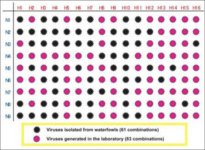
Kida posted on his laboratory wall a chart of 144 boxes, 16 boxes horizontally
and 9 boxes vertically. Each time he found a new subtype, he drew a circle in
the chart.
Last November, he succeeded in incubating H16N1, the last remaining
subtype of his collection. It was then the world?s first and only collection of
all subtypes of the avian influenza A virus was completed.
Dr. Yoshihiro Sakoda, associate professor, Kida?s right hand man, created a
virus database and released it on the internet so that researchers around the
world could use it at once.
Dr. Kouichi Yamanishi, 67, is a researcher who was anxiously awaiting the
completion of Kida?s collection. As president of the National Institute of
Biomedical Innovation, he is responsible for the development of a pandemic
flu vaccine. ?We can go to any direction using this collection.?
Japanese government currently produces a vaccine for H5N1. But there is no
assurance that H5N1 will mutate into pandemic flu. Just last week in Aichi,
quails were found infected with H7N6. Yamanishi considers it dangerous to
pick a single subtype as candidate for a pandemic and only prepare for it.
This year, Yamanishi starts the development of a nasal-spray (inactivated)
vaccine. The vaccine will be very easy to use and effective. Using Kida?s
collection, we can prepare for a pandemic no matter what subtype will trigger
it.
(END OF ARTICLE)
NOTE: As far as I understand, a pandemic flu vaccine will be developed from
virus samples of the actual patient and not from virus samples of Kida?s
collection. Kida?s collection will be useful for the veterinarian and virological
research but not for the pandemic flu vaccine. I wrote to the newspaper for
a confirmation but no response.
Dr. Kida, as chairman of the poultry disease subcommittee of the Ministry of
Agriculture, Forestry and Fisheries, is working on the bird flu outbreaks in
Aichi.
____________________
SN1987A
Source: http://www.asahi.com/jinmyakuki/TKY200903050203.html
Dr. Hiroshi Kida, 65, professor of the graduate school of veterinary, Hokkaido
University, has completed his collection of all subtypes of the avian influenza
A virus, which he had been collecting for 30 years.
In 1978, Kida discovered the avian influenza A virus lurks in the duck?s
intestine. Without falling sick, ducks migrate north and south scattering virus-
containing feces everywhere.
Kida thought if he collected many subtypes of flu virus before an outbreak of
pandemic flu, it might be helpful in making vaccine quickly. By collecting
feces, he can collect viruses.
Kida accompanied hunting groups to duck hunting, only he hunted for duck?s
feces instead. Some subtypes were easily found, some were very scarce. He
collected feces like a child scooping up junk foods to collect freebies.
In 1997, the avian flu H5N1 killed six people in Hong Kong. WHO suspected an
outbreak of pandemic flu and called Kida to request for the H5N1 virus.
However, Kida didn?t have the virus in his collection at that time.
He thought an incomplete collection had little use and extended areas for
collecting as far as to Alaska and Siberia where ducks spend summers. If he
cannot possibly find a subtype, he generated it by himself by mixing subtypes
already in his collection.
Kida posted on his laboratory wall a chart of 144 boxes, 16 boxes horizontally
and 9 boxes vertically. Each time he found a new subtype, he drew a circle in
the chart.
Last November, he succeeded in incubating H16N1, the last remaining
subtype of his collection. It was then the world?s first and only collection of
all subtypes of the avian influenza A virus was completed.
Dr. Yoshihiro Sakoda, associate professor, Kida?s right hand man, created a
virus database and released it on the internet so that researchers around the
world could use it at once.
Dr. Kouichi Yamanishi, 67, is a researcher who was anxiously awaiting the
completion of Kida?s collection. As president of the National Institute of
Biomedical Innovation, he is responsible for the development of a pandemic
flu vaccine. ?We can go to any direction using this collection.?
Japanese government currently produces a vaccine for H5N1. But there is no
assurance that H5N1 will mutate into pandemic flu. Just last week in Aichi,
quails were found infected with H7N6. Yamanishi considers it dangerous to
pick a single subtype as candidate for a pandemic and only prepare for it.
This year, Yamanishi starts the development of a nasal-spray (inactivated)
vaccine. The vaccine will be very easy to use and effective. Using Kida?s
collection, we can prepare for a pandemic no matter what subtype will trigger
it.
(END OF ARTICLE)
NOTE: As far as I understand, a pandemic flu vaccine will be developed from
virus samples of the actual patient and not from virus samples of Kida?s
collection. Kida?s collection will be useful for the veterinarian and virological
research but not for the pandemic flu vaccine. I wrote to the newspaper for
a confirmation but no response.
Dr. Kida, as chairman of the poultry disease subcommittee of the Ministry of
Agriculture, Forestry and Fisheries, is working on the bird flu outbreaks in
Aichi.
____________________
SN1987A