• FluTrackers.com Inc. does not provide medical advice. Information on this web site is collected from various internet resources, and the FluTrackers board of directors makes no warranty to the safety, efficacy, correctness or completeness of the information posted on this site by any author or poster. The information collated here is for instructional and/or discussion purposes only and is NOT intended to diagnose or treat any disease, illness, or other medical condition. Every individual reader or poster should seek advice from their personal physician/healthcare practitioner before considering or using any interventions that are discussed on this website. By continuing to access this website you agree to consult your personal physican before using any interventions posted on this website, and you agree to hold harmless FluTrackers.com Inc., the board of directors, the members, and all authors and posters for any effects from use of any medication, supplement, vitamin or other substance, device, intervention, etc. mentioned in posts on this website, or other internet venues referenced in posts on this website.
  • We are not asking for any donations. Do not donate to any entity who says they are raising funds for us.

HPAI in the Greater Mekong Region: Six Years After

Sally Furniss

Well-known member
HPAI in the Greater Mekong Region: Six Years After

26 February 2010 ? The Greater Mekong Region (GMR) includes Cambodia, Lao PDR, Myanmar, Thailand, Viet Nam and the southern provinces of China. In the GMR, the emergence of Highly Pathogenic Avian Influenza (HPAI) from 2004 to 2010 has affected animal and human health through mortality and morbidity. Poultry production in the region is heterogeneous with a majority of households keeping small flocks of indigenous, dual-purpose birds raised in low-input systems. In rural settings, traditional and small-volume poultry supply chains support livelihoods across extended networks of people associated with production, distribution, processing and marketing. Thailand has a large-scale industrial poultry industry: an important source of export revenues, food, employment and income. In Cambodia, Lao PDR, and Myanmar, the bulk of poultry originates in rural smallholding farms and is consumed domestically; with little industrial poultry production taking place. Viet Nam is an intermediate between traditional backyard and industrial poultry.

In the initial HPAI waves in the GMR, duck abundance, human population and rice cropping intensity were associated with disease emergence. Furthermore, in the Red and Mekong River Deltas of Viet Nam, HPAI risk areas were linked to irrigated rice fields in the lowlands, areas with good market access and high poultry transaction frequencies. Further epidemic waves revealed spatial and temporal patterns that define ?hot? periods during which increased virus circulation can be expected; however, these periods are not synchronised across the GMR. Viral clade changes over time suggest that there are diverse virus introduction and maintenance mechanisms between and within countries.

In general, disease control measures in the GMR have focused on culling, movement controls, cleaning and disinfection of bird markets, biosecurity enhancements, grazing duck production prohibitions, cock fighter passports, nationwide disease detection surveys, awareness-raising programmes, and information campaigns. Mass vaccination was implemented in Viet Nam and southern China. These measures have had mixed results in halting disease transmission and outbreak occurrence, with oftentimes detrimental consequences to rural backyard poultry keepers and market networks. For instance, nowadays there are pockets of endemicity in Viet Nam and southern Cambodia; in these countries virus load reductions could be long-term endeavours. Shortcomings in HPAI control may arise from information and incentive failures, such as minimal communication, inadequate compensation and extensive preventive culling.

As for vaccination, it is now evident that it contributed significantly to reduce HPAI spread and human exposure, but it did not eliminate virus circulation in countries where it was implemented. Clearly, vaccination against avian influenza should be considered as one of the many tools within a broad portfolio of control measures. In fact, commentators ascertain that live mixed bird market hygiene and disinfection might be more cost-effective when compared against sustained fiscal obligations of vaccination campaigns.

The continued occurrence of outbreaks across much of the GMR is likely to be caused by active cross border bird trade, and the increasing phylogenetic variation of virus isolates suggests relatively frequent virus hosts introduction from southern China. In the GMR, domestic duck-rice production has been identified as a key factor affecting virus maintenance and establishment, therefore it seems warranted to focus surveillance and disease control efforts on high duck density areas.

Lastly, owing to diverse multi-country ecological landscapes and high transboundary disease transmission risks, there is urgent need for more determined multilateral policy coordination. Moreover, as HPAI remains endemic in certain locations it is increasingly difficult to justify and sustain public monies for conventional control measures, thus warranting more effective and sustainable long-term risk reduction strategies such as, for example, ?unconventional? privately-financed animal health mechanisms that align incentives with farmers? motivations.

Click here for the full report in PDF.
 
Re: HPAI in the Greater Mekong Region: Six Years After

pg. 17 of the pdf:

The continuing occurrence of outbreaks raises the question which are the underlying
epidemiological mechanisms associated this locally endemic infection status. The main
areas of interest in this respect are in the north and south of Viet Nam. The association
between regional patterns of infection and risk factors has been examined on a national and
regional scale, suggesting that higher density duck populations and/or free grazing duck
production may be linked with increased risk of outbreaks (Pfeiffer et al 2007; Gilbert et al
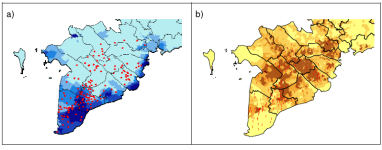
2008). As shown in Figure 16, it appears that outbreaks in Viet Nam in the endemic phase
occurred in areas of relatively high duck and aquaculture density. It is unclear though what
the exact mechanism of local maintenance is, but likely that it is associated with human
activity rather than potential presence of infected wild birds.

Picture 1.png
Figure 16: Locations of reported HPAI H5N1 outbreaks in poultry between 2006 and 2009 (red
dots) in southern Viet Nam draped over density of aquaculture (a) and ducks (b) (darker color =
higher density)

Assessment of the molecular evolution of HPAI virus H5N1 provides further insight into
possible mechanisms behind re-occurrence of outbreaks, although it needs to be noted that
the selection of virus isolates for gene sequencing was not done by a representative
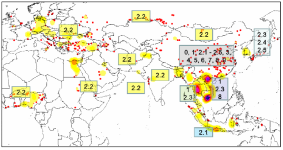
sampling process. As shown in Figure 17, it is notable that the highest variety of molecular
clades has been reported from East Asia, with variety reducing with distance from that part of
Eurasia. Interestingly, all outbreaks west of East and South-east Asia were caused by the
same clade type, whereas the variety in the South-East Asia is higher. It is therefore possible
that East Asia has a key role as a reservoir of HPAI virus H5N1, and outbreaks in other parts
of parts of Eurasia and Africa were originally due to introductions from East Asia.
The higher variety of clades in South-East Asia compared with South Asia and Africa/western Asia
suggest a relatively intensive exchange of poultry (also possible through wild bird migration,
but less likely) with East Asia, despite there being an official ban on trade.
 
Re: HPAI in the Greater Mekong Region: Six Years After

Picture 2.png
Figure 17: Global distribution of HPAI virus H5N1 clades identified in poultry based on
nucleotide sequence variability of the HA gene (draped over density of poultry outbreaks ? red
dots = isolated outbreaks, yellow lower density ? blue highest density)
 
Re: HPAI in the Greater Mekong Region: Six Years After

Interesting map. I didn't realize out of China, that the southern border was the highest density. Thank you Sally for this find. :)
 
Re: HPAI in the Greater Mekong Region: Six Years After

Transmission pathways from poultry to humans (M. VanKerkhove)
Background
HPAI virus H5N1 first crossed the species barrier in 1997 when an outbreak of 18 human
cases resulting in six deaths was identified in Hong Kong. In late 2003, HPAIV H5N1 crossed
the species barrier a second time infecting a family from Hong Kong that had recently
travelled to Fujian Province in China. Since 2003, H5N1 has been confirmed in domestic
poultry and/or wild birds in 61 countries throughout Asia, Africa and Europe. Until end 2009,
HPAI/H5N1 has infected 467 individuals in 15 countries. The number of human cases is not
evenly distributed throughout the world and the age/gender distribution varies by country. By
far, the largest number of human cases reported has been from Indonesia and Viet Nam
each having reported more than 100 cases. No human cases have yet been reported in
Western Europe or the Americas. Although the apparent case fatality rate (CFR) of HPAIV
H5N1 is high (>60%), this may be an overestimate of the true CFR since relatively few
seroprevalence studies have been carried out in humans to determine the number of
subclinical or asymptomatic cases in countries affected by HPAIV H5N1 outbreaks in
domestic or wild poultry populations.

Findings
Several epidemiologic studies have evaluated the risk of transmission of HPAIV H5N1 from
poultry to humans. These studies have identified several risk factors that may be associated
with infection including close direct contact with poultry and indirect transmission via the
environment. However, despite frequent and widespread contact with poultry, transmission of
HPAIV H5N1 from poultry to humans is very rare.
Direct routes poultry-to-human infection of HPAIV H5N1 may include contact with
aerosolized virus, infected blood or bodily fluids via food preparation practices (e.g.,
slaughtering, boiling, defeathering, cutting meat, cleaning meat, removing and/or cleaning
internal organs of poultry); consuming uncooked poultry products (e.g., raw duck blood) or
through the care of poultry (either commercially or domestically). Little is understood about
HPAIV H5N1 transmission via indirect routes, though recent studies have suggested an
association between exposure to a contaminated environment (e.g., water; cleaning poultry
cages or their designated areas; using poultry faeces for fertilizer) and infection either
through ingestion, conjuctival or intranasal inoculation of contaminated water, soil or via
fomites on shared equipment or vehicles transporting products between farms. Other
pathways may exist but are currently unknown.
Epidemiologic investigations of human HPAIV H5N1 cases have shown that transmission of
HPAIV H5N1 from poultry-to-humans is currently limited to individuals who may have been
contact with the highest potential concentrations of virus shed by poultry. This suggests that
there may be threshold of virus concentration needed for effective transmission and that
circulating HPAIV H5N1 strains have not yet mutated to transmit readily from either poultryto-
human or from human-to-human.
The mode of transmission can be quite varied
throughout different countries ranging from exposure to poultry during a visit to a wet market
to preparing infected poultry to swimming or bathing in ponds, which are frequented by
poultry.
 
Re: HPAI in the Greater Mekong Region: Six Years After

Vaccination against HPAI - A literature review (J. Hinrichs et al.)
The available literature on field vaccination experiments with commercially available vaccine
indicates that antibody titres considered as protective can develop within 13 days after the
first vaccination. However, with the exception of Trovac, two injections at two-week intervals
are required to achieve full protection and one of the few long-term serologic response
studies indicates that immunity is lost in most chicken 20.5 weeks after vaccination.
In
general, vaccinated birds have been shown to shed less amounts of virus than unvaccinated
controls at specific times post challenge. Thus, most commercial vaccines have the potential
to reduce the level of circulating virus in infected chicken populations. However, a crucial
factor for achieving significant reductions in circulating virus in poultry flocks are sufficiently
high vaccination coverage levels (50% to 90% immunization of at least 50% of all flocks at
risk of infection) with a vaccine that protects against the circulating virus(es).

Both theoretical considerations as well as field observations show that such high
immunization rates are difficult to attain in large poultry populations through vaccination
campaigns and that they are even more difficult to maintain over a longer time period due to
the high population turn over in short-lived commercial broiler1 and mixed-age backyard
poultry flocks. There are also problems of maintaining immunity levels in long-lived
commercial layer and parent flocks as the currently available vaccines do not lead to lifetime
immunity. The short to medium term gains in reducing the virus load with vaccination are not
likely to result in a cost-effective long-term control approach, if no additional measures are in
place, because infection chains are unlikely to be totally interrupted and virus will not be
eliminated from the entire poultry population.

A major drawback of vaccination is that the probability of detecting outbreaks may decrease
due to a lack or reduction of clinical signs, which could lead to the silent spread of virus (Savill 2006). The main reason for this effect may be that farmers are less likely to be able to
differentiate low levels of HPAI H5N1 mortality from other common causes of poultry
mortality.
Incentives for disease reporting are relatively low and masking disease signs
through vaccination further depresses an already low level of reporting. For northern Viet
Nam, Walker et al. (2009) estimated a 45% effective vaccination coverage achieved by mass
vaccination campaigns, leading to a greatly reduced transmission of virus between
communes but also to an increase in the commune-level infectious period due to outbreaks
remaining unreported for a longer duration. The same authors estimated that, had detection
levels been maintained at pre-vaccination levels, around two-thirds of outbreaks which
occurred in the 2007 wave in northern Viet Nam would have been prevented. This highlights
the fact that, regardless of the underlying reasons for less rapid reporting of outbreaks, in
order to translate the reductions in disease transmission following vaccination into greater
gains in disease control, more effective reporting and surveillance strategies are required.

Another drawback of the extensive use of vaccination is the increased likelihood of genetic
drift as seen in Mexico and the US. Therefore close virus monitoring of circulating field
strains, continuous vaccine testing via challenge trials, and subsequent development of new
vaccines that protect from infection with evolving field strains are an inevitable component of
any longer-term routine vaccination programme.
This requires considerable financial
resources and supporting activities have to be based on surveillance systems that have a
high probability of detecting circulating HPAI viruses even in the absence of significant
clinical disease. It also requires the sharing of isolates with laboratories capable assessing
the suitability of the vaccines used. At present these significant ?collateral? investments to
vaccination are rarely found in countries with problems of HPAI endemicity.

Short-lived broilers, mainly chicken but also ducks, constitute a relatively large share of the
standing poultry population of most countries, which, due to their rapid turnover, provide a
constant and ample supply of susceptible avian hosts. Campaign-based vaccination
programmes can only achieve a very low coverage in these systems, particularly if two
injections are required to achieve immunity. An age-based vaccination schedule for broilers
would be an option to achieve higher vaccination coverage and its maintenance over time,
but the logistical requirements for age-based vaccine delivery and associated costs differ
significantly from those of vaccination campaigns. The private incentives for owners of broiler
flocks to regularly vaccinate replacements are low and even if owners do vaccinate, broiler
flocks will remain at least partially susceptible for two to three weeks, i.e. most of their
lifespan (unless Trovac is used and protects against circulating virus strains). Broilers thus
represent the ?Achilles heel? of any HPAI control strategy that relies, at least to some extent,
on the use of vaccination.

From a public health and national health security perspective the reduction of human cases
of avian influenza as a means of reducing the risk of a national panic and global pandemic is most important. Human cases of avian influenza receive high media attention and the
political pressure to act is high.
The impact of poultry vaccination on human health risk is
controversially debated in the scientific community. Human cases of H5N1 infections in
China in January 2009 raised concerns about the role of vaccination in increasing the
virulence of HPAI virus and masking its symptoms in poultry.
Hygiene practices and
awareness of risk factors for poultry to human transmission are possibly as important for
preventing human infections as reducing virus shedding by vaccination.

The high and recurrent costs, technical difficulties, and epidemiological drawbacks of largescale,
open-ended blanket vaccination programmes in national efforts to control HPAI call for
careful targeting of vaccination in national control strategies, which ?intelligently? combine
available disease control measures. In principle, vaccination can be targeted spatially,
temporally, and / or by production system to maximise its impact and cost-effectiveness.
Effective targeting however requires sound risk assessments, for which data and expertise
are often lacking. Strengthening of the epidemiological capacity of national animal health
systems would thus be a major prerequisite for large-scale use of vaccination in the control
of HPAI.
Two modelling investigations were conducted in Thailand and Viet Nam, and are presented
below.
 
Re: HPAI in the Greater Mekong Region: Six Years After

page 46:
HPAI H5N1 disease risk and control measures
Excerpt:

? The continued occurrence of outbreaks in the GMS is likely to be caused by different
mechanisms across the region, largely dependent on the distance to the border of
southern China. The closer that border, the greater is the phylo-genetic variation
amongst isolates over time which suggests relatively frequent introductions from China

Overall, geographic areas with high density of poultry production appear to be able to
maintain virus infection, whereas outbreaks in low poultry density areas are either not
detected or do not occur.
? Domestic duck production (linked to paddy rice growing) is probably one of the key
mechanisms for maintenance of infection.
? There appears to be a non-negligible risk of continued introductions of HPAIV H5N1 into
the GMS from southern China, particularly in northern Viet Nam and possibly Lao PDR.
? Transmission models, whilst able to capture the dynamics in the RRD well, are unable to
account for the level of risk of outbreaks in communes near these borders based upon
poultry populations alone, suggesting the existence of other risk factors.

? Transboundary transmission risk within the GMS appears to be high and Thailand, Lao
PDR and Viet Nam are exposed to the risk of HPAIV introduction from southern China,
suggesting an urgent need for more determined multilateral policy coordination. It will be
difficult to effectively utilize domestic or external resources in individual countries in the
absence of such coordination.
? Even if each country within the GMS would conduct highly effective control programmes,
eradication of HPAIV H5N1 from the GMS seems impossible as a result of the risk of reintroduction
from southern China.
 
Re: HPAI in the Greater Mekong Region: Six Years After

page 46 continued...

? In the RRD the predominant virus clade(s) have changed over time while the original
clade still dominates in the MRD. This suggests different mechanisms of introduction
and maintenance between the RRD and MRD. Northern Viet Nam seems to be subject
to more frequent introductions of virus from southern China, whereas the MRD may
have a local reservoir of circulating virus.

? A transmission model for the North of Viet Nam confirmed the RRD as a hotspot for
sustained onward transmission. A similar model in Thailand highlighted areas around
and to the North of Bangkok and, to a far lesser extent the Khorat Plateau in the east of
Thailand as areas at risk of onward transmission given epidemiological conditions such
as those leading to the 2004 wave.
 
Re: HPAI in the Greater Mekong Region: Six Years After

? The need for improved disease surveillance is global, willingness to pay at each location
may be small, but gains may be substantial. Based on a simple statistical value of life
calculation, we estimate that the gain from reduced pandemic risk is in the billions of
dollars, annually. The private sector is unlikely to invest optimally in development of
improved surveillance and risk reduction measures. Therefore, development of disease
surveillance technologies has a global public good element, and their development
should be supported by public sources.
? To deal with distributional issues within and across countries and regions, a regime of
penalties should be accompanied by fixed transfers, including from third countries which
benefit from reduced disease risk.
 
Re: HPAI in the Greater Mekong Region: Six Years After

I have my doubts about the long term usefulness of poultry vaccination.

Inevitably there will be a relatively small number of available vaccines and - as can be seen in the clade distribution table - there are plenty of other clades and sub-clades in the region. As the report points out there seems to be surprisingly little in terms of reintroduction, as evidenced by the persistence of dominant clades in fairly small geographical areas, however this does not stop the selective pressure for the emergence of even more sub-clades from within each predominant regional clade. This concerns me as it is a driver of genetic diversity and may cause us to trade a higher number of genetically homogeneous infections for a smaller number of more genetically diverse infections - and I am not convinced the second option is preferable if your primary concern is zoonosis.
 
Re: HPAI in the Greater Mekong Region: Six Years After

Re: Post 3 (Map)...

I am not familiar with Clade 8, or 9. I've done a google search here at FT's, and a general google search, and cannot find anything on it. Can someone point me in the right direction? It seems that the hotspots on this map are Clades 1, 2.3 and 8. I've never heard of Clade 8.
 
Re: HPAI in the Greater Mekong Region: Six Years After

From post #5

Although the apparent case fatality rate (CFR) of HPAIV
H5N1 is high (>60%), this may be an overestimate of the true CFR since relatively few
seroprevalence studies have been carried out in humans to determine the number of
subclinical or asymptomatic cases in countries affected by HPAIV H5N1 outbreaks in
domestic or wild poultry populations.

It is doubtful that the subclinical cases of H5N1 are significant.

http://www.journals.uchicago.edu/doi/abs/10.1086/599208

This is the latest study I found and it again suggests there are very few undiagnosed cases of H5N1 infections in humans.
 
Re: HPAI in the Greater Mekong Region: Six Years After

Re: Post 3 (Map)...

I am not familiar with Clade 8, or 9. I've done a google search here at FT's, and a general google search, and cannot find anything on it. Can someone point me in the right direction? It seems that the hotspots on this map are Clades 1, 2.3 and 8. I've never heard of Clade 8.

Maybe there is not a Clade 8.

From this thread:
Antigenic and genetic characteristics of influenza A(H5N1) and influenza A(H9N2) viruses and candidate vaccine viruses developed for potential use in human vaccines ? February 2010 (Wkly Epidemiol Rec., edited) http://www.flutrackers.com/forum/showthread.php?t=142942
Antigenic and genetic characteristics

A nomenclature for phylogenetic relationships among the haemagglutinin (HA) genes of influenza A(H5N1) viruses was devised in consultation with representatives of the United Nations Food and Agriculture Organization, the World Organisation for Animal Health and WHO. This nomenclature is updated when novel genetic clades emerge; the nomenclature can be found at (LINK).

Viruses characterized from 23 September 2009 to 17 February 2010 belonged to the clades listed below.


  • Clade 1 viruses were detected in poultry in Cambodia. Genetic characterization of these viruses showed that they were closely related to clade 1 viruses previously circulating in the country (Fig. 1). No antigenic data are available.
  • Clade 2.2 viruses were detected in poultry in Nepal. Genetically these viruses were very similar to viruses previously detected in the region (Fig. 1). No antigenic data are available.
  • Clade 2.2.1 viruses continue to circulate in poultry in Egypt; there is sporadic transmission to humans. Viruses isolated during this period were genetically similar to those isolated during 2008 and 2009 (Fig. 1). Data are not available on the antigenic properties of the recent poultry viruses, but isolates from humans are antigenically similar to the clade 2.2.1 reference vaccine virus A/Egypt/321/2007 (Table 2) as measured by haemagglutination inhibition.
  • Clade 2.3.2 viruses were detected in wild birds in China, Hong Kong Special Administrative Region (Hong Kong SAR); in the Russian Federation; and in poultry in Nepal and Viet Nam. These viruses were genetically similar to clade 2.3.2 viruses isolated in previous years (Fig. 1). Antigenically, the virus from Hong Kong SAR reacted to antiserum to the clade 2.3.2 reference vaccine virus A/Common Magpie/Hong Kong/5052/2007, albeit with reduced haemagglutination inhibition titres when compared with the homologous antigen (data not shown).
  • Clade 2.3.4 viruses were detected in poultry in Viet Nam. These viruses formed 2 distinct genetic subclades within the 2.3.4 clade (Fig. 1). Viruses from 1 of these subclades reacted well to postinfection ferret antiserum raised against the reference vaccine virus A/Anhui/1/2005 (data not shown); antigenic data are not available for the other subclade.
 
Back
Top