

Michael Coston
Editor, Senior Moderator
HPAI H5Nx Clade 2.3.4.4. Shedding In Cottontail Rabbits
[TABLE="class: tr-caption-container, cellpadding: 0, cellspacing: 0"]
[TR]
[TD]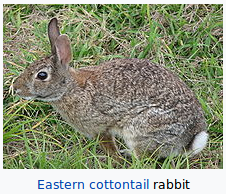 [/TD]
[/TD]
[/TR]
[TR]
[TD="class: tr-caption"]Credit Wikipedia[/TD]
[/TR]
[/TABLE]
#13,370
Regular readers will recall that over the past several years we've been looking into the carriage of novel (and seasonal) flu by domestic and peridomestic animals, and how they might fit into the ecology and evolution of influenza viruses.
On the domestic front, dogs and cats take center stage, as both are susceptible to at least some novel flu strains. A few (of many) blogs include:
A few past blogs include: One of the leaders in research into flu carriage and shedding by peridomestic animals is Dr Jeffery Root - a Research Wildlife Biologist at the National Wildlife Research Center - whose work we've been following for several years.
First the (very) brief abstract, then I'll return with a bit more.
And may require the the rethinking of some farm biosecurity measures in the future to prevent a repeat of 2016/17 epizootic.
http://afludiary.blogspot.com/2018/0...edding-in.html
[TABLE="class: tr-caption-container, cellpadding: 0, cellspacing: 0"]
[TR]
[TD]
[/TD][/TR]
[TR]
[TD="class: tr-caption"]Credit Wikipedia[/TD]
[/TR]
[/TABLE]
#13,370
Regular readers will recall that over the past several years we've been looking into the carriage of novel (and seasonal) flu by domestic and peridomestic animals, and how they might fit into the ecology and evolution of influenza viruses.
On the domestic front, dogs and cats take center stage, as both are susceptible to at least some novel flu strains. A few (of many) blogs include:
EID Journal: Avian H7N2 Virus in Human Exposed to Sick Cats
Study: Dogs As Potential `Mixing Vessels’ For Influenza
On the peridomestic front, in recent years we've seen growing evidence that small mammals - like rabbits, skunks, mink, and even small rodents - can be infected by, and potentially spread, flu viruses. Study: Dogs As Potential `Mixing Vessels’ For Influenza
While these types of animals may not pose as much as a direct threat of transmitting flu viruses to humans, they do provide a way for viruses in the wild to gain entry into farms, or to jump to dogs and cats.
And carriage of novel flu viruses by any mammalian host provides the virus with an opportunity to develop host adaptations, potentially making it easier to jump to other mammals.A few past blogs include: One of the leaders in research into flu carriage and shedding by peridomestic animals is Dr Jeffery Root - a Research Wildlife Biologist at the National Wildlife Research Center - whose work we've been following for several years.
- Dr. Root was one of the authors of a 2014 PLoS One study called Shedding of a Low Pathogenic Avian Influenza Virus in a Common Synanthropic Mammal – The Cottontail Rabbit, which was the first to show shedding of LPAI by cottontail rabbits.
- In 2015, this work was followed up with Virology: Experimental Infection of Peridomestic Animals With Avian H7N9where Dr. Root et al. demonstrated H7N9’s ability to infect, and to be shed by, peridomestic animals like skunks, raccoons, and rabbits.
- And again in 2016, in Report: Skunks and Rabbits Can Catch And Shed Avian Flu, we looked at an AP News report that quoted Dr. Root as saying that small mammals like rabbits and skunks can become infected with avian flu, and they can shed enough of the virus to pass it onto ducks (and presumably other types of birds).
This is of particular interest since most clade 2.3.4.4. viruses - while causing huge losses in the poultry industry and among wild birds over the past four years - have shown a very limited ability to infect mammals.
The exception (so far) being the HPAI H5N6 virus which has infected at least 17 people in China (see Human Clade 2.3.4.4 A/H5N6 Influenza Virus Lacks Mammalian Adaptation Markers and Does Not Transmit via the Airborne Route between Ferrets).First the (very) brief abstract, then I'll return with a bit more.
J. Jeffrey Root, Angela M. Bosco-Lauth, Nicole L. Marlenee, Richard A. Bowen
First Online: 13 June 2018
Abstract
During 2014-2015, clade 2.3.4.4 H5Nx highly pathogenic (HP) avian influenza A viruses (IAV) were first detected in North America and subsequently caused one of the largest agricultural emergencies in U.S. history.
Recent evidence has suggested that cottontail rabbits can shed multiple IAV subtypes. We experimentally infected cottontail rabbits with three HP H5Nx IAVs. All rabbits tested shed virus on at least one day by at least one route.
Cottontail rabbits appear to be an exception to the limited capacity for replication that has been previously reported for certain other mammalian species inoculated with clade 2.3.4.4 HP H5Nx avian influenza A viruses.
While clade 2.3.4.4. H5N8, H5N5 and (European Lineage) H5N6 viruses have not been shown to infect humans, we did see early reports out of South Korea in 2014 of dogs having been infected (see MAFRA: H5N8 Antibodies Detected In South Korean Dogs (Again)) and just over a year ago we looked at J. Vet. Sci.: Experimental Canine Infection With Avian H5N8. Abstract
During 2014-2015, clade 2.3.4.4 H5Nx highly pathogenic (HP) avian influenza A viruses (IAV) were first detected in North America and subsequently caused one of the largest agricultural emergencies in U.S. history.
Recent evidence has suggested that cottontail rabbits can shed multiple IAV subtypes. We experimentally infected cottontail rabbits with three HP H5Nx IAVs. All rabbits tested shed virus on at least one day by at least one route.
Cottontail rabbits appear to be an exception to the limited capacity for replication that has been previously reported for certain other mammalian species inoculated with clade 2.3.4.4 HP H5Nx avian influenza A viruses.
So we know that mammalian infection with at least some genotypes of H5N8 is at least possible. Today's report expands that host range a bit.
Over the past two years we've looked at a number of studies that have explored the potential for H5N8 or its spin offs to evolve into a human health threat. A few include: Study: Virulence Of HPAI H5N8 Enhanced By 2 Amino Acid Substitutions
Sci Rpts: H5N8 - Rapid Acquisition of Virulence Markers After Serial Passage In Mice
Perhaps most telling of these came last September in J. Virulence : Altered Virulence Of (HPAI) H5N8 Reassortant Viruses In Mammalian Models, which found: Sci Rpts: H5N8 - Rapid Acquisition of Virulence Markers After Serial Passage In Mice
Taken together, our study demonstrates that a single gene substitution from other avian influenza viruses can alter the pathogenicity of recent H5N8 viruses, and therefore emphasizes the need for intensive monitoring of reassortment events among co-circulating avian and mammalian viruses.
Last October's J. Virulence Editorial: HPAI H5N8 - Should We Be Worried? reviewed and summarized the literature, and found enough reasons to be concerned over the future evolutionary path of H5N8, stating that: The extensive distribution of HPAI H5N8, as well as the gene reassortment with other circulating avian viruses already observed for H5N8 suggests there is a potential risk for human cases of H5N8 infections.
While expanding H5's host range is always a concern, the ability of small mammals like rabbits, raccoons, and rodents to breach farm biosecurity measures, and infect poultry populations is also troubling.And may require the the rethinking of some farm biosecurity measures in the future to prevent a repeat of 2016/17 epizootic.
http://afludiary.blogspot.com/2018/0...edding-in.html