• FluTrackers.com Inc. does not provide medical advice. Information on this web site is collected from various internet resources, and the FluTrackers board of directors makes no warranty to the safety, efficacy, correctness or completeness of the information posted on this site by any author or poster. The information collated here is for instructional and/or discussion purposes only and is NOT intended to diagnose or treat any disease, illness, or other medical condition. Every individual reader or poster should seek advice from their personal physician/healthcare practitioner before considering or using any interventions that are discussed on this website. By continuing to access this website you agree to consult your personal physican before using any interventions posted on this website, and you agree to hold harmless FluTrackers.com Inc., the board of directors, the members, and all authors and posters for any effects from use of any medication, supplement, vitamin or other substance, device, intervention, etc. mentioned in posts on this website, or other internet venues referenced in posts on this website.
  • We are not asking for any donations. Do not donate to any entity who says they are raising funds for us.

How Dangerous is Bird Flu (H5N1) to Global Public Health? Part 2 (Oct 17, 2011 - Nov 25, 2012)

Status
Not open for further replies.
Re: How Dangerous is Bird Flu (H5N1) to Global Public Health? Part 2

Re: How Dangerous is Bird Flu (H5N1) to Global Public Health? Part 2

For a pandemic of Zoonotic origin there are two distinct phases.
First you need the animal to human contact.
Second you need human to human contact.
At stage two you have a basically non human disease attempting to spread among humans. Its Ro is likely to be low and it needs lots of contacts (of what ever transmission system it employs) to perfect its infection skills, and so up its Ro. Densely packed humanity is obviously the best place for it to go from zoonotic infection to human pandemic.
The ideal for stages one and two (in avian flu's case) is a city where the population have lots of contact with birds, preferably ducks as they can be infectious and apparently healthy.
Rice growing areas are a problem as ducks are a secondary crop as they keep down pests in the paddy and then become entrenched in the local culture and cuisine so even when these population become city dwellers they retain the duck keeping, and eating, tradition.
 
Re: How Dangerous is Bird Flu (H5N1) to Global Public Health? Part 2

Re: How Dangerous is Bird Flu (H5N1) to Global Public Health? Part 2

I believe the reason there have been so few urban cases of H5N1 is due to the vectors rather than herd immunity. In very large cities few people have a flock of chickens or ducks. The only exception to this are large 'wet markets' where poultry from outlying regions is brought into the city for slaughter. The reason so many were worried when the latest Hong Kong resident died of H5N1 infection was he had no contact with either wild or domestic birds. When we start to see cases in urban areas we need to pay attention.

As for the CFR. Novel influenza almost always results in an uptick of fatalities. Sometimes to a high degree as was the case in 1918. The first varients found at Ft. Riley during the summer were serious but, no where close to the severity of the fall varients. We know from the now censored ferret study last fall that H5N1, in ferrets at least, was terrifying. If the disease as it exits in humans today doesn't change radically when it makes the leap to H2H, we are in serious trouble. The only reason the CFR has remained at apprx. 60% to date is because of immediate use of a single antiviral. What happens when this drug no longer works? What happens when we run out of vents? What happens when most of the hospital workers are stricken with the disease. Changes to the virus is what most seem to be hoping for but how realistic is this? There have been pandemics throught our history why would now be any different?
 
Re: How Dangerous is Bird Flu (H5N1) to Global Public Health? Part 2

Re: How Dangerous is Bird Flu (H5N1) to Global Public Health? Part 2

Avian Influenza in Wild Birds in Vietnam

In Avian influenza viruses in wild land birds in northern Vietnam, the authors research H5 antibodies in wild birds in Vietnam. In 2007, four of 197 samples were positive, about 2%. In 2008, 14 of the 193 collected samples were apparently positive, almost double the rate of the year before (about 7%). Of significance is that less than half of the genera reported in the article have been identified as affected by avian influenza See: USGS - List of Species Affected by H5N1 (Avian Influenza)

The authors provide this recommendation. ?Our results suggest that attention should be given to terrestrial species, particularly flocking passerines, in AIV surveillance and monitoring programs.?
 
Re: How Dangerous is Bird Flu (H5N1) to Global Public Health? Part 2

Re: How Dangerous is Bird Flu (H5N1) to Global Public Health? Part 2

Preparing for the Next Pandemic

An article by Fleming And Durnall just published in Human Vaccines & Immunotherapeutics presents 10 observations and practical suggestions that need to be considered before the start of the next pandemic. Unfortunately, as important as these points are, they will probably not receive widespread attention or be taken seriously, at least not until the start of the next pandemic.

Ten lessons for the next influenza pandemic?an English perspective: A personal reflection based on community surveillance data

Volume 8, Issue 1 January 2012


Douglas M. Fleming and Hayley Durnall


Douglas M. Fleming
Corresponding author: dfleming@rcgpbhamresunit.nhs.uk
Department of Virology, Erasmus MC; Rotterdam, the Netherlands

Hayley Durnall
Royal College of General Practitioners; Research and Surveillance Centre; Birmingham, UK

We review experience in England of the swine flu pandemic between May 2009 and April 2010. The surveillance data from the Royal College of General Practitioners Weekly Returns Service and the linked virological data collected in the integrated program with the Health Protection Agency are used as a reference frame to consider issues emerging during the pandemic. Nine lessons are summarized.

(1) Delay between illness onset in the first worldwide cases and virological diagnosis restricted opportunities for containment by regional prophylaxis.

(2) Pandemic vaccines are unlikely to be available for effective prevention during the first wave of the pandemic.

(3) Open, realistic and continuing communication with the public is important.

(4) Surveillance programs should be continued through summer as well as winter.

(5) Severity of illness should be incorporated in pandemic definition.

(6) The reliability of diagnostic tests as used in routine clinical practice calls for further investigation.

(7) Evidence from serological studies is not consistent with evidence based on health care requests made by sick persons and is thus of limited value in cost effectiveness studies.

(8) Pregnancy was an important risk factor.

(9) New strategies for administering vaccines need to be explored.

(10) Acceptance by the public and by health professionals of influenza vaccination as the major plank on which the impact of influenza is controlled has still not been achieved.
http://www.landesbioscience.com/journals/vaccines/article/18808/ (hat tip to Tetano for the abstract link.)


Comment


The irony is that the senior author?s affiliation is with the Department of Virology at the Erasmus Medical Center, the same department that has conducted H5N1 research under the direction of R. A. Fouchier (FT Link). If as much media attention was directed at preparing for the next pandemic as has been directed at Fouchier?s research, the world might be better prepared for the next pandemic whether it is H5N1 or some other emerging infectious disease.
 
Re: How Dangerous is Bird Flu (H5N1) to Global Public Health? Part 2

Re: How Dangerous is Bird Flu (H5N1) to Global Public Health? Part 2

The H5N1 Research Publication Controversy

The debate continues to rage over whether or not the details of the laboratory-created virulent strain of H5N1 should be published (see this FluTrackers link for a full discussion). The heated exchange among the researchers raises many critical issues about scientific research and the protection of the public good.

But in my estimation this debate is a distraction from the real issue at hand - How can the world quickly and efficiently prepare for the next pandemic?

And there will be a next pandemic.

Governments and public health organizations need to focus on new production and delivery strategies for vaccine and encourage researchers to develop new drugs to replace neuraminidase inhibitors for when they are no longer effective. The 2009 H1N1 pandemic demonstrated how ill-prepared the world is to handle a pandemic. Lucky for us it was mild. We may not be so lucky if H5N1 goes pandemic.

Throughout history, humans have always taken the most recent scientific advances and turned then into weapons of death and destruction, starting with the invention of gun powder for fireworks in China in 9<sup>th</sup> century and continuing through the nuclear age in the 20<sup>th</sup> century with atomic bombs. Even today the world is wrestling with the issue of peaceful nuclear development versus atomic aggression. So the restriction of publication of the H5N1 research may delay, but will certainly not deter, the spread of the details to anyone determined to obtain them.

And the restriction of the data will not stop the next pandemic from occurring.

Once the next pandemic starts, it will not be important if it is a result a bioterrorist plot, a laboratory escape, or a virus born in the wild. What will be important is if the world is prepared for it.

<!--[if gte mso 9]><xml> <o:OfficeDocumentSettings> <o:AllowPNG/> </o:OfficeDocumentSettings> </xml><![endif][if gte mso 9]><xml> <w:WordDocument> <w:View>Normal</w:View> <w:Zoom>0</w:Zoom> <w:TrackMoves/> <w:TrackFormatting/> <w:PunctuationKerning/> <w:ValidateAgainstSchemas/> <w:SaveIfXMLInvalid>false</w:SaveIfXMLInvalid> <w:IgnoreMixedContent>false</w:IgnoreMixedContent> <w:AlwaysShowPlaceholderText>false</w:AlwaysShowPlaceholderText> <w:DoNotPromoteQF/> <w:LidThemeOther>EN-US</w:LidThemeOther> <w:LidThemeAsian>X-NONE</w:LidThemeAsian> <w:LidThemeComplexScript>KHM</w:LidThemeComplexScript> <w:Compatibility> <w:BreakWrappedTables/> <w:SnapToGridInCell/> <w:WrapTextWithPunct/> <w:UseAsianBreakRules/> <w:DontGrowAutofit/> <w:SplitPgBreakAndParaMark/> <w:EnableOpenTypeKerning/> <w:DontFlipMirrorIndents/> <w:OverrideTableStyleHps/> </w:Compatibility> <m:mathPr> <m:mathFont m:val="Cambria Math"/> <m:brkBin m:val="before"/> <m:brkBinSub m:val="--"/> <m:smallFrac m:val="off"/> <m:dispDef/> <m:lMargin m:val="0"/> <m:rMargin m:val="0"/> <m:defJc m:val="centerGroup"/> <m:wrapIndent m:val="1440"/> <m:intLim m:val="subSup"/> <m:naryLim m:val="undOvr"/> </m:mathPr></w:WordDocument> </xml><![endif][if gte mso 9]><xml> <w:LatentStyles DefLockedState="false" DefUnhideWhenUsed="true" DefSemiHidden="true" DefQFormat="false" DefPriority="99" LatentStyleCount="267"> <w:LsdException Locked="false" Priority="0" SemiHidden="false" UnhideWhenUsed="false" QFormat="true" Name="Normal"/> <w:LsdException Locked="false" Priority="9" SemiHidden="false" UnhideWhenUsed="false" QFormat="true" Name="heading 1"/> <w:LsdException Locked="false" Priority="9" QFormat="true" Name="heading 2"/> <w:LsdException Locked="false" Priority="9" QFormat="true" Name="heading 3"/> <w:LsdException Locked="false" Priority="9" QFormat="true" Name="heading 4"/> <w:LsdException Locked="false" Priority="9" QFormat="true" Name="heading 5"/> <w:LsdException Locked="false" Priority="9" QFormat="true" Name="heading 6"/> <w:LsdException Locked="false" Priority="9" QFormat="true" Name="heading 7"/> <w:LsdException Locked="false" Priority="9" QFormat="true" Name="heading 8"/> <w:LsdException Locked="false" Priority="9" QFormat="true" Name="heading 9"/> <w:LsdException Locked="false" Priority="39" Name="toc 1"/> <w:LsdException Locked="false" Priority="39" Name="toc 2"/> <w:LsdException Locked="false" Priority="39" Name="toc 3"/> <w:LsdException Locked="false" Priority="39" Name="toc 4"/> <w:LsdException Locked="false" Priority="39" Name="toc 5"/> <w:LsdException Locked="false" Priority="39" Name="toc 6"/> <w:LsdException Locked="false" Priority="39" Name="toc 7"/> <w:LsdException Locked="false" Priority="39" Name="toc 8"/> <w:LsdException Locked="false" Priority="39" Name="toc 9"/> <w:LsdException Locked="false" Priority="35" QFormat="true" Name="caption"/> <w:LsdException Locked="false" Priority="10" SemiHidden="false" UnhideWhenUsed="false" QFormat="true" Name="Title"/> <w:LsdException Locked="false" Priority="1" Name="Default Paragraph Font"/> <w:LsdException Locked="false" Priority="11" SemiHidden="false" UnhideWhenUsed="false" QFormat="true" Name="Subtitle"/> <w:LsdException Locked="false" Priority="22" SemiHidden="false" UnhideWhenUsed="false" QFormat="true" Name="Strong"/> <w:LsdException Locked="false" Priority="20" SemiHidden="false" UnhideWhenUsed="false" QFormat="true" Name="Emphasis"/> <w:LsdException Locked="false" Priority="59" SemiHidden="false" UnhideWhenUsed="false" Name="Table Grid"/> <w:LsdException Locked="false" UnhideWhenUsed="false" Name="Placeholder Text"/> <w:LsdException Locked="false" Priority="1" SemiHidden="false" UnhideWhenUsed="false" QFormat="true" Name="No Spacing"/> <w:LsdException Locked="false" Priority="60" SemiHidden="false" UnhideWhenUsed="false" Name="Light Shading"/> <w:LsdException Locked="false" Priority="61" SemiHidden="false" UnhideWhenUsed="false" Name="Light List"/> <w:LsdException Locked="false" Priority="62" SemiHidden="false" UnhideWhenUsed="false" Name="Light Grid"/> <w:LsdException Locked="false" Priority="63" SemiHidden="false" UnhideWhenUsed="false" Name="Medium Shading 1"/> <w:LsdException Locked="false" Priority="64" SemiHidden="false" UnhideWhenUsed="false" Name="Medium Shading 2"/> <w:LsdException Locked="false" Priority="65" SemiHidden="false" UnhideWhenUsed="false" Name="Medium List 1"/> <w:LsdException Locked="false" Priority="66" SemiHidden="false" UnhideWhenUsed="false" Name="Medium List 2"/> <w:LsdException Locked="false" Priority="67" SemiHidden="false" UnhideWhenUsed="false" Name="Medium Grid 1"/> <w:LsdException Locked="false" Priority="68" SemiHidden="false" UnhideWhenUsed="false" Name="Medium Grid 2"/> <w:LsdException Locked="false" Priority="69" SemiHidden="false" UnhideWhenUsed="false" Name="Medium Grid 3"/> <w:LsdException Locked="false" Priority="70" SemiHidden="false" UnhideWhenUsed="false" Name="Dark List"/> <w:LsdException Locked="false" Priority="71" SemiHidden="false" UnhideWhenUsed="false" Name="Colorful Shading"/> <w:LsdException Locked="false" Priority="72" SemiHidden="false" UnhideWhenUsed="false" Name="Colorful List"/> <w:LsdException Locked="false" Priority="73" SemiHidden="false" UnhideWhenUsed="false" Name="Colorful Grid"/> <w:LsdException Locked="false" Priority="60" SemiHidden="false" UnhideWhenUsed="false" Name="Light Shading Accent 1"/> <w:LsdException Locked="false" Priority="61" SemiHidden="false" UnhideWhenUsed="false" Name="Light List Accent 1"/> <w:LsdException Locked="false" Priority="62" SemiHidden="false" UnhideWhenUsed="false" Name="Light Grid Accent 1"/> <w:LsdException Locked="false" Priority="63" SemiHidden="false" UnhideWhenUsed="false" Name="Medium Shading 1 Accent 1"/> <w:LsdException Locked="false" Priority="64" SemiHidden="false" UnhideWhenUsed="false" Name="Medium Shading 2 Accent 1"/> <w:LsdException Locked="false" Priority="65" SemiHidden="false" UnhideWhenUsed="false" Name="Medium List 1 Accent 1"/> <w:LsdException Locked="false" UnhideWhenUsed="false" Name="Revision"/> <w:LsdException Locked="false" Priority="34" SemiHidden="false" UnhideWhenUsed="false" QFormat="true" Name="List Paragraph"/> <w:LsdException Locked="false" Priority="29" SemiHidden="false" UnhideWhenUsed="false" QFormat="true" Name="Quote"/> <w:LsdException Locked="false" Priority="30" SemiHidden="false" UnhideWhenUsed="false" QFormat="true" Name="Intense Quote"/> <w:LsdException Locked="false" Priority="66" SemiHidden="false" UnhideWhenUsed="false" Name="Medium List 2 Accent 1"/> <w:LsdException Locked="false" Priority="67" SemiHidden="false" UnhideWhenUsed="false" Name="Medium Grid 1 Accent 1"/> <w:LsdException Locked="false" Priority="68" SemiHidden="false" UnhideWhenUsed="false" Name="Medium Grid 2 Accent 1"/> <w:LsdException Locked="false" Priority="69" SemiHidden="false" UnhideWhenUsed="false" Name="Medium Grid 3 Accent 1"/> <w:LsdException Locked="false" Priority="70" SemiHidden="false" UnhideWhenUsed="false" Name="Dark List Accent 1"/> <w:LsdException Locked="false" Priority="71" SemiHidden="false" UnhideWhenUsed="false" Name="Colorful Shading Accent 1"/> <w:LsdException Locked="false" Priority="72" SemiHidden="false" UnhideWhenUsed="false" Name="Colorful List Accent 1"/> <w:LsdException Locked="false" Priority="73" SemiHidden="false" UnhideWhenUsed="false" Name="Colorful Grid Accent 1"/> <w:LsdException Locked="false" Priority="60" SemiHidden="false" UnhideWhenUsed="false" Name="Light Shading Accent 2"/> <w:LsdException Locked="false" Priority="61" SemiHidden="false" UnhideWhenUsed="false" Name="Light List Accent 2"/> <w:LsdException Locked="false" Priority="62" SemiHidden="false" UnhideWhenUsed="false" Name="Light Grid Accent 2"/> <w:LsdException Locked="false" Priority="63" SemiHidden="false" UnhideWhenUsed="false" Name="Medium Shading 1 Accent 2"/> <w:LsdException Locked="false" Priority="64" SemiHidden="false" UnhideWhenUsed="false" Name="Medium Shading 2 Accent 2"/> <w:LsdException Locked="false" Priority="65" SemiHidden="false" UnhideWhenUsed="false" Name="Medium List 1 Accent 2"/> <w:LsdException Locked="false" Priority="66" SemiHidden="false" UnhideWhenUsed="false" Name="Medium List 2 Accent 2"/> <w:LsdException Locked="false" Priority="67" SemiHidden="false" UnhideWhenUsed="false" Name="Medium Grid 1 Accent 2"/> <w:LsdException Locked="false" Priority="68" SemiHidden="false" UnhideWhenUsed="false" Name="Medium Grid 2 Accent 2"/> <w:LsdException Locked="false" Priority="69" SemiHidden="false" UnhideWhenUsed="false" Name="Medium Grid 3 Accent 2"/> <w:LsdException Locked="false" Priority="70" SemiHidden="false" UnhideWhenUsed="false" Name="Dark List Accent 2"/> <w:LsdException Locked="false" Priority="71" SemiHidden="false" UnhideWhenUsed="false" Name="Colorful Shading Accent 2"/> <w:LsdException Locked="false" Priority="72" SemiHidden="false" UnhideWhenUsed="false" Name="Colorful List Accent 2"/> <w:LsdException Locked="false" Priority="73" SemiHidden="false" UnhideWhenUsed="false" Name="Colorful Grid Accent 2"/> <w:LsdException Locked="false" Priority="60" SemiHidden="false" UnhideWhenUsed="false" Name="Light Shading Accent 3"/> <w:LsdException Locked="false" Priority="61" SemiHidden="false" UnhideWhenUsed="false" Name="Light List Accent 3"/> <w:LsdException Locked="false" Priority="62" SemiHidden="false" UnhideWhenUsed="false" Name="Light Grid Accent 3"/> <w:LsdException Locked="false" Priority="63" SemiHidden="false" UnhideWhenUsed="false" Name="Medium Shading 1 Accent 3"/> <w:LsdException Locked="false" Priority="64" SemiHidden="false" UnhideWhenUsed="false" Name="Medium Shading 2 Accent 3"/> <w:LsdException Locked="false" Priority="65" SemiHidden="false" UnhideWhenUsed="false" Name="Medium List 1 Accent 3"/> <w:LsdException Locked="false" Priority="66" SemiHidden="false" UnhideWhenUsed="false" Name="Medium List 2 Accent 3"/> <w:LsdException Locked="false" Priority="67" SemiHidden="false" UnhideWhenUsed="false" Name="Medium Grid 1 Accent 3"/> <w:LsdException Locked="false" Priority="68" SemiHidden="false" UnhideWhenUsed="false" Name="Medium Grid 2 Accent 3"/> <w:LsdException Locked="false" Priority="69" SemiHidden="false" UnhideWhenUsed="false" Name="Medium Grid 3 Accent 3"/> <w:LsdException Locked="false" Priority="70" SemiHidden="false" UnhideWhenUsed="false" Name="Dark List Accent 3"/> <w:LsdException Locked="false" Priority="71" SemiHidden="false" UnhideWhenUsed="false" Name="Colorful Shading Accent 3"/> <w:LsdException Locked="false" Priority="72" SemiHidden="false" UnhideWhenUsed="false" Name="Colorful List Accent 3"/> <w:LsdException Locked="false" Priority="73" SemiHidden="false" UnhideWhenUsed="false" Name="Colorful Grid Accent 3"/> <w:LsdException Locked="false" Priority="60" SemiHidden="false" UnhideWhenUsed="false" Name="Light Shading Accent 4"/> <w:LsdException Locked="false" Priority="61" SemiHidden="false" UnhideWhenUsed="false" Name="Light List Accent 4"/> <w:LsdException Locked="false" Priority="62" SemiHidden="false" UnhideWhenUsed="false" Name="Light Grid Accent 4"/> <w:LsdException Locked="false" Priority="63" SemiHidden="false" UnhideWhenUsed="false" Name="Medium Shading 1 Accent 4"/> <w:LsdException Locked="false" Priority="64" SemiHidden="false" UnhideWhenUsed="false" Name="Medium Shading 2 Accent 4"/> <w:LsdException Locked="false" Priority="65" SemiHidden="false" UnhideWhenUsed="false" Name="Medium List 1 Accent 4"/> <w:LsdException Locked="false" Priority="66" SemiHidden="false" UnhideWhenUsed="false" Name="Medium List 2 Accent 4"/> <w:LsdException Locked="false" Priority="67" SemiHidden="false" UnhideWhenUsed="false" Name="Medium Grid 1 Accent 4"/> <w:LsdException Locked="false" Priority="68" SemiHidden="false" UnhideWhenUsed="false" Name="Medium Grid 2 Accent 4"/> <w:LsdException Locked="false" Priority="69" SemiHidden="false" UnhideWhenUsed="false" Name="Medium Grid 3 Accent 4"/> <w:LsdException Locked="false" Priority="70" SemiHidden="false" UnhideWhenUsed="false" Name="Dark List Accent 4"/> <w:LsdException Locked="false" Priority="71" SemiHidden="false" UnhideWhenUsed="false" Name="Colorful Shading Accent 4"/> <w:LsdException Locked="false" Priority="72" SemiHidden="false" UnhideWhenUsed="false" Name="Colorful List Accent 4"/> <w:LsdException Locked="false" Priority="73" SemiHidden="false" UnhideWhenUsed="false" Name="Colorful Grid Accent 4"/> <w:LsdException Locked="false" Priority="60" SemiHidden="false" UnhideWhenUsed="false" Name="Light Shading Accent 5"/> <w:LsdException Locked="false" Priority="61" SemiHidden="false" UnhideWhenUsed="false" Name="Light List Accent 5"/> <w:LsdException Locked="false" Priority="62" SemiHidden="false" UnhideWhenUsed="false" Name="Light Grid Accent 5"/> <w:LsdException Locked="false" Priority="63" SemiHidden="false" UnhideWhenUsed="false" Name="Medium Shading 1 Accent 5"/> <w:LsdException Locked="false" Priority="64" SemiHidden="false" UnhideWhenUsed="false" Name="Medium Shading 2 Accent 5"/> <w:LsdException Locked="false" Priority="65" SemiHidden="false" UnhideWhenUsed="false" Name="Medium List 1 Accent 5"/> <w:LsdException Locked="false" Priority="66" SemiHidden="false" UnhideWhenUsed="false" Name="Medium List 2 Accent 5"/> <w:LsdException Locked="false" Priority="67" SemiHidden="false" UnhideWhenUsed="false" Name="Medium Grid 1 Accent 5"/> <w:LsdException Locked="false" Priority="68" SemiHidden="false" UnhideWhenUsed="false" Name="Medium Grid 2 Accent 5"/> <w:LsdException Locked="false" Priority="69" SemiHidden="false" UnhideWhenUsed="false" Name="Medium Grid 3 Accent 5"/> <w:LsdException Locked="false" Priority="70" SemiHidden="false" UnhideWhenUsed="false" Name="Dark List Accent 5"/> <w:LsdException Locked="false" Priority="71" SemiHidden="false" UnhideWhenUsed="false" Name="Colorful Shading Accent 5"/> <w:LsdException Locked="false" Priority="72" SemiHidden="false" UnhideWhenUsed="false" Name="Colorful List Accent 5"/> <w:LsdException Locked="false" Priority="73" SemiHidden="false" UnhideWhenUsed="false" Name="Colorful Grid Accent 5"/> <w:LsdException Locked="false" Priority="60" SemiHidden="false" UnhideWhenUsed="false" Name="Light Shading Accent 6"/> <w:LsdException Locked="false" Priority="61" SemiHidden="false" UnhideWhenUsed="false" Name="Light List Accent 6"/> <w:LsdException Locked="false" Priority="62" SemiHidden="false" UnhideWhenUsed="false" Name="Light Grid Accent 6"/> <w:LsdException Locked="false" Priority="63" SemiHidden="false" UnhideWhenUsed="false" Name="Medium Shading 1 Accent 6"/> <w:LsdException Locked="false" Priority="64" SemiHidden="false" UnhideWhenUsed="false" Name="Medium Shading 2 Accent 6"/> <w:LsdException Locked="false" Priority="65" SemiHidden="false" UnhideWhenUsed="false" Name="Medium List 1 Accent 6"/> <w:LsdException Locked="false" Priority="66" SemiHidden="false" UnhideWhenUsed="false" Name="Medium List 2 Accent 6"/> <w:LsdException Locked="false" Priority="67" SemiHidden="false" UnhideWhenUsed="false" Name="Medium Grid 1 Accent 6"/> <w:LsdException Locked="false" Priority="68" SemiHidden="false" UnhideWhenUsed="false" Name="Medium Grid 2 Accent 6"/> <w:LsdException Locked="false" Priority="69" SemiHidden="false" UnhideWhenUsed="false" Name="Medium Grid 3 Accent 6"/> <w:LsdException Locked="false" Priority="70" SemiHidden="false" UnhideWhenUsed="false" Name="Dark List Accent 6"/> <w:LsdException Locked="false" Priority="71" SemiHidden="false" UnhideWhenUsed="false" Name="Colorful Shading Accent 6"/> <w:LsdException Locked="false" Priority="72" SemiHidden="false" UnhideWhenUsed="false" Name="Colorful List Accent 6"/> <w:LsdException Locked="false" Priority="73" SemiHidden="false" UnhideWhenUsed="false" Name="Colorful Grid Accent 6"/> <w:LsdException Locked="false" Priority="19" SemiHidden="false" UnhideWhenUsed="false" QFormat="true" Name="Subtle Emphasis"/> <w:LsdException Locked="false" Priority="21" SemiHidden="false" UnhideWhenUsed="false" QFormat="true" Name="Intense Emphasis"/> <w:LsdException Locked="false" Priority="31" SemiHidden="false" UnhideWhenUsed="false" QFormat="true" Name="Subtle Reference"/> <w:LsdException Locked="false" Priority="32" SemiHidden="false" UnhideWhenUsed="false" QFormat="true" Name="Intense Reference"/> <w:LsdException Locked="false" Priority="33" SemiHidden="false" UnhideWhenUsed="false" QFormat="true" Name="Book Title"/> <w:LsdException Locked="false" Priority="37" Name="Bibliography"/> <w:LsdException Locked="false" Priority="39" QFormat="true" Name="TOC Heading"/> </w:LatentStyles> </xml><![endif][if gte mso 10]> <style> /* Style Definitions */ table.MsoNormalTable {mso-style-name:"Table Normal"; mso-tstyle-rowband-size:0; mso-tstyle-colband-size:0; mso-style-noshow:yes; mso-style-priority:99; mso-style-parent:""; mso-padding-alt:0in 5.4pt 0in 5.4pt; mso-para-margin:0in; mso-para-margin-bottom:.0001pt; mso-pagination:widow-orphan; font-size:10.0pt; font-family:"Times New Roman","serif";} </style> <![endif]--> Let?s shift the focus of this debate from withholding research data to emphasizing the need for worldwide preparation for the next pandemic.
 
Re: How Dangerous is Bird Flu (H5N1) to Global Public Health? Part 2

Re: How Dangerous is Bird Flu (H5N1) to Global Public Health? Part 2

Vietnam H5N1 poultry infections

Between 2003 and 2007 Vietnam had the world?s largest number of human cases of H5N1, a total of 93. In 2007 Indonesia finally exceed the total from Vietnam with 117 cumulative H5N1 human cases. Within the past few weeks Vietnam has experienced several outbreaks of H5N1 in poultry and reported two human deaths from H5N1.

See these FT links:

Highly pathogenic avian influenza, Vietnam (OIE, February 13 2012): 4 New H5N1 Poultry Outbreaks

Highly pathogenic avian influenza, Vietnam (OIE, February 13 2012): 2 New H5N1 Poultry Outbreaks, Ha Nam, Hai Duong

Highly pathogenic avian influenza, Vietnam (OIE, February 10 2012): 2 New H5N1 Poultry Outbreaks, Hai Duong, Ha Nam

Highly pathogenic avian influenza, Vietnam (OIE, February 8 2012): 3 New H5N1 Poultry Outbreaks, Quang Tri, Thanh Hoa

Highly pathogenic avian influenza, Vietnam (OIE, February 6 2012): 1 New H5N1 Poultry Outbreak, Soc Trang

Vietnam: Smuggled poultry trade despite the influenza A/H5N1 virus

Vietnam - Woman, 26, died of H5N1 bird flu says MOH - Soc Trang province

Vietnam - Man, 18, tests positive for bird flu H5N1 (WHO confirmed)- dies - Kien Giang Province

Because the most likely scenario for the start of an H5N1 pandemic will involve an individual who contracts the disease from sick poultry, two local reporters from Viet Nam News posed a series of questions about H5N1 and poultry infections to several local experts. Excerpts are presented below. Read the full interview at: http://vietnamnews.vnagency.com.vn/...new-bird-flu-strain-poses-serious-threat.html

What is the main reason for the resurgence of bird flu at this moment?

Dr. Santanu K. Bandyopadhyay, Team Leader Avian Influenza Programme, Food and Agriculture Organisation of the United Nations (FAO) in Viet Nam
: In northern Viet Nam and parts of central Viet Nam, we have seen the emergence of a new strain of the bird flu virus since the beginning of 2011. This particular virus is not adequately protected by the currently available vaccines for poultry. Due to the complexity of this virus strain, the government has halted the mass vaccination of poultry since the summer of last year. So there is now a large number of vulnerable poultry populations not immune to the disease. Therefore, a disease outbreak in such a naive population will spread fast and involve huge losses to the poultry. . .

Ph.D Nguyen Van Cam, deputy director of the Ministry of Agriculture and Rural Development's Centre for Veterinary Public Health
: The resurgence of this disease is the result of unfavourable weather conditions weakening the resistance of poultry and the poultry production system of small-farm oriented and free-grazing ducks failing to adopt appropriate bio-security measures. We have to get used to living with this disease.

It is not right to assume that stopping mass vaccination nationwide is the main cause of the disease's outbreak. . . No country has sustained a mass vaccination programme in poultry for a long time.
After an emergency situation has been controlled with vaccinations, a strategic exit-plan has to be applied in which vaccinations are gradually withdrawn.

Dr. Graham Harrison, Acting WHO Representative
: Viet Nam is considered to be endemically infected with H5N1 . . . H5N1 viruses will likely continue to persist and be a concern for Viet Nam and more widely, pose a threat to the poultry industries and remain a potential source of pandemic human influenza. . . .

Prof. Nguyen Tran Hien, Director of the National Institute of Hygiene and Epidemiology:
The Ministry of Agriculture and Rural Development reports that 5 per cent of ducks were infected with H5N1 virus. . . .There is a high risk of H5N1 virus transmission from animals to humans. The biggest problem is that many people have not been fully aware about the risk of disease after a long time of no infected cases in humans. . . . In the coming time, we forecast that bird flu in poultry could break out in many provinces and bird flu in humans will also occur scatteredly.

Is it farmers that should be blamed for the spread of the disease?


Cam
: No, it's not their fault for the spread of bird flu. If we wish to raise their awareness of the disease in a timely way, we should first publish and implement the supporting policies to assist them in case their poultry is contaminated. . . .So when farmers find that they may lose their flocks of poultry, their most precious assets, they will have to find a way to lessen their losses by selling them off.

Bandyopadhyay:
We cannot entirely blame them when they don't want to bring signs of any sickness in their poultry to the attention of the authorities. It is necessary for the Government to give a supporting hand to them when trying to encourage them to promptly report any signs of infection.

Which short and long-term measures should Viet Nam take to cope with this disease?


Harrison: Control measures must continue to focus on reducing the transmission of the virus ? both to other poultry and to people. Key transmission pathways for this virus are bird to bird, farm to farm, or market to farm. Also spreading happens through contaminated materials and equipment such as manure, feathers, vehicles and soiled clothing. In order to reduce the threat of H5N1 infections, transmission pathways of the infection will have to be broken. . . .

Bandyopadhyay:
. . .In the long-term, both the disease management and the poultry production management need to be improved.

There is a need for investments in improving the veterinary service delivery system, particularly in the rural areas so that the poultry farmers are adequately advised on appropriate care, vaccination and bio-security methods in farms. Investments will be required in surveillance for the disease rather than waiting for these to be brought to the notice of the authorities. The farmers have to be encouraged to report any sickness in their flock rather than try to sell off or eat sick birds themselves.
. . .


Cam:
Viet Nam has yet to be successful in producing its own vaccine because H5N1 virus continuously evolves through mutation and re-assortments. It forms its new strains during the process of researching, experimenting and creating a vaccine, which in Viet Nam takes several years. So, I put forward two long-term solutions.

First, the country needs to build a system of local animal health workers who take responsibility for detecting and reporting signs of sickness in poultry to the higher authorities to immediately respond
. . . .

Second, appropriate bio-security measures should be applied to poultry production in the country.


What should people do to protect themselves?


Hien:
Both of the two fatal cases resulted from too late hospitalisation and treatment. So, it is important to early detect and treat patients. People are absolutely not allowed to slaughter and eat ill poultry. Personal hygiene and food safety measures should also be followed. People, who have a high fever and are in proximity to sick poultry need to come to the medical unit for examination and treatment.

Harrison:
It is very important that the general public always take simple precautions to reduce exposure to the H5N1 virus. These include extra vigilance in cases of sudden disease and death in poultry, immediate reporting of the disease to authorities and good hygiene practices while handling, slaughtering and preparing poultry for consumption. ? VNS
http://vietnamnews.vnagency.com.vn/...new-bird-flu-strain-poses-serious-threat.html


:tiphat: Shiloh
 
Re: How Dangerous is Bird Flu (H5N1) to Global Public Health? Part 2

Re: How Dangerous is Bird Flu (H5N1) to Global Public Health? Part 2

Are New Strains of H5N1 Evolving in Indonesia?

From this post by Shiloh - Indonesia: H5N1 symptoms in poultry have changed

Chairman of the Avian Influenza Research Center, zoonosis, which is also a lecturer at the Faculty of Veterinary Medicine Airlangga University, Surabaya, CA Nidom, say, the existence of the bird flu virus in Indonesia to worry about. "There are allegations of meetings between the H5N1 virus (bird flu) and pan2009 A H1N1 (swine flu) in Indonesia. This could produce a new type of virus is more dangerous, "he said.

Allegations were based on the character of the virus that continues to change with the environmental conditions are in place. During research in the laboratory, he saw that the bird flu virus is very sensitive. When the electricity in the laboratory die, for example, the character of the virus is changing to respond to environmental changes.
Comment - As one of the foremost bird flu researchers at Airlangga University in Surabaya, CA Nidom should know what he is talking about. His comments suggest that he may have observed the same kind of viral changes in his lab that has been causing so much controversy in the media about laboratory created strains of virulent H5N1 in Wisconsin and the Netherlands. (see: this FluTrackers thread)
 
Re: How Dangerous is Bird Flu (H5N1) to Global Public Health? Part 2

Re: How Dangerous is Bird Flu (H5N1) to Global Public Health? Part 2

Are New Strains of H5N1 Evolving in Indonesia?

From this post by Shiloh - Indonesia: H5N1 symptoms in poultry have changed

Comment - As one of the foremost bird flu researchers at Airlangga University in Surabaya, CA Nidom should know what he is talking about. His comments suggest that he may have observed the same kind of viral changes in his lab that has been causing so much controversy in the media about laboratory created strains of virulent H5N1 in Wisconsin and the Netherlands. (see: this FluTrackers thread)


If I look at the Toggletext translation it could be less dramatic.

It seems Nidom is talking about the possibility of "a meeting" between H5N1 and the novel H1N1. This is a real possibility, like it is in other countries where H5N1 is endemic.

For me it is to soon to conclude this "meeting" was observed already in the wild.

Similar H5N1 mutations as shown in the Kawaoka/Fouchier researches? I don't see any proof of that?

The point in the Kompas article seems to be the observation that poultry is showing less symptoms?

This observation and the possible reassortment of nH1N1 and H5N1 both are worrying enough.


Avian Influenza-zoonosis Research Center Chairman, that also the lecturer in the Universitas Airlangga School Of Veterinary Medicine, Surabaya, CA Nidom, said, the existence of the bird flu virus ought to be in Indonesia worried.

"There was the assumption" of the "meeting between the virus H5N1 (bird flu) and A H1N1 pan2009 (pig flu) in Indonesia."

This could produce the more dangerous new virus kind, he said.
 
Re: How Dangerous is Bird Flu (H5N1) to Global Public Health? Part 2

Re: How Dangerous is Bird Flu (H5N1) to Global Public Health? Part 2

Should The World Be Concerned About Suspected Human H5N1 Clusters in Gowa Regency, South Sulawesi, Indonesia?

Since late December there have been three media-reported clusters of suspected human H5N1 cases in Gowa Regency in Indonesia, each associated with a confirmed H5N1 poultry outbreak.

Cluster 1 ? Erelembang, Gowa Regency, December 20, 2011 to January 13, 2012 (link).

This suspected H5N1 cluster included three family members who died, four other symptomatic individuals who were isolated (including other family members), and at least 11 other individuals who received antiviral treatment. As I note in that thread, no official diagnoses were presented by public health officials regarding the deaths or hospitalizations.

Cluster 2 - Panaikang, Pallangga District, Gowa Regency, February 18(?), 2012 to February 27, 2012 (link).

Five family members, including three children, were suspected with H5N1 infections and were taken to the bird flu Hospital in Makassar for treatment. The youngest, a three month-old baby, was apparently treated in isolation. Today, just as the media reports emerged about a third human cluster of suspected H5N1 cases in Gowa Regency, the media reported that all five of these individuals tested negative for H5N1.

Cluster 3 ? Parang Banoa, Pallangga District, Gowa Regency, February 26, 2012 to ?? (link).

On February 26, one individual from this village, Rusdi, was taken to the Makassar hospital with symptoms of H5N1 infection and was placed in intensive care. Hundreds of his chickens died suddenly. On February 28, between 10 and 20 other individuals from the same village complained of flu symptoms, but are reported to only be suffering from ?stomach upset?.

Discussion

So far, no deaths from suspected bird flu patients have been reported from Gowa Regency since the death of three siblings in late December and early January. As noted elsewhere in this and the previous thread (link), Indonesia only seems to officially confirm H5N1 cases that die. The standard treatment for a possible H5N1 infection in Indonesia is a double dose of oseltamivir. As long as antivirals are administered early enough, the infected patient will probably not die and will come up negative on H5N1 tests.

Taken together, since mid-December 2011, there have been a minimum of 34 individuals with suspected H5N1 infections in the Gowa Regency among three clusters, each cluster in an area with confirmed H5N1 poultry infections.

If a wild H5N1 virus is going to reassort into a transmissible pandemic influenza virus, then the Gowa Regency in South Sulawesi seems like a good location to monitor for such a novel H5N1 reassortment event.
 
Re: How Dangerous is Bird Flu (H5N1) to Global Public Health? Part 2

Re: How Dangerous is Bird Flu (H5N1) to Global Public Health? Part 2

Some potentially good news for children infected with H5N1 and intriguing research results. . . .

Clin Infect Dis. (2012) doi: 10.1093/cid/cis295 First published online: March 15, 2012

H5N1 Avian Influenza in Children

  1. Ahmet Faik Oner1,
  2. Nazim Dogan2,
  3. Viktor Gasimov3,
  4. Wiku Adisasmito4,
  5. Richard Coker5,
  6. Paul K. S. Chan7,
  7. Nelson Lee7,
  8. Owen Tsang8,
  9. Wanna Hanshaoworakul9,
  10. Mukhtiar Zaman10,
  11. Ebun Bamgboye11,
  12. Anna Swenson12,
  13. Stephen Toovey6, and
  14. Nancy A. Dreyer12
+ Author Affiliations

  • <sup>1</sup>Yuzuncu Yil University, Van, and
  • <sup>2</sup>Ataturk University Medical School, Erzurum, Turkey
  • <sup>3</sup>Azerbaijan Ministry of Health, Baku, Azerbaijan
  • <sup>4</sup>University of Indonesia, Depok, Indonesia
  • <sup>5</sup>London School of Hygiene and Tropical Medicine, and
  • <sup>6</sup>Royal Free and University College Medical School, Department of Infection and Immunity, Academic Centre for Travel Medicine and Vaccines, London, United Kingdom
  • <sup>7</sup>Faculty of Medicine, Chinese University of Hong Kong
  • <sup>8</sup>Princess Margaret Hospital, Hong Kong, SAR
  • <sup>9</sup>Ministry of Public Health, Nonthaburi, Thailand
  • <sup>10</sup>Khyber Teaching Hospital, Peshawar, Pakistan
  • <sup>11</sup>St Nicholas Hospital, Lagos, Nigeria
  • <sup>12</sup>Outcome Sciences, Inc, Cambridge, Massachusetts

  1. Corresponding Author: Dr. Nancy A. Dreyer, Outcome Sciences, 201 Broadway, Cambridge, MA, 02139 (ndreyer@outcome.com)

  1. Alternate Corresponding Author: Dr. Stephen Toovey, Royal Free and University College Medical School, Department of Infection and Immunity, Academic Centre for Travel Medicine and Vaccines, London, United Kingdom, (malaria@sunrise.ch)
A patient registry, representing the largest global knowledge base on clinical presentation and case fatality for confirmed cases of avian influenza, shows that most pediatric cases who present with rhinorrhea survive this infection, regardless of country and antiviral treatment.

Abstract


Background
Avian influenza continues to pose a threat to humans and maintains the potential for greater transmissibility. Understanding the clinical presentation and prognosis in children will help guide effective diagnosis and treatment.

Methods
A global patient registry was created to enable systematic collection of clinical, exposure, treatment and outcomes data on confirmed cases of H5N1. Bivariate and multivariate statistical tools were used to describe clinical presentation and evaluate factors prognostic of survival.

Results
Data were available from 13 countries on 193 cases <18 years who were confirmed as having been infected with H5N1; 35.2% of cases were from Egypt. The case fatality rate (CFR) for children was 48.7%, with Egypt having very low pediatric CFR. Overall, children aged ≤5 years had the lowest CFR and were brought to hospital more quickly and treated sooner than older children. Pediatric cases who presented for medical care with a complaint of rhinorrhea had a 76% reduction in the likelihood of death compared with those who presented without rhinorrhea, even after statistical adjustment for age, having been infected in Egypt, and oseltamivir treatment (P=0.02). Delayed initiation of treatment with oseltamivir increases the likelihood of death, with an overall 75% increase in the adjusted odds ratio for death for each day of delay.

Conclusions
The presence of rhinorrhea appears to indicate a better prognosis for children with H5N1, with most cases surviving regardless of age, country, or treatment. For cases treated with oseltamivir, early initiation of treatment substantially enhances the chance of survival.

Footnotes


  • Received November 8, 2011.
  • Revision received February 1, 2012.
  • Accepted February 23, 2012
From http://cid.oxfordjournals.org/content/early/2012/03/13/cid.cis295.abstract

Full text of accepted manuscript here: http://cid.oxfordjournals.org/content/early/2012/03/13/cid.cis295.full.pdf+html

Important points from the article:

The clinical presentation of avian influenza in children differs in some meaningful ways from that in adults. Unlike some earlier reports that characterized H5N1 infections as carrying a higher mortality in children, the lower mortality rate in children aged <5 years in this large case series is quite striking, especially since the survival benefit is evident even when type of presenting symptom, antiviral treatment, time to treatment initiation and country are taken into account [8,9]. Of note, using a small
series from Vietnam (N=36), Kawachi et al reported that children aged 6years were at higher risk of fulminant disease with acute respiratory distress syndrome (ARDS) than younger children [10]. It might be that the less mature systems of younger children mount an immune response less harmful to their hosts.
. . .
The presence of rhinorrhea at presentation is more common in children aged <5 years, and appears to be associated with a markedly decreased risk of death in this age group. . . . Thus, there remains an intriguing difference in the frequency of rhinorrhea as a presenting symptom and its apparent prognostic value, which declines with increasing age. One might speculate that this represents primary inoculation of the virus into the upper rather than the lower airways, or perhaps a less injurious pathway to immune activation [11]. . . .
hat tip Tetano
 
Re: How Dangerous is Bird Flu (H5N1) to Global Public Health? Part 2

Re: How Dangerous is Bird Flu (H5N1) to Global Public Health? Part 2

Reconsidering Human H5N1 Cases in 2009 in Indonesia

The year 2009 probably represents a low point in the relationship between WHO and government of Indonesia regarding the timely report of human cases of H5N1. Under IHR, member countries such as Indonesia are requested to immediately report any confirmed cases of H5N1. However, throughout the year of 2009 Indonesia failed to report human cases to WHO in a timely manner. On December 28, 2009, DEPKES, the Indonesia Public Health authority, quietly report a total of 20 cases for the year. Ultimately WHO now reports a total of 21 human cases from Indonesia for 2009, with only 2 survivors that year. (link)

Public information on these 21 cases is limited. WHO has not published any demographic or epidemiological information about these cases. However, media reports since 2009 sometimes provide information about these cases years later. For example, a local media report in 2011 clearly indicates that there was a family cluster of three confirmed H5N1 cases in West Jakarta in 2009. (link)

And now in 2012 another media article on bird flu in Jakarta reports that there were 10 confirmed H5N1 cases in the greater urban area of Jakarta in 2009. Of these cases, only two survived.

. . . Although the Jakarta Health Service data shows the number of cases of bird flu continues to decline, but the number of deaths from this disease is high. Data on the Jakarta Health Agency noted, during 2009, eight of 10 patients suspect bird flu death (84%). In 2010 the amount was decreased to 3 patients, but all died (100%). . . .
http://m.inilah.com/read/detail/1855043/lebih-baik-dari-kota-lain

Because WHO reports only two survivors among the 21 H5N1 cases in Indonesia in 2009, they must have been from Jakarta. It seems that at least 10 of the 21 confirmed cases of H5N1 in Indonesia in 2009 occurred in the urban Jakarta area including the family cluster.

Why discuss this now in 2012? Isn?t it almost ancient history?

First, it shows that H5N1 infections in Indonesia in 2009 were not just occurring in the countryside, but were common in urban settings in DKI Jakarta.

Second, had the H5N1 strain circulating in DKI Jarkarta in 2009 become easily transmissible, there would have been no stopping it in an urban environment. A ?Tamiflu blanket? would have been ineffective. The failure of Indonesia to report these cases immediately would have hampered pandemic preparations elsewhere in the world. Thankfully the strain(s) didn?t mutate or change in 2009.

That is why we here at FluTrackers continually call for increased human and animal surveillance for H5N1 and other emerging infectious disease. While the world will not be able to stop the next pandemic, some advance warning might help us all better prepare for the outcome.
 
Re: How Dangerous is Bird Flu (H5N1) to Global Public Health? Part 2

Re: How Dangerous is Bird Flu (H5N1) to Global Public Health? Part 2

If bird flu strikes in British Columbia you won?t hear about in the media

According to several media reports (FT link and link) the provincial government of British Columbia will soon make it a crime to publicly report disease outbreaks such as bird flu. According to the media reports the law requires that "a person must refuse ... to disclose... information that would reveal that a notifiable or reportable disease is or may be present in a specific place or on or in a specific vehicle." This means if you are aware of bird flu outbreak anywhere in the province, you cannot inform the media or post it on the internet.

You might ask why should we worry about this, after all, there is no bird flu in North America. A search of FluTrackers archive brings up this thread Canada - LPAI H5 Confirmed on 2nd Turkey Farm from 2009. More than 60,000 turkeys were culled in British Columbia in 2009 because of an outbreak of low pathogenic avian influenza. The 2009 outbreak was not the first avian influenza outbreak in the Fraser Valley in this province. Avian influenza outbreaks had previously occurred in the area as early as 2004.

If this new law is passed restricting public reporting of disease outbreaks in British Columbia, it may protect the poultry producers but will not protect the citizenry in the event of a jump from animals to humans. It seems that media transparency is less important than protecting the economic infrastructure of poultry farms in the province.

We have come to expect suppression of media reports on bird flu outbreaks in countries such as China and Indonesia. I never thought Canada would be the next country to suppress such media reports by catering to special interest groups at the expense of public welfare.
 
Re: How Dangerous is Bird Flu (H5N1) to Global Public Health? Part 2

Re: How Dangerous is Bird Flu (H5N1) to Global Public Health? Part 2

New test for H5N1 developed, nearly 100% accuracy

There is some good news out of Singapore. Researchers at Experimental Therapeutics Centre (ETC), a division of Agency for Science and Technology Research (A*STAR), in conjunction with researchers from Tan Tock Seng Hospital (TTSH) have developed a new RT-PCR assay that can test for multiple strains of H5N1. According to press releases, this H5N1 test kit has been clinically validated by several hospitals in Southeast Asia. This test was co-developed by Dr. Masafumi Inoue, a Senior Research Scientist and Project Director of Technology Development from ETC and Dr. Timothy Barkham, a senior consultant of Laboratory Medicine from TTSH.
The current gold standard for H5N1 detection recommended by the World Health Organization (WHO) is only able to detect three out of the 10 distinct genetic groups (clades 1, 2 and 3). To detect all existing strains of H5N1 with the WHO detection method would not be possible. The made-in-Singapore H5N1 test kit, which is more accurately known as the H5N1 real-time Reverse Transcription Polymerase Chain Reaction (RT-PCR) assay, is the only detection kit currently available on the market that can accurately and rapidly detect all known strains of the H5N1 Avian Influenza A virus in a single test within a matter of hours.
http://www.news-medical.net/news/20...d-that-detects-all-known-strains-of-H5N1.aspx More media report links at this FT thread.

Hopefully, this test kit will be made widely available to local laboratories in regions with endemic H5N1. Local detection and identification of H5N1 infections within a few hours will undoubtedly save lives and perhaps help contain a local or regional outbreak.
 
Re: How Dangerous is Bird Flu (H5N1) to Global Public Health? Part 2

Re: How Dangerous is Bird Flu (H5N1) to Global Public Health? Part 2

Are human H5N1 cases being underreported to the World Health Organization?

In the thread on H5N1 in Egypt, Sharon Sanders suggests the possibility that human H5N1 cases are now being underreported in Egypt.
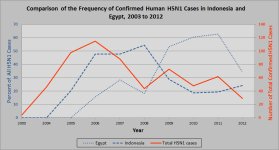
If we look at both the FluTrackers human H5N1 case chart and the WHO Human H5N1 case chart we can see a large decrease in confirmed cases occuring since early 2011. If there are no more confirmed cases in Egypt in the next 5 months of 2012 (or only 1 or 2), then the numbers will tell us that the confirmed cases have dropped up to 75% in recent years.

Is this believable when there are ongoing poultry outbreaks?
A closer look at the WHO data on H5N1 cases in light of recent political and social events in Egypt and Indonesia may shed some light on the variability on H5N1 case numbers over time.

Background and Data

To date 607 human cases of H5N1 have been confirmed by WHO since 2003 (link). Although 19 human cases were reported in Hong Kong in 1997, WHO did not start reporting cases until 2003. Of the 607 case reported by WHO through July 6, 2012, almost 59% of these cases have been reported from just two countries, Indonesia with 190 cases and Egypt with 168 cases. The graph below plots the total number of WHO-confirmed H5N1 cases by year since 2003 (red line). The chart also shows the number of cases in each of these two countries as a percentage of total WHO reported cases for each of the years since 2003 (blue dashed lines).

Notably, there has been a general overall decrease in the number of reported H5N1 cases worldwide since 2006. Whether these lower case numbers represent a decline in human H5N1 infections or shortcomings in local surveillance and reporting is not known.

Between 2006 and 2008, Indonesia was reporting year-after-year increases in the proportion of worldwide cases. This increase peaked in 2008. The following year, 2009, the number of reported human cases in Indonesia dropped and has remained low ever since. It was in 2009 that Indonesia flaunted IHR and failed to notify WHO of H5N1 cases in a timely manner. This late reporting was a reaction to issues about the limited availability of H5N1 vaccines to Indonesia even though some of the vaccines were derived from locally identified strains of the virus. We do know that of the 20 H5N1 cases reported to WHO at the end of 2009 by Indonesia, there was at least one family cluster that thankfully did not produce a transmissible strain.

Egypt first exceeded Indonesia in the raw number of local human H5N1 infections in 2009. Every year since then, Egypt has reported more H5N1 cases than Indonesia. Between 2009 and 2011, Egypt was proportionally reporting more cases than Indonesia. However, for the first six months of 2012 that proportional difference between Egypt and Indonesia has dramatically decreased. Perhaps, the political turmoil in Egypt in 2011 has crippled the health system in that country as speculated by Sharon Sanders. It is also possible that the H5N1 surveillance network in Egypt has been disrupted resulting in fewer reported cases of H5N1.

H5N1 counts EG and ID 20120801.jpg
8HI1uSEEhKOFMAAAAASUVORK5CYII=

Discussion

It is difficult to speculate whether the recent decline in worldwide reported H5N1 cases represented an actual decline in cases of human infection or if other political and social factors have conspired to restrict surveillance and reporting.

With media attention focusing on laboratory manipulation of H5N1 viruses over the past few months, there seems to be a renewed concern over an H5N1 pandemic. H5N1 is already endemic in animal populations in a number of countries including China, Vietnam, Indonesia, and Egypt. No one country wants to be associated with an H5N1 epidemic, and certainly none want to be recognized as the source of pandemic H5N1 strain.

Further epidemiological and virological research is needed to assess whether or not the recent declines of confirmed H5N1 cases represent absolute declines in infections or lax surveillance and deliberate misreporting of human cases in the countries where H5N1 is endemic.
 
How Dangerous is Bird Flu (H5N1) to Global Public Health? Part 2

How Dangerous is Bird Flu (H5N1) to Global Public Health? Part 2

The antigenic property of the H5N1 avian influenza viruses isolated in central China

Wei Zou, Jianjiang Ke, Jiping Zhu, Hongbo Zhou and Meilin Jin

For all author emails, please log on.

Virology Journal 2012, 9:148 doi:10.1186/1743-422X-9-148
Published: 6 August 2012
Abstract (provisional)
Background

Three influenza pandemics outbroke in the last century accompanied the viral antigen shift and drift, resulting in the change of antigenic property and the low cross protective ability of the existed antibody to the newly emerged pandemic virus, and eventually the death of millions of people. The antigenic characterizations of the viruses isolated in central China in 2004 and 2006-2007 were investigated in the present study.
Results

Hemagglutinin inhibition assay and neutralization assay displayed differential antigenic characteristics of the viruses isolated in central China in two periods (2004 and 2006-2007). HA genes of the viruses mainly located in two branches in phylogeny analysis. 53 mutations of the deduced amino acids of the HA genes were divided into 4 patterns. Mutations in pattern 2 and 3 showed the main difference between viruses isolated in 2004 and 2006-2007. Meanwhile, most amino acids in pattern 2 and 3 located in the globular head of the HA protein, and some of the mutations evenly distributed at the epitope sites.
Conclusions

The study demonstrated that a major antigenic drift had occurred in the viruses isolated in central China. And monitoring the antigenic property should be the priority in preventing the potential pandemic of H5N1 avian influenza virus.

http://www.virologyj.com/content/pdf/1743-422X-9-148.pdf
 
Re: How Dangerous is Bird Flu (H5N1) to Global Public Health? Part 2

Re: How Dangerous is Bird Flu (H5N1) to Global Public Health? Part 2

H5N1 Antigenic Drift in China

It is important to remember that the research showing antigenic drift of H5N1 HPAIV in China (abstract posted by tetano above) was from data collected in China in 2004 and from 2006-2007, almost five years ago.

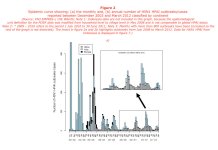
Since then there have been additional H5N1 HPAI infections in China and elsewhere as show in the graph below from the most recent FAO global summary of H5N1 (January – March 2012 ) (link).

HPAI Outbreaks FAO 20120808.jpg

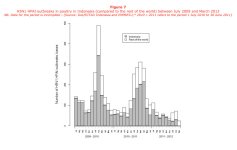
As noted by the FAO, because of data collections methods, local outbreaks in Indonesia are not comparable to the outbreaks graphed in the above figure. The outbreaks in Indonesia are depicted in Figure 7 in the same FAO report (shown below). It is clear that Indonesia continues to have an exceptionally high number of HPAI outbreaks every year.

Indonesia H5N1 outbreaks FAO 20120808.jpg

The article by Wei Zou and colleagues reminds us of that continued, real time surveillance of HPAI outbreaks is critical if we are to monitor changes in H5N1 HPAI viruses that might give rise to a pandemic strain.<object style="position:absolute;z-index:1000" type="application/x-dgnria" id="plugin0" width="0" height="0">

</object>
 
Last edited:
Re: How Dangerous is Bird Flu (H5N1) to Global Public Health? Part 2

Re: How Dangerous is Bird Flu (H5N1) to Global Public Health? Part 2

Yesterday the Indonesia Ministry of Health updated their site with a new H5N1 bird flu death. This is the 9th death reported in Indonesia this year.

The case fatality for 2012 is 100%. This is not a believable statistic. How many cases are not being reported to the World Health Organization?

Our chart with links to WHO:


#183 - Male, 23, onset date December 31, hospitalized January 3, 2012, died January 7 - Jakarta province Death

#184 - Female, 5, family member of case #183, onset date unknown, hospitalized January 7, died on January 16 - Jakarta province Death

#185 - Female, 19, onset date February 8, hospitalized February 12, died on February 13 - Tangerang, Banten province (near Jakarta) Death

#186 - Male, 12, onset date February 11, hospitalized February 16, died on February 21 - Badung, Bali Death

#187 - Female, 24, onset date February 23, hospitalized February 24, died March 1 - Bengkulu, Sumatra Death

#188 - Male, 17, onset date February 28, hospitalized March 7, died March 9 - West Lombok, West Nusa Tenggara Death

#189 - Male, 2, onset date April 17, hospitalized April 21, died April 27 - Riau Province Death

#190 - Female,8, onset date June 18, hospitalized June 24, died July 3 - West Java Death

#191 - Male 37, onset date July 24, hospitalized July 27, died July 30 - Yogyakarta Province Death


--------------------------


Please also view this post about the H5N1 statistical anomaly in Egypt:


Are human H5N1 cases being underreported to the World Health Organization?

 
Re: How Dangerous is Bird Flu (H5N1) to Global Public Health? Part 2

Re: How Dangerous is Bird Flu (H5N1) to Global Public Health? Part 2

Zoonotic Transmission of Influenza Viruses

In an article to be published in Veterinary Microbiology entitled ?Dog to dog transmission of a novel influenza virus (H5N2) isolated from a canine,? researchers in China demonstrated that a novel H5N2 influenza virus can be transmitted by direct contact between dogs (link to abstract).

It is worth remembering that the only recent HPAI outbreak in North America was novel H5N2 in a poultry flock in Texas in 2004. No human cases were associated with this outbreak (link). However, possible poultry-to-human infection of H5N2 occurred in Japan in 2005 and was reported in 2008 in article in the Journal of Epidemiology (full text available here).

The recent outbreak of human cases of novel H3N2v in the USA has been attributed to swine-to-human transmission although there is now some evidence for limited human-to-human transmission of H3N2v (link).

It is a sobering reminder of how little we understand about zoonotic transmission of influenza viruses.

Credits to tetano for abstract link
 
Re: J Infect Dis. Determinants of Antiviral Effectiveness in H5N1 Avian Influenza.

Re: J Infect Dis. Determinants of Antiviral Effectiveness in H5N1 Avian Influenza.

Antiviral treatment - H5N1

Determinants of Antiviral Effectiveness in H5N1 Avian Influenza.
<cite><abbr title="Journal of Infectious Diseases" class="slug-jnl-abbrev">
J Infect Dis.</abbr> (2012) doi: 10.1093/infdis/jis509 </cite> First published online: August 20, 2012

Chan PK, Lee N, Zaman M, Adisasmito W, Coker R, Hanshaoworakul W, Gasimov V, Oner AF, Dogan N, Tsang O, Phommasack B, Touch S, Swenson A, Toovey S, Dreyer NA.

Abstract

Background. Oseltamivir is widely used as treatment for H5N1 infection, but like any intervention, is not always effective.

Methods. Using Avian Influenza Registry data from ten countries (www.avianfluregistry.org), the risk of death in 215 patients with confirmed H5N1 infections and treated with oseltamivir is examined according to viral clade, age, respiratory failure, and adjunctive treatment with corticosteroids or antibiotics.

Results. The median age of cases was 18 years, and 50% were male. The highest fatality rate occurred in a country with clade 2.1 virus circulation, and the lowest, in countries with clade 2.2 (p<0.001). In univariate analyses, youth (≤5 years) and treatment within 2 days of symptom onset were protective against fatality. When accounting for all risk factors, early oseltamivir is particularly effective when initiated in the absence of respiratory failure (OR 0.17, p=0.04). Patients already suffering from advanced respiratory failure requiring ventilatory support at the time of oseltamivir initiation were more likely to die than patients who did not (p<0.001 ). Adjunctive therapy did not improve survival.

Conclusions. Oseltamivir is especially effective for treating human H5N1 infection when given early and before onset of respiratory failure. Effect of viral clade on fatality and treatment response deserves further investigation.

http://jid.oxfordjournals.org/content/early/2012/08/20/infdis.jis509.short?rss=1
<!--[if gte mso 9]><xml> <w:WordDocument> <w:View>Normal</w:View> <w:Zoom>0</w:Zoom> <w:TrackMoves/> <w:TrackFormatting/> <w:PunctuationKerning/> <w:ValidateAgainstSchemas/> <w:SaveIfXMLInvalid>false</w:SaveIfXMLInvalid> <w:IgnoreMixedContent>false</w:IgnoreMixedContent> <w:AlwaysShowPlaceholderText>false</w:AlwaysShowPlaceholderText> <w:DoNotPromoteQF/> <w:LidThemeOther>EN-US</w:LidThemeOther> <w:LidThemeAsian>X-NONE</w:LidThemeAsian> <w:LidThemeComplexScript>KHM</w:LidThemeComplexScript> <w:Compatibility> <w:BreakWrappedTables/> <w:SnapToGridInCell/> <w:WrapTextWithPunct/> <w:UseAsianBreakRules/> <w:DontGrowAutofit/> <w:SplitPgBreakAndParaMark/> <w:EnableOpenTypeKerning/> <w:DontFlipMirrorIndents/> <w:OverrideTableStyleHps/> </w:Compatibility> <m:mathPr> <m:mathFont m:val="Cambria Math"/> <m:brkBin m:val="before"/> <m:brkBinSub m:val="--"/> <m:smallFrac m:val="off"/> <m:dispDef/> <m:lMargin m:val="0"/> <m:rMargin m:val="0"/> <m:defJc m:val="centerGroup"/> <m:wrapIndent m:val="1440"/> <m:intLim m:val="subSup"/> <m:naryLim m:val="undOvr"/> </m:mathPr></w:WordDocument> </xml><![endif]--><!--[if gte mso 9]><xml> <w:LatentStyles DefLockedState="false" DefUnhideWhenUsed="true" DefSemiHidden="true" DefQFormat="false" DefPriority="99" LatentStyleCount="267"> <w:LsdException Locked="false" Priority="0" SemiHidden="false" UnhideWhenUsed="false" QFormat="true" Name="Normal"/> <w:LsdException Locked="false" Priority="9" SemiHidden="false" UnhideWhenUsed="false" QFormat="true" Name="heading 1"/> <w:LsdException Locked="false" Priority="9" QFormat="true" Name="heading 2"/> <w:LsdException Locked="false" Priority="9" QFormat="true" Name="heading 3"/> <w:LsdException Locked="false" Priority="9" QFormat="true" Name="heading 4"/> <w:LsdException Locked="false" Priority="9" QFormat="true" Name="heading 5"/> <w:LsdException Locked="false" Priority="9" QFormat="true" Name="heading 6"/> <w:LsdException Locked="false" Priority="9" QFormat="true" Name="heading 7"/> <w:LsdException Locked="false" Priority="9" QFormat="true" Name="heading 8"/> <w:LsdException Locked="false" Priority="9" QFormat="true" Name="heading 9"/> <w:LsdException Locked="false" Priority="39" Name="toc 1"/> <w:LsdException Locked="false" Priority="39" Name="toc 2"/> <w:LsdException Locked="false" Priority="39" Name="toc 3"/> <w:LsdException Locked="false" Priority="39" Name="toc 4"/> <w:LsdException Locked="false" Priority="39" Name="toc 5"/> <w:LsdException Locked="false" Priority="39" Name="toc 6"/> <w:LsdException Locked="false" Priority="39" Name="toc 7"/> <w:LsdException Locked="false" Priority="39" Name="toc 8"/> <w:LsdException Locked="false" Priority="39" Name="toc 9"/> <w:LsdException Locked="false" Priority="35" QFormat="true" Name="caption"/> <w:LsdException Locked="false" Priority="10" SemiHidden="false" UnhideWhenUsed="false" QFormat="true" Name="Title"/> <w:LsdException Locked="false" Priority="1" Name="Default Paragraph Font"/> <w:LsdException Locked="false" Priority="11" SemiHidden="false" UnhideWhenUsed="false" QFormat="true" Name="Subtitle"/> <w:LsdException Locked="false" Priority="22" SemiHidden="false" UnhideWhenUsed="false" QFormat="true" Name="Strong"/> <w:LsdException Locked="false" Priority="20" SemiHidden="false" UnhideWhenUsed="false" QFormat="true" Name="Emphasis"/> <w:LsdException Locked="false" Priority="59" SemiHidden="false" UnhideWhenUsed="false" Name="Table Grid"/> <w:LsdException Locked="false" UnhideWhenUsed="false" Name="Placeholder Text"/> <w:LsdException Locked="false" Priority="1" SemiHidden="false" UnhideWhenUsed="false" QFormat="true" Name="No Spacing"/> <w:LsdException Locked="false" Priority="60" SemiHidden="false" UnhideWhenUsed="false" Name="Light Shading"/> <w:LsdException Locked="false" Priority="61" SemiHidden="false" UnhideWhenUsed="false" Name="Light List"/> <w:LsdException Locked="false" Priority="62" SemiHidden="false" UnhideWhenUsed="false" Name="Light Grid"/> <w:LsdException Locked="false" Priority="63" SemiHidden="false" UnhideWhenUsed="false" Name="Medium Shading 1"/> <w:LsdException Locked="false" Priority="64" SemiHidden="false" UnhideWhenUsed="false" Name="Medium Shading 2"/> <w:LsdException Locked="false" Priority="65" SemiHidden="false" UnhideWhenUsed="false" Name="Medium List 1"/> <w:LsdException Locked="false" Priority="66" SemiHidden="false" UnhideWhenUsed="false" Name="Medium List 2"/> <w:LsdException Locked="false" Priority="67" SemiHidden="false" UnhideWhenUsed="false" Name="Medium Grid 1"/> <w:LsdException Locked="false" Priority="68" SemiHidden="false" UnhideWhenUsed="false" Name="Medium Grid 2"/> <w:LsdException Locked="false" Priority="69" SemiHidden="false" UnhideWhenUsed="false" Name="Medium Grid 3"/> <w:LsdException Locked="false" Priority="70" SemiHidden="false" UnhideWhenUsed="false" Name="Dark List"/> <w:LsdException Locked="false" Priority="71" SemiHidden="false" UnhideWhenUsed="false" Name="Colorful Shading"/> <w:LsdException Locked="false" Priority="72" SemiHidden="false" UnhideWhenUsed="false" Name="Colorful List"/> <w:LsdException Locked="false" Priority="73" SemiHidden="false" UnhideWhenUsed="false" Name="Colorful Grid"/> <w:LsdException Locked="false" Priority="60" SemiHidden="false" UnhideWhenUsed="false" Name="Light Shading Accent 1"/> <w:LsdException Locked="false" Priority="61" SemiHidden="false" UnhideWhenUsed="false" Name="Light List Accent 1"/> <w:LsdException Locked="false" Priority="62" SemiHidden="false" UnhideWhenUsed="false" Name="Light Grid Accent 1"/> <w:LsdException Locked="false" Priority="63" SemiHidden="false" UnhideWhenUsed="false" Name="Medium Shading 1 Accent 1"/> <w:LsdException Locked="false" Priority="64" SemiHidden="false" UnhideWhenUsed="false" Name="Medium Shading 2 Accent 1"/> <w:LsdException Locked="false" Priority="65" SemiHidden="false" UnhideWhenUsed="false" Name="Medium List 1 Accent 1"/> <w:LsdException Locked="false" UnhideWhenUsed="false" Name="Revision"/> <w:LsdException Locked="false" Priority="34" SemiHidden="false" UnhideWhenUsed="false" QFormat="true" Name="List Paragraph"/> <w:LsdException Locked="false" Priority="29" SemiHidden="false" UnhideWhenUsed="false" QFormat="true" Name="Quote"/> <w:LsdException Locked="false" Priority="30" SemiHidden="false" UnhideWhenUsed="false" QFormat="true" Name="Intense Quote"/> <w:LsdException Locked="false" Priority="66" SemiHidden="false" UnhideWhenUsed="false" Name="Medium List 2 Accent 1"/> <w:LsdException Locked="false" Priority="67" SemiHidden="false" UnhideWhenUsed="false" Name="Medium Grid 1 Accent 1"/> <w:LsdException Locked="false" Priority="68" SemiHidden="false" UnhideWhenUsed="false" Name="Medium Grid 2 Accent 1"/> <w:LsdException Locked="false" Priority="69" SemiHidden="false" UnhideWhenUsed="false" Name="Medium Grid 3 Accent 1"/> <w:LsdException Locked="false" Priority="70" SemiHidden="false" UnhideWhenUsed="false" Name="Dark List Accent 1"/> <w:LsdException Locked="false" Priority="71" SemiHidden="false" UnhideWhenUsed="false" Name="Colorful Shading Accent 1"/> <w:LsdException Locked="false" Priority="72" SemiHidden="false" UnhideWhenUsed="false" Name="Colorful List Accent 1"/> <w:LsdException Locked="false" Priority="73" SemiHidden="false" UnhideWhenUsed="false" Name="Colorful Grid Accent 1"/> <w:LsdException Locked="false" Priority="60" SemiHidden="false" UnhideWhenUsed="false" Name="Light Shading Accent 2"/> <w:LsdException Locked="false" Priority="61" SemiHidden="false" UnhideWhenUsed="false" Name="Light List Accent 2"/> <w:LsdException Locked="false" Priority="62" SemiHidden="false" UnhideWhenUsed="false" Name="Light Grid Accent 2"/> <w:LsdException Locked="false" Priority="63" SemiHidden="false" UnhideWhenUsed="false" Name="Medium Shading 1 Accent 2"/> <w:LsdException Locked="false" Priority="64" SemiHidden="false" UnhideWhenUsed="false" Name="Medium Shading 2 Accent 2"/> <w:LsdException Locked="false" Priority="65" SemiHidden="false" UnhideWhenUsed="false" Name="Medium List 1 Accent 2"/> <w:LsdException Locked="false" Priority="66" SemiHidden="false" UnhideWhenUsed="false" Name="Medium List 2 Accent 2"/> <w:LsdException Locked="false" Priority="67" SemiHidden="false" UnhideWhenUsed="false" Name="Medium Grid 1 Accent 2"/> <w:LsdException Locked="false" Priority="68" SemiHidden="false" UnhideWhenUsed="false" Name="Medium Grid 2 Accent 2"/> <w:LsdException Locked="false" Priority="69" SemiHidden="false" UnhideWhenUsed="false" Name="Medium Grid 3 Accent 2"/> <w:LsdException Locked="false" Priority="70" SemiHidden="false" UnhideWhenUsed="false" Name="Dark List Accent 2"/> <w:LsdException Locked="false" Priority="71" SemiHidden="false" UnhideWhenUsed="false" Name="Colorful Shading Accent 2"/> <w:LsdException Locked="false" Priority="72" SemiHidden="false" UnhideWhenUsed="false" Name="Colorful List Accent 2"/> <w:LsdException Locked="false" Priority="73" SemiHidden="false" UnhideWhenUsed="false" Name="Colorful Grid Accent 2"/> <w:LsdException Locked="false" Priority="60" SemiHidden="false" UnhideWhenUsed="false" Name="Light Shading Accent 3"/> <w:LsdException Locked="false" Priority="61" SemiHidden="false" UnhideWhenUsed="false" Name="Light List Accent 3"/> <w:LsdException Locked="false" Priority="62" SemiHidden="false" UnhideWhenUsed="false" Name="Light Grid Accent 3"/> <w:LsdException Locked="false" Priority="63" SemiHidden="false" UnhideWhenUsed="false" Name="Medium Shading 1 Accent 3"/> <w:LsdException Locked="false" Priority="64" SemiHidden="false" UnhideWhenUsed="false" Name="Medium Shading 2 Accent 3"/> <w:LsdException Locked="false" Priority="65" SemiHidden="false" UnhideWhenUsed="false" Name="Medium List 1 Accent 3"/> <w:LsdException Locked="false" Priority="66" SemiHidden="false" UnhideWhenUsed="false" Name="Medium List 2 Accent 3"/> <w:LsdException Locked="false" Priority="67" SemiHidden="false" UnhideWhenUsed="false" Name="Medium Grid 1 Accent 3"/> <w:LsdException Locked="false" Priority="68" SemiHidden="false" UnhideWhenUsed="false" Name="Medium Grid 2 Accent 3"/> <w:LsdException Locked="false" Priority="69" SemiHidden="false" UnhideWhenUsed="false" Name="Medium Grid 3 Accent 3"/> <w:LsdException Locked="false" Priority="70" SemiHidden="false" UnhideWhenUsed="false" Name="Dark List Accent 3"/> <w:LsdException Locked="false" Priority="71" SemiHidden="false" UnhideWhenUsed="false" Name="Colorful Shading Accent 3"/> <w:LsdException Locked="false" Priority="72" SemiHidden="false" UnhideWhenUsed="false" Name="Colorful List Accent 3"/> <w:LsdException Locked="false" Priority="73" SemiHidden="false" UnhideWhenUsed="false" Name="Colorful Grid Accent 3"/> <w:LsdException Locked="false" Priority="60" SemiHidden="false" UnhideWhenUsed="false" Name="Light Shading Accent 4"/> <w:LsdException Locked="false" Priority="61" SemiHidden="false" UnhideWhenUsed="false" Name="Light List Accent 4"/> <w:LsdException Locked="false" Priority="62" SemiHidden="false" UnhideWhenUsed="false" Name="Light Grid Accent 4"/> <w:LsdException Locked="false" Priority="63" SemiHidden="false" UnhideWhenUsed="false" Name="Medium Shading 1 Accent 4"/> <w:LsdException Locked="false" Priority="64" SemiHidden="false" UnhideWhenUsed="false" Name="Medium Shading 2 Accent 4"/> <w:LsdException Locked="false" Priority="65" SemiHidden="false" UnhideWhenUsed="false" Name="Medium List 1 Accent 4"/> <w:LsdException Locked="false" Priority="66" SemiHidden="false" UnhideWhenUsed="false" Name="Medium List 2 Accent 4"/> <w:LsdException Locked="false" Priority="67" SemiHidden="false" UnhideWhenUsed="false" Name="Medium Grid 1 Accent 4"/> <w:LsdException Locked="false" Priority="68" SemiHidden="false" UnhideWhenUsed="false" Name="Medium Grid 2 Accent 4"/> <w:LsdException Locked="false" Priority="69" SemiHidden="false" UnhideWhenUsed="false" Name="Medium Grid 3 Accent 4"/> <w:LsdException Locked="false" Priority="70" SemiHidden="false" UnhideWhenUsed="false" Name="Dark List Accent 4"/> <w:LsdException Locked="false" Priority="71" SemiHidden="false" UnhideWhenUsed="false" Name="Colorful Shading Accent 4"/> <w:LsdException Locked="false" Priority="72" SemiHidden="false" UnhideWhenUsed="false" Name="Colorful List Accent 4"/> <w:LsdException Locked="false" Priority="73" SemiHidden="false" UnhideWhenUsed="false" Name="Colorful Grid Accent 4"/> <w:LsdException Locked="false" Priority="60" SemiHidden="false" UnhideWhenUsed="false" Name="Light Shading Accent 5"/> <w:LsdException Locked="false" Priority="61" SemiHidden="false" UnhideWhenUsed="false" Name="Light List Accent 5"/> <w:LsdException Locked="false" Priority="62" SemiHidden="false" UnhideWhenUsed="false" Name="Light Grid Accent 5"/> <w:LsdException Locked="false" Priority="63" SemiHidden="false" UnhideWhenUsed="false" Name="Medium Shading 1 Accent 5"/> <w:LsdException Locked="false" Priority="64" SemiHidden="false" UnhideWhenUsed="false" Name="Medium Shading 2 Accent 5"/> <w:LsdException Locked="false" Priority="65" SemiHidden="false" UnhideWhenUsed="false" Name="Medium List 1 Accent 5"/> <w:LsdException Locked="false" Priority="66" SemiHidden="false" UnhideWhenUsed="false" Name="Medium List 2 Accent 5"/> <w:LsdException Locked="false" Priority="67" SemiHidden="false" UnhideWhenUsed="false" Name="Medium Grid 1 Accent 5"/> <w:LsdException Locked="false" Priority="68" SemiHidden="false" UnhideWhenUsed="false" Name="Medium Grid 2 Accent 5"/> <w:LsdException Locked="false" Priority="69" SemiHidden="false" UnhideWhenUsed="false" Name="Medium Grid 3 Accent 5"/> <w:LsdException Locked="false" Priority="70" SemiHidden="false" UnhideWhenUsed="false" Name="Dark List Accent 5"/> <w:LsdException Locked="false" Priority="71" SemiHidden="false" UnhideWhenUsed="false" Name="Colorful Shading Accent 5"/> <w:LsdException Locked="false" Priority="72" SemiHidden="false" UnhideWhenUsed="false" Name="Colorful List Accent 5"/> <w:LsdException Locked="false" Priority="73" SemiHidden="false" UnhideWhenUsed="false" Name="Colorful Grid Accent 5"/> <w:LsdException Locked="false" Priority="60" SemiHidden="false" UnhideWhenUsed="false" Name="Light Shading Accent 6"/> <w:LsdException Locked="false" Priority="61" SemiHidden="false" UnhideWhenUsed="false" Name="Light List Accent 6"/> <w:LsdException Locked="false" Priority="62" SemiHidden="false" UnhideWhenUsed="false" Name="Light Grid Accent 6"/> <w:LsdException Locked="false" Priority="63" SemiHidden="false" UnhideWhenUsed="false" Name="Medium Shading 1 Accent 6"/> <w:LsdException Locked="false" Priority="64" SemiHidden="false" UnhideWhenUsed="false" Name="Medium Shading 2 Accent 6"/> <w:LsdException Locked="false" Priority="65" SemiHidden="false" UnhideWhenUsed="false" Name="Medium List 1 Accent 6"/> <w:LsdException Locked="false" Priority="66" SemiHidden="false" UnhideWhenUsed="false" Name="Medium List 2 Accent 6"/> <w:LsdException Locked="false" Priority="67" SemiHidden="false" UnhideWhenUsed="false" Name="Medium Grid 1 Accent 6"/> <w:LsdException Locked="false" Priority="68" SemiHidden="false" UnhideWhenUsed="false" Name="Medium Grid 2 Accent 6"/> <w:LsdException Locked="false" Priority="69" SemiHidden="false" UnhideWhenUsed="false" Name="Medium Grid 3 Accent 6"/> <w:LsdException Locked="false" Priority="70" SemiHidden="false" UnhideWhenUsed="false" Name="Dark List Accent 6"/> <w:LsdException Locked="false" Priority="71" SemiHidden="false" UnhideWhenUsed="false" Name="Colorful Shading Accent 6"/> <w:LsdException Locked="false" Priority="72" SemiHidden="false" UnhideWhenUsed="false" Name="Colorful List Accent 6"/> <w:LsdException Locked="false" Priority="73" SemiHidden="false" UnhideWhenUsed="false" Name="Colorful Grid Accent 6"/> <w:LsdException Locked="false" Priority="19" SemiHidden="false" UnhideWhenUsed="false" QFormat="true" Name="Subtle Emphasis"/> <w:LsdException Locked="false" Priority="21" SemiHidden="false" UnhideWhenUsed="false" QFormat="true" Name="Intense Emphasis"/> <w:LsdException Locked="false" Priority="31" SemiHidden="false" UnhideWhenUsed="false" QFormat="true" Name="Subtle Reference"/> <w:LsdException Locked="false" Priority="32" SemiHidden="false" UnhideWhenUsed="false" QFormat="true" Name="Intense Reference"/> <w:LsdException Locked="false" Priority="33" SemiHidden="false" UnhideWhenUsed="false" QFormat="true" Name="Book Title"/> <w:LsdException Locked="false" Priority="37" Name="Bibliography"/> <w:LsdException Locked="false" Priority="39" QFormat="true" Name="TOC Heading"/> </w:LatentStyles> </xml><![endif]--><!--[if gte mso 10]> <style> /* Style Definitions */ table.MsoNormalTable {mso-style-name:"Table Normal"; mso-tstyle-rowband-size:0; mso-tstyle-colband-size:0; mso-style-noshow:yes; mso-style-priority:99; mso-style-parent:""; mso-padding-alt:0in 5.4pt 0in 5.4pt; mso-para-margin-top:0in; mso-para-margin-right:0in; mso-para-margin-bottom:10.0pt; mso-para-margin-left:0in; line-height:115%; mso-pagination:widow-orphan; font-size:11.0pt; font-family:"Calibri","sans-serif"; mso-ascii-font-family:Calibri; mso-ascii-theme-font:minor-latin; mso-hansi-font-family:Calibri; mso-hansi-theme-font:minor-latin; mso-bidi-font-family:DaunPenh; mso-bidi-theme-font:minor-bidi; mso-bidi-language:AR-SA;} </style> <![endif]-->
A number of research articles and reports by specialists have demonstrated the efficacy of antiviral treatment of H5N1 with neuraminidase inhibitors within 48 hours of onset. It is unfortunate that H5N1 case information in the avian flu registry (www.avianfluregistry.org) is not open access and is controlled by a private, for-profit entity.
<object style="position:absolute;z-index:1000" type="application/x-dgnria" id="plugin0" height="0" width="0">

</object>
 
Re: How Dangerous is Bird Flu (H5N1) to Global Public Health? Part 2

Re: How Dangerous is Bird Flu (H5N1) to Global Public Health? Part 2

It appears that www.avianfluregistry.org is owned by Outcome Sciences, Inc. who is owned by Quintiles Outcome.

One of the 2 principles:

"Dr. Gliklich is the editor of a textbook on the practical value of real-world data in medical practice, "Profiting from Quality: Outcomes strategies for medical practice," published by Jossey-Bass, Inc., in 1999. He is a Principal Investigator (PI) for the Outcome DEcIDE Center under the Agency for Healthcare Research and Quality's Effective Healthcare Program. In 2010, Dr. Gliklich was recognized by the trade journal PharmaVoice as one of the 100 most inspiring people in the pharmaceutical and life sciences industry."

Since the data base is private and is controlled by a pharma company, the findings of the study, which support the use of a pharmaceutical product, rest solely on the reputation of the study participants.


This means that......
 
Status
Not open for further replies.
Back
Top Bottom