

sharon sanders
Editor-in-Chief & President
Wednesday, October 30, 2013
Referral: Dr. Mackay On MERS-CoV Testing
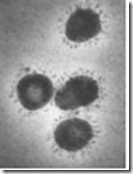
Coronavirus ? Credit CDC PHIL
# 7921
Dr. Ian Mackay has a informative post this morning on his Virology Down Under blog on the recently announced rapid blood test for MERS-CoV. As readers who follow this blog already know, lab tests are not always definitive. First a link to Ian?s piece, then I?ll be back with a bit more.
The two main measures of the accuracy of any diagnostic test are sensitivity and specificity.
While a rapid MERS-CoV test would be a great boon to surveillance, our experience with Rapid Influenza test kits (see MMWR: Evaluating RIDTs) has not been all that encouraging.
The World Health Organization issued the following testing recommendations for MERS last summer (see WHO: Revised MERS-CoV Case Definitions), for precisely this reason.
Posted by Michael Coston at <a class="timestamp-link" href="http://afludiary.blogspot.com/2013/10/referral-dr-mackay-on-mers-cov-testing.html" rel="bookmark" title="permanent link"><abbr class="published" itemprop="datePublished" title="2013-10-30T06:49:00-04:00">6:49 AM</abbr>
Referral: Dr. Mackay On MERS-CoV Testing
Coronavirus ? Credit CDC PHIL
# 7921
Dr. Ian Mackay has a informative post this morning on his Virology Down Under blog on the recently announced rapid blood test for MERS-CoV. As readers who follow this blog already know, lab tests are not always definitive. First a link to Ian?s piece, then I?ll be back with a bit more.
The two main measures of the accuracy of any diagnostic test are sensitivity and specificity.
- Sensitivity is defined as the ability of a test to correctly identify individuals who have a given disease or condition.
- Specificity is defined as the ability of a test to exclude someone from having a disease or illness.
While a rapid MERS-CoV test would be a great boon to surveillance, our experience with Rapid Influenza test kits (see MMWR: Evaluating RIDTs) has not been all that encouraging.
According to the CDC:
The rapid tests vary in terms of sensitivity and specificity when compared with viral culture or RT-PCR. Product insert information and research publications indicate that:
But of course, this is a different test, a different collection method, and a different virus. As Dr. Mackay points out, we need to see some real-world data on how well this new test works in the field. The rapid tests vary in terms of sensitivity and specificity when compared with viral culture or RT-PCR. Product insert information and research publications indicate that:
- Sensitivities are approximately 50-70%
- Specificities are approximately 90-95%
We also know a lab test can have excellent sensitivity and specificity under laboratory conditions ? but if the sample collected from the patient doesn?t contain enough virus (or is improperly stored or transported) ? then the best test in the world won?t be accurate.
Testing for MERS has often relied on taking throat swabs - which can be sub-optimal when trying to detect deep lung infections. As we?ve seen with H5N1, H7N9, and MERS-CoV - false negatives can result.
The World Health Organization issued the following testing recommendations for MERS last summer (see WHO: Revised MERS-CoV Case Definitions), for precisely this reason.
Inconclusive testing: Patients with an inconclusive initial testing should undergo additional virologic and serologic testing to determine if the patient can be classified as a confirmed MERS-CoV case. It is strongly advised that lower respiratory specimens such as sputum, endotracheal aspirate, or bronchoalveolar lavage fluid be used when possible. If patients do not have signs or symptoms of lower respiratory tract infection and lower track specimens are not available or clinically indicated, both nasopharyngeal and oropharyngeal swab specimens should be collected.
If initial testing of a nasopharyngeal swab is negative in a patient who is strongly suspected to have MERS-CoV infection, patients should be retested using a lower respiratory specimen tract or a repeat nasopharyngeal specimen with additional oropharyngeal specimen if lower respiratory tract specimens are not possible, and paired acute and convalescent sera.
A reminder, that at least with lab tests, `No? doesn?t always mean `no?.If initial testing of a nasopharyngeal swab is negative in a patient who is strongly suspected to have MERS-CoV infection, patients should be retested using a lower respiratory specimen tract or a repeat nasopharyngeal specimen with additional oropharyngeal specimen if lower respiratory tract specimens are not possible, and paired acute and convalescent sera.
Posted by Michael Coston at <a class="timestamp-link" href="http://afludiary.blogspot.com/2013/10/referral-dr-mackay-on-mers-cov-testing.html" rel="bookmark" title="permanent link"><abbr class="published" itemprop="datePublished" title="2013-10-30T06:49:00-04:00">6:49 AM</abbr>