Re: HK researchers warn of H7N9 threat (RTHK, July 25 2013)
Lancet: Tropism Of H7N9 In the Human Respiratory Tract
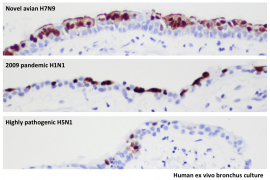
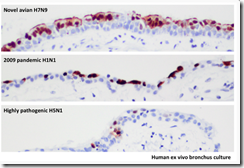 ex vivo bronchus culture ? Credit University Of Hong Kong
# 7513
An important new study from researchers at the
University of Hong Kong appears today in
The Lancet Respiratory Medicine, that finds that China?s emerging H7N9 virus
infects and replicates in the cells of the
human respiratory tract about as well as the 2009 H1N1 virus.
While we?ve seen a welcome reduction in human H7N9 infections over the summer, this is the latest in a series of studies that suggests this virus may have substantial pandemic potential (for more see
Science: H7N9 Transmissibility Study In Ferrets).
In today?s study, researchers led by Dr. Malik Peiris inoculated
in-vitro and
ex-vivo cultures representing
human bronchus and lung tissues with six different virus strains (
H5N1,
H1N1,
2 Human-derived H7N9 strains,
1 duck-derived H7N9, and the
H7N7 2003 Netherlands outbreak stain) and compared how well they infected and replicated within the cells.
While the duck-derived H7N9 failed to replicate, both human H7N9 viruses replicated efficiently, far better than H5N1, andon a par with the 2009 H1N1 pandemic virus.
We?ve three stops this morning for this paper, after which I?ll return with a bit more.
First, a
link to the abstract in the Lancet, then
a companion piece by
Jessica A Belser &
Terrence M Tumpey of the
CDC?s NCIRD, and finally a
press release from the University of Hong Kong on this research.
Tropism and innate host responses of a novel avian influenza A H7N9 virus: an analysis of ex-vivo and in-vitro cultures of the human respiratory tract
Michael CW Chan PhD a ?, Renee WY Chan PhD a ?, Louisa LY Chan BSc a ?, Chris KP Mok PhD a ?, Kenrie PY Hui PhD a, Joanne HM Fong MSc a, Kin P Tao PhD a, Leo LM Poon DPhil a b, Prof John M Nicholls FRCPA c, Prof Y Guan PhD a b d, Prof JS Malik Peiris DPhil a b
ABSTRACT (Excerpt)
Methods
We obtained ex-vivo cultures of the human bronchus, lung, nasopharynx, and tonsil and in-vitro cultures of primary human alveolar epithelial cells and peripheral blood monocyte-derived macrophages. We compared virus tropism and induction of proinflammatory cytokine responses of two human influenza A H7N9 virus isolates, A/Shanghai/1/2013 and A/Shanghai/2/2013; a highly pathogenic avian influenza H5N1 virus; the highly pathogenic avian influenza H7N7 virus that infected human beings in the Netherlands in 2003; the 2009 pandemic influenza H1N1 virus, and a low pathogenic duck H7N9 virus that was genetically different to the human disease causing A H7N9 viruses.
Findings
Both human H7N9 viruses replicated efficiently in human bronchus and lung ex-vivo cultures, whereas duck/H7N9 virus failed to replicate in either. Both human A H7N9 viruses infected both ciliated and non-ciliated human bronchial epithelial cells and replicated to higher titres than did H5N1 (p<0?0001 to 0?0046) and A/Shanghai/1/2013 replicated to higher titres than did H7N7 (p=0?0002?0?01). Both human A H7N9 viruses predominantly infected type II alveolar epithelial cells and alveolar macrophages in the human lung and replicated to higher titres than did H5N1 (p<0?0001 to 0?0078); A/Shanghai/1/2013 replicated to higher titres than did H1N1 (p=0?0052?0?05) and H7N7 (p=0?0031?0?0151). Human H7N9 viruses were less potent inducers of proinflammatory cytokines compared with H5N1 virus.
Interpretation
Collectively, the results suggest that the novel H7N9 viruses are better adapted to infect and replicate in the human conducting and lower airways than are other avian influenza viruses, including H5N1, and pose an important pandemic threat
In a companion article, Belser and Tumpey explore these findings further (
full access with free registration) in:
While referring to the
`remarkable ability of this low pathogenic avian influenza virus to cause severe human disease? the authors caution that this study leaves a good many questions unanswered.
And our last stop is a press release from the University of Hong Kong (excerpts below).
HKU?s finding on avian influenza A (H7N9) virus well adapted to infect human respiratory tract reveals why numerous human infected cases in a short period of time
25 Jul 2013
HKU research team reveals why the avian influenza (H7N9) virus led to over 130 human cases in a relatively short period of time. By using human respiratory tract tissues maintained in culture, the researchers discover that the avian influenza A (H7N9) virus is as efficient as the 2009 pandemic H1N1 virus, commonly known as swine influenza, in infecting the human respiratory tract. Compared to the avian influenza A (H5N1) virus, H7N9 virus might pose an even more important pandemic threat to human.
<SNIP>
Research findings
The researchers used human respiratory tract tissues (bronchus and lung) maintained in culture to compare infection with the avian influenza A (H7N9) virus, the 2009 pandemic influenza A (H1N1) virus (commonly known as swine influenza) and highly pathogenic avian influenza A (H5N1) virus. They find that the H7N9 virus infects and replicates in both human bronchus as well as the H1N1 virus, and far more efficiently than the H5N1 virus.
These studies also identify the type II alveolar epithelial cells within the lung as a key target for H7N9 virus replication. This is the key cell type supporting regeneration and repair of damaged lung tissues. Thus infection and damage to these cells will prevent the repair processes that allow the lung to recover from injury or infection.
Taken together, this study demonstrates that the H7N9 viruses are better adapted to infect and replicate in the human airways and pose an important pandemic threat, perhaps even more so than H5N1 virus.
This latest research, along with a number of other recent studies, continue to show that the H7N9 virus has many of the qualities we would expect to find in an pandemic strain of influenza:
- it is a novel strain to which humans appear to have little or no immunity
- it can infect human (a2,6) receptor cells
- it replicates efficiently in human tissue;
- and it is capable of producing severe disease.
Yet, despite these worrisome traits in the lab, we?ve
not seen sustained human-to-human transmission of the virus in the field.
Exactly why that is, and whether or not this virus can gain the necessary changes to overcome that limitation, remain unanswered.
About the only thing we can say with any certainty is that none of the studies we?ve seen over the summer have done anything to
lower the level of concern over this emerging virus.
Which is why all eyes will be on China later this year to see if, and with how much vigor, this virus returns in the fall or winter.
Posted by Michael Coston at <a class="timestamp-link" href="http://afludiary.blogspot.ca/2013/07/lancet-tropism-of-h7n9-in-human.html" rel="bookmark" title="permanent link"><abbr class="published" title="2013-07-25T07:39:00-04:00">7:39 AM</abbr>