• FluTrackers.com Inc. does not provide medical advice. Information on this web site is collected from various internet resources, and the FluTrackers board of directors makes no warranty to the safety, efficacy, correctness or completeness of the information posted on this site by any author or poster. The information collated here is for instructional and/or discussion purposes only and is NOT intended to diagnose or treat any disease, illness, or other medical condition. Every individual reader or poster should seek advice from their personal physician/healthcare practitioner before considering or using any interventions that are discussed on this website. By continuing to access this website you agree to consult your personal physican before using any interventions posted on this website, and you agree to hold harmless FluTrackers.com Inc., the board of directors, the members, and all authors and posters for any effects from use of any medication, supplement, vitamin or other substance, device, intervention, etc. mentioned in posts on this website, or other internet venues referenced in posts on this website.
  • We are not asking for any donations. Do not donate to any entity who says they are raising funds for us.

H5N1: Who gets infected, who dies - 4/7/06

Mellie

Well-known member
I posted a graph yesterday (from the Influenza Report) of H5N1 Cases of Infection by Age and now I can't find it. Maybe it got edited out by mistake or maybe I just dreamed it. In any case, I'm updating the talk I give and gathering current infection and mortality information by data. Interesting stuff to summarize once in a while...

It would be interesting to discuss why patients might be younger.

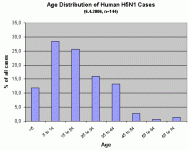
From the Influenza Report
http://influenzareport.com/ir/figures/ad060406.htm

Age distribution of human H5N1 influenza cases (n=144).
50% of cases were 17 years or younger;
75% of cases were 29 years or younger;
90% of cases were 37 years or younger.
Most patients were born after 1968.


ad060406.gif
 
A Comment on Demographic Data - 2/11/06

A Comment on Demographic Data - 2/11/06

More info on Demographic Data from WHO, summarized by Bernd Sebastian Kamps and presented on ProMed 11 Feb '06 here: http://www.promedmail.org/pls/prome..._BACK_PAGE,F2400_P1001_PUB_MAIL_ID:1000,31984


A Comment on Demographic Data
-----------------------------
We have recently analysed demographic data available from the "WHO
situation updates on avian influenza"
(<http://www.who.int/csr/disease/avian_influenza/updates/en/index.html>).

Age was reported for 116 human H5N1 influenza cases. According to
these data, 50 percent of cases occurred in individuals 16 years or
younger, 75 percent of cases were 29 years or younger, and 90 percent
of cases were 39 years or younger (see
<http://influenzareport.com/ir/figures/ad060210.htm>).

The reasons for the concentration of cases in children and young
adults are unclear.

We have compiled the data in a Microsoft Access file which is
available from <http://influenzareport.com/download_mdb.htm>

--
Bernd Sebastian Kamps, M.D.
Senior Editor
Influenza Report 2006
Flying Publisher
<Sebastian.Kamps@amedeo.com>

[ProMED-mail thanks Dr. Kamps for making these data and the analysis
available to ProMED-mail participants. - Mod.CP]

[Playing with the data a bit (as this epidemiologist couldn't
resist), if one stratifies by country of origin, the mean ages of
cases is somewhat lower in Turkey:

For 116 cases on whom the information is available, the ages range
from 1-69 years of age, with a mean age of 19.8 years (SD 14.6)

By country of origin:
Cambodia - 4 cases; ages range from 8 to 28 years, with a mean age of
20.3 (SD 8.8)
China - 11 cases; ages range from 6 to 41 years, with a mean age of
25.5 (SD 12.0)
Indonesia - 21 cases; ages range from 4 to 39 years, with a mean age
of 19.3 (SD 11.7)
Iraq - 1 case age 15
Thailand - 21 cases; ages range from 2 to 58 years, with a mean age
of 21.4 (SD 18.1)
Turkey - 16 cases; ages range from 2 to 65 years, with a mean age of
13.0 (SD 16.2)
Vietnam - 42 cases; ages range from 1 to 69 years, with a mean age
of 20.4 (SD 14.2)

Many questions arise (and remain) as to why the age distribution of
cases is skewed to younger age groups, including exposure risk,
disease reporting bias, and intrinsic host issues. - Mod.MPP]</pre>


</pre>

 
H5N1: 2/06 Effect Measure

H5N1: 2/06 Effect Measure

What Revere had to say last month ... at Effect Measure.

http://effectmeasure.blogspot.com/2006/02/trainwreck-in-slow-motion.html

Sunday, February 12, 2006 A trainwreck in slow motion


Dr. Bernd Sebastian Kamps,.Senior Editor at Influenza Report 2006 has taken a look at the age distribution of 116 WHO confirmed H5N1 cases. Bar charts can be seen at the link. Some additional age breakdowns stratified by country were made available to ProMed by Dr. Kamps.

The age distribution shows an extreme skew toward the younger age groups. In ordinary (seasonal, inter-pandemic) influenza, it is the oldest age groups that have the highest mortality. But these data show half the cases below the age of 16, three quarters below the age of 29 and 90% below the age of 39. Mean age is about 20 years old. The mean age of cases in Turkey appear to be somewhat lower (13 years old).

This is an extraordinary distribution and not matched by any influenza outbreak on record to our knowledge. A characteristic of pandemic influenza is a marked shift to younger age groups, but this is more extreme than anything yet seen. In 1918 most of the excess mortality was under the age of 65, but there continued to be considerable "normal" influenza mortality in the over 65 age group.

Not so, as far as we know, in this case. It may be we are seeing some kind of reporting bias, i.e., that younger age cases are being recognized but not older ones, although this seems unlikely given the severity of the illness. It is also possible that there is something about exposure that is higher in the young. It has been suggested that it is the youngest who are closest to poultry, either by virtue of having the chore of collecting the eggs in the henhouse in the morning or because they play with the birds as pets. But it has been a puzzling feature of H5N1 outbreaks that adult poultry workers and those involved in culling operations rarely become ill or show signs of infection. It is possible there is some kind of cross immunity in the older age groups or other unidentified biological feature that either protects an older person or makes the younger ones especially susceptible.

As yet this is not a pandemic virus. But it has the hallmarks of one in the making. It is like watching a trainwreck in slow motion.


posted by Revere at 8:42 AM
 
Last edited:
H5N1: 9/05 Who got infected, who died?

H5N1: 9/05 Who got infected, who died?

For comparison, download and read this NEJM article from September of 2005.

Avian Influenza A (H5N1) Infection in Humans
http://content.nejm.org/cgi/reprint/353/13/1374.pdf

for example... look at how far we have come since then...
Incidence:

The occurrence of human influenza A (H5N1) in Southeast Asia (Table 1) has paralleled large outbreaks of avian influenza A (H5N1), although the avian epidemics in 2004 and 2005 have only rarely led to disease in humans. The largest number of cases has occurred in Vietnam, particularly during the third, ongoing wave, and the first human death was recently reported in Indonesia. The frequencies of human infection have not been determined, and seroprevalence studies are urgently needed. The expanding geographic distribution of avian influenza A (H5N1) infections, with recent outbreaks in Kazakstan, Mongolia, and Russia, indicates that more human populations are at risk.
That was detailed information. There are amazing tables in this pdf file. Well worth looking at.

As I recall small clusters began occurring around the time this paper came out and it seemed to me that the detail in information declined.

It's unclear to me if it actually did decline or did I just want more? And if less information was made available, why?... Were they becoming overwhelmed with documentation and reporting?

Did the clusters indicate they should be going to Pandemic Phase 4 and they didn't want to do that yet? It wasn't (and still isn't) EFFICIENT Human to Human transmission after all, but back then I don't think the word efficient had even come up.

I look at the different versions of my talk from last fall to this spring and for humans they are not all that much different on the face of it, numbers are a little higher, cleary a trend to more kids than older people...

but it's clear the world is dealing with a virus that has enlarged its geographic range extensively in wild birds and caused the culling of millions of domestic fowl and has been found in many animals.

It's a virus on the move... still on the move... Is it a panzootic virus?
If it is and it continues to enlarge the number of species it infects, what selective pressure will there be for it to become less of a killer?

Tomorrow I'll do a bit more summarizing of the human numbers.
 
Last edited:
Re: H5N1: Who gets infected, who dies - 4/7/06

One thought this morning... on panzootic.

As far as I can tell from info available, H5N1 transmission right now is from bird to mammal, whichever mammal that is. It is only if the virus changes to transmit easily mammal to mammal within (and between) species that panzootic will sweep the world in my opinion.

So much to do today (garden, walk at the marsh, preparing talks, revising...)
... so little time.

I sure am glad the pandemic didn't hit overnight. I wouldn't have time for it today. (chuckle) <chuckle></chuckle>
 
Last edited:
Re: H5N1: Who gets infected, who dies - 4/7/06

Age by Incidence H5N1, Recovered, Dead, etc.

What are the patterns?

More than 50% of those who die are between ages 5 and 24. (Younger than 1918 when 50% were between 18 and 40)
96% of those who become ill are younger than 45,
but only 1 of the 4 who did, lives. Small numbers, I know, but interesting. Don't get sick!

Did the pandemic in 1968 confer some small holdover immunity?

HTML:
  Age     Ill   Recovered   Dead   %D of Total   Cumulative %D
 under5    24         8      16        14.5         14.5
 5-14      38         9      29        26.4         40.9
 15-24     39        10      29        26.4         67.3
 25-34     24         7      17        15.4         82.2
 35-44     15         0      15        13.6         96.3
 45-54      3         1       2         1.8         98.1
 55-64      1         0       1         0.9         99
 over64     1         0       1         0.9        100
 Total    145        35     110       100


(Thanks Lobotomy, for prodding me to do this...)

 
Back
Top