• FluTrackers.com Inc. does not provide medical advice. Information on this web site is collected from various internet resources, and the FluTrackers board of directors makes no warranty to the safety, efficacy, correctness or completeness of the information posted on this site by any author or poster. The information collated here is for instructional and/or discussion purposes only and is NOT intended to diagnose or treat any disease, illness, or other medical condition. Every individual reader or poster should seek advice from their personal physician/healthcare practitioner before considering or using any interventions that are discussed on this website. By continuing to access this website you agree to consult your personal physican before using any interventions posted on this website, and you agree to hold harmless FluTrackers.com Inc., the board of directors, the members, and all authors and posters for any effects from use of any medication, supplement, vitamin or other substance, device, intervention, etc. mentioned in posts on this website, or other internet venues referenced in posts on this website.
  • We are not asking for any donations. Do not donate to any entity who says they are raising funds for us.

H5N1 cleavage sites

JJackson

In Memoriam - Senior Moderator
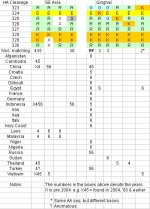
I made this for my own benefit as a quick look at changes in the H5N1 HA cleavage site. It is NOT definitive and is based only on a fairly random set of sequences I had but has enough data to give a qualatative feel for the sites in circulation.

I post it here so I can have a quick look while reading posts and incase anyone else finds it useful. If I get around to updating it I will repost.

PM me if you would like the XLS to add to yourself.

cleavage.jpg
 
Re: H5N1 cleavage sites

What is the basis for classifying the SE Asia sequences as Qinghai?

I believe the Egyption cleavage site should be GKRRRKKR.
 
Re: H5N1 cleavage sites

Great table. It looks like most of the cleavage site sequences that deviate from SE Asia consensus and from Quinghai consensus are human cases - is that correct ? If so this could be very relvant.


JJackson said:
I made this for my own benefit as a quick look at changes in the H5N1 HA cleavage site. It is NOT definitive and is based only on a fairly random set of sequences I had but has enough data to give a qualatative feel for the sites in circulation.

I post it here so I can have a quick look while reading posts and incase anyone else finds it useful. If I get around to updating it I will repost.

PM me if you would like the XLS to add to yourself.

View attachment 567
 
Re: H5N1 cleavage sites

I have had a couple of PMs and the sheet is not as clear as I hoped.

I have pasted below a bit more detail.

All I have done is search the Los Alamos data base with the CGAT sequence taken form a typical example of the cleavage change to see which sequences included it. I use BioEdit to align sequences, find anomalous cleavage sites in the AA view and toggle to get the residues that created them and then use this as the search input. The problem is that more than one codon can code for a given AA and I will only find those that have an exact match for the residue sequence and there may be other residue strings that produce an identical AA string. The KERRRKKR is an example of this the Vietnam '05 and Egypt '06 needed different probes.

Re the coloured bit at the top. Once I have aligned the bases the cleavage site lies between position 323 to 330 along the Amino Acid chain. So reading down the second column you have a RERRRKKR cleavage site, when I searched the data base for the sequence of bases that created it I found 435 instances in H5N1 and the section below shows the countries, and years, that those sequence occurred in. The letters in the coloured area denoted the AA found at that position, the colours are just there to make it easier to see changes from the consensus sequence (X denoted a gap in the sequence - this presents a problem when searching as the raw data does not have gaps they only 'appear' when you align samples). I divided the sites into two blocks headed SE Asia and
Qinghai because they have - up till know - followed separate evolutionary paths.

BioEdit and all the links and methods used are to be found in Mingus' Lab.

I hope it helps,

Jonathan.

Henry:
What is the basis for classifying the SE Asia sequences as Qinghai?

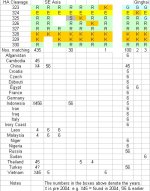
Sorry my mistake in the version I 'cleaned up' to post I split into blocks and forgot to move two of the columns REKRRKKR & RERKRKKR should have been dragged into the SE Asian block.

As to the Egyptian sequences I listed three different sites all in 2006 and have pasted an example of each below.


A/chicken/Egypt/2253-1/2006 H5N1 GERRRKKR
A/chicken/Egypt/5610NAMRU3-F3/2006 H5N1 KERRRKKR
A/chicken/Egypt/5611NAMRU3-AN/2006 H5N1 GKRRRKKR

I have attached a corrected .xls as a .zip
View attachment H5N1 Cleavage sites.zip
 
Re: H5N1 cleavage sites

Toaster2 said:
Great table. It looks like most of the cleavage site sequences that deviate from SE Asia consensus and from Quinghai consensus are human cases - is that correct ? If so this could be very relevant.

As you will see from the Egypt sequences the 'straight Qinghai' and the two variants are in Chickens. I was not very methodical when I originally did this and should have made a note of the sequences' No. so I could check. It was just rough and ready for my own use initially.
 
Re: H5N1 cleavage sites

JJackson said:
I have had a couple of PMs and the sheet is not as clear as I hoped.

I have pasted below a bit more detail.


Henry:

Sorry my mistake in the version I 'cleaned up' to post I split into blocks and forgot to move two of the columns REKRRKKR & RERKRKKR should have been dragged into the SE Asian block.

As to the Egyptian sequences I listed three different sites all in 2006 and have pasted an example of each below.


A/chicken/Egypt/2253-1/2006 H5N1 GERRRKKR
A/chicken/Egypt/5610NAMRU3-F3/2006 H5N1 KERRRKKR
A/chicken/Egypt/5611NAMRU3-AN/2006 H5N1 GKRRRKKR

I have attached a corrected .xls as a .zip
View attachment 568

I believe both novel Egyptian sequences are GKRRRKKR
 
Re: H5N1 cleavage sites

Toaster2 said:
Great table. It looks like most of the cleavage site sequences that deviate from SE Asia consensus and from Quinghai consensus are human cases - is that correct ? If so this could be very relvant.

No there are a large number of bird sequences that have either dropper one R or one K. There are also novel sequences in Ian Brown's presentation on Qinghai in Europe (which are all bird sequences). There are also novel swine HA cleavage sites China and Indonesia.
 
Re: H5N1 cleavage sites

here are the other polymorphisms in HA (I haven't yet looked at the other genes) which distinguish the human sequences in Java from the avian:

residue, human, avian
19: I(ATC),I(ATA)
86: T(ACC),A(GCC)
200: I(ATT),V(GTT)
235: P(CCT),P(CCG)
325: S(AGC),R(AGA)
417: G(GGG),G(GGA)

3 synonymous,3 nonsynonymous which is a relatively high proportion of
nonsynonymous=amino-relevant changes.

Looks as if the humans don't get it from the chickens and that there are different,separated sources from which humans and chickens get it.
And also that these changes are part of an adaption of H5N1
to other species. I can't remember that we saw this before ?!?


edit: I checked PB2 now - no such examples found.
 
Last edited:
Re: H5N1 cleavage sites

JJackson said:
I have redownloaded and checked Henry is correct. Apologies to all, I must have accidently edited a residue.

re-re-corrected graphic & zip. Many thanks for correcting errors Dr Niman.

View attachment 572

View attachment 573

Indonesia also has isolates with a cleavage site missing a K (RERRRKR). Isolates with this cleavage site are

ISDN138756 A/chicken/Malaysia/935/2006 2006 H5N1
ISDN138780 A/duck/Laos/3295/2006 2006 H5N1
DQ643809 A/Zhejiang/16/2006 2006 H5N1
DQ371928 A/Anhui/1/2005 2005 H5N1
DQ371929 A/Anhui/2/2005 2005 H5N1
DQ320898 A/chicken/Guangxi/604/2005 2005 H5N1
DQ320910 A/chicken/Hunan/999/2005 2005 H5N1
DQ095626 A/Chicken/Shantou/810/05 2005 H5N1
DQ095624 A/Chicken/Yunnan/447/05 2005 H5N1
DQ095625 A/Chicken/Yunnan/493/05 2005 H5N1
DQ320925 A/Chinese pond heron/Hong Kong/18/2005 2005 H5N1
DQ095629 A/Duck/Fujian/1734/05 2005 H5N1
DQ320899 A/duck/Guangxi/793/2005 2005 H5N1
DQ320900 A/duck/Guangxi/951/2005 2005 H5N1
DQ095630 A/Duck/Hunan/114/05 HA 2005 H5N1
DQ320911 A/duck/Hunan/1265/2005 2005 H5N1
DQ320902 A/duck/Hunan/127/2005 2005 H5N1
DQ320903 A/duck/Hunan/139/2005 2005 H5N1
DQ320904 A/duck/Hunan/149/2005 2005 H5N1
DQ320905 A/duck/Hunan/152/2005 2005 H5N1
DQ320906 A/duck/Hunan/157/2005 2005 H5N1
DQ320907 A/duck/Hunan/160/2005 2005 H5N1
DQ320912 A/duck/Hunan/1608/2005 2005 H5N1
DQ320913 A/duck/Hunan/1652/2005 2005 H5N1
DQ320908 A/duck/Hunan/166/2005 2005 H5N1
DQ320909 A/duck/Hunan/182/2005 2005 H5N1
DQ095631 A/Duck/Hunan/191/05 2005 H5N1
DQ320939 A/duck/Vietnam/568/2005 2005 H5N1
DQ320896 A/goose/Guangxi/345/2005 2005 H5N1
DQ371930 A/Guangxi/1/2005 2005 H5N1
DQ320897 A/quail/Guangxi/575/2005 2005 H5N1
DQ095627 A/Quail/Shantou/911/05 2005 H5N1
AY737296 A/chicken/Guangdong/178/04 2004 H5N1
DQ320894 A/chicken/Guangxi/2448/2004 2004 H5N1
DQ320895 A/chicken/Guangxi/2461/2004 2004 H5N1
DQ320931 A/chicken/Kulon Progo/BBVet-XII-1/2004 2004 H5N1
DQ497650 A/chicken/Kulon Progo/BBVet-XII-2/2004 2004 H5N1
AY651365 A/Dk/HN/101/2004 2004 H5N1
AY651364 A/Dk/HN/303/2004 2004 H5N1
DQ320877 A/duck/Guangxi/351/2004 2004 H5N1
DQ320878 A/duck/Guangxi/380/2004 2004 H5N1
ISDN48957 A/Duck/Hu nan/15/2004 2004 H5N1
DQ320923 A/grey heron/Hong Kong/728/2004 2004 H5N1
AY651366 A/Ph/ST/44/2004 2004 H5N1
AY651363 A/Dk/HN/5806/2003 2003 H5N1
AY518362 A/duck/China/E319-2/03 2003 H5N1

 
Re: H5N1 cleavage sites

The cleavage site is the red button that allow the virus to "shoot his gene" inside our cells.
A high pathogenic cleavage site like the one H5N1 have will be more "sensible" than a low path does.

JJackson try to record every variant of this feature in the virus.
 
Re: H5N1 cleavage sites

JJackson said:
I have redownloaded and checked Henry is correct. Apologies to all, I must have accidently edited a residue.

re-re-corrected graphic & zip. Many thanks for correcting errors Dr Niman.

View attachment 572

View attachment 573

Sequneces that have dropped an R (RERRKKR)

ISDN124038 A/Chicken/Viet Nam/NCVD09/2005 2005 H5N1
ISDN124037 A/Chicken/Viet Nam/NCVD10/2005 2005 H5N1
DQ497676 A/chicken/Vietnam/348/2005 2005 H5N1
AM183674 A/chicken/Vietnam/P22/05 2005 H5N1
AM183672 A/chicken/Vietnam/P41/05 2005 H5
ISDN124044 A/Duck/Viet Nam/NCVD01/2005 2005 H5N1
ISDN124040 A/Duck/Viet Nam/NCVD04/2005 2005 H5N1
ISDN124142 A/Duck/Viet Nam/NCVD05/2005 2005 H5N1
ISDN124035 A/Duck/Viet Nam/NCVD06/2005 2005 H5N1
ISDN124032 A/Duck/Viet Nam/NCVD07/2005 2005 H5N1
DQ497674 A/duck/Vietnam/272/2005 2005 H5N1
DQ497689 A/duck/Vietnam/317/2005 2005 H5N1
AM183676 A/duck/Vietnam/AG40-O2/05 2005 H5
DQ497688 A/duck/Vietnam/N-TB/2005 2005 H5N1
AM183675 A/duck/Vietnam/TG36-H2/05 2005 H5
AB239125 A/Hanoi/30408/2005 2005 H5N1
ISDN129400 A/Hanoi/30408/2005 2005 H5N1
DQ497675 A/mallard/Vietnam/347/2005 2005 H5N1
DQ497677 A/mallard/Vietnam/352/2005 2005 H5N1
ISDN124042 A/Muscovy Duck/Viet Nam/NCVD02/2005 2005 H5N1
ISDN119678 A/Viet Nam/HN30408/2005 2005 H5N1
ISDN124036 AChicken/Viet Nam/NCVD12/2005 2005 H5N1
AB212649 A/blow fly/Kyoto/93/2004 2004 H5N1
AB188824 A/chicken/Kyoto/3/2004 2004 H5N1
AY728894 A/chicken/Viet Nam/HauGiang-617/2004 2004 H5N1
DQ497687 A/chicken/Vietnam/32/2004 2004 H5N1
ISDN49016 A/Chicken/Yamaguchi/7/2004 2004 H5N1
AB166862 A/chicken/Yamaguchi/7/2004 2004 H5N1
AB189053 A/crow/Kyoto/53/2004 2004 H5N1
AB189061 A/crow/Osaka/102/2004 2004 H5N1
AY737304 A/duck/Guangdong/173/04 2004 H5N1
DQ497684 A/duck/Vietnam/219/2004 2004 H5N1
DQ497685 A/duck/Vietnam/220/2004 2004 H5N1
DQ497686 A/duck/Vietnam/N-XX/2004 2004 H5N1
AY651353 A/Ck/Hong Kong/2133.1/2003 2003 H5N1
AF509038 A/Duck/Hong Kong/573.4/01 2001 H5N1
 
Re: H5N1 cleavage sites

Mingus said:
The cleavage site is the red button that allow the virus to "shoot his gene" inside our cells.
A high pathogenic cleavage site like the one H5N1 have will be more "sensible" than a low path does.

.

Thank you. Next stupid question. Do these new sequences lead one to believe that things are getting better, or do they indicate "bad things".

nawty
 
Re: H5N1 cleavage sites

Now with the updates from Dr. Niman's posts - Again thanks.

Got any more sites anyone?

After reading post #11 I searched for Mongolian bird sequences and also found this cleavage site IETR in
(DQ659326 A/Whooping swan/Mongolia/244/2005 H5N1)
and it also occurs in
(DQ659327 A/Bar headed goose/Qinghai/1A/2005 H5N1)

I have not added it to the table as I assumed it is a LP site, does anyone know?

Now we seem to be getting more human sequences has anyone found a reliable way of linking them back to case histories (In most cases I have guessed based on the sequence no.). It would be nice to try and link the Accession No. to the numbering system in the online human database have worked so hard on. In the event of increasing cluster size, changes in virulence or drug resistance we obviously need to know what samples to look at.


View attachment cleavage.bmp
 
Last edited by a moderator:
Re: H5N1 cleavage sites

NawtyBits said:
Thank you. Next stupid question. Do these new sequences lead one to believe that things are getting better, or do they indicate "bad things".

nawty

The cleavage site is only one little area on one strand of RNA (although it is very important bit). The RERRRKKR site, and all the variants in the table are associated with high virulence, the LP strains tend to have shorter sites. (see this thread for a discussion on cleavage http://www.flutrackers.com/forum/showthread.php?t=3901). Mingus posts a paper (post #40) which shows that a single change can be engineered to turn on and off a function in one strain (in vitro) but it is dangerous to extrapolate as performing the same change on another strain did not replicate the effect. Changes at some sites have known effects (e.g. E119V, R292K, H274Y, and R152K on the NA strand effect Tamiflu resistance & 5 sites on M are involved with resistance to the ion pump blockers). Interaction between changes on different stands - or different parts of the same strand - are poorly understood (again see the linked thread for a discussion on the role of NA in sequestering proteases aiding HA cleavage).
 
Last edited:
Back
Top