
Install the app
How to install the app on iOS
Follow along with the video below to see how to install our site as a web app on your home screen.
Note: This feature may not be available in some browsers.
-
FluTrackers.com Inc. does not provide medical advice. Information on this web site is collected from various internet resources, and the FluTrackers board of directors makes no warranty to the safety, efficacy, correctness or completeness of the information posted on this site by any author or poster. The information collated here is for instructional and/or discussion purposes only and is NOT intended to diagnose or treat any disease, illness, or other medical condition. Every individual reader or poster should seek advice from their personal physician/healthcare practitioner before considering or using any interventions that are discussed on this website. By continuing to access this website you agree to consult your personal physican before using any interventions posted on this website, and you agree to hold harmless FluTrackers.com Inc., the board of directors, the members, and all authors and posters for any effects from use of any medication, supplement, vitamin or other substance, device, intervention, etc. mentioned in posts on this website, or other internet venues referenced in posts on this website. -
We are not asking for any donations. Do not donate to any entity who says they are raising funds for us.
- Home
- Forums
- Forum
- How to Prepare for a Pandemic and How to Cope
- Personal, Family, & Professional Emergency Prep
- 2006 - 2019 Personal, Family, & Professional Emerg
- Preventing Human Infection & Personal Hygiene
You are using an out of date browser. It may not display this or other websites correctly.
You should upgrade or use an alternative browser.
You should upgrade or use an alternative browser.
H5N1 bird flu spread by drinking water ?
- Thread starter Gert van der Hoek
- Start date

wilfriedsoddemann
Active member
Re: H5N1 bird flu spread by drinking water ?
@gsgs:
General recommendation is 1 yard distance should protect you from droplet infection.
nose/throat vs. saliva .... sneezing is mainly saliva, I think.
@gsgs: 1 yard is 0,9 m. I know this distance from 0,9 m for ?hard? droplets ? not for saliva. Influenza epidemics in Germany step to small extent as well as recognized in a cluster (9% of the cases in the violent season 2004/2005). I think human to human (and contact) transmission occur - but is overvalued immense.
@gsgs: Thanks for your links:
Review finds little evidence of airborne spread of flu
Maryn McKenna - Contributing Writer
Mar 13, 2007 (CIDRAP News)
http://www.cidrap.umn.edu/cidrap/con...7transmit.html
A rigorous review of research into influenza transmission concludes that the virus is overwhelmingly transmitted at close quarters, a finding that discounts the likelihood of airborne transmission and could have important implications for pandemic planning.
In the April 1 issue of Lancet Infectious Diseases, published online ahead of print, Gabrielle Brankston and colleagues of Toronto's University Health Network describe their evaluation of 32 experimental and observational studies that they sifted out of 2,012 citations addressing flu transmission in the English-language literature.
They come to two conclusions.
First, that despite more than 70 years' research, much of what is believed to be known about flu transmission is based on poorly structured studies or faulty interpretations of results. ?
risk evaluations
@gsgs: I think this is the crunch point: If H5N1 infects the upper respiratory system risk evaluations have to be updated. If H5N1 infects the upper respiratory system a very low dose of viruses is sufficient for infection I think ? like we know from the seasonal human influenza:
The link to seasonality of influenza, dependance on temperature, there had been discussion at effectmeasure
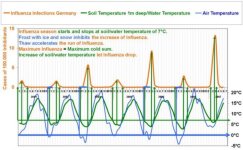
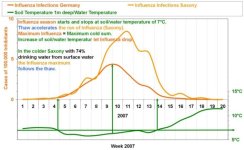
@gsgs: I attach 2 graphs to show that Influenza depends on environmental and e.g. water temperatures. So Influenza predominant will be transmitted by an abiotic vehicle like drinking water but not by biotic (warm) droplets.
... I had a look at the pictures
do you have the data in computer-readable form?
I'd like to have:
- influenza-cases
- temperature
- water-temperature
weekly for several towns.
@gsgs: I have my data in computer-readable form. I use soil and air temperatures from Erfurt as middle from Germany. For the overview this is sufficient because of the run in the area from Germany is very similar, shifted with 1 to 2?C.
Influenza-cases are available from http://www3.rki.de/SurvStat/
Air temperatures - daily and monthly - are available from http://www.dwd.de/de/FundE/Klima/KLIS/daten/online/nat/ausgabe_tageswerte.htm
http://www.dwd.de/de/FundE/Klima/KLIS/daten/online/nat/index_monatswerte.htm
Soil temperatures 1m deep I buy from DWD and calculate weekly and monthly data.
Water temperatures are very similar to soil temperatures 1m deep I show in my presentation.
If you like send me an Email an I send you my data (Excel) and my presentation.
Contact: soddemann-aachen@t-online.de
it should be possible to find out, whether air-temperature or water temperature is important.
@gsgs: Both ? but soil/water temperatures are more important. Please look for my graphs.
also flu spread is often within families, that doesn't support the water-spread theory ?!?
@gsgs: Influenza epidemics in Germany step to small extent as well as recognized in a cluster (9% of the cases in the violent season 2004/2005).
@ AlaskaDenise: Welcome too!
Please look for my graphs. Frost inhibits the increase of Influenza. I think thaw is important because of thaw water accelerate the zoonosis Influenza. Thaw occurs when the middle air temperature near the soil is > 0?C.
best regards
Dipl.-Ing. Wilfried Soddemann
contact: soddemann-aachen@t-online.de
@gsgs:
General recommendation is 1 yard distance should protect you from droplet infection.
nose/throat vs. saliva .... sneezing is mainly saliva, I think.
@gsgs: 1 yard is 0,9 m. I know this distance from 0,9 m for ?hard? droplets ? not for saliva. Influenza epidemics in Germany step to small extent as well as recognized in a cluster (9% of the cases in the violent season 2004/2005). I think human to human (and contact) transmission occur - but is overvalued immense.
@gsgs: Thanks for your links:
Review finds little evidence of airborne spread of flu
Maryn McKenna - Contributing Writer
Mar 13, 2007 (CIDRAP News)
http://www.cidrap.umn.edu/cidrap/con...7transmit.html
A rigorous review of research into influenza transmission concludes that the virus is overwhelmingly transmitted at close quarters, a finding that discounts the likelihood of airborne transmission and could have important implications for pandemic planning.
In the April 1 issue of Lancet Infectious Diseases, published online ahead of print, Gabrielle Brankston and colleagues of Toronto's University Health Network describe their evaluation of 32 experimental and observational studies that they sifted out of 2,012 citations addressing flu transmission in the English-language literature.
They come to two conclusions.
First, that despite more than 70 years' research, much of what is believed to be known about flu transmission is based on poorly structured studies or faulty interpretations of results. ?
risk evaluations
@gsgs: I think this is the crunch point: If H5N1 infects the upper respiratory system risk evaluations have to be updated. If H5N1 infects the upper respiratory system a very low dose of viruses is sufficient for infection I think ? like we know from the seasonal human influenza:
The link to seasonality of influenza, dependance on temperature, there had been discussion at effectmeasure
@gsgs: I attach 2 graphs to show that Influenza depends on environmental and e.g. water temperatures. So Influenza predominant will be transmitted by an abiotic vehicle like drinking water but not by biotic (warm) droplets.
... I had a look at the pictures
do you have the data in computer-readable form?
I'd like to have:
- influenza-cases
- temperature
- water-temperature
weekly for several towns.
@gsgs: I have my data in computer-readable form. I use soil and air temperatures from Erfurt as middle from Germany. For the overview this is sufficient because of the run in the area from Germany is very similar, shifted with 1 to 2?C.
Influenza-cases are available from http://www3.rki.de/SurvStat/
Air temperatures - daily and monthly - are available from http://www.dwd.de/de/FundE/Klima/KLIS/daten/online/nat/ausgabe_tageswerte.htm
http://www.dwd.de/de/FundE/Klima/KLIS/daten/online/nat/index_monatswerte.htm
Soil temperatures 1m deep I buy from DWD and calculate weekly and monthly data.
Water temperatures are very similar to soil temperatures 1m deep I show in my presentation.
If you like send me an Email an I send you my data (Excel) and my presentation.
Contact: soddemann-aachen@t-online.de
it should be possible to find out, whether air-temperature or water temperature is important.
@gsgs: Both ? but soil/water temperatures are more important. Please look for my graphs.
also flu spread is often within families, that doesn't support the water-spread theory ?!?
@gsgs: Influenza epidemics in Germany step to small extent as well as recognized in a cluster (9% of the cases in the violent season 2004/2005).
@ AlaskaDenise: Welcome too!
Please look for my graphs. Frost inhibits the increase of Influenza. I think thaw is important because of thaw water accelerate the zoonosis Influenza. Thaw occurs when the middle air temperature near the soil is > 0?C.
best regards
Dipl.-Ing. Wilfried Soddemann
contact: soddemann-aachen@t-online.de
Attachments
deadandalive
Well-known member
Re: H5N1 bird flu by drinking water ?
Re: H5N1 bird flu by drinking water ?
 From Wikipedia, the free encyclopedia
Jump to: navigation, search
Sodium percarbonate is an addition compound of sodium carbonate and hydrogen peroxide. It is a white crystalline water-soluble chemical compound. When dissolved into water, it releases H2O2 and soda ash (sodium carbonate):
Sodium percarbonate is effective as a disinfectant on both bacteria and viruses. New coating technologies have helped give sodium percarbonate stability levels similar to sodium perborate's in detergent formulations used at moderate temperatures
For its environmental advantages, sodium percarbonate is a good oxygen release chemical for agricultural and aquicultural applications
Re: H5N1 bird flu by drinking water ?
there must be other ways for disinfecting water other than boiling .in hydroponics hydrogen peroxide is used, creating oxigen and water as by products this is then repeated at intervals to inhibit fungus and virral threats. i wonder if their are set limits of time and concentrations to make safe drinking and bathing water.also i use a cheap form of oxidizing agent in my kitchen(sodium percarbonate)could this be used? Wilfred you are welcome to the flowers thanks for the musicSo using chlorine for disinfection is inadequate?
.
From Wikipedia, the free encyclopediaJump to: navigation, search
Sodium percarbonate is an addition compound of sodium carbonate and hydrogen peroxide. It is a white crystalline water-soluble chemical compound. When dissolved into water, it releases H2O2 and soda ash (sodium carbonate):
Sodium percarbonate is effective as a disinfectant on both bacteria and viruses. New coating technologies have helped give sodium percarbonate stability levels similar to sodium perborate's in detergent formulations used at moderate temperatures
For its environmental advantages, sodium percarbonate is a good oxygen release chemical for agricultural and aquicultural applications
Last edited:
wilfriedsoddemann
Active member
Re: H5N1 bird flu spread by drinking water ?
Hi deadandalive,
I propose ultra- or nanofiltration to eliminate viruses physical without chemicals.
best regards
Wilfried Soddemann
Hi deadandalive,
I propose ultra- or nanofiltration to eliminate viruses physical without chemicals.
best regards
Wilfried Soddemann
wilfriedsoddemann
Active member
Re: H5N1 bird flu by drinking water ?
Re: H5N1 bird flu by drinking water ?
Hi deadandalive, what's the meaning of "Wilfred you are welcome to the flowers thanks for the music From Wikipedia, the free encyclopedia
Jump to: navigation, search" ?
Can you give me the link?
best regards Wilfried.
Re: H5N1 bird flu by drinking water ?
Hi deadandalive, what's the meaning of "Wilfred you are welcome to the flowers thanks for the music From Wikipedia, the free encyclopedia
Jump to: navigation, search" ?
Can you give me the link?
best regards Wilfried.
wilfriedsoddemann
Active member
Re: H5N1 bird flu spread by drinking water ?
Hi Anne,
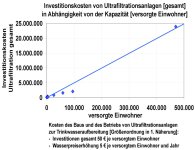
a public water supply ultrafiltration costs about 50 €/habitant (investment) and only about 3 - 7 €/year and habitant for 50 m³/year and habitant (3 € for a great plant for 500.000 people and 7 € for a little plant for 5.000 people).
best regards
Wilfried.
Hi Anne,
a public water supply ultrafiltration costs about 50 €/habitant (investment) and only about 3 - 7 €/year and habitant for 50 m³/year and habitant (3 € for a great plant for 500.000 people and 7 € for a little plant for 5.000 people).
best regards
Wilfried.
Attachments
Last edited:

gsgs
Registered User
Re: H5N1 bird flu spread by drinking water ?
hmm, water temperature is almost the same as air temperature
with a delay of 1-2 weeks.
Flu also needs some time to build up before you can see
the increase in the chart.
So it could also be air-temperature.
What about tropical countries like Brazil, HongKong ?
They still have significant flu and in Brazil it travels
equator -- south -- back each season, see recent paper.
hmm, water temperature is almost the same as air temperature
with a delay of 1-2 weeks.
Flu also needs some time to build up before you can see
the increase in the chart.
So it could also be air-temperature.
What about tropical countries like Brazil, HongKong ?
They still have significant flu and in Brazil it travels
equator -- south -- back each season, see recent paper.
deadandalive
Well-known member
Re: H5N1 bird flu by drinking water ?
Re: H5N1 bird flu by drinking water ?
 ref post 12 good to see your face wilfriedsoddemann
Re: H5N1 bird flu by drinking water ?
it could be my spelling and grammer or a zen koanHi deadandalive, what's the meaning of "Wilfred you are welcome to the flowers thanks for the music From Wikipedia, the free encyclopedia
Jump to: navigation, search" ?
Can you give me the link?
best regards Wilfried.
ref post 12 good to see your face wilfriedsoddemann
wilfriedsoddemann
Active member
Re: H5N1 bird flu spread by drinking water ?
Yes, you a right!
Wilfried.
Yes, you a right!
Wilfried.
wilfriedsoddemann
Active member
Re: H5N1 bird flu spread by drinking water ?
gsgs,
water temperature is not the same as air temperature. The maxima of cold have a delay of about 2 month. When water temperatur is 3°C air temperature was 2 month before 0°C/-4°C.
Wilfried.
gsgs,
water temperature is not the same as air temperature. The maxima of cold have a delay of about 2 month. When water temperatur is 3°C air temperature was 2 month before 0°C/-4°C.
Wilfried.
wilfriedsoddemann
Active member
Re: H5N1 bird flu spread by drinking water ?
http://www.china.org.cn/english/China/169243.htm
china.org.cn
Bird Flu Outbreaks Not over: Scientists
?
Unknown sources
Like most other scientists, Liu's anxiety comes from too many unknown factors about the H5N1 virus, especially how it infects people.
?
Between last October and February this year, China reported 35 bird flu outbreaks among domesticated chicken and ducks, which killed a total of 186,000. To curb its spread, 22.8 million birds were culled.
?
Since the first case of human infection was reported in Viet Nam in 2003, scientists believed humans could only be infected by having close contact with H5N1-infected poultry.
However, Jia admitted that of 15 confirmed human infections of the H5N1 bird flu in China between last October and March of this year, 11 became seriously ill in areas where no poultry bird flu outbreak had been recorded.
In the past two months, three new human infections were reported respectively in Sichuan Province, Guangzhou and Wuhan. Among the 18 total human infections in China, 12 lost their lives.
Jia explained that people may actually get infected by inhaling the air or saliva polluted with the H5N1 virus, drinking contaminated water or contacting the pollutants.
But the infections in metropolis areas further increase the mystery about the H5N1 virus, said Liu.
"How did the pollutants or H5N1-polluted water travel to cities from the epidemic outbreaks?
"It is not impossible that some poultry sold in the markets could still carry the virus without having shown any symptoms," Liu said.
His hypothesis seems to be confirmed by the finding of Guan Yi, a microbiologist at Hong Kong University.
Guan's research shows that in the six months leading to April, the H5N1 virus could be found in around 1 per cent of birds randomly seized in the markets in South China, even though they appeared healthy.
There may be a few factors causing this, such as insufficient vaccination, poor administration and low quality of vaccines, Guan explained.
?
Holding mutating virus
Although how H5N1 is transmitted between birds still remains unknown, scientists are concerned that H5N1 may mutate to cause human-to-human transmission. They are also worried whether current drugs and vaccines will be effective to curb its replication in human cells if that should occur.
A study headed by Thijs Kuiken of the Erasmus Medical Centre in the Netherlands indicated that human infection of H5N1 virus is currently low.
According to the study, H5N1 could begin to destroy human cells only when it reaches the lower parts of the lungs, but it is difficult for the virus to travel that far in the human respiratory system.
But James Stevens of Scripps University in the United States found that there is a protein called HA on the virus's outer surface mutates, it will enable the H5N1 to easily bind itself to human cells, making it easier for poultry to transmit the virus to humans, and perhaps for humans to transmit to other humans.
?
(China Daily May 24, 2006)
http://infectiousdiseases.about.com/od/birdtohuman/p/birdhumtransmis.htm
about.com: Infectious Diseases
How People Get Bird Flu
?
Contaminated Water: H5N1 virus remains alive in water for several days, even up to a month or longer in cooler waters (and perhaps even longer at refrigerator temperatures). Wild birds, such as ducks, excrete large amounts of H5N1 virus in their faeces even when they show no signs of being ill. Public drinking water from bodies of water could become contaminated.
There's still no known mechanism for contracting bird flu via the gastrointestinal tract, meaning no one knows if you can really get bird flu by eating or drinking the virus. However, the possibility exists and hasn't been discarded.
Contaminated Sewage: There is not any evidence that humans have been infected by bird flu through sewage, but there is potential for infection via this route. Faeces from infected humans contain H5N1 virus. H5N1 remains alive and well in wet faeces and water for several days depending on various factors such as the temperature of the environment. Sewage used for the irrigation of crops or dumped into bodies or water that is then used for bathing or drinking water are some modes of human contact with sewage.
?
Sources:
? World Health Organization. Review of latest available evidence of risk to human health through potential transmission of avian influenza (H5N1) through water and sewage. Last updated March 24, 2006. See text: http://www.who.int/water_sanitation_health/emerging/h5n1background.pdf
? World Health Organization. Avian Influenza, Assessing the Pandemic Threat. January, 2005. See text: http://www.who.int/csr/disease/influenza/H5N1-9reduit.pdf
? United States Department of Agriculture. Avian Influenza Factsheet. Release 0092.06. United States Prepares for Highly Pathogenic (H5N1) Avian Influenza in Wild Birds. Last modified March 20, 2006.
? United States PandemicFlu.gov. Questions and Answers about Wild Birds.
? United States Department of Agriculture. Animal and Plant Health Inspection Service. List of Countries Affected by Highly Pathogenic Avian Influenza Subtype H5N1.
Updated: January 19, 2007
http://jvi.asm.org/cgi/reprint/78/9/4892.pdf
JOURNAL OF VIROLOGY, May 2004, p. 4892?4901 Vol. 78, No. 9
0022-538X/04/$08.00_0 DOI: 10.1128/JVI.78.9.4892?4901.2004
Copyright ? 2004, American Society for Microbiology. All Rights Reserved.
Reemerging H5N1 Influenza Viruses in Hong Kong in 2002 Are Highly Pathogenic to Ducks
Katharine M. Sturm-Ramirez,1 Trevor Ellis,2 Barry Bousfield,3 Lucy Bissett,2 Kitman Dyrting,2 Jerold E. Rehg,4 Leo Poon,5 Yi Guan,5 Malik Peiris,5 and Robert G. Webster1,6*
Division of Virology, Department of Infectious Diseases,1 and Department of Pathology,4 St. Jude Children?s Research Hospital, and Department of Pathology, University of Tennessee,6 Memphis, Tennessee, and Department of Agriculture, Fisheries and Conservation, Tai Lung Veterinary Laboratory,2 Veterinary Section, Leisure and Cultural Service Department, Hong Kong Zoological and Botanical Gardens,3 and Department of Microbiology, University of Hong Kong,5 Hong Kong Special Administrative Region, People?s Republic of China
Received 28 August 2003/Accepted 29 December 2003
Waterfowl are the natural reservoir of all influenza A viruses, which are usually nonpathogenic in wild aquatic birds. However, in late 2002, outbreaks of highly pathogenic H5N1 influenza virus caused deaths among wild migratory birds and resident waterfowl, including ducks, in two Hong Kong parks. In February 2003, an avian H5N1 virus closely related to one of these viruses was isolated from two humans with acute respiratory distress, one of whom died. Antigenic analysis of the new avian isolates showed a reactivity pattern different from that of H5N1 viruses isolated in 1997 and 2001. This finding suggests that significant antigenic variation has recently occurred among H5N1 viruses. We inoculated mallards with antigenically different H5N1 influenza viruses isolated between 1997 and 2003. The new 2002 avian isolates caused systemic infection in the ducks, with high virus titers and pathology in multiple organs, particularly the brain. Ducks developed acute disease, including severe neurological dysfunction and death. Virus was also isolated at high titers from the birds? drinking water and from contact birds, demonstrating efficient transmission. In contrast, H5N1 isolates from 1997 and 2001 were not consistently transmitted efficiently among ducks and did not cause significant disease. Despite a high level of genomic homology, the human isolate showed striking biological differences from its avian homologue in a duck model. This is the first reported case of lethal influenza virus infection in wild aquatic birds since 1961.
http://yosemite.epa.gov/opa/admpres...c56fd2fe51f53b0d8525713b00780b79!OpenDocument
EPA Newsroom
24.03.2006
As Prepared for Administrator Johnson, Governor?s Summit: Utah Plans for Pandemic Influenza, Salt Lake City, UT
?
EPA?s plans and preparations for the arrival of the H5N1 strain of highly pathogenic avian influenza virus are an extension of the Agency?s core mission. As part of EPA?s normal statutory responsibilities, we routinely advise our state and local partners on issues such as disposal and decontamination options, as well as the safety of drinking water supplies. As America prepares for avian flu and the potential for a human pandemic, EPA is preparing to support our partners on a national scale.
?
Access to EPA?s technical assistance on disposal and decontamination issues during an outbreak will be channeled through EPA?s Emergency Operations Center. For example, in the area of disposal, this technical assistance would include scientific advice that could take into account environmental conditions such as proximity to water bodies, streams or wells, physical conditions like soil type and depth, and other factors like weather, the distance required for disposal, the disposal volume, and the potential for secondary environmental impacts such as odors.
?
EPA has been tasked by the President to serve as the lead federal agency for the nation?s critical water sector. EPA routinely provides our state and local partners with technical assistance and advice in matters regarding the health and safety of their residents? drinking water. EPA is prepared to support our partners during an avian influenza outbreak by providing expertise regarding surface and ground waters, and the effectiveness of drinking water treatment.
?
http://www.china.org.cn/english/China/169243.htm
china.org.cn
Bird Flu Outbreaks Not over: Scientists
?
Unknown sources
Like most other scientists, Liu's anxiety comes from too many unknown factors about the H5N1 virus, especially how it infects people.
?
Between last October and February this year, China reported 35 bird flu outbreaks among domesticated chicken and ducks, which killed a total of 186,000. To curb its spread, 22.8 million birds were culled.
?
Since the first case of human infection was reported in Viet Nam in 2003, scientists believed humans could only be infected by having close contact with H5N1-infected poultry.
However, Jia admitted that of 15 confirmed human infections of the H5N1 bird flu in China between last October and March of this year, 11 became seriously ill in areas where no poultry bird flu outbreak had been recorded.
In the past two months, three new human infections were reported respectively in Sichuan Province, Guangzhou and Wuhan. Among the 18 total human infections in China, 12 lost their lives.
Jia explained that people may actually get infected by inhaling the air or saliva polluted with the H5N1 virus, drinking contaminated water or contacting the pollutants.
But the infections in metropolis areas further increase the mystery about the H5N1 virus, said Liu.
"How did the pollutants or H5N1-polluted water travel to cities from the epidemic outbreaks?
"It is not impossible that some poultry sold in the markets could still carry the virus without having shown any symptoms," Liu said.
His hypothesis seems to be confirmed by the finding of Guan Yi, a microbiologist at Hong Kong University.
Guan's research shows that in the six months leading to April, the H5N1 virus could be found in around 1 per cent of birds randomly seized in the markets in South China, even though they appeared healthy.
There may be a few factors causing this, such as insufficient vaccination, poor administration and low quality of vaccines, Guan explained.
?
Holding mutating virus
Although how H5N1 is transmitted between birds still remains unknown, scientists are concerned that H5N1 may mutate to cause human-to-human transmission. They are also worried whether current drugs and vaccines will be effective to curb its replication in human cells if that should occur.
A study headed by Thijs Kuiken of the Erasmus Medical Centre in the Netherlands indicated that human infection of H5N1 virus is currently low.
According to the study, H5N1 could begin to destroy human cells only when it reaches the lower parts of the lungs, but it is difficult for the virus to travel that far in the human respiratory system.
But James Stevens of Scripps University in the United States found that there is a protein called HA on the virus's outer surface mutates, it will enable the H5N1 to easily bind itself to human cells, making it easier for poultry to transmit the virus to humans, and perhaps for humans to transmit to other humans.
?
(China Daily May 24, 2006)
http://infectiousdiseases.about.com/od/birdtohuman/p/birdhumtransmis.htm
about.com: Infectious Diseases
How People Get Bird Flu
?
Contaminated Water: H5N1 virus remains alive in water for several days, even up to a month or longer in cooler waters (and perhaps even longer at refrigerator temperatures). Wild birds, such as ducks, excrete large amounts of H5N1 virus in their faeces even when they show no signs of being ill. Public drinking water from bodies of water could become contaminated.
There's still no known mechanism for contracting bird flu via the gastrointestinal tract, meaning no one knows if you can really get bird flu by eating or drinking the virus. However, the possibility exists and hasn't been discarded.
Contaminated Sewage: There is not any evidence that humans have been infected by bird flu through sewage, but there is potential for infection via this route. Faeces from infected humans contain H5N1 virus. H5N1 remains alive and well in wet faeces and water for several days depending on various factors such as the temperature of the environment. Sewage used for the irrigation of crops or dumped into bodies or water that is then used for bathing or drinking water are some modes of human contact with sewage.
?
Sources:
? World Health Organization. Review of latest available evidence of risk to human health through potential transmission of avian influenza (H5N1) through water and sewage. Last updated March 24, 2006. See text: http://www.who.int/water_sanitation_health/emerging/h5n1background.pdf
? World Health Organization. Avian Influenza, Assessing the Pandemic Threat. January, 2005. See text: http://www.who.int/csr/disease/influenza/H5N1-9reduit.pdf
? United States Department of Agriculture. Avian Influenza Factsheet. Release 0092.06. United States Prepares for Highly Pathogenic (H5N1) Avian Influenza in Wild Birds. Last modified March 20, 2006.
? United States PandemicFlu.gov. Questions and Answers about Wild Birds.
? United States Department of Agriculture. Animal and Plant Health Inspection Service. List of Countries Affected by Highly Pathogenic Avian Influenza Subtype H5N1.
Updated: January 19, 2007
http://jvi.asm.org/cgi/reprint/78/9/4892.pdf
JOURNAL OF VIROLOGY, May 2004, p. 4892?4901 Vol. 78, No. 9
0022-538X/04/$08.00_0 DOI: 10.1128/JVI.78.9.4892?4901.2004
Copyright ? 2004, American Society for Microbiology. All Rights Reserved.
Reemerging H5N1 Influenza Viruses in Hong Kong in 2002 Are Highly Pathogenic to Ducks
Katharine M. Sturm-Ramirez,1 Trevor Ellis,2 Barry Bousfield,3 Lucy Bissett,2 Kitman Dyrting,2 Jerold E. Rehg,4 Leo Poon,5 Yi Guan,5 Malik Peiris,5 and Robert G. Webster1,6*
Division of Virology, Department of Infectious Diseases,1 and Department of Pathology,4 St. Jude Children?s Research Hospital, and Department of Pathology, University of Tennessee,6 Memphis, Tennessee, and Department of Agriculture, Fisheries and Conservation, Tai Lung Veterinary Laboratory,2 Veterinary Section, Leisure and Cultural Service Department, Hong Kong Zoological and Botanical Gardens,3 and Department of Microbiology, University of Hong Kong,5 Hong Kong Special Administrative Region, People?s Republic of China
Received 28 August 2003/Accepted 29 December 2003
Waterfowl are the natural reservoir of all influenza A viruses, which are usually nonpathogenic in wild aquatic birds. However, in late 2002, outbreaks of highly pathogenic H5N1 influenza virus caused deaths among wild migratory birds and resident waterfowl, including ducks, in two Hong Kong parks. In February 2003, an avian H5N1 virus closely related to one of these viruses was isolated from two humans with acute respiratory distress, one of whom died. Antigenic analysis of the new avian isolates showed a reactivity pattern different from that of H5N1 viruses isolated in 1997 and 2001. This finding suggests that significant antigenic variation has recently occurred among H5N1 viruses. We inoculated mallards with antigenically different H5N1 influenza viruses isolated between 1997 and 2003. The new 2002 avian isolates caused systemic infection in the ducks, with high virus titers and pathology in multiple organs, particularly the brain. Ducks developed acute disease, including severe neurological dysfunction and death. Virus was also isolated at high titers from the birds? drinking water and from contact birds, demonstrating efficient transmission. In contrast, H5N1 isolates from 1997 and 2001 were not consistently transmitted efficiently among ducks and did not cause significant disease. Despite a high level of genomic homology, the human isolate showed striking biological differences from its avian homologue in a duck model. This is the first reported case of lethal influenza virus infection in wild aquatic birds since 1961.
http://yosemite.epa.gov/opa/admpres...c56fd2fe51f53b0d8525713b00780b79!OpenDocument
EPA Newsroom
24.03.2006
As Prepared for Administrator Johnson, Governor?s Summit: Utah Plans for Pandemic Influenza, Salt Lake City, UT
?
EPA?s plans and preparations for the arrival of the H5N1 strain of highly pathogenic avian influenza virus are an extension of the Agency?s core mission. As part of EPA?s normal statutory responsibilities, we routinely advise our state and local partners on issues such as disposal and decontamination options, as well as the safety of drinking water supplies. As America prepares for avian flu and the potential for a human pandemic, EPA is preparing to support our partners on a national scale.
?
Access to EPA?s technical assistance on disposal and decontamination issues during an outbreak will be channeled through EPA?s Emergency Operations Center. For example, in the area of disposal, this technical assistance would include scientific advice that could take into account environmental conditions such as proximity to water bodies, streams or wells, physical conditions like soil type and depth, and other factors like weather, the distance required for disposal, the disposal volume, and the potential for secondary environmental impacts such as odors.
?
EPA has been tasked by the President to serve as the lead federal agency for the nation?s critical water sector. EPA routinely provides our state and local partners with technical assistance and advice in matters regarding the health and safety of their residents? drinking water. EPA is prepared to support our partners during an avian influenza outbreak by providing expertise regarding surface and ground waters, and the effectiveness of drinking water treatment.
?
wilfriedsoddemann
Active member
H5N1 INFLUENZA TRIGGER DRINKING WATER
H5N1 INFLUENZA TRIGGER DRINKING WATER
Attached you find my article
< Influenza: Primary - initial - spread triggered by the abiotic vehicle ?cold drinking water? - Trigger of human influenza epidemics by the ?warm biotic droplet infection? improbably >.
Please read it and answer your opinion to me.
Thank you!
best regards
Wilfried Soddemann
H5N1 INFLUENZA TRIGGER DRINKING WATER
Attached you find my article
< Influenza: Primary - initial - spread triggered by the abiotic vehicle ?cold drinking water? - Trigger of human influenza epidemics by the ?warm biotic droplet infection? improbably >.
Please read it and answer your opinion to me.
Thank you!
best regards
Wilfried Soddemann
Attachments
deadandalive
Well-known member
Re: H5N1 INFLUENZA TRIGGER DRINKING WATER
Re: H5N1 INFLUENZA TRIGGER DRINKING WATER
Re: H5N1 INFLUENZA TRIGGER DRINKING WATER
sorry that my veiws are only from a layman, your article could explain a major role of drinking water in flu transmision and could fill a large gap in our knoledge of how and when flu occurs,it seems simple and it maybe so ,i look forward to more evidence.in regard to the concerns you have raised in my mind,i will set my boiler to 80;c and will not use cold water during a pandemic .:tiphatAttached you find my article
< Influenza: Primary - initial - spread triggered by the abiotic vehicle ?cold drinking water? - Trigger of human influenza epidemics by the ?warm biotic droplet infection? improbably >.
Please read it and answer your opinion to me.
Thank you!
best regards
Wilfried Soddemann
Ganseerpel
Advisory Board, Senior Moderator
Re: H5N1 bird flu spread by drinking water ?
Noboby contests the fact that AI can be transmitted by contaminated water. But the question is, if drinking water is a substantial way of transmission. Does it play a role?
Infection dose is not a completely unknown issue as you are trying to say. Even if for many strains there ist unsufficient data available, we have enough precise data shaping the order of what we are talking about.
The doses rerquired for a 50 % Infection probability are roughly in the order of
10 to 10<sup>6</sup> EID(or TCID) corresponding to virus concentrations which can be easily identified (even in the order 2 - 3 orders beneath).
In this whole debate we should not forget the most important: When there is a precise source focussed, you have first to identify the agens, So: Where is the evidence of virus presence in drinking water, wherever in the world?<o ></o>
></o>
<o> </o>
Secondly nobody contests that AI virus is better conserved in cold, humid ambiente. This having been said, the arguments apply to all other possible sources, fomites etc. ein particular as to viru conservation in aerosols.
And: Virus concentration in aerosols is supposed to be higher than in drinking water. <o></o>
<o> </o>
The third question is, how long time does it take for virus to get from the droplet to the water tape outlet? Even if we hypothesize several weeks, how long does it take? How much of infective virus is alive and infective at the endpoint of this trip? <o></o>
Noboby contests the fact that AI can be transmitted by contaminated water. But the question is, if drinking water is a substantial way of transmission. Does it play a role?
Infection dose is not a completely unknown issue as you are trying to say. Even if for many strains there ist unsufficient data available, we have enough precise data shaping the order of what we are talking about.
The doses rerquired for a 50 % Infection probability are roughly in the order of
10 to 10<sup>6</sup> EID(or TCID) corresponding to virus concentrations which can be easily identified (even in the order 2 - 3 orders beneath).
In this whole debate we should not forget the most important: When there is a precise source focussed, you have first to identify the agens, So: Where is the evidence of virus presence in drinking water, wherever in the world?<o
></o><o
> </o>Secondly nobody contests that AI virus is better conserved in cold, humid ambiente. This having been said, the arguments apply to all other possible sources, fomites etc. ein particular as to viru conservation in aerosols.
And: Virus concentration in aerosols is supposed to be higher than in drinking water. <o
></o><o
> </o>The third question is, how long time does it take for virus to get from the droplet to the water tape outlet? Even if we hypothesize several weeks, how long does it take? How much of infective virus is alive and infective at the endpoint of this trip? <o
></o>
Last edited:

AlaskaDenise
In Memoriam
H5N1 bird flu spread by drinking water ?
CINCINNATI ? A sub-type (H5N1) of the highly pathogenic avian influenza virus is ?readily inactivated? by chlorination of drinking water, according to a new study, as first reported September 7 on Effect Measure, a health-related Web site.
Researchers from the US Environmental Protection Agency (EPA), the University of Georgia (Athens, GA) and US Department of Agriculture (USDA) found that the maintenance of a free chlorine residual of 0.52 to 1.08 milligrams per liter (mg/L) was sufficient to inactivate the virus by greater than three orders of magnitude within an exposure time of one minute, according to the study. They noted that EPA specifications for public water supplies that the free chlorine residual values be 6 to 8 mg/L per minute would be ?more than sufficient? to inactivate H5N1 in the water environment.
The study was conducted by Eugene W. Rice, Noreen J. Adcock and Mano Sivaganesan of EPA?s Cincinnati office; Justin D. Brown and David E. Stallknecht of the University of Georgia; and David E. Swayne of the USDA. It is slated for publication in the October issue of Emerging Infectious Diseases, a journal published by the US Centers for Disease Control and Prevention.
Wild waterfowl spread the potentially deadly avian flu virus through their feces to poultry, and surface waters and potentially groundwaters can contain the virus, the researchers noted.
The World Health Organization, concerned about its potential to spread to humans, has sought more information about the effectiveness of its inactivation.
The study can be accessed directly by clicking here.
http://www.watertechonline.com/news.asp?N_ID=68139
CINCINNATI ? A sub-type (H5N1) of the highly pathogenic avian influenza virus is ?readily inactivated? by chlorination of drinking water, according to a new study, as first reported September 7 on Effect Measure, a health-related Web site.
Researchers from the US Environmental Protection Agency (EPA), the University of Georgia (Athens, GA) and US Department of Agriculture (USDA) found that the maintenance of a free chlorine residual of 0.52 to 1.08 milligrams per liter (mg/L) was sufficient to inactivate the virus by greater than three orders of magnitude within an exposure time of one minute, according to the study. They noted that EPA specifications for public water supplies that the free chlorine residual values be 6 to 8 mg/L per minute would be ?more than sufficient? to inactivate H5N1 in the water environment.
The study was conducted by Eugene W. Rice, Noreen J. Adcock and Mano Sivaganesan of EPA?s Cincinnati office; Justin D. Brown and David E. Stallknecht of the University of Georgia; and David E. Swayne of the USDA. It is slated for publication in the October issue of Emerging Infectious Diseases, a journal published by the US Centers for Disease Control and Prevention.
Wild waterfowl spread the potentially deadly avian flu virus through their feces to poultry, and surface waters and potentially groundwaters can contain the virus, the researchers noted.
The World Health Organization, concerned about its potential to spread to humans, has sought more information about the effectiveness of its inactivation.
The study can be accessed directly by clicking here.
http://www.watertechonline.com/news.asp?N_ID=68139
wilfriedsoddemann
Active member
Re: H5N1 bird flu spread by drinking water ?
Rice EW, Adcock NJ, Sivaganesan M, Brown JD, Stallknecht DE, Swayne DE.
Chlorine inactivation of highly pathogenic avian influenza virus (H5N1).
Emerg Infect Dis. 2007 Oct; [Epub ahead of print]:
?? Briefly, virus-infected allantoic fluid was diluted (1:1,000) into continuously stirred, chlorinated, chlorine demand?free phosphate buffer (0.05 M, pH 7.0 and 8.0). ? To slow the rate of inactivation, experiments were conducted at 5 ?C. ??
?Ct (Ct value is the chlorine concentration, C [mg/L], multiplied by the exposure time, t [min]) apply to microorganisms in suspension, not embedded in particles.? [GUIDELINES FOR DRINKING-WATER QUALITY, 7. MICROBIAL ASPECTS, 7.3.2 Treatment, Table 7.6, footnote].
In (drinking-) water H5N1 viruses are embedded in particles and drinking-water may be colder than 5 ?C and the pH often is > 8.0, perhaps 9.5 ?
Inactivates chlorination in practice and under all conditions avian flu strains, flu viruses embedded in particles, water pH 9.5, water temperature at 3 ?C ? ?
Dipl.-Ing. Wilfried Soddemann
soddemann-aachen@t-online.de

CINCINNATI ? A sub-type (H5N1) of the highly pathogenic avian influenza virus is ?readily inactivated? by chlorination of drinking water, according to a new study, as first reported September 7 on Effect Measure, a health-related Web site.
Researchers from the US Environmental Protection Agency (EPA), the University of Georgia (Athens, GA) and US Department of Agriculture (USDA) found that the maintenance of a free chlorine residual of 0.52 to 1.08 milligrams per liter (mg/L) was sufficient to inactivate the virus by greater than three orders of magnitude within an exposure time of one minute, according to the study. They noted that EPA specifications for public water supplies that the free chlorine residual values be 6 to 8 mg/L per minute would be ?more than sufficient? to inactivate H5N1 in the water environment.
The study was conducted by Eugene W. Rice, Noreen J. Adcock and Mano Sivaganesan of EPA?s Cincinnati office; Justin D. Brown and David E. Stallknecht of the University of Georgia; and David E. Swayne of the USDA. It is slated for publication in the October issue of Emerging Infectious Diseases, a journal published by the US Centers for Disease Control and Prevention.
Wild waterfowl spread the potentially deadly avian flu virus through their feces to poultry, and surface waters and potentially groundwaters can contain the virus, the researchers noted.
The World Health Organization, concerned about its potential to spread to humans, has sought more information about the effectiveness of its inactivation.
The study can be accessed directly by clicking here.
http://www.watertechonline.com/news.asp?N_ID=68139
Rice EW, Adcock NJ, Sivaganesan M, Brown JD, Stallknecht DE, Swayne DE.
Chlorine inactivation of highly pathogenic avian influenza virus (H5N1).
Emerg Infect Dis. 2007 Oct; [Epub ahead of print]:
?? Briefly, virus-infected allantoic fluid was diluted (1:1,000) into continuously stirred, chlorinated, chlorine demand?free phosphate buffer (0.05 M, pH 7.0 and 8.0). ? To slow the rate of inactivation, experiments were conducted at 5 ?C. ??
?Ct (Ct value is the chlorine concentration, C [mg/L], multiplied by the exposure time, t [min]) apply to microorganisms in suspension, not embedded in particles.? [GUIDELINES FOR DRINKING-WATER QUALITY, 7. MICROBIAL ASPECTS, 7.3.2 Treatment, Table 7.6, footnote].
In (drinking-) water H5N1 viruses are embedded in particles and drinking-water may be colder than 5 ?C and the pH often is > 8.0, perhaps 9.5 ?
Inactivates chlorination in practice and under all conditions avian flu strains, flu viruses embedded in particles, water pH 9.5, water temperature at 3 ?C ? ?
Dipl.-Ing. Wilfried Soddemann
soddemann-aachen@t-online.de

Gert van der Hoek
In Memoriam - Editor, Senior Moderator
Re: H5N1 bird flu spread by drinking water ?
Bird Flu Virus Killed in Chlorinated Drinking Water, Study Says
By Jason Gale
Oct. 1 (Bloomberg) -- Bird flu is killed by chlorine and concentrations of the disinfectant typically used in drinking water make the lethal virus inactive, a new study found.
Scientists from the U.S. Environmental Protection Agency in Cincinnati found chlorinating water at a concentration of 0.52 milligrams to 1.08 milligrams of chlorine per liter lowered levels of the H5N1 strain of avian influenza virus by more than 1,000 times within 1 minute.
The chlorine concentration is less than recommended by the agency for disinfecting drinking water. Treating water at the recommended level ``would be more than sufficient to inactivate'' the H5N1 virus in the water, the scientists said in a study published in this month's Emerging Infectious Diseases journal.
The findings may help governments develop risk management procedures regarding the role of water in the transmission of the virus to humans and poultry, the authors said. World health officials say the H5N1 flu virus, which has killed at least 200 people during the past four years, may spark a global outbreak if it mutates to become as infectious to humans as seasonal flu.
The highly pathogenic H5N1 avian flu virus has been collected from more than 50 different species of wild birds since 2002. Experiments show waterfowl can shed the virus in feces and respiratory secretions, the study found.
Open bodies of water, including drinking water reservoirs, can become contaminated by birds that are actively spreading the virus or by waterfowl carcasses, the authors said.
``Surface runoff also represents a potential source of contamination for groundwater,'' they said. ``In terms of avian health, drinking water has been implicated in the transmission of avian influenza among domestic poultry.''
Studies by scientists at Cornell University on a low- pathogenic H5N2 avian flu virus found water treatments, including chlorination, ultraviolet radiation and bacterial digesters, killed the microbes.
To contact the reporter on this story: Jason Gale in Singapore at j.gale@bloomberg.net
Last Updated: September 30, 2007 23:45 EDT
http://www.bloomberg.com/apps/news?pid=20601202&sid=aLQT4OzNGHcE&refer=healthcare
Bird Flu Virus Killed in Chlorinated Drinking Water, Study Says
By Jason Gale
Oct. 1 (Bloomberg) -- Bird flu is killed by chlorine and concentrations of the disinfectant typically used in drinking water make the lethal virus inactive, a new study found.
Scientists from the U.S. Environmental Protection Agency in Cincinnati found chlorinating water at a concentration of 0.52 milligrams to 1.08 milligrams of chlorine per liter lowered levels of the H5N1 strain of avian influenza virus by more than 1,000 times within 1 minute.
The chlorine concentration is less than recommended by the agency for disinfecting drinking water. Treating water at the recommended level ``would be more than sufficient to inactivate'' the H5N1 virus in the water, the scientists said in a study published in this month's Emerging Infectious Diseases journal.
The findings may help governments develop risk management procedures regarding the role of water in the transmission of the virus to humans and poultry, the authors said. World health officials say the H5N1 flu virus, which has killed at least 200 people during the past four years, may spark a global outbreak if it mutates to become as infectious to humans as seasonal flu.
The highly pathogenic H5N1 avian flu virus has been collected from more than 50 different species of wild birds since 2002. Experiments show waterfowl can shed the virus in feces and respiratory secretions, the study found.
Open bodies of water, including drinking water reservoirs, can become contaminated by birds that are actively spreading the virus or by waterfowl carcasses, the authors said.
``Surface runoff also represents a potential source of contamination for groundwater,'' they said. ``In terms of avian health, drinking water has been implicated in the transmission of avian influenza among domestic poultry.''
Studies by scientists at Cornell University on a low- pathogenic H5N2 avian flu virus found water treatments, including chlorination, ultraviolet radiation and bacterial digesters, killed the microbes.
To contact the reporter on this story: Jason Gale in Singapore at j.gale@bloomberg.net
Last Updated: September 30, 2007 23:45 EDT
http://www.bloomberg.com/apps/news?pid=20601202&sid=aLQT4OzNGHcE&refer=healthcare

Sally Furniss
Well-known member
Re: H5N1 bird flu spread by drinking water ?
Bird Flu Virus Killed in Chlorinated Drinking Water, Study Says
Bird Flu Virus Killed in Chlorinated Drinking Water, Study Says
Bird Flu Virus Killed in Chlorinated Drinking Water, Study Says
By Jason Gale
Oct. 1 (Bloomberg) -- Bird flu is killed by chlorine and concentrations of the disinfectant typically used in drinking water make the lethal virus inactive, a new study found.
Scientists from the U.S. Environmental Protection Agency in Cincinnati found chlorinating water at a concentration of 0.52 milligrams to 1.08 milligrams of chlorine per liter lowered levels of the H5N1 strain of avian influenza virus by more than 1,000 times within 1 minute.
The chlorine concentration is less than recommended by the agency for disinfecting drinking water. Treating water at the recommended level ``would be more than sufficient to inactivate'' the H5N1 virus in the water, the scientists said in a study published in this month's Emerging Infectious Diseases journal.
The findings may help governments develop risk management procedures regarding the role of water in the transmission of the virus to humans and poultry, the authors said. World health officials say the H5N1 flu virus, which has killed at least 200 people during the past four years, may spark a global outbreak if it mutates to become as infectious to humans as seasonal flu.
The highly pathogenic H5N1 avian flu virus has been collected from more than 50 different species of wild birds since 2002. Experiments show waterfowl can shed the virus in feces and respiratory secretions, the study found.
Open bodies of water, including drinking water reservoirs, can become contaminated by birds that are actively spreading the virus or by waterfowl carcasses, the authors said.
``Surface runoff also represents a potential source of contamination for groundwater,'' they said. `In terms of avian health, drinking water has been implicated in the transmission of avian influenza among domestic poultry.''
Studies by scientists at Cornell University on a low- pathogenic H5N2 avian flu virus found water treatments, including chlorination, ultraviolet radiation and bacterial digesters, killed the microbes.
To contact the reporter on this story: Jason Gale in Singapore at j.gale@bloomberg.net
Last Updated: September 30, 2007 23:45 EDT
http://www.bloomberg.com/apps/news?pid=20601202&sid=aLQT4OzNGHcE&refer=healthcare