• FluTrackers.com Inc. does not provide medical advice. Information on this web site is collected from various internet resources, and the FluTrackers board of directors makes no warranty to the safety, efficacy, correctness or completeness of the information posted on this site by any author or poster. The information collated here is for instructional and/or discussion purposes only and is NOT intended to diagnose or treat any disease, illness, or other medical condition. Every individual reader or poster should seek advice from their personal physician/healthcare practitioner before considering or using any interventions that are discussed on this website. By continuing to access this website you agree to consult your personal physican before using any interventions posted on this website, and you agree to hold harmless FluTrackers.com Inc., the board of directors, the members, and all authors and posters for any effects from use of any medication, supplement, vitamin or other substance, device, intervention, etc. mentioned in posts on this website, or other internet venues referenced in posts on this website.
  • We are not asking for any donations. Do not donate to any entity who says they are raising funds for us.

H1N1 Spread Declining in NYC (with Hospital Statistics)

appleblossom

Senior Moderator
From the NYC Department of Health Website:

FOR IMMEDIATE RELEASE
Press Release # 042-09
Friday, June 12, 2009

CONTACT: (212) 788-5290
Jessica Scaperotti/Erin Brady: PressOffice@health.nyc.gov


Community Transmission of H1N1 Flu Appears to Decline in New York City

80% of New Yorkers hospitalized for H1N1 flu have had at least one known risk factor for severe illness; Health Department confirms one additional death, bringing city?s total to 16.


June 12, 2009 ? Community transmission of the H1N1 virus appears to be declining in New York City, as emergency departments report lower numbers of visits due to influenza-like illness, the Health Department reported today. As expected, however, hospitalizations and fatalities continue to occur. As of June 11, the Health Department had recorded 567 hospitalizations and 16 deaths. The latest death occurred in a person aged 40-49.*

As the charts on the next page illustrate, emergency-department visits for flu-like illness surged during May, reaching a peak on May 25, but have since declined markedly. Hospital admissions for H1N1 influenza have also declined ? after peaking on May 27. "The Health Department monitors influenza-like illness every day in New York City," said Dr. Thomas Farley, New York City Health Commissioner. "While every hospitalization is concerning and every death is a tragedy, our surveillance data indicate that the number of people newly infected is declining."

Of the 16 New York City deaths attributed to H1N1 flu, 14 have occurred in people under 65, and 12 of the decedents (75%) have had an established underlying risk factor (PDF) for developing severe influenza or complications. All four of the others have been obese, a condition that is not a known risk factor for severe illness but which could potentially increase the risk of complications from flu. Further study is needed to evaluate this finding.

The hospitalized patients have been younger than those who normally experience severe illness during a seasonal flu outbreak. Some 79% of the hospitalized patients have been younger than 50. Nearly half (46%) have been younger than 18, and 20% have been under 5. Only 5% of New Yorkers hospitalized with H1N1 have been 65 or older. Residents from all five boroughs have been hospitalized, with the majority of hospitalizations occurring in residents of Brooklyn (32%) and the Bronx (29%), followed by Queens (23%), Manhattan (14%) and Staten Island (2%).

Of the 567 hospitalizations, 80% of the patients had at least one known risk factor for severe illness or complications due to influenza. The most common risk factor is asthma, which has been found in 41% of all confirmed hospitalized cases. Other important risk factors include pregnancy (noted in 28% of the 142 women of childbearing age hospitalized for confirmed H1N1), age less than 2 years (12%), diabetes (11%), weakened immunity (9%), and cardiovascular disease (9%).

While most of the influenza now circulating in New York City is H1N1, seasonal flu is still present at low levels. The Health Department's Public Health Laboratory identified seasonal flu in 10% of all flu samples tested during this outbreak.


Earlier this week, the Health Department released preliminary findings from a household survey suggesting that 6.9% of New Yorkers may have experienced flu-like illness between May 1 and May 20. The city-wide survey, conducted by telephone from May 21 through May 27, found that overall prevalence of reported flu-like illness was highest in Queens, where 9.4% of respondents reported symptoms, and Brooklyn (8.9%), followed by Staten Island (4.2%), Manhattan (3.7%) and the Bronx (3.6%). Queens also reported the most influenza-like illness among children, with 16% of those affected being under the age of 18. While not all those with flu-like illness had H1N1 influenza, these results suggest that H1N1 infections were common at that time, especially in Queens and Brooklyn.


Symptoms of H1N1 (SO) include fever, cough, sore throat, body aches, headache, chills and fatigue. Some people have reported diarrhea and vomiting as well. Any New Yorker experiencing severe symptoms, such as difficulty breathing, should seek immediate health care and treatment. New Yorkers with an underlying health condition should immediately call their doctor if they experience flu-like illness, or come into contact with someone who has the flu.

Actions that anyone can take to slow the spread of influenza:
? Cover your mouth when you cough with your sleeve or a tissue or handkerchief.
? Wash your hands often with soap and water, especially after you cough or sneeze. Alcohol-based hand cleaners are also effective.
? Try to avoid close contact with sick people.
? If you are sick with fever and either a cough or sore throat, stay home for at least 24 hours after all of your symptoms are gone.
? Stay away from clinics and hospitals unless you have severe symptoms, and notify your doctor or the clinic before, or as soon as you arrive, that you have a fever and respiratory systems so that you can be appropriately isolated from others.


Link to the press release (with charts):

http://www.nyc.gov/html/doh/html/pr2009/pr042-09.shtml
 
Re: H1N1 Spread Declining in NYC (with Hospital Statistics)

So either the virus is waning, or else people who are sick are staying home and not "overwhleming" health care services, like they've been advised to do.
 
Re: H1N1 Spread Declining in NYC (with Hospital Statistics)

I think the virus has peaked in NYC.

They are providing important information in this release.

Since the NYC DOH seems more confident that the worst is behind the city, now would be a good time for them to provide the treating medical community of the world with more detail about those hospitalized with the virus, their treatment, comorbidities, and what worked and did not work.

We also need to know the results of the autopsies of those who died within NYC and the US as a whole of this novel virus. This information is critical for treating physicians.

This information can be prepared in a way that would protect the privacy rights of the victims of influenza while providing the world's medical and scientific community with this vital data. I am sure the dead would approve of this step. HIPPA was never intended to be used as a means to prevent the dissemination of critically important medical data especially in the face of a pandemic.

With the prospect that A/(novel)H1N1 could reassort, recombine, or mutate into a much more virulent strain in the near future, time is clearly of the essence.

Free the data!

GW
 
Re: H1N1 Spread Declining in NYC (with Hospital Statistics)

that's not a real pandemic wave then.
Only a few percent of New Yorkers had been infected
and only 4 weeks from first detection to peak.

Similar as in Mexico.

So, is it fading out because of weather conditions or such
or is it a general feature of this "pandemic" ?
I.e. on the Southern Hemisphere now...

Do we expect similar "waves" all over the world now ?

When H1N1 "is through" with the children, will it attack adults
as in the years following 1977 ?


Earlier or later it will mutate, reassort to become a "real pandemic",
I think. That's just how flu is normally, what flu does. Not so hard
to learn for H1N1...

With such mini-waves it can hardly wipe out seasonal H1N1
or H3N2
 
Re: H1N1 Spread Declining in NYC (with Hospital Statistics)

information flow in USA was bad. We only learn about the peak after 3 weeks.

Why are those data like school attendance rates, hospital admissions,
polls , ILI-data only published now, ~3weeks after the assumed peak ?

I'd expected them daily updated in the New York Times or the
online site of the NY-health department.

Instead we got these CDC-press-conferences without numbers,
without charts. And on 26.April when Schuchat first said it was decrasing,
NY was excluded AFAIR. But other places will get it too, or not ?

Hopefully other cities will do a better job during this "wave".


was the peak influenced by school-closures ?
 
Re: H1N1 Spread Declining in NYC (with Hospital Statistics)

what about antibodies ?

Do infected NY-people have antibodies, how much , how many ?
Better than vaccine ?
How long are they supposed to be protected ?
 
Re: H1N1 Spread Declining in NYC (with Hospital Statistics)

attachment.php


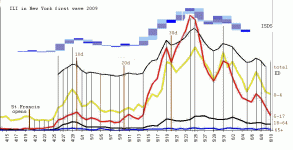
seems that ISDS-data are about 1 week delayed
 

Attachments

  • nyh00a.gif
    nyh00a.gif
    31 KB · Views: 1
Re: H1N1 Spread Declining in NYC (with Hospital Statistics)

that's not a real pandemic wave then.
Only a few percent of New Yorkers had been infected
and only 4 weeks from first detection to peak.

Similar as in Mexico.

So, is it fading out because of weather conditions or such
or is it a general feature of this "pandemic" ?
I.e. on the Southern Hemisphere now...

Do we expect similar "waves" all over the world now ?

When H1N1 "is through" with the children, will it attack adults
as in the years following 1977 ?


Earlier or later it will mutate, reassort to become a "real pandemic",
I think. That's just how flu is normally, what flu does. Not so hard
to learn for H1N1...

With such mini-waves it can hardly wipe out seasonal H1N1
or H3N2
There wasn't any reassortment in 1918. All 8 gene segment had recombined a mix of seasonal and swine flu polymorphisms (close to 50/50 with minor variations for all 8 gene segments).

There also is no evidence of reassortment in 2009 to create efficient H2H. The triple reassortants have been around for years, including the North Amerian / Eurasia combinations in genes almost exclsuively in swine. The only thing new is the release of hoarded swine sequences by Hong Kong and the CDC.
 
Re: H1N1 Spread Declining in NYC (with Hospital Statistics)

that's not a real pandemic wave then.
Only a few percent of New Yorkers had been infected
and only 4 weeks from first detection to peak.

Similar as in Mexico.

So, is it fading out because of weather conditions or such
or is it a general feature of this "pandemic" ?
I.e. on the Southern Hemisphere now...

Do we expect similar "waves" all over the world now ?

When H1N1 "is through" with the children, will it attack adults
as in the years following 1977 ?


Earlier or later it will mutate, reassort to become a "real pandemic",
I think. That's just how flu is normally, what flu does. Not so hard
to learn for H1N1...

With such mini-waves it can hardly wipe out seasonal H1N1
or H3N2
Reality check:

There is no evidence of reassortment playing a proximal role for the efficient H2H in the swine flu. As has been noted MANY times previously, the human PB1 in the 2009 swine entered swine in the mid 1990's. The avian PB2 entered swine well over a decade ago. Thus, triple reassortants (with flu genes from swine, human, and avian) are NOT new. Similarly, the combination of eurasian swine and north american swine is also NOT new and in fact has been seen in ASIA (Thailand and Hong Kong) several YEARS ago.

What is new is efficient H2H transmission of swine H1N1 in humans. There had been sporadic examples in the past several years in the US (13 cases over 3 years). Virtually all were linked to exposure to swine, and transmission in humans was VERY limited. The first strong examples in teh US was at the end of March, when there were two independent familial clusters in southern California, which followed similar outbreaks in Mexico a few weeks earlier.

This 2009 strain (which lacks additional reassortment) quickly spread worldwide and has now belatedly been acknowledges as the 2009 pandemic.

Like 1918 it is widespread but mild in the spring and primarily targets younger people. It spread efficiently within schools, although reporting/testing has been VERY limited. In the latest week, ending June 6, teh detection frequency in samples submitted for testing rose above 40% (compared to 25% at the peak of seasonal flu season).

The 2009 pandemic is quite real and has been obvious since mid-April ("expert" pandemic handwaving nonsense notwithstanding).
 
Re: H1N1 Spread Declining in NYC (with Hospital Statistics)

I found this:
http://www.isdsjournal.org/article/viewFile/3305/2454

let's compare...


DOHMH monitors visits daily from 50 of 61 EDs,capturing about 94% of all ED visits in NYC.

Currently, disposition data is received from 37 EDs
(approximately 1/3 of all visits by the next day and >60% of all visits within 1 week).

314 excess hospitalizations among 14 EDs attributable
to influenza during the 2007-2008 influenza season

the remaining 23 EDs


http://www.isdsjournal.org/article/viewFile/895/634
 
Re: H1N1 Spread Declining in NYC (with Hospital Statistics)

from the picture I estimate ~20000 excess ED-visits for cancunflu
and 570 hospitalizations (~3%).

during 3 flu-seasons (2001-2004) there were 315271 ED-visits
in New York City for ILI and 48791 hospitalisations (15.5%)


from the 2nd picture I estimate ~60000 ILI-visits for newyorkflu
and only ~1% hospitalisations, 15 times less than for seasonal flu
 
Re: H1N1 Spread Declining in NYC (with Hospital Statistics)

from the picture I estimate ~20000 excess ED-visits for cancunflu
and 570 hospitalizations (~3%).

during 3 flu-seasons (2001-2004) there were 315271 ED-visits
in New York City for ILI and 48791 hospitalisations (15.5%)


from the 2nd picture I estimate ~60000 ILI-visits for newyorkflu
and only ~1% hospitalisations, 15 times less than for seasonal flu
What is the avergae age of patients hospitalized for seasonal flu?
 
Re: H1N1 Spread Declining in NYC (with Hospital Statistics)

(... ) the clinical spectrum of disease in such cases is broad, as reported from Mexico and the United States8 and in severe, sometimes fatal, cases, has included pneumonia that rapidly progressed to acute respiratory distress syndrome, and renal and multi-organ failure.

Preliminary clinical and pathological information reported to WHO suggest similarities between severe human cases of new influenza A (H1N1) virus infection and human cases of avian influenza H5N1 virus infection.
From: Human infection with new influenza A (H1N1) virus: clinical observations from a school-associated outbreak in Kobe, Japan, May 2009 (http://www.who.int/wer/2009/wer8424.pdf)
 
Last edited:
Re: H1N1 Spread Declining in NYC (with Hospital Statistics)

looking for an update

looking for a new survey, asking people how many were sick.
The old one only covered 1.May-20.May

looking for serology. Do infecte people now have enough antibodies ?
how many % of New Yorkers have antibodies now ?


New York is first in USA
Mexico could do it, but they speak Spanish and are not eager to
do such things
 
Re: H1N1 Spread Declining in NYC (with Hospital Statistics)

Across the city, the peak number of emergency room visits was in late-May at 2,500, a number that has since decreased to about 500 a day. However, officials said the typical number of visits for the flu season should be about 100 for this time of year.
http://www.silive.com/news/index.ssf/2009/06/swine_flu_cases_on_the_decline.html
Fewer Staten Islanders are falling ill, too, with about 10 people visiting the emergency room per day, down from nearly 50 visits a day in early June.
Overall, the borough is faring much better than the rest of the city, with about two percent (about a dozen people) of New York's hospitalizations for swine flu, or H1N1 virus. Brooklyn tops the list, with 32 percent of hospitalizations; the Bronx saw 29 percent, Queens had 23 percent and Manhattan, 14 percent.

More than 700 people had been admitted to New York hospitals with the virus, officials said.

The situation has also improved in schools, with the Health Department only monitoring four schools across the city as of Thursday
 
Re: H1N1 Spread Declining in NYC (with Hospital Statistics)

Since the US has followed the Mexican epidemic model and we are about 2 months behind them, it makes sense that the number of cases in NYC is beginning to fall. For unknown reasons, NYC was hit before and harder than other areas of the US so it is not surprising that they are seeing a fall in cases now while other regions of the US are seeing a rise in deaths.

If the notion that the US is following the Mexican model is correct, then what is likely is that we will see a fall in cases elsewhere in the US in about 10 days.

GW
 
Re: H1N1 Spread Declining in NYC (with Hospital Statistics)

h1n1-hosp-adm-ed-large.jpg


Why are they saying that H1N1 is declining??? The number of ED visit is correlated with panic for a new virus and media buzz. Now more and more people stay home to get better than at the start. But if you look at hospitalisation, the numbers remain stable ( counting a 3 to 4 day delay on dx and inclusion in the chart)

If you look at number of death, they have 7 new death from the 16 to the 19 of june on a total of 30 since the beginning!!! I do not call that declining!

http://www.nyc.gov/html/doh/html/cd/cd-h1n1flu-data.shtml#3

Am I the only one who see the number like that? Is someone have death in New York by CDC week? This could shed a light on the subject.

WTB
 
Re: H1N1 Spread Declining in NYC (with Hospital Statistics)

The way I (non-expert) interpret this graph is that in NYC, this outbreak is pretty much over from the standpoint of new hospital admissions. Unfortunately, there are still a lot of very sick people in the hospitals, some of whom will probably die, but they are not new patients. The influenza outbreaks that I have seen in graph form are rough bell curves in any particular locality. That is, they go up, reach a peak, and start to descend.

Gives time to restock before the next outbreak.
 
Re: H1N1 Spread Declining in NYC (with Hospital Statistics)

I agree with DarkHorse.

While the ER visits might be panic induced, the hospital admissions for influenza are hard nosed. No ER doc is going to admit a patient to the hopsital that is not in need of it meaning they must meet a critically ill standard. This standard is universal within the US today because it has been enforced by both our government and private insurance plans. What's more, no ER doc that knows a patient is critically ill would not admit them.

Sure, there have been some unfortunate examples we all know about where ER and other docs denied patients who subsequently died with flu admission but what I bet is the case in every instance is that when these folks visited the ER they were not sick enough to justify admission based upon the objective facts.

ER docs have no "skin in the game" we play. They are focused solely on the patient and their illness. While some patients have been seen in the ER and turned away who subsequently died, it is not because the ER doc erred. What is the most likely case is that when the patient presented with and ILI they were sick but not sick enough to justify admission to the hospital.

Since we know who died among the thousands that were turned away, we can accurately point the finger at those ER docs who made the "wrong choice" but only in retrospect. What is important to understand that in prospect the vast majority of the decisions made by these ER docs have proven to correct in prospect and given what we know now about the risk for death from novel H1N1 the decisions these doctors made at the time were correct.

If doctors had better information on which patient characteristics were those that translated into more severe outcomes and which ones into less severe outcomes, then maybe they could have made better judgments.

Since the US public health agencies have decided to conceal this information, for whatever reason, the potentially preventable deaths can not be laid at the doctor's door. In my view, to the extent that transparency regarding the clinical course and characteristics of those who have died from the novel virus in the US is known by our public health community but not shared with our treating physicians makes it clear who is to blame for these deaths.

Grattan Woodson, MD
 
Back
Top Bottom