• FluTrackers.com Inc. does not provide medical advice. Information on this web site is collected from various internet resources, and the FluTrackers board of directors makes no warranty to the safety, efficacy, correctness or completeness of the information posted on this site by any author or poster. The information collated here is for instructional and/or discussion purposes only and is NOT intended to diagnose or treat any disease, illness, or other medical condition. Every individual reader or poster should seek advice from their personal physician/healthcare practitioner before considering or using any interventions that are discussed on this website. By continuing to access this website you agree to consult your personal physican before using any interventions posted on this website, and you agree to hold harmless FluTrackers.com Inc., the board of directors, the members, and all authors and posters for any effects from use of any medication, supplement, vitamin or other substance, device, intervention, etc. mentioned in posts on this website, or other internet venues referenced in posts on this website.
  • We are not asking for any donations. Do not donate to any entity who says they are raising funds for us.

Greece finds bird flu virus in wild duck

Gert van der Hoek

In Memoriam - Editor, Senior Moderator
Greece finds bird flu virus in wild duck

Posted: 18 November 2006 0323 hrs

ATHENS - Greece said Friday it had found bird flu in a wild duck shot by a hunter, adding that more tests were underway to establish whether the virus was the strain that can kill humans.

The H5 virus, most of whose sub-types are only lethal to birds, was confirmed in the migratory duck killed in a coastal area of the central prefecture of Fthiotida, the agriculture ministry said in a statement.

Samples from the bird will be sent to the EU Reference Laboratory for avian influenza in England to determine whether the virus is in fact H5N1, the highly pathogenic strain that has killed 152 people in the Far East, the Middle East and China since 2003.

The relevant European Union authorities have also been informed, the ministry said.

This is the first H5 case reported in Greece since the summer.

Earlier this year, the Greek authorities confirmed 33 cases of H5N1 between February and March, all in wild birds.

Yet even though no domestic poultry cases turned up, demand for chicken in the country took a serious blow for weeks.

Local authorities in Fthiotida have been advised to ban the transport of live poultry near the area where the duck was hunted.

Poultry owners have been warned to keep their flocks indoors, and the public advised to alert the authorities to all bird carcass finds, the ministry said.

http://www.channelnewsasia.com/stories/afp_world/view/242046/1/.html
 
Re: Greece finds bird flu virus in wild duck

BIRD FLU

H5 strain found in wild duck in central Greece; measures demanded

A veterinary laboratory in Halkida, Evia, said yesterday that it had discovered the H5 strain of bird flu in a wild duck that was found in Fthiotida, central Greece. The H5 virus is only lethal to birds but samples from the duck will be sent to England to determine whether the virus is the H5N1 strain which can also kill humans. Authorities in Fthiotoda have been instructed to adopt emergency bird flu measures, such as ensuring that poultry is kept indoors.
 
Re: Greece finds bird flu virus in wild duck

News from a press release that was emailed to me sans url:

"A new press release and some new info about Greece.

The bird was a shoveler Anas clypeata.

According to a new press release issued yesterday by the ministry:
- The tests initially were made at a regional veterinary lab searching
only for subtypes H5 & H7. The H5 was isolated.

- On Friday samples were forwarded to the national AI reference lab for
further tests. This lab searches for all H subtypes. After
haematogglutination suspension tests [I am not sure I am using the
correct english terms; I hope you understand it] a positive response to
LP H6 was found as well as a weaker response to H5
.

- Samples of the bird are forwarded to the London AI reference lab for
further tests."
 
Re: Greece finds bird flu virus in wild duck

canagica said:
News from a press release that was emailed to me sans url:

"A new press release and some new info about Greece.

The bird was a shoveler Anas clypeata.

According to a new press release issued yesterday by the ministry:
- The tests initially were made at a regional veterinary lab searching
only for subtypes H5 & H7. The H5 was isolated.

- On Friday samples were forwarded to the national AI reference lab for
further tests. This lab searches for all H subtypes. After
haematogglutination suspension tests [I am not sure I am using the
correct english terms; I hope you understand it] a positive response to
LP H6 was found as well as a weaker response to H5.

- Samples of the bird are forwarded to the London AI reference lab for
further tests."

Thanks for the update. The hemagglutinin inhibition test showed the the bird had antibodies to H5 and H6, but it is important that H5 was isolated, which should lead to a full characterization, including a full H5 sequence.
 
Re: Greece finds bird flu virus in wild duck

Avian flu steps swing into action

Authorities are implementing safety measures in parts of Fthiotida, central Greece, where a migrating duck was found to be infected with the H5 strain of bird flu last week.

The sample has been sent to a laboratory in London to determine whether it is the H5N1 strain which can also kill humans.

Safety measures include local farmers keeping all poultry in enclosed areas where they cannot come in contact with wildlife possibly carrying the virus.

Authorities have called for calm, saying that all the necessary steps have been taken and that the area where the migrating duck was found, on a riverbank close to the town of Anthilis, is not located near any poultry farms.

?The initial plan for monitoring the bird flu was to take 1,580 samples during 2006. However, following measures adopted last winter, the number of samples taken have already reached 5,000, of which 33 were found to be positive with the virus,? said Panayiotis Triantafyllou, head of the Agricultural Ministry?s department for bird diseases.

http://www.ekathimerini.com/4dcgi/_w_articles_politics_100014_21/11/2006_76819
 
Re: Greece finds bird flu virus in wild duck

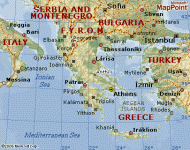
Location...
Anthilis, Greece 2006.gif
 
Re: Greece finds bird flu virus in wild duck

Dutchy said:
......following measures adopted last winter, the number of samples taken have already reached 5,000, of which 33 were found to be positive with the virus,? .........

I wonder if this ALL is of 2006, and how many of those 33 are this late in the year?

Hopefully most of the 33 positives were several months ago.
.
 
Back
Top Bottom