
Install the app
How to install the app on iOS
Follow along with the video below to see how to install our site as a web app on your home screen.
Note: This feature may not be available in some browsers.
-
FluTrackers.com Inc. does not provide medical advice. Information on this web site is collected from various internet resources, and the FluTrackers board of directors makes no warranty to the safety, efficacy, correctness or completeness of the information posted on this site by any author or poster. The information collated here is for instructional and/or discussion purposes only and is NOT intended to diagnose or treat any disease, illness, or other medical condition. Every individual reader or poster should seek advice from their personal physician/healthcare practitioner before considering or using any interventions that are discussed on this website. By continuing to access this website you agree to consult your personal physican before using any interventions posted on this website, and you agree to hold harmless FluTrackers.com Inc., the board of directors, the members, and all authors and posters for any effects from use of any medication, supplement, vitamin or other substance, device, intervention, etc. mentioned in posts on this website, or other internet venues referenced in posts on this website.
-
We are not asking for any donations. Do not donate to any entity who says they are raising funds for us.
You are using an out of date browser. It may not display this or other websites correctly.
You should upgrade or use an alternative browser.
You should upgrade or use an alternative browser.
Germany: 2024-2026 Avian flu in poultry
- Thread starter Shiloh
- Start date

Pathfinder
Editor, Senior Moderator
Translation Google
Current risk assessment for avian influenza/bird flu: Continued high risk of avian influenza
December 12, 2025 Short news
Despite a noticeable decline in case numbers, the Friedrich Loeffler Institute ( FLI ) continues to assess the risk of infection in wild and captive birds as high. While the epidemic among cranes in Germany has largely subsided, the virus still circulates within the wild bird population.
Making predictions for the coming weeks remains difficult, as events can be influenced by numerous factors such as weather conditions and possible changes in the virus's strain.
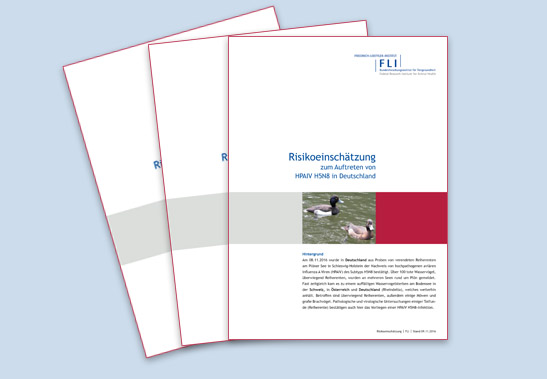
Title page: Risk assessment
Download
https://www.fli.de/de/aktuelles/kur...pe-weiterhin-hohes-risiko-fuer-gefluegelpest/
----------------------------------------------------------------------------------
From the PDF link above:
Risk assessment
for highly pathogenic avian influenza H5
(HPAI H5) clade 2.3.4.4b
Update for December
based on the period
November 1 - November 30, 2025
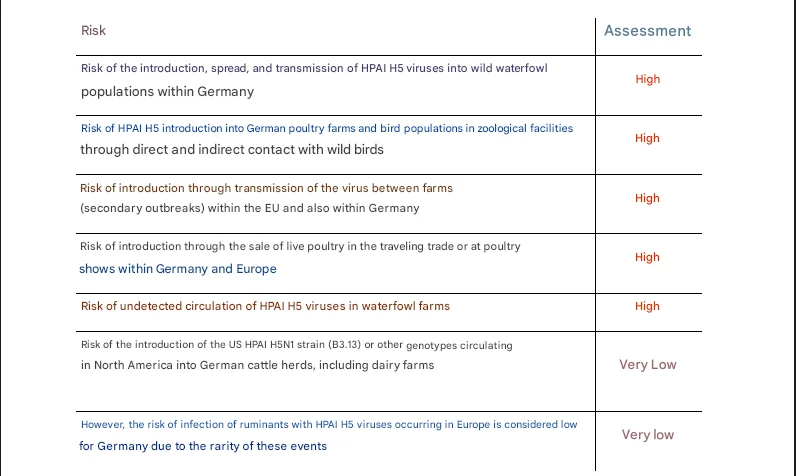
Situation in Germany
Between November 1st and 30th, 105 outbreaks of HPAIV H5N1 were detected in poultry and
captive birds in nine German states (Table 1 and Figure 2). Turkey farms were primarily affected,
followed by chicken, goose, and duck farms (Table 3).
A total of 1,465 cases of HPAIV H5N1 infection in wild birds were reported during the reporting period
(Table 2 and Figures 1 and 2). Some reports refer to outbreaks involving more than one animal. All German states were affected, with cranes (700) and wild geese (>400) being the most commonly affected species.
For the same period, HPAI H5N1 was also detected in a total of four foxes (Hesse, Baden-Württemberg (2), Rhineland-Palatinate), two dogs from Mecklenburg-Western Pomerania (serologically), and one cat from Brandenburg.
...
Current risk assessment for avian influenza/bird flu: Continued high risk of avian influenza
December 12, 2025 Short news
Despite a noticeable decline in case numbers, the Friedrich Loeffler Institute ( FLI ) continues to assess the risk of infection in wild and captive birds as high. While the epidemic among cranes in Germany has largely subsided, the virus still circulates within the wild bird population.
Making predictions for the coming weeks remains difficult, as events can be influenced by numerous factors such as weather conditions and possible changes in the virus's strain.
Title page: Risk assessment
Download
- Risk assessment for highly pathogenic avian influenza H5 ( HPAI H5) clade 2.3.4.4b
https://www.fli.de/de/aktuelles/kur...pe-weiterhin-hohes-risiko-fuer-gefluegelpest/
----------------------------------------------------------------------------------
From the PDF link above:
Risk assessment
for highly pathogenic avian influenza H5
(HPAI H5) clade 2.3.4.4b
Update for December
based on the period
November 1 - November 30, 2025
Situation in Germany
Between November 1st and 30th, 105 outbreaks of HPAIV H5N1 were detected in poultry and
captive birds in nine German states (Table 1 and Figure 2). Turkey farms were primarily affected,
followed by chicken, goose, and duck farms (Table 3).
A total of 1,465 cases of HPAIV H5N1 infection in wild birds were reported during the reporting period
(Table 2 and Figures 1 and 2). Some reports refer to outbreaks involving more than one animal. All German states were affected, with cranes (700) and wild geese (>400) being the most commonly affected species.
For the same period, HPAI H5N1 was also detected in a total of four foxes (Hesse, Baden-Württemberg (2), Rhineland-Palatinate), two dogs from Mecklenburg-Western Pomerania (serologically), and one cat from Brandenburg.
...