

Commonground
Senior Moderator
Georgia Infectious Disease Network (IDN)
Page last updated 6/6/25
In 2015, the Ebola outbreak in West Africa brought the first cases of Ebola Viral Disease (EVD) to the United States. Most hospitals across the country were ill equipped to handle even one potential patient. The Georgia Department of Public Health (DPH) realized the need to ensure that Georgia’s health care system was properly equipped and trained to handle confirmed or suspected cases of EVD. This led to the creation of the Infectious Disease Network (IDN). Although initially focused on EVD, the IDN has since expanded its efforts to include any High Consequence Infectious Disease (HCID).
The IDN has two components– the Hospital Network (IDHN) and the Transportation Network (IDTN).
Hospital Network (IDHN)
The IDHN originally began as a tiered model with three designation levels: treatment centers (Tier 1), assessment centers (Tier 2), and frontline health care facilities (Tier 3). In 2025, the tiers were changed to align with the National Special Pathogen System (NSPS) system of care. The graphic below illustrates the expectations for each of the levels in the NSPS System of Care.
-snip-
The GA IDHN is currently composed of 2 Regional Emerging Special Pathogen Treatment Centers, one for adults and one pediatric facility, 2 Special Pathogen Treatment Centers and 5 Assessment Centers.
Transportation Network (IDTN)
The IDTN is made up of specially trained EMS providers that ensure safe transport of patients from any part of the state to a designated Level 1-3 facility. There are currently 6 designated EMS agencies that are part of the IDTN.
Participation in the IDN is free and voluntary. Any hospital or EMS agency wishing to join as a designated facility or provider can reach out at contactpublichealth@dph.ga.gov.
High Consequence Infectious Diseases
A High Consequence Infectious Disease (HCID) is defined as a disease that poses significant risks to public health due to high transmission rates, severity of illness, high mortality rates, limited or no medical countermeasures, and a need for special containment/treatment. Many highly infectious diseases can cause serious illness but are not classified as HCIDs. HCIDs are typically associated with pathogens such as Middle East Respiratory Syndrome Coronavirus (MERS-CoV), novel respiratory viruses, Ebola, or other viral hemorrhagic fever pathogens. For most HCIDs, the transmissibility of the pathogen is highest when symptoms develop. These diseases require heightened surveillance, rapid response protocols, and specialized measures to prevent their spread and mitigate their impact on communities and healthcare systems.
Healthcare Providers
Caption
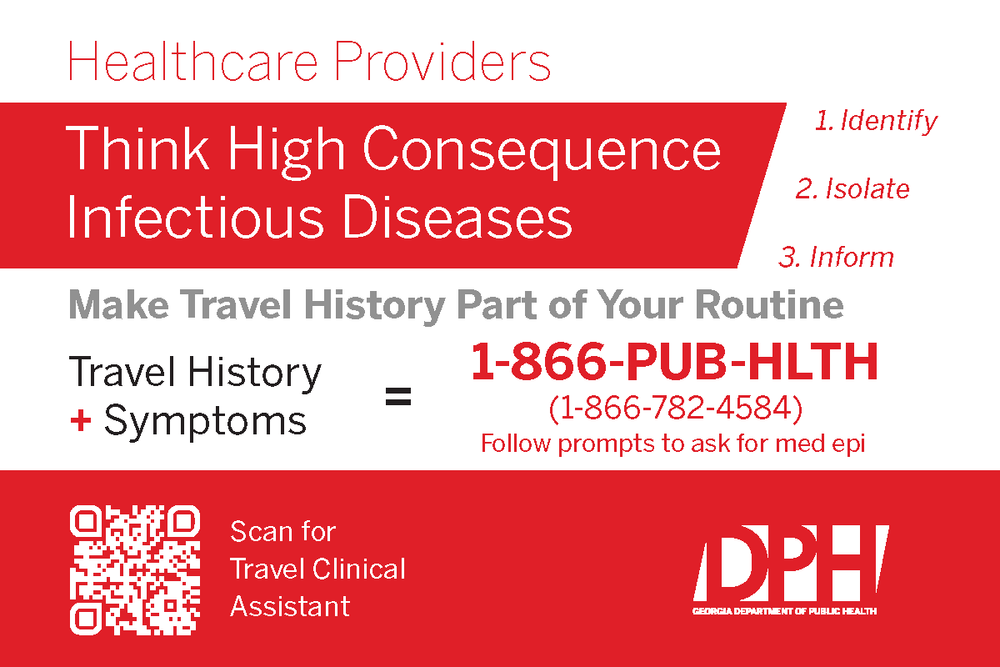
Healthcare Providers Think High Consequence Infectious Diseases. Make Travel History Part of Your Routine. 1. Identify 2. Isolate 3. Inform. Travel History + Symptoms = 1-866-PUB-HLTH (1-866-782-4584) Follow prompts to ask for med epi.
The most important step in preventing and mitigating the spread of HCIDs is the Identify, Isolate, Inform process. Healthcare providers should be asking about travel history along with symptoms. If a patient has relevant symptoms and a travel history to areas of concern, the provider should immediately contact Georgia Department of Public Health at 1-866-PUB-HLTH (1-866-782-4584) for further consultation
https://dph.georgia.gov/epidemiolog...edness/georgia-infectious-disease-network-idn
Page last updated 6/6/25
In 2015, the Ebola outbreak in West Africa brought the first cases of Ebola Viral Disease (EVD) to the United States. Most hospitals across the country were ill equipped to handle even one potential patient. The Georgia Department of Public Health (DPH) realized the need to ensure that Georgia’s health care system was properly equipped and trained to handle confirmed or suspected cases of EVD. This led to the creation of the Infectious Disease Network (IDN). Although initially focused on EVD, the IDN has since expanded its efforts to include any High Consequence Infectious Disease (HCID).
The IDN has two components– the Hospital Network (IDHN) and the Transportation Network (IDTN).
Hospital Network (IDHN)
The IDHN originally began as a tiered model with three designation levels: treatment centers (Tier 1), assessment centers (Tier 2), and frontline health care facilities (Tier 3). In 2025, the tiers were changed to align with the National Special Pathogen System (NSPS) system of care. The graphic below illustrates the expectations for each of the levels in the NSPS System of Care.
-snip-
The GA IDHN is currently composed of 2 Regional Emerging Special Pathogen Treatment Centers, one for adults and one pediatric facility, 2 Special Pathogen Treatment Centers and 5 Assessment Centers.
Transportation Network (IDTN)
The IDTN is made up of specially trained EMS providers that ensure safe transport of patients from any part of the state to a designated Level 1-3 facility. There are currently 6 designated EMS agencies that are part of the IDTN.
Participation in the IDN is free and voluntary. Any hospital or EMS agency wishing to join as a designated facility or provider can reach out at contactpublichealth@dph.ga.gov.
High Consequence Infectious Diseases
A High Consequence Infectious Disease (HCID) is defined as a disease that poses significant risks to public health due to high transmission rates, severity of illness, high mortality rates, limited or no medical countermeasures, and a need for special containment/treatment. Many highly infectious diseases can cause serious illness but are not classified as HCIDs. HCIDs are typically associated with pathogens such as Middle East Respiratory Syndrome Coronavirus (MERS-CoV), novel respiratory viruses, Ebola, or other viral hemorrhagic fever pathogens. For most HCIDs, the transmissibility of the pathogen is highest when symptoms develop. These diseases require heightened surveillance, rapid response protocols, and specialized measures to prevent their spread and mitigate their impact on communities and healthcare systems.
Healthcare Providers
Caption
Healthcare Providers Think High Consequence Infectious Diseases. Make Travel History Part of Your Routine. 1. Identify 2. Isolate 3. Inform. Travel History + Symptoms = 1-866-PUB-HLTH (1-866-782-4584) Follow prompts to ask for med epi.
The most important step in preventing and mitigating the spread of HCIDs is the Identify, Isolate, Inform process. Healthcare providers should be asking about travel history along with symptoms. If a patient has relevant symptoms and a travel history to areas of concern, the provider should immediately contact Georgia Department of Public Health at 1-866-PUB-HLTH (1-866-782-4584) for further consultation
https://dph.georgia.gov/epidemiolog...edness/georgia-infectious-disease-network-idn