

Michael Coston
Editor, Senior Moderator
Frontiers Vet. Sci.: Patterns In the Emergences Of HPAI H5 & H7 Viruses In Poultry
#13,239
Unless you've been living under a rock, you are well aware that we've been watching an incredible growth in the number of newly emerging HPAI H5 and H7 viruses over the past 20 years, and that their rate of appearance appears to be accelerating.
Today the CDC's IRAT actively tracks and scores 14 novel viruses with at least some `pandemic potential' - 8 of which are HPAI avian viruses.
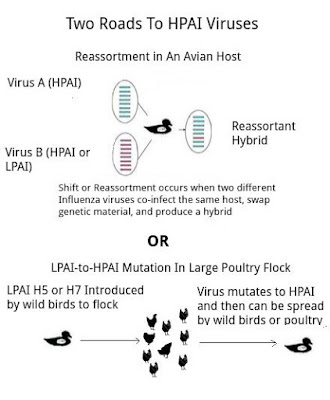
While the two methods by which HPAI viruses emerge are already known - even though the mechanism behind LPAI-to-HPAI mutation isn't completely understood - relatively little has been written about the geographical and historical patterns of how these two separate roads have led to the recent emergence of so many novel HPAI subtypes.
We've a preview of a soon-to-be-published research article in Frontiers In Veterinary Science, that looks at these issues.
First the preview, then I'll return with a postscript.
While most of our focus has been on reassortment events - particularly in China - over the past few years we've seen an increasing number of spontaneous H5 and H7 LPAI-to-HPAI mutations.
These HPAI viruses - once generated in a commercial flock - can be picked up by migratory birds and carried to other farms, or go on to infect large numbers of migratory birds (and likely sparking new reassortments along the way).

#13,239
Unless you've been living under a rock, you are well aware that we've been watching an incredible growth in the number of newly emerging HPAI H5 and H7 viruses over the past 20 years, and that their rate of appearance appears to be accelerating.
Less than a decade ago we really only had one HPAI H5 virus of genuine concern - H5N1 - which emerged in China in the late 1990s, along with a couple of less worrisome HPAI H7 viruses.
Since 2013 the avian flu landscape has changed greatly, with H7N9 (LPAI and HPAI), H5N6, H5N8, H5N5, H6N1, H10N8, and a handful of lesser concerns now on our radar.Today the CDC's IRAT actively tracks and scores 14 novel viruses with at least some `pandemic potential' - 8 of which are HPAI avian viruses.
While the two methods by which HPAI viruses emerge are already known - even though the mechanism behind LPAI-to-HPAI mutation isn't completely understood - relatively little has been written about the geographical and historical patterns of how these two separate roads have led to the recent emergence of so many novel HPAI subtypes.
We've a preview of a soon-to-be-published research article in Frontiers In Veterinary Science, that looks at these issues.
They finds that LPAI-to-HPAI conversion is most likely to occur in high income countries with large commercial poultry production - while reassortment was most apt to occur in countries still transitioning from backyard to commercial poultry production.
While reassortment can occur anywhere - particularly in wild birds - regions (like China or the Middle East) - where there are multiple viruses circulating, numerous live bird markets that put many types of birds together, poor biosecurity, and an over reliance on vaccination tend to produce the most reassortments.First the preview, then I'll return with a postscript.
Madhur S. Dhingra1, 2, Jean Artois1, Simon Dellicour3, Philippe Lemey3, Gwenaelle Dauphin2, Sophie Von Dobschuetz2, Thomas P. Van Boeckel4, 5, David M. Castellan6, Subhash Morzaria2 and Marius Gilbert1, 7*
Over the years, the emergence of novel H5 and H7 highly pathogenic avian influenza viruses (HPAI) has been taking place through two main mechanisms: first, the conversion of a low pathogenic into a highly pathogenic virus, and second, the reassortment between different genetic segments of low and highly pathogenic viruses already in circulation.
We investigated and summarized the literature on emerging HPAI H5 and H7 viruses with the aim of building a spatio-temporal database of all these recorded conversions and reassortments events. We subsequently mapped the spatio-temporal distribution of known emergence events, as well as the species and production systems that they were associated with, the aim being to establish their main characteristics.
From 1959 onwards, we identified a total of 41 independent H7 and H5 LPAI to HPAI conversion events. All but two of these events were reported in commercial poultry production systems, and a majority of these events took place in high-income countries.
In contrast, a total of 125 reassortments have been reported from 1983 to 2015, which predominantly took place in countries with poultry production systems transitioning from backyard to intensive production systems.
Over the years, the emergence of novel H5 and H7 highly pathogenic avian influenza viruses (HPAI) has been taking place through two main mechanisms: first, the conversion of a low pathogenic into a highly pathogenic virus, and second, the reassortment between different genetic segments of low and highly pathogenic viruses already in circulation.
We investigated and summarized the literature on emerging HPAI H5 and H7 viruses with the aim of building a spatio-temporal database of all these recorded conversions and reassortments events. We subsequently mapped the spatio-temporal distribution of known emergence events, as well as the species and production systems that they were associated with, the aim being to establish their main characteristics.
From 1959 onwards, we identified a total of 41 independent H7 and H5 LPAI to HPAI conversion events. All but two of these events were reported in commercial poultry production systems, and a majority of these events took place in high-income countries.
In contrast, a total of 125 reassortments have been reported from 1983 to 2015, which predominantly took place in countries with poultry production systems transitioning from backyard to intensive production systems.
Those systems are characterized by several co-circulating viruses, multiple host species, regular contact points in live bird markets, limited biosecurity within value chains, and frequent vaccination campaigns that impose selection pressures for emergence of novel reassortants.
We conclude that novel HPAI emergences by these two mechanisms occur in different ecological niches, with different viral, environmental and host associated factors, which has implications in early detection and management and mitigation of the risk of emergence of novel HPAI viruses.
(Continue . . . )We conclude that novel HPAI emergences by these two mechanisms occur in different ecological niches, with different viral, environmental and host associated factors, which has implications in early detection and management and mitigation of the risk of emergence of novel HPAI viruses.
While most of our focus has been on reassortment events - particularly in China - over the past few years we've seen an increasing number of spontaneous H5 and H7 LPAI-to-HPAI mutations.
- In Europe (see here, here, and here)
- Two years ago in the H7N8 outbreaks in Indiana (see Genome Announcements: LPAI-to-HPAI Mutation Cited in January's H7N8 Outbreak)
- And last year with H7N9 in Tennessee (see EID Journal: Mammalian Pathogenesis & Transmission of Avian H7N9 Viruses - Tennessee 2017).
These HPAI viruses - once generated in a commercial flock - can be picked up by migratory birds and carried to other farms, or go on to infect large numbers of migratory birds (and likely sparking new reassortments along the way).
The upshot is that while the end result may be the same, the appropriate steps needed to prevent or reduce new HPAI H5 and H7 viruses from emerging can differ greatly from one region to the next.
Understanding those differences can hopefully help guide us towards regional solutions that actually work. One last note, the authors point to `frequent vaccination campaigns that impose selection pressures for emergence of novel reassortants.'
This is a concern we've covered often in the past, including: