

Michael Coston
Editor, Senior Moderator
Frontiers Vet. Sci: Genetic Characterization of an H3N2 Canine Influenza Virus Strain in China in 2023—Acquisition of Novel Human-like Amino Acid Substitutions
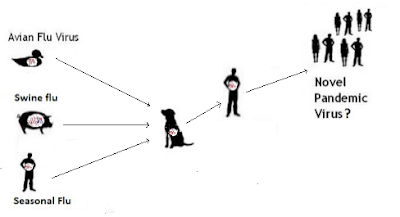
Just one of many scenarios - Dogs as `mixing vessels' for Influenza
#18,353
Up until 2004, dogs (and cats) were believed largely immune to influenza A infection. For cats that perception changed after hundreds of captive cats (tigers) died from H5N1 in Southeast Asia after being fed contaminated poultry (see H5N1: Catch as Cats Can).
For dogs, it happened after an equine H3N8 virus mutated enough to spill over into greyhounds at a Florida race track in 2004 (see EID Journal articleInfluenza A Virus (H3N8) in Dogs with Respiratory Disease, Florida).
A 96% match to the equine H3N8 virus, this canine H3N8 was believed to have jumped directly from horses to dogs without any reassortment.
Since then canine H3N8 has been sporadically reported across much of the United States. It is considered a `canine specific’ virus, and has not crossed back into horses. Additionally, there have been no reports of human infection.
Had that been the only instance, it might be easily dismissed. But in 2007 another virus - this time Avian H3N2 - spilled over and become endemic in dogs in South Korea (see Transmission of Avian Influenza Virus (H3N2) to Dogs).
Analysis showed that the HA and NA genes of the A/canine/Korea/01/2007 (H3N2) isolate were closely related to those identified in 2003 from chickens and doves in South Korea.
While the canine H3N8 virus has remained fairly stable over the past two decades, the same can't be said for the Asian H3N2 virus. We've seen numerous reports coming out of China and Korea suggesting the canine H3N2 continues to adapt and reassort with other avian and human flu viruses. Including:
A Canine H3N2 Virus With PA Gene From Avian H9N2 - Korea
Canine H3N2 Reassortant With pH1N1 Matrix Gene
Virology J: Human-like H3N2 Influenza Viruses In Dogs - Guangxi, China
Interspecies Transmission Of Canine H3N2 In The Laboratory
In April of 2015, this Asian canine H3N2 virus finally turned up in North America (see CDC Statement On H3N2 Canine Influenza In Chicago Region), and quickly spread across much of the United States over a remarkably short period of time.
In 2017, the CDC added Canine H3N2 to their IRAT (Influenza Risk Assessment Tool) list of novel flu viruses with zoonotic potential.
H3N2: [A/canine/Illinois/12191/2015]
The H3N2 canine influenza virus is an avian flu virus that adapted to infect dogs. This virus is different from human seasonal H3N2 viruses. Canine influenza A H3N2 virus was first detected in dogs in South Korea in 2007 and has since been reported in China and Thailand. It was first detected in dogs in the United States in April 2015. H3N2 canine influenza has reportedly infected some cats as well as dogs. There have been no reports of human cases.
Summary: The average summary risk score for the virus to achieve sustained human-to-human transmission was low risk (less than 4). The average summary risk score for the virus to significantly impact public health if it were to achieve sustained human-to-human transmission was in the low risk range (less than 4).
Since then, we've seen sporadic reports (mostly out of China) on a variety of reassortant H3Nx viruses, including:
Follow up reports on these, and other studies out of China, are often slow in coming. But today we've another study - again from China - that finds the canine H3N2 virus continues to pick up human-flu-like amino acid substitutions which may increase its public health threat.
Due to its length, I've only reproduced the abstract and some excerpts from the discussion. Follow the link to read the report in its entirety. I'll have a bit more after the break.
Genetic characterization of an H3N2 canine influenza virus strain in China in 2023—acquisition of novel human-like amino acid substitutions
Sihan Li1 Liangyu Chu1 Yancheng Zhang2 Yaxuan Yu2 Guoqing Wang2*
Around 2005, influenza A virus (IAV) once again crossed species barriers and established a stable lineage within canine populations. Currently, avian-origin H3N2 canine influenza virus (CIV) is the only strain of influenza that is stably circulating in canine populations. Initially, this virus was detected exclusively in Asian countries, such as China and South Korea. However, in 2015, it was isolated from dogs in the United States, where it subsequently caused a large-scale outbreak.
Since its initial isolation, the H3N2 CIV has demonstrated the ability to infect mammals, including cats. Throughout its spread, the virus has continuously enhanced its adaptability to mammalian hosts, posing a potential public health threat.
To monitor the prevalence of H3N2 CIV in China, we collected 131 nasal swabs from dogs and cats with respiratory symptoms between December 2023 and February 2024 in Beijing, Changchun, Shenyang, Hohhot, and Yunfu. From these samples, one influenza virus strain was successfully isolated.
Through whole-genome sequencing and phylogenetic analysis, this strain was identified as avian-origin H3N2 CIV. All eight gene segments exhibited amino acid substitutions, with PB2 107 N, HA1 202I, and M1 227T positions being identical to those found in the currently circulating H3N2 human influenza virus (HuIV). Interestingly, by around 2021, the H3N2 HuIV had already completed the PB2 107 N substitution.
Our study indicates that H3N2 CIV is evolving toward increased adaptability to mammalian hosts, highlighting the necessity for strengthened monitoring and risk assessment.
(Continue . . . )
While we spend a lot of time looking at HPAI H5 or H7 avian viruses that might spark a pandemic - mostly because of their much higher fatality rates in humans - history suggests (see Are Influenza Pandemic Viruses Members Of An Exclusive Club?) that H1, H2, or H3 (avian/swine/canine) novel flu viruses are more likely to spark a human pandemic.
For some other blogs on canine reassortment possibilities, you may wish to revisit:
.
https://afludiary.blogspot.com/2025/03/frontiers-vet-sci-genetic.html
Just one of many scenarios - Dogs as `mixing vessels' for Influenza
#18,353
Up until 2004, dogs (and cats) were believed largely immune to influenza A infection. For cats that perception changed after hundreds of captive cats (tigers) died from H5N1 in Southeast Asia after being fed contaminated poultry (see H5N1: Catch as Cats Can).
For dogs, it happened after an equine H3N8 virus mutated enough to spill over into greyhounds at a Florida race track in 2004 (see EID Journal articleInfluenza A Virus (H3N8) in Dogs with Respiratory Disease, Florida).
A 96% match to the equine H3N8 virus, this canine H3N8 was believed to have jumped directly from horses to dogs without any reassortment.
Since then canine H3N8 has been sporadically reported across much of the United States. It is considered a `canine specific’ virus, and has not crossed back into horses. Additionally, there have been no reports of human infection.
Had that been the only instance, it might be easily dismissed. But in 2007 another virus - this time Avian H3N2 - spilled over and become endemic in dogs in South Korea (see Transmission of Avian Influenza Virus (H3N2) to Dogs).
Analysis showed that the HA and NA genes of the A/canine/Korea/01/2007 (H3N2) isolate were closely related to those identified in 2003 from chickens and doves in South Korea.
While the canine H3N8 virus has remained fairly stable over the past two decades, the same can't be said for the Asian H3N2 virus. We've seen numerous reports coming out of China and Korea suggesting the canine H3N2 continues to adapt and reassort with other avian and human flu viruses. Including:
A Canine H3N2 Virus With PA Gene From Avian H9N2 - Korea
Canine H3N2 Reassortant With pH1N1 Matrix Gene
Virology J: Human-like H3N2 Influenza Viruses In Dogs - Guangxi, China
Interspecies Transmission Of Canine H3N2 In The Laboratory
In April of 2015, this Asian canine H3N2 virus finally turned up in North America (see CDC Statement On H3N2 Canine Influenza In Chicago Region), and quickly spread across much of the United States over a remarkably short period of time.
In 2017, the CDC added Canine H3N2 to their IRAT (Influenza Risk Assessment Tool) list of novel flu viruses with zoonotic potential.
H3N2: [A/canine/Illinois/12191/2015]
The H3N2 canine influenza virus is an avian flu virus that adapted to infect dogs. This virus is different from human seasonal H3N2 viruses. Canine influenza A H3N2 virus was first detected in dogs in South Korea in 2007 and has since been reported in China and Thailand. It was first detected in dogs in the United States in April 2015. H3N2 canine influenza has reportedly infected some cats as well as dogs. There have been no reports of human cases.
Summary: The average summary risk score for the virus to achieve sustained human-to-human transmission was low risk (less than 4). The average summary risk score for the virus to significantly impact public health if it were to achieve sustained human-to-human transmission was in the low risk range (less than 4).
Since then, we've seen sporadic reports (mostly out of China) on a variety of reassortant H3Nx viruses, including:
Follow up reports on these, and other studies out of China, are often slow in coming. But today we've another study - again from China - that finds the canine H3N2 virus continues to pick up human-flu-like amino acid substitutions which may increase its public health threat.
Due to its length, I've only reproduced the abstract and some excerpts from the discussion. Follow the link to read the report in its entirety. I'll have a bit more after the break.
Genetic characterization of an H3N2 canine influenza virus strain in China in 2023—acquisition of novel human-like amino acid substitutions
Sihan Li1 Liangyu Chu1 Yancheng Zhang2 Yaxuan Yu2 Guoqing Wang2*
Around 2005, influenza A virus (IAV) once again crossed species barriers and established a stable lineage within canine populations. Currently, avian-origin H3N2 canine influenza virus (CIV) is the only strain of influenza that is stably circulating in canine populations. Initially, this virus was detected exclusively in Asian countries, such as China and South Korea. However, in 2015, it was isolated from dogs in the United States, where it subsequently caused a large-scale outbreak.
Since its initial isolation, the H3N2 CIV has demonstrated the ability to infect mammals, including cats. Throughout its spread, the virus has continuously enhanced its adaptability to mammalian hosts, posing a potential public health threat.
To monitor the prevalence of H3N2 CIV in China, we collected 131 nasal swabs from dogs and cats with respiratory symptoms between December 2023 and February 2024 in Beijing, Changchun, Shenyang, Hohhot, and Yunfu. From these samples, one influenza virus strain was successfully isolated.
Through whole-genome sequencing and phylogenetic analysis, this strain was identified as avian-origin H3N2 CIV. All eight gene segments exhibited amino acid substitutions, with PB2 107 N, HA1 202I, and M1 227T positions being identical to those found in the currently circulating H3N2 human influenza virus (HuIV). Interestingly, by around 2021, the H3N2 HuIV had already completed the PB2 107 N substitution.
Our study indicates that H3N2 CIV is evolving toward increased adaptability to mammalian hosts, highlighting the necessity for strengthened monitoring and risk assessment.
(SNIP)
CIV-CC23 has acquired 3 novel human-like amino acid substitutions compared to the preceding H3N2 CIV strains. This findings suggest that H3N2 CIV evolves over time, and if it accumulates a sufficient number of human-like amino acid substitutions, it may acquire the ability to efficiently propagate in humans. Among these substitutions, PB2 107 N is an amino acid change that occurred in H3N2 HuIV around 2021. Almost all H3N2 AvIV and previous H3N2 CIV isolates have been PB2 107S, making the emergence of this substitution in CIV-CC23 noteworthy.
CIV-CC23 has acquired 3 novel human-like amino acid substitutions compared to the preceding H3N2 CIV strains. This findings suggest that H3N2 CIV evolves over time, and if it accumulates a sufficient number of human-like amino acid substitutions, it may acquire the ability to efficiently propagate in humans. Among these substitutions, PB2 107 N is an amino acid change that occurred in H3N2 HuIV around 2021. Almost all H3N2 AvIV and previous H3N2 CIV isolates have been PB2 107S, making the emergence of this substitution in CIV-CC23 noteworthy.
While the precise impact of this substitution on H3N2 CIV’s adaptation to mammals remains unclear, PB2 is known to play a significant role in enhancing IAV adaptation to mammals. For example, PB2 E627K increases the virus’s polymerase activity, facilitating replication in mammalian cells (9). Similarly, PB2 S714I in H3N2 CIV has been shown to enhance RNP complex activity, virus replication, and pathogenicity in mice (26). Given our limited sample size, it remains uncertain whether PB2 107 N will be prevalent in future H3N2 CIV. This requires broader temporal and geographic monitoring to obtain a sufficient sample size. However, the relationship between mammalian adaptive changes and human-like amino acid substitutions in H3N2 CIV warrants further investigation.
Our study indicates that H3N2 CIV continues to circulate in canine populations in China, persistently acquiring human-like amino acid substitutions, which poses a potential public health risk. Therefore, a comprehensive surveillance system for H3N2 CIV should be established, with collaboration among animal hospitals, shelters, and pet trade markets nationwide. Nasal swab samples should be collected from dogs and cats presenting with respiratory symptoms to facilitate broader and more diverse studies on virus prevalence and host specificity. Additionally, it is essential to enhance monitoring and management of companion animal transportation and strengthen risk assessment for H3N2 CIV to better understand the zoonotic potential of the currently circulating strain.
Our study indicates that H3N2 CIV continues to circulate in canine populations in China, persistently acquiring human-like amino acid substitutions, which poses a potential public health risk. Therefore, a comprehensive surveillance system for H3N2 CIV should be established, with collaboration among animal hospitals, shelters, and pet trade markets nationwide. Nasal swab samples should be collected from dogs and cats presenting with respiratory symptoms to facilitate broader and more diverse studies on virus prevalence and host specificity. Additionally, it is essential to enhance monitoring and management of companion animal transportation and strengthen risk assessment for H3N2 CIV to better understand the zoonotic potential of the currently circulating strain.
(Continue . . . )
While we spend a lot of time looking at HPAI H5 or H7 avian viruses that might spark a pandemic - mostly because of their much higher fatality rates in humans - history suggests (see Are Influenza Pandemic Viruses Members Of An Exclusive Club?) that H1, H2, or H3 (avian/swine/canine) novel flu viruses are more likely to spark a human pandemic.
For some other blogs on canine reassortment possibilities, you may wish to revisit:
Nature: Adaptation Potential of H3N8 Canine Influenza Virus in Human Respiratory Cells
Viruses Review: Potential Intermediates in the Cross-Species Transmission of Influenza A Virus to Humans
One Health Adv.: Surveillance & Characterization of Avian-origin H3N2 Canine Influenza Viruses (China 2021)
Viruses: Zoonotic Animal Influenza Virus and Potential Mixing Vessel Hosts
Increased Public Health Threat of Avian-origin H3N2 Influenza Virus During Evolution in Dogs (Revisited)
Viruses Review: Potential Intermediates in the Cross-Species Transmission of Influenza A Virus to Humans
One Health Adv.: Surveillance & Characterization of Avian-origin H3N2 Canine Influenza Viruses (China 2021)
Viruses: Zoonotic Animal Influenza Virus and Potential Mixing Vessel Hosts
Increased Public Health Threat of Avian-origin H3N2 Influenza Virus During Evolution in Dogs (Revisited)
.
https://afludiary.blogspot.com/2025/03/frontiers-vet-sci-genetic.html