• FluTrackers.com Inc. does not provide medical advice. Information on this web site is collected from various internet resources, and the FluTrackers board of directors makes no warranty to the safety, efficacy, correctness or completeness of the information posted on this site by any author or poster. The information collated here is for instructional and/or discussion purposes only and is NOT intended to diagnose or treat any disease, illness, or other medical condition. Every individual reader or poster should seek advice from their personal physician/healthcare practitioner before considering or using any interventions that are discussed on this website. By continuing to access this website you agree to consult your personal physican before using any interventions posted on this website, and you agree to hold harmless FluTrackers.com Inc., the board of directors, the members, and all authors and posters for any effects from use of any medication, supplement, vitamin or other substance, device, intervention, etc. mentioned in posts on this website, or other internet venues referenced in posts on this website.
  • We are not asking for any donations. Do not donate to any entity who says they are raising funds for us.

France - Vaccination against highly pathogenic avian influenza starting in October 2023, mandatory for all commercial duck farms

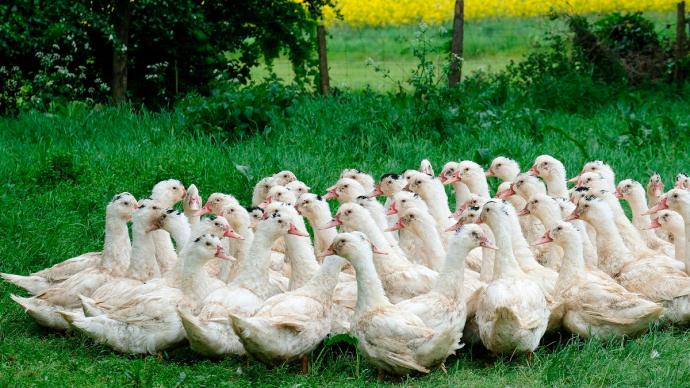
vignette%20test%20vaccination%20des%20canards%20mulards.jpg

Pascal Xicluna/agriculture.gouv.fr

May 25, 2023 Info +

Vaccination experiment of mule ducks in breeding against an HPAI virus



drapeaux%20FR%20UK_1.png


The Ministry of Agriculture and Food Sovereignty initiated an experiment in May 2022 to test vaccines on mule ducks to protect them from avian influenza. The objective is to have scientific proof as to the effectiveness and interest of vaccination against the virus.

In May 2022, the French ministry of agriculture and food sovereignty started trials to test vaccines on Mulard ducks with a view to protection against Highly Pathogenic Avian Influenza (HPAI). The purpose of these trials was to obtain scientific evidence as to the effectiveness and relevance of vaccination when dealing with this virus.

The experiment is governed by an agreement signed between the Ministry of Agriculture, ANSES (Agency for Food, Environmental and Occupational Health Safety, ENVT (National Veterinary School of Toulouse), the CIFOG (Comité interprofessionnel des palmipèdes à foie gras), the laboratories that made two candidate vaccines available (Boehringer Ingelheim animal health and Ceva animal health), as well as the regions of Brittany, New Aquitaine, Occitanie and Pays de la Loire which contributed to financing.

The trials were conducted under the terms of an agreement signed between the Ministry of Agriculture, ANSES (French Agency for Food, Environmental and Occupational Health & Safety), ENVT (National Veterinary School of Toulouse), CIFOG (the interbranch committee for the duck and geese foie gras sector), the pharmaceutical firms supplying the two candidate vaccines (Boehringer Ingelheim Animal Health and Ceva Santé Animale), in addition to the administrations of the French regions helping to fund the programme: Bretagne, Nouvelle-Aquitaine, Occitanie and Pays de the Loire.

This experiment took place in two phases: a first phase in field conditions and a second phase in the confined animal facilities of ANSES's National Reference Laboratory in Ploufragan (NRL).

The study was conducted in two phases, each comprising a series of trials in field conditions and a series of studies in experimental conditions in animal laboratory facilities in order to generate data on Mulard ducks relating to clinical protection and reduction of viral excretion, and to the ability of vaccines to slow transmission of the virus.

The first report presents the results of the field and laboratory component concerning the ability of the vaccines studied to confer clinical protection and to reduce viral shedding.

The second report reports the results of the evaluation of the reduction of viral transmission by mule ducks vaccinated in breeding and then tested at the age of 7 weeks in an A3 containment level animal facility.

These favorable results provide sufficient guarantees to launch a vaccination campaign from autumn 2023.

The results indicate satisfactory effectiveness for the vaccines tested on Mulard ducks. See English summaries below.


Report - "Experimental evaluation of clinical protection and viral excretion" pdf (accessible document) - 2.15 MB

Experimental evaluation of clinical protection and virus excretion pdf - 550.41 KB

Report – “Experimental evaluation of the transmission of an HPAI A(H5N1) clade 2.3.4.4b virus in a population of mule ducks vaccinated and tested at 7 weeks of age” pdf (accessible document) - 1.82 MB

Experimental evaluation of transmission among vaccinated ducks after challenge at 7 weeks of age pdf - 585.47 KB


https://agriculture.gouv.fr/experim...nards-mulards-en-elevage-contre-un-virus-iahp


 
Translation Google

05/26/2023—Research

Encouraging results for the vaccination of ducks against avian influenza

ANSES is co-publishing with the National Veterinary School of Toulouse, the results of two experiments carried out to test vaccines on ducks in order to protect them from highly pathogenic avian influenza (HPAI). The two vaccines give similar results: they greatly limit direct transmission when the animals are in close contact and block indirect transmission, by air.

These experiments, developed under the governance of the Ministry of Agriculture and Food Sovereignty, were conducted by ANSES and the National Veterinary School of Toulouse (ENVT), in partnership with the Interprofessional Committee for Palmipeds with Foie Gras (CIFOG ), local authorities and pharmaceutical companies.

The studies were carried out in real field conditions, on the type of ducks used in France for the production of foie gras (mulard ducks), on experimental sites, to check the practical possibilities of implementation in breeding. In addition to this field phase, the studies included each of the experiments carried out in the A3 containment level animal facilities of ANSES's National Reference Laboratory for Avian Influenza located in Ploufragan (Côtes d'Armor).

The first experiment aimed to study the ability of vaccines to confer clinical protection and reduce virus shedding. The second experiment consisted of evaluating the reduction in viral transmission between vaccinated ducks.

The results of the two studies confirmed the decrease in the excretion of the virus in animals, whether by the respiratory or digestive route. They also made it possible to demonstrate control of the direct transmission of HPAI in the vaccinated animals and the absence of transmission by indirect contact, ie by airborne transmission under the experimental conditions used.

“ These vaccines are very effective. When the animals were not vaccinated, an inoculated animal infected another animal every two hours. Conversely, those who were vaccinated were hardly contaminated by their neighbor even in direct contact, in the same pen, with infected droppings . explains Béatrice Grasland, from ANSES's national reference laboratory for avian influenza.

This work was taken into account in the development of the vaccination action plan against HPAI announced on May 25 by the Ministry of Agriculture and Food Sovereignty.

...
https://www.anses.fr/fr/experimentation-vaccination-canards-influenza-aviaire​
 
Translation Google

South-West: Professionals are calling for vaccination against avian flu, starting this summer

POULTRY Agricultural organizations want a vaccination campaign during the summer when since the beginning of May 81 farms have been contaminated in the South-West, half of them in the Gers

20 Minutes with AFP
Published on 05/31/23 at 10:55 — Updated on 05/31/23 at 11:34

They want preventive measures to ensure the survival of their farms. The agricultural organizations of four departments of the South-West are calling for a vaccination campaign against avian flu this summer to guarantee the "survival" of poultry and duck farms in the region, where the virus is circulating again.

The chambers of agriculture of Gers, Landes, Hautes-Pyrénées, Pyrénées-Atlantiques, the foie gras interprofession (Cifog) and the interregional association of lean poultry in New Aquitaine (Airvol) have published a joint press release on this subject. All are asking the government for a "deployment" of the vaccine "in the heart of summer", for contributions from the State and communities for the management of this vaccination, as well as a "depopulation of all palmipeds" in a radius of three kilometers around breeding farms.

“The survival of poultry sectors”
“The challenge now is indeed the survival of the poultry and waterfowl sectors in the South West, their thousands of jobs, their history, their heritage which are on a thread, ready to break”, alert these organizations. After several years of successive crises caused by avian flu, the virus has been circulating again since the beginning of May in the region, with 81 infected farms, more than half of them in the Gers, according to the latest count from the authorities.


Two vaccines tested in France have already proven to be "very effective" on ducks bred for foie gras, the health security agency ( Anses ) reported last week, paving the way for a national vaccination campaign . . According to the Ministry of Agriculture, this could take place "as early as the fall of 2023" , the vaccination strategy to be finalized in June. During the previous epizootic in 2022-2023, six million poultry were slaughtered in France according to the ministry, after 22 million in 2021-2022.


https://www.20minutes.fr/societe/40...s-reclament-vaccination-contre-grippe-aviaire
 
Translation Google

Avian flu: the vaccination campaign expected for October

The vaccination campaign against avian flu should start during the month of October, said Monday, June 5 the Minister of Agriculture Marc Fesneau during a trip to Gironde.

Published on 06/05/2023 at 12:02 p.m.

"I repeat, in October we will be able to vaccinate" against avian flu , said Monday, June 5 the Minister of Agriculture Marc Fesneau to the press, on the sidelines of a meeting with representatives of the Bordeaux vineyards in Salleboeuf, about twenty km east of Bordeaux.

At the end of May, the chambers of agriculture of four departments of the South-West as well as the interprofessions of foie gras and lean poultry in the region had called for "a deployment" of the vaccine "in the heart of summer" to ensure "survival" local duck and poultry farms, remind our colleagues from AFP .

“I fully understand despair. If we can save a little time we will, but to say today, as before for the Covid-19 vaccine, that we can shorten the schedules is not serious, ”explained Marc Fesneau, listing the vaccine validation, manufacturing, deployment and storage processes, to be put in place before launching the campaign “in good order” .

Vaccines tested on “very effective” ducks
After several years of successive crises caused by avian flu, the virus has been circulating again since the beginning of May in Gers , Landes and Pyrénées-Atlantiques, with 81 infected farms, more than half of them in Gers, according to the count of the authorities at the end of May.

“Obviously, we passed the peak, because we took very strong measures, of this episode” , estimated the Minister of Agriculture Monday.

Two vaccines tested in France have already proven to be “very effective” on ducks bred for foie gras, the health security agency (Anses) reported on May 25, paving the way for a national vaccination campaign. "from the fall" , according to the first estimates of the ministry.

During the previous epizootic in 2022-2023, six million poultry were slaughtered in France according to the ministry, after 22 million in 2021-2022.


https://www.ouest-france.fr/sante/g...-octobre-70eb5c46-0386-11ee-8620-049ca5c7a1cf
 
Translation Google

Avian flu: The framework for vaccination clarified, additional precautionary measures

Up to 80 million doses of avian flu vaccine must be injected into ducks from October on "all commercial farms", the ministry said.

20 Minutes with AFP
Published on 7/17/23 at 10:25 p.m.

The Ministry of Agriculture announced Monday measures to limit the risk of spreading avian influenza while preparing the vaccination campaign and accelerating the compensation of breeders.

Up to 80 million doses of avian flu vaccine - two per animal - must be injected into ducks from October on "all commercial farms", the ministry said, naming both “Mulard ducks” (raised for foie gras) than “Barbary” or “Beijing”, throughout mainland France, excluding Corsica.

Vaccination is “prohibited” in breeding duck farms for all those whose production is intended for export in order “not to block certain commercial flows”. Conversely, for establishments targeting “exclusively national trade”, voluntary work will continue to apply.

The ministry has planned to bear 85 percent of the cost of the vaccination campaign, according to a statement.

He intends to "gradually reduce the density of ducks in farms" to "limit the risk of the appearance of a new epizootic wave" in 45 municipalities "the most densely populated in palmipeds", in the Pays-de-la-Loire region . and the department of Deux-Sèvres (New-Aquitaine).

From July, the introduction of new ducks on these sites should gradually be limited to vaccinated animals. And from October, all specimens will have to be. "Around forty" other sites "strategic for avian genetics" are also targeted.

Advances for affected breeders
\
The losses caused by the breeders will be “taken into account” by the ministry, it is specified in the press release. To “complete the compensation system”, the ministry also announces that advances will be available from Friday for the affected breeders, “up to 50% maximum of the estimated losses”.

In addition, in autumn 2023, subject to validation by the European Commission, compensation is planned for all "losses of gross operating surplus" linked to the avian influenza epizootic "as soon as this loss is greater than 20%" for operators. A revaluation of the compensation scales has also been announced.

During the 2022-23 season, some 10 million poultry were slaughtered, according to a report from the Ministry of Agriculture published at the end of June. Avian flu has not completely disappeared from France, however: some 17,500 turkeys were slaughtered in early July after an outbreak was declared on a farm in Airon-Notre-Dame (Pas-de-Calais). France has been at a “negligible” risk level since July 2023.


https://www.20minutes.fr/sante/4045...on-precise-mesures-precaution-supplementaires
 
03 August 2023
...
All you need to know on the Highly Pathogenic Avian Influenza vaccination action plan in France.

On 22 December 2022, the French Ministry of Agriculture and Food Sovereignty launched an action plan on vaccination against HPAI. Its objective is to enable effective vaccination of poultry in autumn 2023 if all the conditions have been met.

The actors involved in implementing this action plan are as follows: the government administration, relevant public entities (ANSES, French Agency for Veterinary Medicinal Products (ANMV), National Veterinary School at Toulouse), the interbranch trade bodies in the poultry farming industry and representatives of the veterinary profession and the veterinary medicines industry.

To date, several major milestones in the action plan have already been reached: publication of reports on the vaccination trials conducted in France on Mulard ducks; after issuance of a call for tenders in April for supply of 80 million vaccine doses, a first contract has been signed and approvalhas been given to the vaccination scenario.

In this context, France intends to provide third countries with all necessary information for a full understanding of the vaccination action plan and with a view to this, several key elements have been defined (dated May 2023, being updated)
  • 1. Highly Pathogenic Avian Influenza (HPAI): the French vaccination strategy...
  • 2. Available vaccines that are effective against HPAI in circulation...
  • 3. Execution of a programme of on-farm trials of vaccination of Mulard ducks...
  • 4. A presentation of the scenario under consideration for vaccination against HPAI in France...
  • 5. The reinforced post-vaccination surveillance programme...


https://agriculture.gouv.fr/tout-ce-quil-faut-savoir-sur-le-plan-daction-vaccination-iahp-en-france


Translation Google

August 31, 2023

Press release

Avian influenza: Marc Fesneau meets breeders and the poultry industry in Vendée to confirm the operational launch of vaccination at the beginning of October


The Minister of Agriculture and Food Sovereignty visited a duck farm in Vendée on August 31, a few weeks before the operational launch of the national vaccination campaign against highly pathogenic avian influenza (HPAI). During this trip, Marc Fesneau confirmed to professionals in the poultry industry that the schedule announced for the implementation of the vaccination campaign will be met at the beginning of October. Preparations for the HPAI vaccination campaign are entering their final phase. After the selection of the company responsible for producing the first order of vaccines (July 2023) and the sending of the official vaccination plan to the European Commission (August), the final steps will be taken during September: publication of the orders s technical and financial ministerial documents, instructions to services, operational sheets for field workers, progressive deployment of the information system for traceability and feedback of information.

Therefore, given the current state of preparation of the system, the first vaccination operations in duck farms will be able to begin the first week of October.

As a reminder, vaccination will be mandatory for all commercial duck farms (Pekin, Barbarie and Mulard) throughout France throughout the year. The minister confirmed that, for this first vaccination campaign, the State would cover 85% of the total cost of this project.

During his trip to a poultry farm in Vendée, he praised the work carried out as a team by State services, agricultural professionals and veterinarians to prepare the launch of this campaign.

Marc Fesneau thus recalled the State's unwavering commitment to managing the HPAI crisis and the national solidarity from which the sectors can benefit. Concerning compensation for breeders in the event of slaughter of animals , 86% of deposit requests were processed for the 2022-2023 crisis, for a total amount paid of 37.2 million euros. Concerning compensation for economic losses, the first advances on economic compensation intended for breeders located within regulated areas were paid at the beginning of August. As was announced, payments over time began during the summer and nearly 30 million euros have already been paid in order to provide cash flow support within 1,980 farms.

The minister also insisted on the innovative nature of the approach undertaken by professionals, financially supported by the State, to reduce, since July, the density of ducks on farms in order to limit the risk of the appearance of ducks. a new epizootic wave and thus guarantee the launch of the vaccination campaign in good conditions. In fact, no ducklings have been established in the 45 municipalities with the highest densities of duck farms in the Pays de la Loire region. This measure was also deployed around a certain number of strategic breeding sites for the preservation of avian genetics.

Finally, Marc Fesneau underlines the crucial role of the veterinary profession in the deployment of this campaign, both for the application of the vaccine and associated surveillance and for securing information and financial circuits.

I salute the enormous work that has been carried out in my departments to keep the calendar and I congratulate the professional sectors – both in terms of breeding and veterinarians – for their commitment and their involvement in the success of this upcoming campaign . As I announced, the State is there to support breeders on a health and economic level in this crisis which is affecting them very hard. The French poultry industry is a pillar and a pride of our gastronomic culture. »

Marc Fesneau
Minister of Agriculture and Food Sovereignty
Marc-Fesneau-official-ckeditor-150.jpg


To find out more : https://agriculture.gouv.fr/influenza-aviaire-le-plan-daction-vaccination-de-la-france


https://agriculture.gouv.fr/influen...-operationnel-de-la-vaccination-debut-octobre
 
Avian flu: four countries sanction French poultry for vaccination

By Marie-Josée Cougard
Published on September 7, 2023 at 7:16 p.m.
Updated September 8, 2023 at 5:53

Canada, Japan, Taiwan and Hong Kong no longer want French poultry. The decision to vaccinate ducks against avian flu casts opprobrium on the health security of the exporting country.

It didn't take long. France's announcement of its decision to vaccinate ducks against avian flu caused the borders of four countries importing French poultry to be closed. Vaccination therefore obviously does not act as a guarantee of security in commercial relations: the commonly held idea is that when a country vaccinates its animals, it is because it is facing health problems.

For some countries, including Japan, this is enough to close its doors. At this stage, according to our information, Tokyo has not yet announced a blockade of French foie gras, even though only ducks will be vaccinated. On the other hand, poultry from Bresse, which the archipelago is fond of during the end-of-year holidays, and all tricolor poultry products will no longer have access to the Japanese archipelago from October 1, the date of the first vaccinations ...


https://www.lesechos.fr/industrie-s...a-volaille-francaise-pour-vaccination-1976301
 
Translation Google

Avian flu: vaccination starts with still many questions for some breeders

From this Sunday, ducks will begin to be vaccinated in France against avian flu. A vast campaign is launched by the State. Faced with successive crises, many breeders were impatiently awaiting this vaccine. Despite everything, for some, its arrival is far from solving all the problems.

Article written by France Info - Aurore Richard
Radio France
Published on 09/30/2023 09:47

This is a first in Europe. France wants to vaccinate 64 million ducks against avian flu in one year and this campaign begins on Sunday October 1st . All commercial duck farms, in other words meat ducks intended for consumption ("Muscop" ducks, "Peking" ducks and Mulard ducks, those reserved for the production of foie gras) are concerned. This is an obligation throughout mainland France (with the exception of Corsica) and if the breeder does not respect it, he risks administrative and criminal sanctions.
...
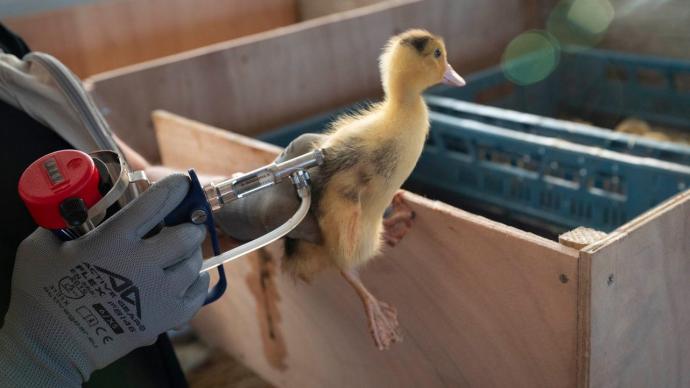
This vaccination campaign, led by the General Directorate of Food, was decided by the Ministry of Agriculture when nearly ten million poultry were slaughtered during the 2022-2023 season due to influenza highly pathogenic avian. The vaccine administered is that of the German laboratory Boehringer Ingelheim, which must supply 80 million doses to France. Two injections are planned. The first must be carried out on ducklings 10 days old and older, and the second, 18 days later.

The Ministry of Agriculture indicates that this act must be supervised by a livestock health veterinarian, mandated by the prefects. Based on this principle, this official veterinarian can inject the vaccine but this is also the case for other practicing veterinarians, the breeders themselves, their employees as well as agricultural technicians. The need to be supervised by an official veterinarian may be a limit, according to Sylvie Colas, national avian flu referent for the Confédération paysanne. This poultry breeder in Lectoure in the Gers has also stopped breeding ducks in favor of chickens because of the difficulties caused by the avian flu epidemic.

“As we lack doctors, we also lack reference veterinarians in our countryside.”
Sylvie Colas, from the Peasant Confederation to franceinfo

“Of course, for large breeders which are integrated into so-called organized sectors, it is often the referring veterinarian who will supervise the technician for vaccination. On the other hand, for small independent breeders, it will be a difficulty to have a veterinarian who can come in a timely manner ,” she emphasizes.

In the Landes , in Mugron, Julien Mora, a duck breeder, has not yet contacted a health veterinarian to schedule a vaccination appointment but he is not more worried than that. "I'll have to take care of it. There will be a window in the first week of October ," said the man who is also the national avian influenza spokesperson for the Modef union (Movement for the Defense of Family Farmers). For Julien Mora, not all breeders will vaccinate at exactly the same time.

This breeder is more concerned about the time it will take him: “Vaccination is additional work, monitoring after vaccination is also additional work. For breeder-feeders like us who do everything, this are burdens to add to our organization . During vaccination, the task will be more or less long because you will have to catch each duck and then carry out a subcutaneous injection. And it will be necessary to start again 18 days later for the second dose, and so on for each batch of ducks throughout the year. The breeder, who "makes" up to 8,000 ducks per year, also wishes to be "trained" by the health veterinarian in order to be able to administer the vaccine to his poultry himself.

Mandatory post-vaccination monitoring

The post-vaccination surveillance mission also rests partly on the breeder. In particular, he will have to take samples from dead ducks. He will also have to schedule appointments with an official veterinarian every 30 days and at the end of each batch so that he can come and carry out analyses. Succeeding in managing everything is this aspect that concerns Julien Mora. “At Modef, it’s true, we have been asking for the vaccine tool for a long time,” he admits. “But here, the strategy is to vaccinate the ducks all year round.”

“Rather than doing something systematic, I wonder if it wouldn’t have been more relevant to do it based on risk periods.”
Julien Mora, breeder-feeder in Mugron, in the Landes to franceinfo

“We could have vaccinated for the winter and not necessarily for the summer when we experience fewer outbreaks of cases,” he adds .

Sylvie Colas, from the Confédération paysanne, also notes that avian flu does not only affect ducks. “Certainly, he was the first contaminated but chicken and laying hen farms were also contaminated and there, only the duck will be vaccinated. And we must not forget that the breeding ducks will not be vaccinated whereas in certain departments, they can represent 20% of production and they have been contaminated in the past, in Vendée and in Deux-Sèvres ,” she specifies.

“Vaccination is only part of the solution,” she continues. In the South-West, buildings are filling up as if nothing had happened last year and everyone is hoping that vaccination will solve the avian flu problem, so I hope there won't be too many disappointed breeders . " The vaccine is “ very effective ” in limiting the spread of the virus according to ANSES, despite everything, the Ministry of Agriculture explains that it is “a complementary prevention tool” .“On its own, the vaccine is not capable of 100% protection of a farm. Complying with preventive measures therefore remains imperative: biosecurity measures; health surveillance for early detection of the disease; control of the density of farms to limit the spread of the virus ,” write the authorities.
...
Sylvie Colas, like Julien Mora, are mainly wondering about the support for this campaign. This year, the State is absorbing 85% of the total cost, or nearly 95 million euros (55 million euros for the vaccination part and 40 million for the surveillance part). According to the breeder, the remaining cost this year should be around 20 cents per duck: "We don't know what will happen tomorrow. Will there be the same support next year or will the State consider that this is too much for ducks of which we are not yet sure that they will not have avian flu?" . Julien Mora explains that if this remaining charge were to get closer to the 50 cent mark, “it would be potentially absorbable, with a rounded back”. On the other hand, if it were to exceed 50 cents, there would really be no other choice than to pass this increase on to the consumer.

https://www.francetvinfo.fr/sante/m...uestions-pour-certains-eleveurs_6087624.html​
 
Translation Google

October 2, 2023 Info +

Why is it necessary to vaccinate today?


The significant resources deployed each year to prevent epizootics of highly pathogenic avian influenza (HPAI) are no longer sufficient to protect farms effectively.
In recent years, HPAI has spread throughout the world, causing epizootics of unprecedented scale and posing a permanent threat to both wild and farmed birds, but also to certain mammals and animals. 'man.

The vaccination campaign launched in France offers a completely innovative additional shield to protect farms. It strengthens the prevention system already in force in metropolitan France (biosecurity measures, sheltering animals, surveillance, etc.) whose proper application remains imperative.


1. Dealing with a virus that is now recurring.
  • Long confined to Asia, the HPAI virus (whose strains can vary from one year to the next) now affects the entire world. Europe and North America experience epizootics every year and certain continents that have remained unaffected for a long time – such as South America – are now affected. With more than 58 million poultry slaughtered, the United States experienced one of the worst crises in its history in 2022/2023.
  • In Europe, the frequency of epizootics has accelerated over the past ten years. While in 2012/2013, around twenty countries in Europe were affected by the virus, 34 were affected by the virus in 2022/2023. France is no exception. Affected sporadically in 2006 (Ain department) and 2007 (Moselle), France recorded a first major crisis in 2015-2016 in the southwest, which was repeated in 2016-2017. From 2020, epizootics become annual in metropolitan France.In 2020-2021, nearly 500 farms are contaminated (15 departments affected) and 3.5 million poultry slaughtered. The 2021-2022 crisis reaches an unprecedented level with 1,378 contaminated farms (mainly in the southwest and Pays de la Loire), for a total of 22 million poultry slaughtered. Although the 2022-2023 crisis proved less severe, it nevertheless led to the contamination of 402 farms, leading to the slaughter of 10 million poultry.
  • The “seasonality” of the virus, usually observed, tends to disappear. Until now, the virus usually stopped circulating and contaminating farms between the end of spring and the beginning of autumn. In 2022, for the first time, the virus has become established permanently in sedentary wildlife and among migratory birds that spend the winter in France. That same year, the virus returned from Africa for the first time with spring upward migrations, whereas it was usually detected during autumn migrations, when animals leave the northern regions of Europe to go South.
2. Better protect livestock sectors and limit the cost of crises

Vaccination offers an additional line of defense in the protection system for livestock. It complements the measures already implemented, compliance with which remains imperative: compliance with biosecurity measures at all links in the sector; health surveillance guaranteeing early detection of the disease; a reduction in breeding density to limit the spread of the virus; sheltering animals to avoid contact with wild birds.
Vaccination expands the prevention arsenal and should make it possible to limit the overall cost (economic, human, financial, etc.) of crises. The repetition of epizootics has in fact greatly weakened the breeding sectors, placing many breeders in difficult economic and psychological situations. In response, the State was present during each crisis by strongly mobilizing its teams and national solidarity. The cost of the 2021-2022 crisis amounted to €650 million for public finances, to which are added the resources mobilized under the partial activity regime.
The vaccination campaign aims to strengthen the overall resilience of farms and limit the cost of crises.


3. Preserve public health: limit the risk of transmission to humans

Avian influenza viruses have the particularity of having a zoonotic potential: certain strains have the capacity to transmit the disease from animals to humans. This was the case in Asia in 1997, 2003 and 2004-2005, leading to several deaths, notably in Thailand and Vietnam. More recently, human cases have been identified, particularly in China. Health vigilance on this subject is extremely strong at the international level.
Vaccinating means better protecting animals, reducing the ability of the virus to circulate and mutate, and ultimately, limiting the risks of transmission to humans.


4. Why weren't poultry vaccinated against HPAI earlier?
  • The absence of European authorization: vaccination against HPAI has long been prohibited by European regulations. It is now possible since the adoption of a European regulation on February 20, 2023.
  • The reluctance of certain foreign commercial partners: until recently, analysis techniques did not make it possible to determine whether an antibody detected in an animal was caused by vaccination or contamination by a wild virus. For fear of introducing the virus into their territory, certain countries have long displayed a precautionary position by refusing to import poultry or products from poultry that have been vaccinated. Proceeding with vaccination meant taking the risk of seeing your export flows blocked.
    The new generation of vaccines is now changing the situation by offering a clear biological signature.
    These technical developments, combined with the need to develop new methods of combating HPAI, have gradually removed reluctance towards vaccination over the past 2 years. In May 2023, the World Organization for Animal Health (the equivalent of the WHO for human health) adopted a resolution calling for innovative solutions to combat HPAI, first and foremost vaccination.

https://agriculture.gouv.fr/pourquoi-est-il-necessaire-de-vacciner-aujourdhui


​------------------------------------------

October 2, 2023 Info +

Vaccination in practice: frequently asked questions for breeders and field workers

The vaccination campaign launched from October 2023 in mainland France will mobilize a significant number of field stakeholders for several months: breeders, health veterinarians, technicians, etc. Who should vaccinate? Who is exempt? How many injections are needed? What are the best practices to follow? Who covers the cost of the campaign?...
So many questions to which this FAQ provides answers, organized around 10 major themes. In addition to these frequently asked questions, operational sheets prepared by SNGTV are available by clicking here .
​...

https://agriculture.gouv.fr/la-vacc...nation-des-eleveurs-et-des-acteurs-de-terrain

 
Translation Google

Avian flu: with the vaccination of ducks in France, the first restrictions from importing countries

From Frederic Denis
Friday October 6, 2023 at 5:34 p.m.
By France Blue...

After the start of the vaccination of ducks against avian flu in France on Monday October 2, the United States, Canada and Japan began to restrict their imports of French poultry. These measures have limited economic consequences, for the moment.

While the vaccination of ducks against avian flu was officially launched in France by the Minister of Agriculture on Monday October 2 in the Landes, the first restrictions in countries importing French poultry fall this weekend. The United States, Canada and Japan began restricting their imports . “From the moment we vaccinate, countries can refuse the goods while waiting to have guarantees in terms of surveillance ,” according to the director of the French poultry inter-professional association Anvol. Yann Nédélec specifies that a virus surveillance system has been put in place,

Vaccination “can mask infection with the avian flu virus”

If the health campaign does not call into question the fact that France has been considered by the World Organization for Animal Health (WHOA) as a zone free of avian flu since August, it concerns the American Department of Agriculture (USDA) . Vaccination “can mask infection with the avian influenza virus (...) and thus allow the export of infected live animals or products contaminated by the virus to the United States ,” explains the ministry in a message. at Agence France Presse. The country has therefore banned imports from France of live poultry, hatching eggs - intended to produce future chicks or ducklings - as well as unprocessed poultry meat.

The United States also restricts imports of live ducks and raw duck products from European countries that are members of the common market. “When we receive all the necessary documents confirming that the vaccination, surveillance and movement control strategy will not increase the risk of avian flu (...), we will be able to remove or reduce the restrictions related to avian flu” , assures the American ministry, without giving a timetable.

For its part, Canada has initiated a “risk assessment” linked to the vaccination campaign. Pending the conclusions, the country has “temporarily” suspended the importation of live poultry, hatching eggs, and fresh, frozen or raw poultry products from France. “We do not know whether meat from vaccinated ducks can be exported to other countries, nor how France will identify, trace and control vaccinated breeding animals,” explains the Canadian food inspection agency.
Japan has also imposed restrictions. They concern products with very high added value, such as Bresse poultry or foie gras .

For the moment, limited economic consequences

According to Yann Nédélec, director of the French poultry inter-professional association Anvol, the volumes involved on the scale of the sector “are not enormous”. In the "live poultry and eggs" category, exports to the United States, for example, represented only 1% of France's total exports, according to French customs.

If restrictions from importing countries remain problematic for products with very high added value, they are also problematic for the genetics sector, which includes hatching eggs and day-old poultry sent to other farms for production. eggs or broiler poultry, says Yann Nédélec, emphasizing that France is recognized for its know-how in rustic strains or organic labels.

For foie gras, a symbolic product of French gastronomy, the situation is especially problematic in Japan , according to Marie-Pierre Pé, director of the interprofessional committee of foie gras palmipedes (Cifog). Flows to the United States are almost zero and the restrictions in Canada only concern the raw. But Tokyo's decision was expected, admits Marie-Pierre Pé: "We had taken precautions in advance to be able to serve the Japanese during the end-of-year holidays."
In France, 32 million poultry have been slaughtered since the summer of 2021 because of avian flu, the government has therefore made vaccination compulsory in farms of more than 250 ducks, excluding breeding ducks, from October 1 to stop its spread. spread. Highly pathogenic avian influenza also affected the country of foie gras from 2015 to 2017, then almost continuously since the end of 2020.

https://www.francebleu.fr/infos/agr...es-restrictions-des-pays-importateurs-9824880

------------------------
See also:

USDA Bans Import Of French Poultry Over HPAI Vaccine Concerns
https://flutrackers.com/forum/forum...of-french-poultry-over-hpai-vaccine-concerns​
 
Translation Google

Avian flu in Dordogne: in one month, more than 208,000 ducks received their first dose of vaccine

Dordogne
From Emmanuel Claverie
Tuesday November 14, 2023 at 7:35 p.m.
By France Blue Périgord

In one month, more than 208,000 ducks received their first dose of avian flu vaccine in Dordogne. The vaccination campaign should last one year.

A little over a month after the start of the national vaccination campaign against avian flu , the Directorate General of Food announces that 208,334 mulard ducks received their first dose of vaccine between October 1 and 29, 2023 in Dordogne .

Mandatory vaccination

Since October 1, 2023, commercial farms with more than 250 poultry in mainland France and Corsica are required to vaccinate their animals. This is what Pierre Attard, the co-president of the Association of Duck Producers of Périgord, did in Saint-Mayme-de-Péreyrol in Dordogne. Its 6,900 mulard ducks received their two doses, eighteen days apart, as specified in the vaccination protocol.

A tedious operation carried out as a family. “We have returned to our old vaccination methods which work very well ,” explains the breeder, who receives his ducklings at the age of one day, and raises them until the 82nd, before entrusting them to feeders. " My children helped me vaccinate the animals. In total, it took me six hours to vaccinate my 6,900 ducks. It's still a bit of hard work, it's not very pleasant, but it has to be done. do it, and so we did it.”

The vaccine, a hope for breeders

Like many of his colleagues, Pierre Attard is crossing his fingers that the vaccine will finally allow Périgord breeders to emerge from the crisis which has undermined the sector for several years, he whose 9,000 ducks were euthanized on April 24, 2022, after the discovery of cases in his breeding. “We give everything we have to make it work and we believe in it,” he confides.

“In any case, there is only this solution that will be able to get us out of trouble if it ever comes back. I hope for the breeders that it will work. It is not pleasant to have breedings empty for six months, of not knowing in what sauce we are going to be eaten and what we are going to be able to do. Our only hope is this vaccine which will perhaps allow us to be able to work in the conditions that "We met a few years ago, when everything was going well."

https://www.francebleu.fr/infos/agr...ont-recu-leur-premiere-dose-de-vaccin-4391930
 
Everything you need to know about France's avian influenza vaccination plan

The Ministry of Agriculture and Food Sovereignty is launching a national vaccination campaign against highly pathogenic avian influenza (HPAI) from October 2023. Targeted at farmed ducks, this vaccination campaign is a first in Europe.

On an international scale, it makes France the first major poultry exporting country to deploy an innovative system to strengthen the protection of farms. Vaccination complements the prevention measures already in force in metropolitan France (biosecurity, sheltering animals, surveillance, etc.), whose proper compliance remains imperative.

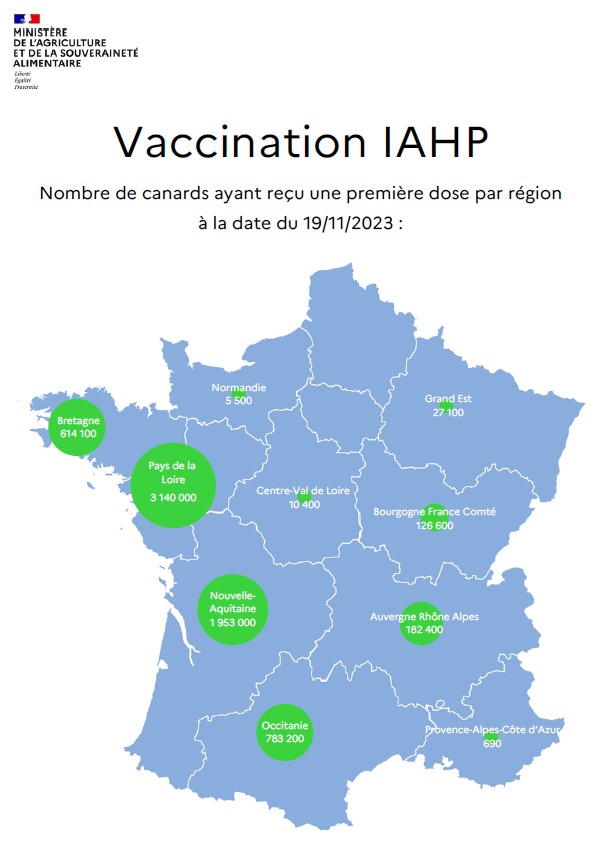
As of November 19, 2023, 6,893,000 ducks have received a first dose of vaccine. The distribution of vaccinated ducks by region is presented below.
2023-12-05_140819.jpg

Map of France representing the number of ducks having received a first dose by region as of 11/19/2023

View image description

IHAP vaccination

Number of ducks having received a first dose per region as of 11/19/2023:

Brittany: 614,100
Pays de la Loire: 3,140,000
Normandy: 5,500
Centre-Val de Loire: 10,400
New Aquitaine: 1953,000
Occitanie: 783,200
Grand-Est: 27,100
Burgundy France County: 126,600
Auvergne Rhône Alpes: 182,400
Provence-Alpes-Côte d’Azur: 690


https://agriculture.gouv.fr/influenza-aviaire-le-plan-daction-vaccination-de-la-france


Translation Google

Ille-et-Vilaine Dinard

In Dinard, the Port Breton park will close… to vaccinate its birds

December 28, 2023 at 11:36 a.m.

The Port Breton park will be closed on January 2 and 3, 2024 for the bird vaccination campaign. The birds in the park will be captured during this period in order to be vaccinated against avian flu on January 4. This vaccination will be carried out by the park health veterinarian in agreement with the Departmental Directorate for Population Protection.

https://www.letelegramme.fr/ille-et...-fermer-pour-vacciner-ses-oiseaux-6496579.php
 
Translation Google

Avian flu surprises ducks in Vendée

Ducks vaccinated against avian flu probably contracted the disease in a Vendée farm. Surprise and disappointment of professionals.

Published on January 2, 2024 - By Sylvie Carriat

A case of avian flu in Muscovy ducks will undoubtedly be confirmed in Vendée on the afternoon of Tuesday, January 2, 2024 by the National Reference Laboratory (LNR), according to Guy-Marie Brochard, president of the Cicar interprofessional committee .

...
(Paywall)
https://www.reussir.fr/lesmarches/la-grippe-aviaire-surprend-des-canards-en-vendee
 
Everything you need to know about France's avian influenza vaccination plan

The Ministry of Agriculture and Food Sovereignty is launching a national vaccination campaign against highly pathogenic avian influenza (HPAI) from October 2023. Targeted at farmed ducks, this vaccination campaign is a first in Europe.

On an international scale, it makes France the first major poultry exporting country to deploy an innovative system to strengthen the protection of farms. Vaccination complements the prevention measures already in force in metropolitan France (biosecurity, sheltering animals, surveillance, etc.), whose proper compliance remains imperative.

As of January 8, 2024, 12,441,478 ducks have been vaccinated against HPAI.

The distribution of ducks vaccinated by region is presented in the sequence below.


image.png - Click image for larger version  Name:	image.png Views:	1 Size:	738.2 KB ID:	984476
...

https://agriculture.gouv.fr/influenza-aviaire-le-plan-daction-vaccination-de-la-france
 
Translation Google

DGAL/SDSBEA/2024-269

from 10-05-2024
Status: In force


SUBJECT: Official IAHP vaccination plan – Implementation of the second vaccine market with a pilot phase for hatchery vaccination.

( Download PDF (1084ko) )

SUMMARY: This technical instruction aims to implement the second HPAI vaccine market. It specifies, in particular, the conditions for setting up a pilot vaccination phase at the duckling hatchery.

​...

https://info.agriculture.gouv.fr/gedei/site/bo-agri/instruction-2024-269

-----------------------------------
From the PDF link above:

General Directorate of Food
Health Action Service
Animal Health and Welfare Sub-Directorate


251 rue de Vaugirard
75 732 PARIS CEDEX 15
0149554955

Technical instruction
DGAL/SDSBEA/2024-269
05/10/2024


Date of application: Immediate
Diffusion: All audiences

This instruction does not repeal any instruction.
This instruction does not modify any instructions.
Number of annexes: 2


Subject: Official IAHP vaccination plan – Implementation of the second vaccine market with a
pilot phase for hatchery vaccination.

Execution recipients
DRAAF
DAAF
DD(ETS)PP

Summary: This technical instruction has as the implementation of the second vaccine market
HPAI. It specifies, particularly the conditions for setting up a pilot phase of
vaccination at the duckling hatchery.
...
Context

Second market for 61 million doses of HPAI vaccine

After a first call for tenders carried out in 2023 which enabled the State to acquire 80 million
doses of vaccine against HPAI, a second call was concluded with Boehringer laboratories
Ingelheim Animal Health (BI) and Ceva Santé Animale (Ceva) for a total of 61 million doses of
additional vaccines to cover the remaining vaccination needs for the 2023 campaign-
2024, according to the following distribution:
- 34,188,300 doses of the Volvac B.E.S.T vaccine. AI+NC of BI
- 26,811,700 doses of Ceva Respons IA H5 vaccine from Ceva

The implementation of this second, multi-award vaccine market requires supervision
logistical and operational for the allocation of doses according to the species and the possibility
administration at the hatchery. The objective of this framework is to give visibility to all
actors in the field and guarantee the smooth running of the vaccination campaign.

The challenges of hatchery vaccination

The possibility of vaccinating ducklings at the hatchery is a request that has been expressed to several
taken up by the members of the Steering Committee of the IAHP Vaccination Action Plan (COPIL). Indeed,
vaccination of ducklings at one day of age is desired, in particular:
− To increase the acceptability of vaccination by breeders, by reducing the number
livestock interventions,
− To limit the possible risk of a breakdown in biosecurity on farms linked to interventions
exterior,
− To improve the quality of vaccination,
− To reduce production costs.

However, implementing hatchery vaccination on a large scale requires significant
economic, technical and organizational investment in the hatchery sector (supply
in materials, recruitment, team training, premises expansion work). In
Consequently, hatchery companies are asking for visibility on vaccination at the hatchery in
depending on the vaccines and species concerned.

Furthermore, the implementation of HPAI vaccination from one day of age requires prior verification
compatibility with other vaccination protocols carried out (Parvovirus and Derzsy vaccines) and
guarantee post-vaccination safety.

In addition to technical and operational constraints, the implementation of vaccination at the hatchery
depends on the possibility of vaccinating ducklings in the presence of antibodies of maternal origin. Gold,
a large proportion of breeding flocks have been vaccinated to protect breeding grounds
breeding animals, but also to guarantee the success of the vaccination campaign.

A pilot phase for vaccination at the hatchery is set up before considering its deployment
in large scale.

This technical instruction establishes the logistical and operational organization for the application
of the two vaccines and the implementation of a pilot phase of vaccination at the hatchery.

1. Establishment of a pilot phase for vaccination at the hatchery

To enable the feasibility of large-scale hatchery vaccination to be assessed, a pilot phase
is setup. The pilot phase will be carried out through a gradual ramp-up of the
vaccination at the hatchery depending on the constraints and equipment of each hatchery and pitfalls
techniques possibly encountered at the hatchery.

The objective of the pilot phase is to provide feedback on the following 3 components:
1. Scientific: collection of data to assess the interference of vaccines with
antibodies of maternal origin and to monitor serological profiles.
2. Operational: field feedback on logistics organization and traceability, particularly on
the delivery of the vaccine, the application of the first dose at the hatchery, the second
dose in breeding and the possibility of combining other vaccinations carried out in the field (p
ex parvovirus and pasteurellosis).
3. Economic: evaluation of the financial cost of vaccination at the hatchery. A first
evaluation of the costs of vaccination at the hatchery will be quickly produced by ITAVI in order to
to allow the effective start of the pilot phase. Then a first assessment of the real costs
observed will be made by ITAVI towards the end of June.
The feedback will focus on monitoring the ducks, from their vaccination at the hatchery to the
finalization of the primary vaccination protocol.

2. Allocation of vaccine doses

Vaccination at the hatchery is only authorized for species whose vaccination protocol
provided for in the RCP1 is possible from one day of age.

The pilot phase is carried out in voluntary hatcheries and using the equipment
existing. The list of hatcheries designated for the pilot phase is presented in Appendix 1. This list
may evolve as new knowledge is acquired.

Distribution of doses:

- Ceva Respons IA H5: The doses of the Ceva Respons IA H5 vaccine are allocated in a
preferential to vaccination of the pilot phase in hatcheries designated for this purpose (V1 to
hatchery and V2 between 3 and 4 weeks later, in breeding).
- Volvac B.E.S.T. AI+ND:
o No restrictions are applied for ordering doses of Volvac vaccine
B.E.S.T. AI+ND for vaccination on farms or for vaccination of ducks
Beijing at the hatchery.
o Hatcheries designated for the pilot phase can use the Volvac B.E.S.T vaccine.
AI+ND for the vaccination of mulard ducks at one day of age.

Regular monitoring of the consumption of vaccine doses is carried out to ensure smooth progress.
of the pilot vaccination phase at the hatchery and to prevent the risk of stock shortages.​
...
 
Translation Google

Bird flu: "We no longer have a sword of Damocles hanging over the heads of animals", success of duck vaccination

Written by Sardin Claire
Published on 07/17/2024 at 5:20 p.m.

The duck industry in the South-West can start to breathe. The implementation of the vaccination campaign against avian flu nine months ago seems to be a success. No more farms have been contaminated this year in our region. Local products are back in shops and restaurants.

The vast campaign to vaccinate ducks against avian flu has borne fruit. To the great relief of the entire sector, which sees a glimmer of hope five months before the end-of-year holidays.

64 million ducks to be vaccinated

In small groups, the ducklings are gathered to be vaccinated. Less than a second per injection, under the close supervision of a veterinarian: "We see it slightly spreading under the skin ," says Léni Corrand. "It's a good sign that there is no vaccine leakage . "

After a second dose, these ducklings will be permanently immunized against bird flu. And besides, since the launch of the vaccination campaign in October 2023, the virus has no longer caused any damage in the farms.

Vaccination: a winning strategy

"There have been no cases reported in the South-West since vaccination began ," confirms the veterinarian. "There have been a few other cases in France, but they have not spread. So, we can say that the vaccination strategy was good, since the virus has never left the contaminated farms."

For Anthony Sarrailh, it is a relief. It must be said that he has come a long way. On two occasions, his breeding was contaminated. Each time, all the ducks had to be euthanized. Since the beginning of the crisis, this breeder has lost 18,000 animals.

Is the crisis over?

"We went through such crises that I no longer believed in ducks ," says the breeder. "I was thinking more about finishing paying for my buildings and even stopping breeding. I admit that the release of this vaccine has given me a glimmer of hope."

With the vaccine, the entire sector is coming back to life. Confined until April, ducks are coming out all over the region: "It's been doing us good for six months ," admits Pierre-Marie Soubiran, a canner in Demu, in the Gers. "We no longer have a sword of Damocles hanging over the animals' heads, we see them frolicking and our customers are delighted too . "
Stock replenishment before Christmas

Because the canners had to, for their part, manage the shortage and refuse large orders during the crisis. In the summer, half of the staff had even been put on technical unemployment. Today, they can refill their stocks again.

"We are working better, we are manufacturing again," confides Miraine Soubiran. " We will see the result at the end of the year. And if there is no other case, it will be a win ." And as a result, Gascon salads are also back on restaurant menus: "This is what tourists come looking for, a typical dish from the South-West ," rejoices this restaurateur.

The only downside is the increase in prices caused by the crisis, which has been passed on to consumers. In restaurants, a whole duck breast often costs more than 20 euros.

(Article written in collaboration with Isabelle Delion from France 2)

https://france3-regions.francetvinf...s-de-la-vaccination-des-canards-3006158.html​
 
Translation Google

23337_113%202.jpg

Xavier Remongin/agriculture.gouv.fr

August 20, 2024 Press Release

Highly pathogenic avian influenza: the State commits to funding to launch the duck vaccination campaign for 2024/25

The Minister of Agriculture and Food Sovereignty announced on August 20, 2024, the State's commitment to the 2024/25 vaccination campaign for ducks against highly pathogenic avian influenza (HPAI). Considering the urgency to act, the State has already ordered the necessary vaccine doses and will cover 70% of the costs generated by the first three months of this campaign, which will start on October 1.

It is necessary to give impetus to the 2024/25 vaccination campaign, in an epidemiological context which raises fears of continued significant contamination of wild birds, and to have the framework allowing work with the sector to be collectively ready to effectively launch vaccination from 1 October.

The State is thus renewing the HPAI vaccination campaign in order to prevent the introduction and spread of the virus on French territory while an outbreak recently appeared in Brittany. In anticipation of this campaign, the State secured the availability of HPAI vaccines by ordering, from the beginning of July, 67.75 million doses of vaccines from the Ceva Santé Animale and Boehringer Ingelheim Animal Health laboratories .

The entire sector will be able to draw on the successful experience and lessons learned from the 2023/24 vaccination campaign. The organization between vaccine suppliers, veterinarians, professional agricultural organizations and breeders was a success, even though this mandatory vaccination campaign was the first to be deployed on this scale against HPAI, worldwide.

As of August 20, 2024, more than 50 million ducks have been vaccinated against HPAI.
Furthermore, all stakeholders in the sector are asked to maintain their vigilance with regard to this disease and to respect strict application of biosecurity measures.
Surveillance, biosecurity and vaccination are in fact complementary pillars of HPAI prevention.


...
https://agriculture.gouv.fr/iahp-le...la-campagne-vaccinale-des-canards-pour-202425
 
Translation Google

17140_021_bd.jpg

Pascal Xicluna / agriculture.gouv.fr

August 30, 2024 Press Release

Highly pathogenic avian influenza: the State continues its exceptional commitment to the 2024/2025 duck vaccination campaign
...
During the steering committee dedicated to the vaccination of ducks against highly pathogenic avian influenza (HPAI), organized this Friday, August 30, the Ministry of Agriculture and Food Sovereignty and representatives of the poultry sectors jointly validated the distribution of costs for the next mandatory vaccination campaign for ducks for the period from October to December 2024.


As indicated on August 20, 2024, the State has already committed until the end of the year to cover a large part (70%) of the costs generated by this campaign which will begin on October 1.

By mutual agreement with the stakeholders, the Ministry of Agriculture and Food Sovereignty has undertaken to take 100% responsibility for:

  • The purchase of the vaccine.
  • Storage and delivery of vaccine doses.
  • Supervision of vaccination operations by a veterinarian.
  • Carrying out monthly post-vaccination monitoring, known as "active", with samples taken for virological analysis on vaccinated ducks. The aim of this active monitoring is to enable possible low-level detection of virus circulation in healthy animals.
  • Laboratory analyses of samples taken during active surveillance.
For their part, the livestock sectors will take charge of:
  • Duck vaccination interventions.
  • The analyses, carried out as part of the weekly so-called "passive" monitoring, of the samples taken by the breeder or breeding technician on ducks found dead or sick. The objective of this passive monitoring is to allow possible detection of the circulation of the virus.
This agreement with professional representatives of poultry farming is a guarantee of success for the start of the next campaign.

The Ministry of Agriculture and Food Sovereignty welcomes the commitment and responsibility of farmers and veterinarians, following the first vaccination campaign, which began in October 2023 and will end at the end of September. It was supported to the tune of 96 million euros by the State . This system, unprecedented in Europe, contributed to the very low number of outbreaks in livestock farming in the 2023/24 season, compared to previous years. As of August 20, more than 50 million ducks had been vaccinated against HPAI.

In a context where several cases of HPAI have recently been detected in wildlife among gulls in Brittany, the Ministry of Agriculture and Food Sovereignty reminds all stakeholders in the sector to remain vigilant with regard to HPAI and to strictly apply biosecurity measures. Surveillance, biosecurity and vaccination are, in fact, the pillars of preventing the spread of HPAI.

As a reminder, the State has paid compensation worth more than 1 billion euros for this sector alone over the last 3 years.


https://agriculture.gouv.fr/influen...-son-engagement-exceptionnel-pour-la-campagne
 
Back
Top Bottom