• FluTrackers.com Inc. does not provide medical advice. Information on this web site is collected from various internet resources, and the FluTrackers board of directors makes no warranty to the safety, efficacy, correctness or completeness of the information posted on this site by any author or poster. The information collated here is for instructional and/or discussion purposes only and is NOT intended to diagnose or treat any disease, illness, or other medical condition. Every individual reader or poster should seek advice from their personal physician/healthcare practitioner before considering or using any interventions that are discussed on this website. By continuing to access this website you agree to consult your personal physican before using any interventions posted on this website, and you agree to hold harmless FluTrackers.com Inc., the board of directors, the members, and all authors and posters for any effects from use of any medication, supplement, vitamin or other substance, device, intervention, etc. mentioned in posts on this website, or other internet venues referenced in posts on this website.
  • We are not asking for any donations. Do not donate to any entity who says they are raising funds for us.

France - Outbreaks of Epizootic haemorrhagic disease (EHD) in cattle farms 2023-2025

Pathfinder

Editor, Senior Moderator

VIGNETTE%20-%20CP%20g%C3%A9n%C3%A9rique%20-%20web_1.jpg

Translation Google

September 21, 2023 Press release

Animal health: detection of first outbreaks of MHE in cattle farms

The Maisons-Alfort national animal health reference laboratory (ANSES) has just confirmed the presence of the Epizootic Hemorrhagic Disease (EHD) virus on cattle on 3 farms located in the Pyrénées-Atlantiques and Hautes-Pyrénées. Management measures for this disease are put in place by the services of the Ministry of Agriculture and Food Sovereignty, in conjunction with professional organizations.

What is MHE?

Epizootic haemorrhagic disease (EHD) is a viral disease affecting wild ruminants (notably deer) and domestic ruminants (cattle and to a lesser extent small ruminants). The virus is transmitted between animals by blood-sucking biting insects of the genus Culicoides.

MHE causes clinical signs very similar to those of bluetongue (BCF), including fever, weight loss, mouth lesions and breathing difficulties; it generates very low mortality.
There is currently no vaccine against MHE. This disease is not transmissible to humans.


In which countries is MHE established?

MHE has long been known in North America where it particularly affects white-tailed deer. It also circulates in Australia, Asia, North Africa and the Middle East.
In Europe, it has so far been revealed in Italy (Sardinia and Sicily), Portugal and Spain.

In the Iberian Peninsula, monitoring of cases in wildlife and on ruminant animal farms revealed a gradual increase from the South to the North and East between 2022 and 2023. The last cases recorded by the Spanish authorities at the end of August were located less than 100 kilometers from the French border.


What are the regulatory consequences of the appearance of this disease in France?

MHE is a disease regulated at European level and notifiable.

Impacted countries have an obligation to establish surveillance measures in order to monitor the evolution of the disease in space and time.

In terms of animal movements, European regulations do not impose movement restrictions on national territory. On the other hand, the regulations prohibit the sending, to other Member States of the European Union for breeding purposes, of any ruminant coming from farms located within a radius of 150 kilometers around each household.

Direct dispatch for slaughter in another Member State remains possible.

Any export restrictions depend on the import requirements provided by each third country.


What are the consequences on breeding and commercial activities?

Following the identification of the three outbreaks present in the Pyrénées-Atlantiques and the Hautes-Pyrénées, the cessation of movements towards States of the European Union currently concerns all or part of several departments (departments 64, 65, 40, 32, 31, and 09 are concerned in full, departments 40, 33, 47, 82, 81, 11 and 66 are partly concerned).

The Ministry of Agriculture and Food Sovereignty has initiated discussions in collaboration with professional organizations to facilitate the recovery of trade flows towards Member States and third countries wishing to maintain their supplies from France.


https://agriculture.gouv.fr/sante-a...ce que la,moindre mesure les petits ruminants).
 
​France - Epizootic hemorrhagic disease virus (Inf. with) - Immediate notification

GENERAL INFORMATION
COUNTRY/TERRITORY OR ZONE
ZONE

ANIMAL TYPE
TERRESTRIAL

DISEASE CATEGORY
Listed disease

EVENT ID
5237

DISEASE
Epizootic hemorrhagic disease virus (Inf. with)

CAUSAL AGENT
Epizootic haemorrhagic disease virus

GENOTYPE / SEROTYPE / SUBTYPE
Pending

START DATE
2023/09/04

REASON FOR NOTIFICATION
First occurrence in the country

DATE OF LAST OCCURRENCE
-

CONFIRMATION DATE
2023/09/19

EVENT STATUS
On-going

END DATE
-

SELF-DECLARATION
NO

REPORT INFORMATION
REPORT NUMBER
Immediate notification

REPORT ID
IN_162841

REPORT REFERENCE
MHE_2023_1.0_I.N

REPORT DATE
2023/09/21

REPORT STATUS
Validated

NO EVOLUTION REPORT
-

EPIDEMIOLOGY
SOURCE OF EVENT OR ORIGIN OF INFECTION
Vectors
EPIDEMIOLOGICAL COMMENTS
No epidemiological comment

QUANTITATIVE DATA SUMMARY
MEASURING UNIT
Animal

SpeciesSusceptibleCasesDeathsKilled and Disposed ofSlaughtered/ Killed for commercial useVaccinated
Cattle (DOMESTIC)
NEW 334
3 0 0 0 0
TOTAL 334 3 0 0 0 0
...

NEW OUTBREAKS

OB_125194 - 2023-64-002-BSA - HASPARREN
OB_125175 - 2023-65-001-BSA - BIZE
OB_125152 - 2023-64-001-BSA - ETCHEBAR
...
https://wahis.woah.org/#/in-review/5237​
 
Translation Google

A first case of MHE, epizootic hemorrhagic disease, in the Landes

From Leila Benjelloun
Thursday October 5, 2023 at 6:54 p.m.
By France Bleu Gascogne

The FDSEA union announced this Thursday, October 5, a first case of MHE, an epizootic hemorrhagic disease in the Landes. According to the Ministry of Agriculture, France has at least twenty outbreaks, mainly in the Hautes-Pyrénées and the Pyrénées-Atlantiques.

After the Pyrénées-Atlantiques and the Hautes-Pyrénées, it is the turn of the Landes to be affected by MHE: epizootic hemorrhagic disease . According to the FDSEA, the first Landes case was detected in a bull, in a suckler cow farm in the north-east of the department .

A mortality rate of less than 1%

France therefore has, at least, 20 proven outbreaks of MHE**: this disease reappeared in Europe via Spain at the end of 2022 and transmitted by a biting midge. According to experts, mortality is very low in cattle: less than 1%. It is not transmissible to humans and the consumption of meat is safe for your health .

The consequences are economic since exports abroad are blocked in the ten or so departments placed in restricted zones (totally or partially). Landes has been affected since September 20. The Minister of Agriculture, Marc Fesneau, however announced, this Wednesday, October 4, during the Livestock Summit in Cournon-d'Auvergne, that the situation with Spain was "unblocked", that he had good hope “concerning Italy” but “it will be longer with the Maghreb”.


https://www.francebleu.fr/infos/agr...orragique-epizootique-dans-les-landes-2801817
 
Translation Google

Cow Covid: a first confirmed case on a cattle farm in Tarn


Published on10/24/2023 at 3:07 p.m.
La Dépêche du Midi

...
A first confirmed case of epizootic hemorrhagic disease, also called cow Covid, has just been confirmed in Tarn. This is a cattle farm located in the commune of Montredon-Labessonnié, indicates the Tarn prefecture. Only one animal showed clinical signs, which resolved in less than a week.

This case has no impact for the department as Tarn is entirely in a regulated zone under the MHE. On the other hand, the increase in the national restricted zone extends by a radius of 150 km from this focus towards the departments located to the east and north of Tarn.

As a reminder, this disease transmitted by a stinging insect has been introduced into the national territory since September 19. This condition, which affects ruminants: cattle, sheep, goats and wild or farmed deer, is not transmissible to humans.

Furthermore, the Italian authorities have just given their agreement to receive ruminants from French regulated zones under the following conditions: absence of clinical signs; the animals are disinsected for 14 days; at the end of 14 days a virological analysis is carried out (PCR MHE); disinsection of the transport vehicle when leaving the restricted zone.

The ministry is also actively continuing discussions with its commercial partners to reopen markets that are temporarily closed. The priority is to preserve – while respecting health requirements – trade flows towards the major countries that traditionally import French animals, both in Europe and in North Africa.


https://www.ladepeche.fr/2023/10/24...me-dans-un-elevage-bovin-du-tarn-11539785.php


----------------------------------------------------------------

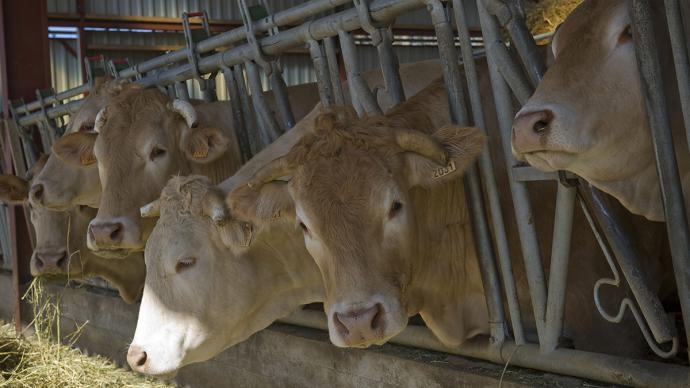
10074_061_RZ_vache_Blonde_Aquitaine_%C3%A9table_stabulation.jpg


October 24, 2023 Info +

Epizootic hemorrhagic disease (EHD): update on an emerging disease


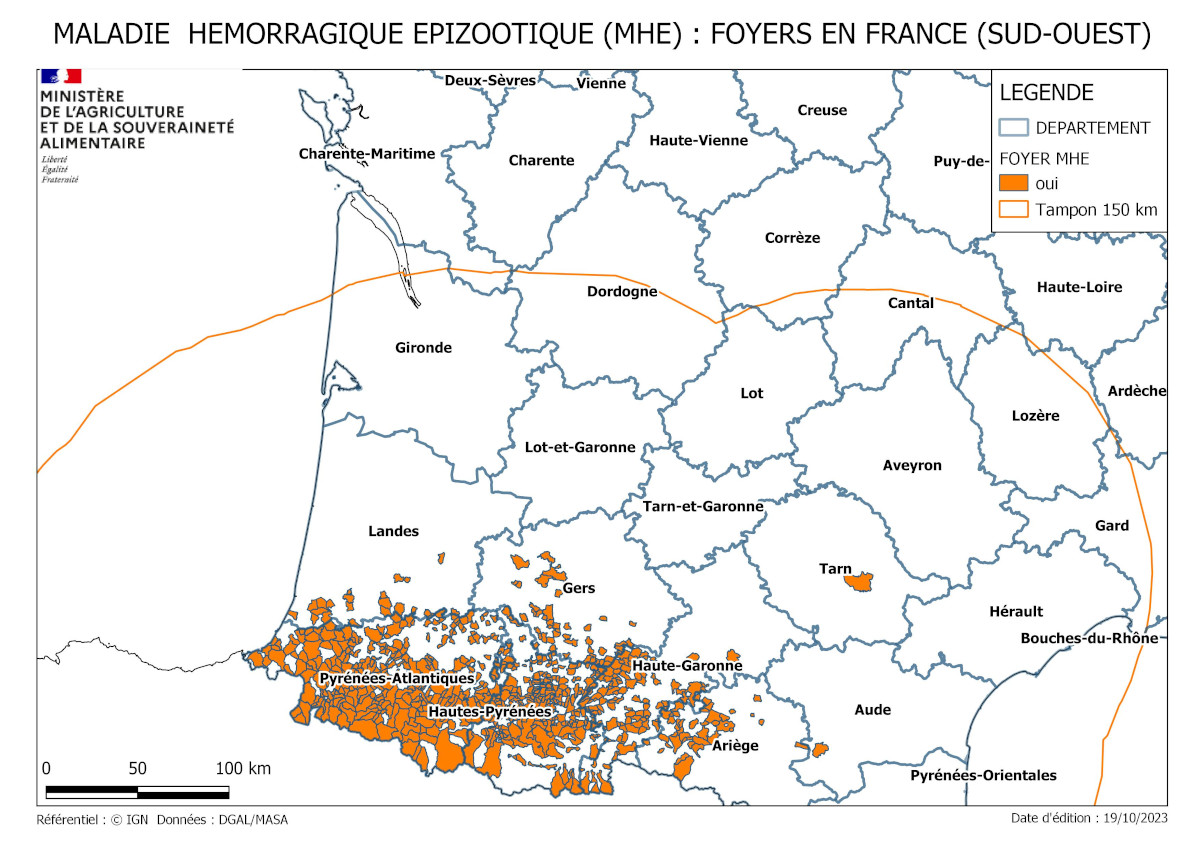
The first outbreaks of epizootic hemorrhagic disease (EHD) were declared in France in September 2023 on cattle farms in the southwest. This infectious disease caused by a virus is transmitted exclusively by midges of the genus Culicoides , the same as those of bluetongue (BFT). The detection of MHE outbreaks leads to specific control and prevention measures within a radius of 150 km around the outbreaks. This restricted zone can be viewed below (map). The list of municipalities included in it is also downloadable.

As of October 20, 1,194 outbreaks of epizootic hemorrhagic disease (EHD) were recorded in France on farms. These outbreaks concern the following 8 departments: Pyrénées-Atlantiques, Hautes-Pyrénées, Haute-Garonne, Gers, Landes, Ariège, Aude, Tarn.

A study is underway in infected farms to consolidate mortality and morbidity data. In almost all cases, the care provided allows sick animals to recover within a few days.

Concerning recent developments in the situation of MHE in Europe, Switzerland had notified in the first half of October two outbreaks of M
HE in the canton of Bern and in the canton of Jura. Measures had been introduced in the French departments covered by the 150 kilometer radius from these outbreaks. However, these two outbreaks were canceled on October 24 by the Swiss authorities, allowing the measures taken on the French side to be immediately lifted.


Mapping of the regulated area under the MHE from outbreaks in the southwest (as of October 20, 2023)

20231019_carte_foyers_MHE_1.jpeg
To download

Consult the list of municipalities included in the regulated zone (France - 10/20/2023)[COLOR=var(--text-mention-grey)]xlsx - 309.39 KB

What are the clinical signs of MHE?

The clinical signs of MHE are very similar to those of bluetongue and appear mainly in cattle and deer. The disease results in fever, ulcerations of the muzzle, discharge (runny nose) and lameness. Sheep, goats and camels are receptive to the virus (i.e. they can become infected) but do not show clinical signs (i.e. they are not sick).

How did the disease arrive in France?

The disease is present in North America, Australia, Asia, Africa, particularly in the Maghreb and the Middle East. It first appeared in continental Europe at the end of October 2022, probably following the dispersal of midges by wind from Tunisia. Since this date, it has also been present in Italy (Sardinia and Sicily), Spain and Portugal. The disease probably arrived in the South-West of France from Spain.

What are the regulations regarding this disease?

Under European regulations, MHE is classified into categories D and E: there are therefore trade measures for the movement of animals between the member states of the European Union and a compulsory declaration of outbreaks by France to the European Commission. Breeders must report suspicions and cases to their health veterinarian. Until September 20, 2023, France was free from MHE, the detection of the virus on the territory thus led the French authorities to make an immediate notification to the World Organization for Animal Health (WHOA) and the animal health services. European Commission.

What are the consequences if an outbreak is detected?

The detection of MHE on the national territory leads to restrictions on movements with a ban on the movement of animals to another Member State of the European Union, for all farms located within a radius of 150 km around an outbreak. Certain destinations to third countries are also subject to restrictions.

Is there a vaccine?

There is currently no vaccine available. The treatment of animals is symptomatic, that is to say it aims to help them tolerate the illness and recover.


https://agriculture.gouv.fr/mhe-la-maladie-hemorragique-epizootique

 
Translation Google

MHE, “Covid of the cow”, is wreaking havoc throughout Occitania

Escoulis
From Shannon Marini
Wednesday November 1, 2023 at 8:50 p.m.
By France Bleu Occitanie

It is called the “Covid of the cow”, the epizootic hemorrhagic disease (EMD) now affects all of Occitania. Fever, breathing difficulties, edema... On the Chayroux farm in Escoulis, in Comminges, Guillaume Leclerc saw 60% of his livestock contaminated by the disease.

The first case was detected at the end of September in the Hautes-Pyrénées. Farms in Haut-Garonne are also affected by this cattle disease transmitted by midges: MHE, an epizootic hemorrhagic disease. The entire Occitanie region is in a protection zone , with a perimeter of 150 kilometers around the outbreaks being set up.
Some symptoms can resemble Covid: fever, difficulty breathing... in addition to edema and limping animals, but the disease is not transmissible to humans .

Even if few animals die from MHE (around 1% according to initial estimates), it is a real loss of income for breeders, because export is prohibited in protection zones even if the meat or milk from an animal infected with the disease can be consumed.

“That’s euthanasia…”

Abnormally thin cows, with protruding bones, that Guillaume Leclerc cannot take out into the meadow as a precaution: “ These are unsaleable six-month-old calves,” he said as he passed his animals. “That’s euthanasia.. ." The observation is very serious on his Chayroux farm in Escoulis, in Comminges. He was one of the first affected, at the end of September: 60% of his livestock were contaminated by the disease.

After the bite of a contaminated midge, the condition of cows can deteriorate very quickly, within a few hours, without treatment. A month after the start of the infection, some animals have not yet recovered. “ They have ulcers in the mouth in particular, so they stop eating and drinking ,” explains the breeder. For about two weeks, he stayed at their bedside. “ It’s from 8 a.m. in the morning to 9 p.m. in the evening .” , you just do that. "

A calf and a cow died, six stillborn calves . A toll that could have been much heavier. He took care of his animals very early and for that, he put in the means: " 6,000 euros in costs in three weeks, that's what we usually spend over the year."

If the wave has passed for him for the moment, the future remains uncertain . Will affected cows whose calves are stillborn be able to father new calves? Question that does not yet have an answer.

The entire region concerned

The entire Occitanie region is concerned, in a protection zone. A situation to be taken seriously for Carole Delga, the regional president: “ I wrote to the Minister of Agriculture. It is necessary to push the spotlight on research, the question of transmission, possibly vaccination. Then the "compensation for losses and the reopening of exports. This is becoming worrying , particularly in the Pyrenees."

The Minister of Agriculture, Marc Fesneau, is going this Thursday morning to Monein, near Pau, in the Pyrénées-Atlantiques to visit a farm affected by epizootic hemorrhagic disease.

https://www.francebleu.fr/infos/eco...it-des-ravages-dans-toute-l-occitanie-1932540
 
Translation Google
vignette%20Ministre%20d%C3%A9placement%20MHE.jpg

Cheick Saidou / agriculture.gouv.fr

November 2, 2023

Press release


Epizootic hemorrhagic disease: Marc Fesneau meets cattle breeders impacted by the disease and confirms state support

On November 2, the Minister of Agriculture and Food Sovereignty visited a cattle farm impacted by epizootic hemorrhagic disease (EHD) in the Pyrénées-Atlantiques in order to demonstrate the State's support for hard-pressed breeders. affected. While more than 2,000 outbreaks have now been identified, he announces the deployment of an action plan to support the sector and mitigate the impact of this disease for breeders.

Discovered at the end of September on French territory, MHE has experienced rapid expansion since 2,136 outbreaks are now recorded in the South-West of France. This trip was an opportunity to recall that a major economic crisis was avoided thanks to the rapid opening of the Spanish and Italian markets, representing between them 95% of exports of young cattle in the European Union. This result was made possible thanks to the intense health diplomacy work carried out by France as well as the seriousness of the management measures implemented upon notification of the first outbreaks: France notably set up in less than 10 days a network of laboratories capable of carrying out the tests required to authorize the exit of animals from the restricted zone set up around the outbreaks.

The Minister of Agriculture and Food Sovereignty announced the establishment of an action plan intended to structure and extend the efforts undertaken to limit as much as possible the impact of this disease on the cattle sector, but also within each farm.

This plan, the measures of which will need to be refined with professionals, should make it possible to deepen existing knowledge on the disease and its health impacts in order to adapt surveillance, prevention and fight against the disease measures. It will also serve as a guide to coordinate the action of stakeholders (professionals, veterinarians, State services) and inform Member States and third countries of developments in the health situation in order to maintain the openness of markets. . The weaknesses of the economic model of the beef sector, whose dependence on the Italian and Spanish markets is highlighted by this health crisis, are intended to be taken into account in this plan to improve the resilience of the sector.

In terms of compensation, PCR analyzes and veterinary costs for taking the sample in the event of clinical suspicion will be fully covered by the State. The Ministry of Agriculture and Food Sovereignty also brought together a working group in mid-October to prepare the conditions for joint support - by the State and by the health risk mutualization fund and environmental (FMSE) - the measurable short-term economic impact of MHE on farms (mortality and cost of care for sick animals).

Marc Fesneau declared: “The introduction of MHE on French territory once again reminds us of the need to improve the resilience of livestock sectors in the face of health risks, including emerging ones due to the impacts of climate change. The plan to regain sovereignty over livestock farming thus provides for the mobilization of an envelope of €20 million to better fight against animal diseases present in France but also to prepare us for the occurrence of new diseases. »


https://agriculture.gouv.fr/maladie...contre-les-eleveurs-de-bovins-impactes-par-la
 
Translation Google

November 6, 2023 Info +

Epizootic hemorrhagic disease (EHD): update on an emerging disease


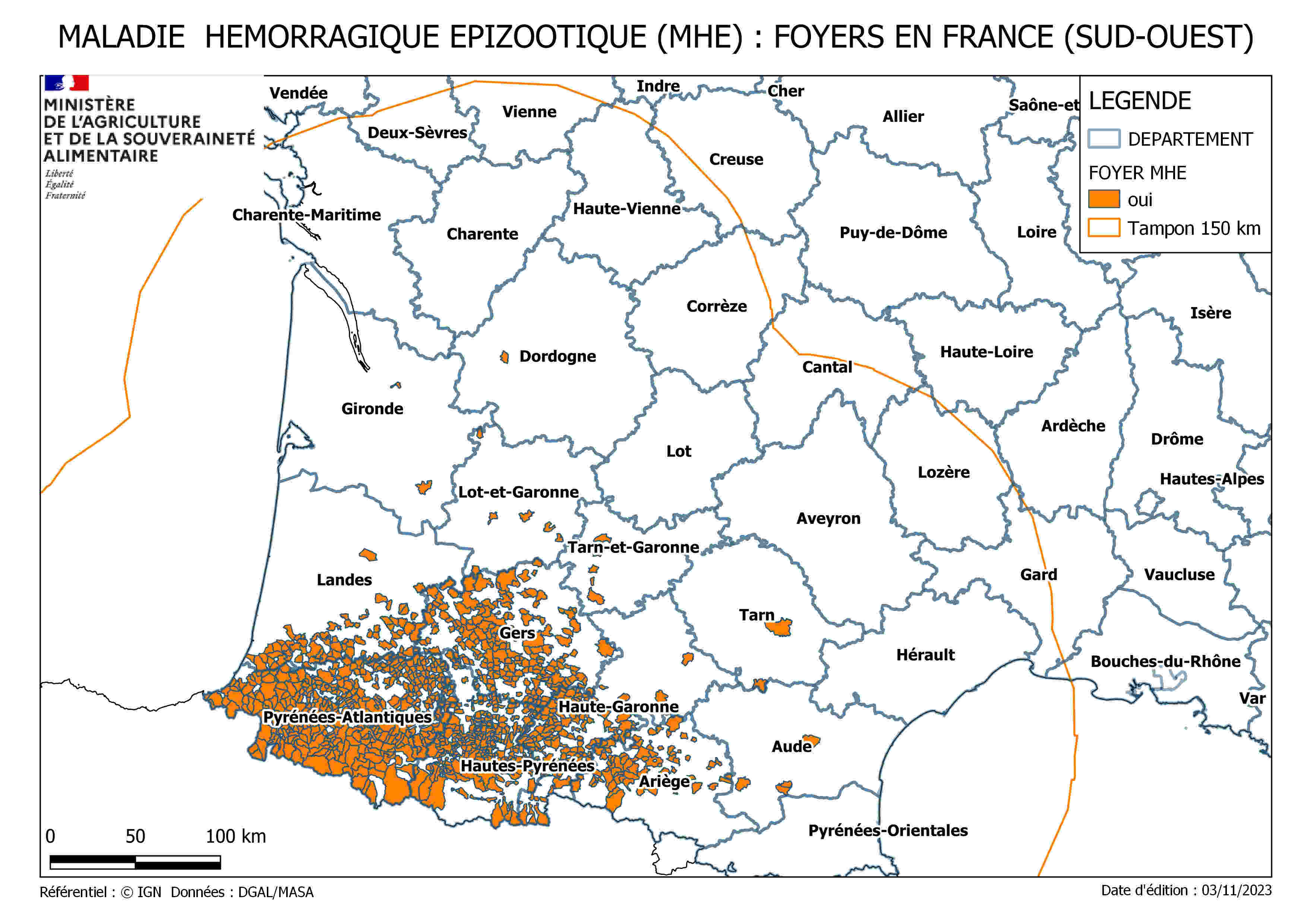
The first outbreaks of epizootic hemorrhagic disease (EHD) were declared in France in September 2023 on cattle farms in the southwest. This infectious disease caused by a virus is transmitted exclusively by midges of the genus Culicoides , the same as those of bluetongue (BFT). The detection of MHE outbreaks leads to specific control and prevention measures within a radius of 150 km around the outbreaks. This restricted zone can be viewed below (map). The list of municipalities included in it is also downloadable.

As of November 2, 2,136 outbreaks of epizootic hemorrhagic disease (EHD) were recorded in France on farms. These outbreaks concern the following 12 departments: Pyrénées-Atlantiques, Hautes-Pyrénées, Haute-Garonne, Gers, Landes, Ariège, Aude, Tarn, Lot-et-Garonne, Gironde, Tarn-et-Garonne, Dordogne.

A study is underway in infected farms to consolidate mortality and morbidity data. In almost all cases, the care provided allows sick animals to recover within a few days.

Concerning recent developments in the situation of MHE in Europe, Switzerland had notified in the first half of October two outbreaks of MHE in the canton of Bern and in the canton of Jura. Measures had been introduced in the French departments covered by the 150 kilometer radius from these outbreaks. However, these two outbreaks were canceled on October 24 by the Swiss authorities, allowing the measures taken on the French side to be immediately lifted.


Mapping of the regulated area under the MHE from outbreaks in the southwest (as of November 3, 2023)

20231103_carte_foyers_MHE%20bo_0.jpeg
...

https://agriculture.gouv.fr/mhe-la-maladie-hemorragique-epizootique


Translation Google

Epizootic hemorrhagic disease: a first case detected in cattle in Corrèze

Published on 09/11/2023 at 12:33 p.m.
Written by Manon Pélissier

While the first outbreaks of epizootic hemorrhagic disease (EHD) were discovered in September in the south-west of France, Corrèze recorded its first cases. The disease mainly affects cattle, without being fatal. For breeders who export their calves to Italy, the consequences are mainly economic.

A first case of epizootic hemorrhagic disease (EHD) was detected in Corrèze at the beginning of November. This disease, transmitted by biting midges, mainly affects deer and cattle. It causes fever, weight loss, mouth lesions, breathing difficulties and lameness.

To export to Italy, a mandatory and expensive health test

14 kilometers from Jean-Claude Fontaine, the first Corrèze case was detected. The cattle breeder is not overly concerned about it, as the disease is not very fatal. For him, the main consequence is economic: either he finds himself with his animals on his hands due to the closure of export markets, or he exports to Italy, which remains open to export, but he must pay for a test sanitary for each calf. A considerable cost for the breeder, who then loses 10% of his margin.

“ The cost of the laboratory, the veterinarian, and all the risks generated by this situation, indeed this creates problems for us, but today it is the only solution we have to manage to send calves to Italy” , he indicates.

As for the CAPEL cooperative, the pastoralists will not yet leave for Italy. Instead, head to a fattening workshop in Gramat to postpone their export date. Heavy procedures which complicate the work of this cattle exporter.

“ This involves taking blood tests which are billed by veterinarians. This comes at an additional cost and is a huge job. Instead of taking half an hour to produce a health certificate, it takes more than 2 hours. It’s very complicated ,” underlines Gaël Hernandez, director of cattle activity at the CAPEL cooperative, which exports 25,000 cattle per year, mainly to Italy.

The FDSEA appeals to the government

To try to absorb the costs, the FDSEA of Corrèze is appealing to the government. “ What we are asking for is either reimbursement of blood tests, so that the breeder can then ship his healthy animals, or compensation for the costs of caring for the cattle that remain on the farm, estimated three euros per day to store and feed them. We are also asking to be compensated for the difference in price between that of the slaughterhouse and that of the grazer ,” explains Daniel Couderc, president of the departmental federation of agricultural operators’ unions of Corrèze ( FDSEA19).

The first outbreaks of MHE in France were discovered in September 2023 in the Pyrénées-Atlantiques and the Hautes-Pyrénées. The disease spread like wildfire: at the beginning of November, more than 2,000 outbreaks of MHE were recorded, compared to 3 at the beginning of September.

France, a country of “birthers”, very dependent on exports

“ In these crises, we see that we are very dependent on exports and we must be able to add value locally ”, in particular by fattening animals in France, underlined Marc Fesneau, Minister of Agriculture, on November 2, according to AFP.

Despite attempts to relocate fattening, France is primarily a country of "breeders": in essence, breeders keep the females who renew the herd and sell the males whose meat is little consumed in the country because it is considered too clear.

France, the leading European herd of cows raised for meat, exported in 2022 a little over a million “broutards”, the vast majority to Italy. These young animals, generally males aged 8 to 12 months, are fattened and slaughtered in the country of destination.

With Eva Pressiat and AFP


-https://france3-regions.francetvinf...etecte-sur-des-bovins-en-correze-2869727.html
 
Translation Google

Bovine disease: a first case of MHE detected in the Lot

From: Remy Doutre
Tuesday November 21, 2023 at 2:58 p.m.
By France Bleu Occitanie

A first case of epizootic hemorrhagic disease was detected in the Lot, which had been spared until now. Cattle cannot leave the department.

MHE, an epizootic hemorrhagic disease, continues to spread in the South-West . After a first case detected in the Basque Country at the end of September, several cases appeared in Béarn, Landes, Gers, Hautes-Pyrénées, and now Lot. Until then spared, the virus appeared on a farm in the town of Castelnau-Montratier.

Upon detection of each case, a “regulated zone” is set up within a diameter of 150 kilometers around the outbreak, specifies the Lot prefecture. Inside, “ surveillance , prevention and control measures managed by the services of the Ministry of Agriculture and Food Sovereignty ” explains the prefecture in a press release. Unless there is an exemption, cattle cannot cross this zone, to prevent the virus from spreading to unaffected zones. Restrictions to which the department was already subject, it was already in a regulated zone due to the proximity to other cases detected.

MHE is not transmissible to humans , only “ between wild and domestic ruminants (cattle, sheep, goats) ”. It is transmitted via biting insects, midges in this case. Contaminated animals suffer from “ fever, weight loss, and breathing difficulties, ” adds the prefecture.

https://www.francebleu.fr/infos/agr...remier-cas-de-mhe-detecte-dans-le-lot-9239952
 
First case of MHE confirmed in Loire-Atlantique

Epizootic hemorrhagic disease (EHD) continues to rise on French territory. The restricted zone now extends to Côtes-d'Armor.

Published on November 27, 2023

“This Wednesday, November 22, 2023, the administration registered an official outbreak of MHE, in the town of Chaumes-en-Retz,” announced the health defense group (GDS) of Loire-Atlantique, on November 24, 2023. The regulated zone of 150 kilometers around the outbreaks therefore extends more widely over the west of France, up to brushing the English Channel. From now on, Morbihan and Ille-et-Vilaine are almost completely integrated into it. Mayenne and Côtes-d'Armor are partly affected by animal movement restrictions.

Within the zone, no movement constraints are legally applied, “even if in terms of health, the risk is very great for the farms”, specifies the GDS of Loire-Atlantique. Exemptions allow animals in the restricted zone to leave it, particularly to importing European countries, under certain conditions: animals and means of transport disinsected, no clinical signs, PCR test, etc. The GDS 44 specifies the different modalities on its site Internet.

As of November 22, the State recorded 3,527 MHE outbreaks on French farms. These outbreaks concern the following 17 departments: Pyrénées-Atlantiques, Hautes-Pyrénées, Haute-Garonne, Gers, Landes, Ariège, Aude, Tarn, Lot-et-Garonne, Gironde, Tarn-et-Garonne, Dordogne, Corrèze, Vendée, Deux-Sèvres, Loire-Atlantique and Lot.

https://www.lafranceagricole.fr/mhe...mier-cas-de-mhe-confirme-en-loire-atlantique​
 
Translation Google

December 4, 2023 Info +

Epizootic hemorrhagic disease (EHD): update on an emerging disease


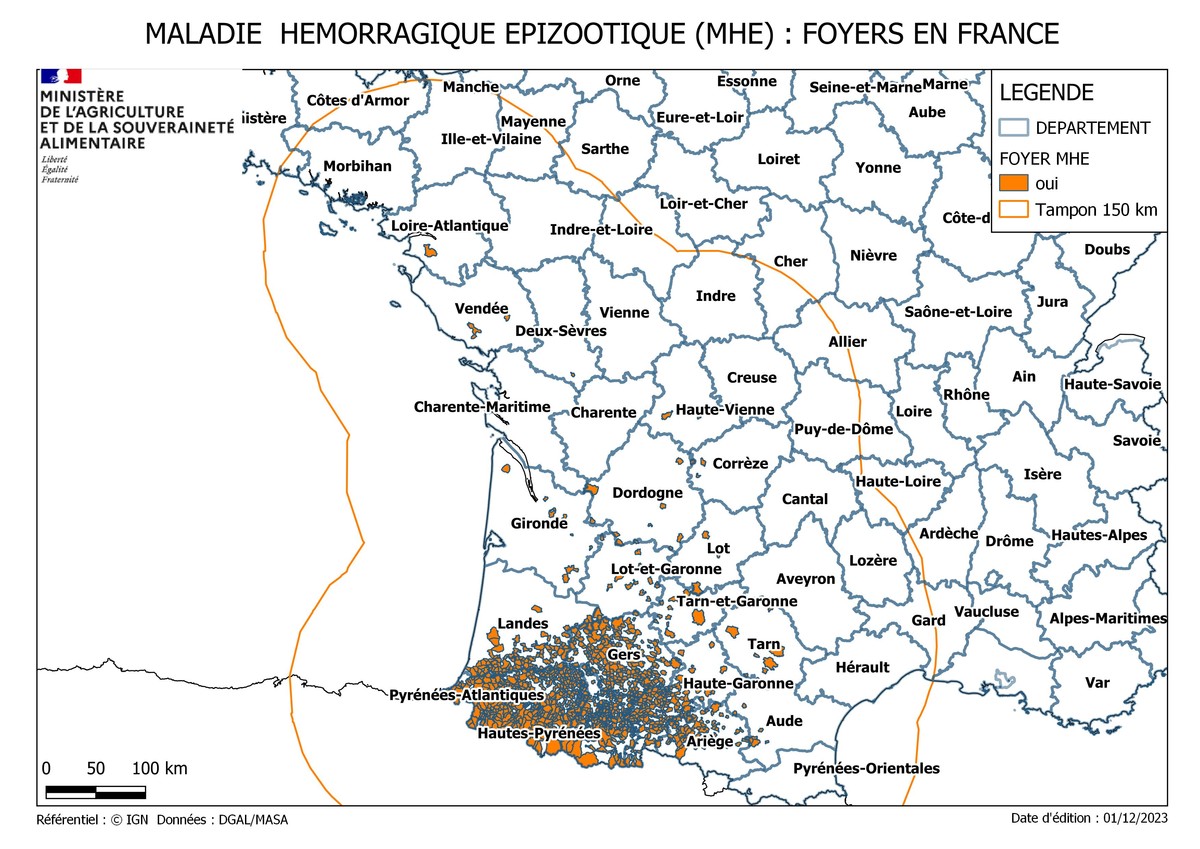
The first outbreaks of epizootic hemorrhagic disease (EHD) were declared in France in September 2023 on cattle farms in the southwest. This infectious disease caused by a virus is transmitted exclusively by midges of the genus Culicoides , the same as those of bluetongue (BFT). The detection of MHE outbreaks leads to specific control and prevention measures within a radius of 150 km around the outbreaks. This restricted zone can be viewed below (map). The list of municipalities included in it is also downloadable.

As of November 30, 3,556 outbreaks of epizootic hemorrhagic disease (EHD) were recorded in France on farms. These outbreaks concern the following 18 departments: Pyrénées-Atlantiques, Hautes-Pyrénées, Haute-Garonne, Gers, Landes, Ariège, Aude, Tarn, Lot-et-Garonne, Gironde, Tarn-et-Garonne, Dordogne, Corrèze, Vendée, Deux-Sèvres, Loire-Atlantique, Lot and Haute-Vienne .

A study is underway in infected farms to consolidate mortality and morbidity data. In almost all cases, the care provided allows sick animals to recover within a few days.
Concerning recent developments in the situation of MHE in Europe, Switzerland had notified in the first half of October two outbreaks of MHE in the canton of Bern and in the canton of Jura. Measures had been introduced in the French departments covered by the 150 kilometer radius from these outbreaks. However, these two outbreaks were canceled on October 24 by the Swiss authorities, allowing the measures taken on the French side to be immediately lifted.


Mapping of the regulated area under the MHE from outbreaks in the southwest (as of November 30, 2023)

20231201%20MHE%20Foyers.jpeg


...
https://agriculture.gouv.fr/mhe-la-maladie-hemorragique-epizootique


Translation Google

December 8, 2023 Info +

Epizootic hemorrhagic disease (EHD): update on an emerging disease

The first outbreaks of epizootic hemorrhagic disease (EHD) were declared in France in September 2023 on cattle farms in the southwest. This infectious disease caused by a virus is transmitted exclusively by midges of the genus Culicoides , the same as those of bluetongue (BFT). The detection of MHE outbreaks leads to specific control and prevention measures within a radius of 150 km around the outbreaks. This restricted zone can be viewed below (map). The list of municipalities included in it is also downloadable.

As of December 6, 3,636 outbreaks of epizootic hemorrhagic disease (EHD) were recorded in France on farms. These outbreaks concern the following 20 departments: Pyrénées-Atlantiques, Hautes-Pyrénées, Haute-Garonne, Gers, Landes, Ariège, Aude, Tarn, Lot-et-Garonne, Gironde, Tarn-et-Garonne, Dordogne, Corrèze, Vendée, Deux-Sèvres, Loire-Atlantique, Lot, Haute-Vienne, Morbihan and Pyrénées-Orientales.

A study is underway in infected farms to consolidate mortality and morbidity data. In almost all cases, the care provided allows sick animals to recover within a few days.

Concerning recent developments in the situation of MHE in Europe, Switzerland had notified in the first half of October two outbreaks of MHE in the canton of Bern and in the canton of Jura. Measures had been introduced in the French departments covered by the 150 kilometer radius from these outbreaks. However, these two outbreaks were canceled on October 24 by the Swiss authorities, allowing the measures taken on the French side to be immediately lifted.
...

https://agriculture.gouv.fr/mhe-la-maladie-hemorragique-epizootique
 
December 26, 2023 Info +

Epizootic hemorrhagic disease (EHD): update on an emerging disease


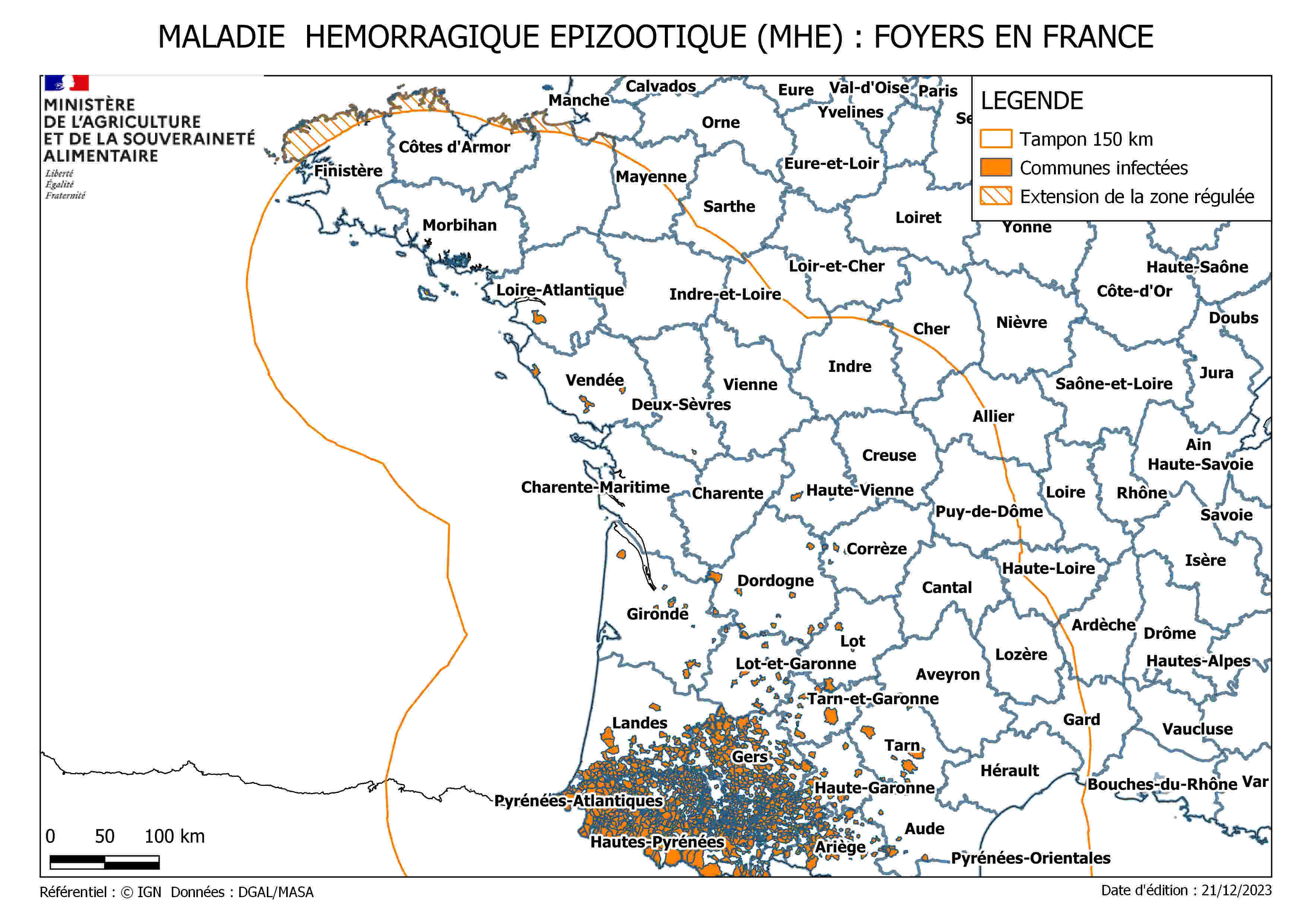
The first outbreaks of epizootic hemorrhagic disease (EHD) were declared in France in September 2023 on cattle farms in the southwest. This infectious disease caused by a virus is transmitted exclusively by midges of the genus Culicoides , the same as those of bluetongue (BFT). The detection of MHE outbreaks leads to specific control and prevention measures within a radius of 150 km around the outbreaks. This restricted zone can be viewed below (map). The list of municipalities included in it is also downloadable.

As of December 21, 3,671 outbreaks of epizootic hemorrhagic disease (EHD) were recorded in France on farms. These outbreaks concern the following 20 departments: Pyrénées-Atlantiques, Hautes-Pyrénées, Haute-Garonne, Gers, Landes, Ariège, Aude, Tarn, Lot-et-Garonne, Gironde, Tarn-et-Garonne, Dordogne, Corrèze, Vendée, Deux-Sèvres, Loire-Atlantique, Lot, Haute-Vienne, Morbihan and Pyrénées-Orientales.

A study is underway in infected farms to consolidate mortality and morbidity data. In almost all cases, the care provided allows sick animals to recover within a few days.
Concerning recent developments in the situation of MHE in Europe, Switzerland had notified in the first half of October two outbreaks of MHE in the canton of Bern and in the canton of Jura. Measures had been introduced in the French departments covered by the 150 kilometer radius from these outbreaks. However, these two outbreaks were canceled on October 24 by the Swiss authorities, allowing the measures taken on the French side to be immediately lifted.


Mapping of the regulated area under the MHE from outbreaks in the southwest (as of December 21, 2023)

20231221%20MHE%20Foyers%20v2.jpeg


​...
https://agriculture.gouv.fr/mhe-la-maladie-hemorragique-epizootique
 
Translation Google

​January 5, 2024 Info +

Epizootic hemorrhagic disease (EHD): update on an emerging disease
...
As of January 3, 2024, 3,708 outbreaks of epizootic hemorrhagic disease (EHD) were recorded in France on farms. These outbreaks concern the following 20 departments: Pyrénées-Atlantiques, Hautes-Pyrénées, Haute-Garonne, Gers, Landes, Ariège, Aude, Tarn, Lot-et-Garonne, Gironde, Tarn-et-Garonne, Dordogne, Corrèze, Vendée, Deux-Sèvres, Loire-Atlantique, Lot, Haute-Vienne, Morbihan and Pyrénées-Orientales.
...
https://agriculture.gouv.fr/mhe-la-maladie-hemorragique-epizootique
 
Translation Google

January 16, 2024 Info +

Epizootic hemorrhagic disease (EHD): update on an emerging disease
...
As of January 11, 2024, 3,729 outbreaks of epizootic hemorrhagic disease (EHD) were recorded in France on farms.

These outbreaks concern the following 20 departments: Pyrénées-Atlantiques, Hautes-Pyrénées, Haute-Garonne, Gers, Landes, Ariège, Aude, Tarn, Lot-et-Garonne, Gironde, Tarn-et-Garonne, Dordogne, Corrèze, Vendée, Deux-Sèvres, Loire-Atlantique, Lot, Haute-Vienne, Morbihan and Pyrénées-Orientales.
...
https://agriculture.gouv.fr/mhe-la-maladie-hemorragique-epizootique
 
Translation Google

February 9, 2024 Info +

Epizootic hemorrhagic disease (EHD): update on an emerging disease
...
As of February 8, 2024, 3,853 outbreaks of epizootic hemorrhagic disease (EHD) were recorded in France on farms. These outbreaks concern the following 20 departments: Pyrénées-Atlantiques, Hautes-Pyrénées, Haute-Garonne, Gers, Landes, Ariège, Aude, Tarn, Lot-et-Garonne, Gironde, Tarn-et-Garonne, Dordogne, Corrèze, Vendée, Deux-Sèvres, Loire-Atlantique, Lot, Haute-Vienne, Morbihan and Pyrénées-Orientales.
...

https://agriculture.gouv.fr/mhe-la-maladie-hemorragique-epizootique
 
Translation Google

Now 16 Dordogne farms affected by MHE, bovine hemorrhagic disease

Dordogne
From Lisa Guinic
Tuesday February 20, 2024 at 7:59 p.m.
By France Blue Périgord

According to the Dordogne prefecture, 16 cattle farms are affected by MHE, epizootic hemorrhagic disease, in the department. No animal died, according to the health defense group. The State is deploying two exceptional aid schemes for the farmers concerned.

At the beginning of November, there were three cases in Dordogne. There are now 16 farms affected by MHE , the disease which affects cattle, in the department. No animal would have died from this virus transmitted by midges and whose symptoms resemble a serious flu, with abscesses and ulcers.

According to Nicolas Corboz, director of the health defense group (GDS), only a few cattle are affected on each farm concerned, we are talking about 3-4 cows maximum . The cases were detected in the municipalities of Beauronne, Eymet, Lanouaille, La Roche-Chalais, Lavaur, Mauzens-et-Miremont, Montcaret, Naussannes, Pontours, Saint-Cyr-les-Champagnes, Saint-Martial-de-Nabirat, Saint-Pompont, Soulaures and Thénac.

https://www.francebleu.fr/infos/agr...la-mhe-la-maladie-hemorragique-bovine-9295991
 
Translation Google

April 29, 2024 Info +

Epizootic hemorrhagic disease (EHD): update on an emerging disease

The first outbreaks of epizootic hemorrhagic disease (EHD) were declared in France in September 2023 on cattle farms in the southwest. This infectious disease caused by a virus is transmitted exclusively by midges of the Culicoides genus , the same as those of bluetongue (BFT). The detection of MHE outbreaks leads to specific control and prevention measures within a radius of 150 km around the outbreaks. This restricted zone can be viewed below (map). The list of municipalities included in it is also downloadable.

As of April 25, 2024, 4,275 outbreaks of epizootic hemorrhagic disease (EHD) have been recorded in France on farms. These outbreaks concern the following 20 departments: Pyrénées-Atlantiques, Hautes-Pyrénées, Haute-Garonne, Gers, Landes, Ariège, Aude, Tarn, Lot-et-Garonne, Gironde, Tarn-et-Garonne, Dordogne, Corrèze, Vendée, Deux-Sèvres, Loire-Atlantique, Lot, Haute-Vienne, Morbihan and Pyrénées-Orientales.

A study is underway in infected farms to consolidate mortality and morbidity data. In almost all cases, the care provided allows sick animals to recover within a few days.
...

https://agriculture.gouv.fr/mhe-la-maladie-hemorragique-epizootique
 
Translation Google

10074_061_RZ_vache_Blonde_Aquitaine_%C3%A9table_stabulation.jpg


August 23, 2024 Info +

Epizootic hemorrhagic disease (EHD): update on an emerging disease
,,,
The first outbreaks of epizootic hemorrhagic disease (EHD) were declared in France in September 2023 in cattle farms in the southwest. This infectious disease caused by a virus is transmitted exclusively by midges of the genus Culicoides , the same as those of bluetongue (BT). The detection of EHD outbreaks leads to specific control and prevention measures within a radius of 150 km around the outbreaks. This regulated zone can be viewed below (map). The list of municipalities included in it can also be downloaded.

Between June 1 and August 22, 2024, 208 outbreaks of epizootic hemorrhagic disease (EHD) were recorded in France in livestock farms due to the resumption of vector activity (i.e. culicoides). The departments affected by EHD since its emergence in 2023 in France are: Pyrénées-Atlantiques, Hautes-Pyrénées, Haute-Garonne, Gers, Landes, Ariège, Aude, Tarn, Lot-et-Garonne, Gironde, Tarn-et-Garonne, Dordogne, Corrèze, Vendée, Deux-Sèvres, Loire-Atlantique, Lot, Haute-Vienne, Morbihan, Pyrénées-Orientales, Aveyron and Maine-et-Loire.

A study is underway in infected farms to consolidate mortality and morbidity data. The care implemented allows in almost all cases a cure of sick animals within a few days.


Mapping of the regulated area under MHE from the southwest outbreaks (as of 22 August 2024)

20240822_mhe_zone_regulee.jpg


...
https://agriculture.gouv.fr/mhe-la-maladie-hemorragique-epizootique
 
Translation Google

September 2, 2024 Info +

Epizootic hemorrhagic disease (EHD): update on an emerging disease
...

The first outbreaks of epizootic hemorrhagic disease (EHD) were declared in France in September 2023 in cattle farms in the southwest. This infectious disease caused by a virus is transmitted exclusively by midges of the genus Culicoides , the same as those of bluetongue (BT). The detection of EHD outbreaks leads to specific control and prevention measures within a radius of 150 km around the outbreaks. This regulated zone can be viewed below (map). The list of municipalities included in it can also be downloaded.

Between June 1 and August 29, 2024, 344 outbreaks of epizootic hemorrhagic disease (EHD) were recorded in France in livestock farms due to the resumption of vector activity (i.e. culicoides). The departments affected by EHD since June 1, 2024 are: Haute-Garonne, Gers, Pyrénées-Atlantiques, Hautes-Pyrénées, Landes, Maine-et-Loire, Pyrénées Orientales, Ariège, Dordogne, Tarn, Tarn-et-Garonne, Aude, Aveyron, Loire-Atlantique, Lot, Lot-et-Garonne.

A study is underway in infected farms to consolidate mortality and morbidity data. The care implemented allows in almost all cases a cure of sick animals within a few days.
...

https://agriculture.gouv.fr/mhe-la-maladie-hemorragique-epizootique
 
Back
Top