• FluTrackers.com Inc. does not provide medical advice. Information on this web site is collected from various internet resources, and the FluTrackers board of directors makes no warranty to the safety, efficacy, correctness or completeness of the information posted on this site by any author or poster. The information collated here is for instructional and/or discussion purposes only and is NOT intended to diagnose or treat any disease, illness, or other medical condition. Every individual reader or poster should seek advice from their personal physician/healthcare practitioner before considering or using any interventions that are discussed on this website. By continuing to access this website you agree to consult your personal physican before using any interventions posted on this website, and you agree to hold harmless FluTrackers.com Inc., the board of directors, the members, and all authors and posters for any effects from use of any medication, supplement, vitamin or other substance, device, intervention, etc. mentioned in posts on this website, or other internet venues referenced in posts on this website.
  • We are not asking for any donations. Do not donate to any entity who says they are raising funds for us.

France - Outbreak of lumpy skin disease in cattle 2025-2026

Pathfinder

Editor, Senior Moderator
Translation Google

June 29, 2025 Press Release

An outbreak of lumpy skin disease confirmed on a cattle farm in Savoie


An outbreak of contagious lumpy skin disease (CLD) was confirmed for the first time in France on June 29, 2025.

This strictly animal disease only affects cattle, zebus, and buffalo. Other animal species, such as sheep and goats, are not affected.

LSD is not transmissible to humans , either through contact with infected cattle, through food, or through insect bites. There is also no risk to human health from the consumption of products derived from these animals.

On the other hand, this animal disease is highly detrimental to the health of cattle and leads to significant production losses.

It is transmitted between animals through the bite of insects such as stomoxys or horseflies (flies). It is particularly present in North Africa and, since June 22, in Italy, where authorities have confirmed this disease, also for the first time, in Sardinia and then in Lombardy.

The affected cattle farm in France is located in Savoie. The cattle showed suggestive clinical signs (fever and skin nodules). On June 29, the national reference laboratory confirmed the infection with the LSD virus.

Consequently, and in accordance with European law which requires the eradication of this disease, by prefectural decree declaring the infection, the outbreak will be depopulated in order to prevent this disease from taking hold and spreading.

In addition, a regulated zone with a radius of 50 kilometers around this outbreak establishes, by prefectural decrees, preventive measures by strengthening veterinary surveillance, as well as restrictions in particular on the movement of cattle aimed at preventing the disease from spreading to other farms, in particular beyond this regulated zone.

The prefectures of the departments of Savoie, Haute-Savoie, Ain, and Isère are affected by the 50-kilometer restriction perimeter around the outbreak. Investigations will be conducted to identify the source of the infection.

To learn more about lumpy skin disease:

https://agriculture.gouv.fr/maladies-animales


https://agriculture.gouv.fr/un-foyer-de-dermatose-nodulaire-confirme-dans-un-elevage-bovin-en-savoie

 
Translation Google

Lumpy skin disease (LSD) - Update in Savoie

Updated on 07/07/2025


Dermatose-nodulaire-contagieuse-DNC-Point-de-situation-en-Savoie_large.png


Updated Monday, July 7, 2025:

Following the collection of samples over the weekend, both outbreaks in the commune of Entrelacs tested positive. A new suspected case is also under investigation in Saint-Jean-de-Chevelu.


What is an epidemiological unit and how is it defined?

In accordance with national guidelines and in order to stop the spread of the disease, health authorities think in terms of epidemiological units. A unit corresponds to a group of cattle living or having lived in close proximity to each other over the past 28 days. A suspicion refers to a unit in which at least one cattle is believed to be carrying LSD. A single farm can therefore contain several epidemiological units.


How are depopulation decisions made?

The decision to depopulate an entire unit is made once the suspicion is confirmed, meaning that at least one bovine is found to be carrying LSD. To date, 62 cattle have had to be euthanized in accordance with national guidelines.


How does a veterinary visit take place?

During their visit, veterinarians visit the farm to examine the various herds identified as epidemiological units. After establishing a census of the animals, potentially scattered throughout the pastures, they take the appropriate biological samples based on the apparent condition of each bovine. These samples are sent to the national reference laboratory in Montpellier for analysis.

Within the 20km protection zone, 180 farms must be visited.

→ For more information, a frequently asked questions section is available on the website of the Ministry of Agriculture and Food Sovereignty

Updated Friday, July 4, 2025:

Following the confirmation of a first outbreak in Entrelacs, a second outbreak of lumpy skin disease was confirmed this Friday, July 4, in the immediate vicinity of the first.
A depopulation plan was subsequently implemented there.


Of the three other suspected outbreaks identified, one was negative and the other two are still being analyzed and, depending on the results, will be subject to appropriate measures.

Veterinary teams deployed in the field continue to conduct the necessary investigations to detect positive cases of LSD in all farms in regulated areas. The priority remains to stop the spread of the disease.

The medical-psychological emergency unit has been activated for the entire agricultural community.

Updated on Thursday, July 3, 2025:

This Thursday, July 3, 2025, Vanina Nicoli, Prefect of Savoie, activated the departmental operational center (COD) to coordinate all the services involved in the management of contagious bovine lumpy skin disease in Savoie.


Following Italy last week, France confirmed for the first time on June 29, 2025, an outbreak of bovine lumpy skin disease (LSD) on a dairy cattle farm in Savoie, in the commune of Entrelacs.

LSD is a disease that is not transmissible to humans. This strictly animal vector-borne disease affects only cattle, zebus, and buffalo. It is transmitted between animals through the bite of insects such as stomoxys (anthrax flies) or horseflies. Other animal species, such as sheep and goats, are not affected.

Animal diseases are categorized by European regulations according to their risk of spread, their economic impact on the livestock sector and the necessary control measures.
Classified as a category A disease, LSD is a disease requiring mandatory eradication, which requires the implementation of management measures without delay.
European regulations therefore prescribe the depopulation of all infected herds and the establishment of regulated zones around outbreaks to prevent the disease from taking hold and spreading. These zones affect the departments of Savoie, Haute-Savoie, Ain, and Isère.

Situation in Savoie

The restricted area, with a radius of 50 kilometers, was established around the outbreak on June 29. Within this restricted area, measures were immediately prescribed to prevent the spread of the disease.

The regulated zone, established by prefectural decree, is composed
- a 20km protection zone around the outbreak, covering 50 municipalities in the department
- a 50km surveillance zone around the outbreak, including 150 municipalities in Savoie

Carte-DNC_reference.png


The exhaustive list of municipalities concerned is indicated in the decree dated June 29, 2025 .

Following confirmation of the outbreak in Entrelacs, the depopulation of the 52 affected cattle was carried out on Monday, June 30.

On Wednesday, July 2, the Prefect of Savoie, along with the Prefect of Haute-Savoie, met with breeders and representatives of the sectors of the two Savoie regions to explain the measures taken and provide them with perspectives.

The Departmental Directorate of Employment, Labor, Solidarity and Population Protection (DDETSPP) has activated a telephone line to answer questions from breeders: 04 56 11 05 73 from Monday to Friday from 8:30 a.m. to 6:00 p.m.

To date, four new suspected outbreaks around the original outbreak are being investigated by the veterinary teams deployed on the ground.

The priority must be to stop the spread of the disease by carrying out a complete census of animals showing symptoms of LSD.

The Prefect of Savoie underlines the importance of the collective work taking place with the interdepartmental chamber of agriculture, breeders, veterinarians and state services to act quickly and preserve healthy herds.

As a reminder, if a cattle farm is located in a regulated zone , it is subject to the following measures:
– biosecurity measures:
  • Keep cattle separate from other kept species.
  • Fight against insects present in buildings and surrounding areas.
  • Limit access to farms to people essential to their management who must wear single-use protective clothing.
  • Keep a register of people entering the farms.
  • Clean, disinfect and disinfest means of transport and equipment at the entrance and exit of farms.
  • Disinfect and disinfect people entering and leaving farms.
  • Store corpses in waterproof containers.
– increased health surveillance measures:
  • A sample of cattle establishments located in the surveillance zone will be subject to veterinary visits to check the health status of the animals by clinical examination, check the breeding register and, if necessary, take samples in the surveillance zone.
  • Report any appearance of signs indicating DNC to the DDETSPP.
– measures to limit animal movements:
  • Ban on the movement of cattle and animals susceptible to DNC (in particular no collection of calves and young cattle).
  • Ban on the movement of semen and germinal products from susceptible species.
  • Ban on shows, markets, fairs, gatherings, etc.
  • Avoid all movement of people, domestic mammals, vehicles and equipment in farms holding sensitive species.
  • Take special precautions if these movements are unavoidable (change clothing, park away from the farm, cleaning, disinfection, etc.).
If DNC is suspected, farmers must notify their health veterinarian immediately .
Number dedicated to breeders in Savoie

The Departmental Directorate of Employment, Labor, Solidarity and Population Protection (DDETSPP) has activated a telephone line to answer questions from breeders. ✆ 04 56 11 05 73 Monday to Friday from 8:30 a.m. to 6:00 p.m.
Useful resources

Technical sheets, animal movement certificates, etc.
Press release from the Ministry of Agriculture and Food Sovereignty
Prefectural decree of 02/07/2025 determining a regulated zone following an outbreak of contagious bovine lumpy skin disease in Savoie and repealing the decree of 29/06/2025
➝ To find out more about contagious lumpy skin disease: agriculture.gouv.fr/maladies-animales


https://www.savoie.gouv.fr/Actualit...-contagieuse-DNC-Point-de-situation-en-Savoie
-----------------------------------------

Cattle Dermatosis: France Awaits Vaccine Delivery and Seeks Veterinary Reinforcements


Jonathan Landais
Published onTuesday, July 8, 2025 at 5:57 p.m.

France is awaiting delivery of vaccines for its cattle herd following the discovery at the end of June of a first outbreak of lumpy skin disease (LSD), a disease affecting cattle but not transmissible to humans, Agriculture Minister Annie Genevard said on Tuesday.

"As soon as we have the vaccines made available by the European Union - they come to us from South Africa - we will be able to put in place a vaccination strategy with ANSES (the French National Agency for Food Safety) and the services of my ministry ," she said, responding to a question in the National Assembly from Savoie MP Marina Ferrari on the action planned by the government. Four outbreaks have been identified in Savoie since June 29 and a fifth is also suspected in Saint-Jean-de-Chevelu.

Analyses "in 48 hours"

The government has asked approved laboratories to produce analysis results "within 48 hours" and is considering the possibility of providing additional veterinary support, particularly for veterinary students, the minister said. The MP is calling for the approval of local laboratories in Savoie to save time, as the laboratory competent to analyze samples is located in Montpellier. Vaccines are expected by the end of July.

"On the issue of exports, as soon as you vaccinate, you are no longer an unaffected country, which does indeed compromise exports, but we can't have it all: vaccination and the right to export," the minister added regarding "this new misfortune that is hitting French livestock farms" and which "comes to us from Italy." "We are working on a reflection to aim for tax neutrality in compensation," she also added.

To date, 62 cattle affected by the disease have been euthanized in Savoie to prevent its spread, "in accordance with European law ," the ministry emphasized. Measures have also been put in place within a 50 km radius of the infected farm, with increased veterinary surveillance and restrictions on the movement of cattle.

LSD, which affects cattle, buffalo and zebus, is transmitted by insect bites such as "stomoxe" (a biting fly) or "horsefly" , but is not transmissible to humans, neither by contact with infected cattle, nor through food, nor by insect bites.

https://www.francebleu.fr/infos/agr...france-attend-la-livraison-de-vaccins-5392068
 
France - Lumpy skin disease virus (Inf. with) - Follow up report 3
...
REPORT DATE

2025/07/11
...
image.png
​...

​NEW OUTBREAKS
ob_161050 - DNC_2025_037 - Annecy
ob_160967 - DNC_2025_014 - Chambéry
ob_161041 - DNC_2025_036 - Chambéry
ob_161040 - DNC_2025_035 - Chambéry
ob_161039 - DNC_2025_034 - Chambéry
ob_161038 - DNC_2025_033 - Chambéry
ob_160977 - DNC_2025_028 - Chambéry
ob_160975 - DNC_2025_027 - Chambéry
ob_160971 - DNC_2025_019 - Annecy
ob_160969 - DNC_2025_017 - Chambéry
ob_160739 - DNC_2025_010 - Chambéry
ob_160738 - DNC_2025_008 - Chambéry
ob_160961 - Chambéry
ob_160654 - DNC_2025_002 - Chambéry

PREVIOUSLY REPORTED OUTBREAKS
ob_160408 - DNC_2025001 - Chambéry

...
https://wahis.woah.org/#/in-review/6584​
 
Translation Google

Lumpy skin disease (LSD) - Update in Savoie

Updated on 11/07/2025


Dermatose-nodulaire-contagieuse-DNC-Point-de-situation-en-Savoie_large.png


Updated Thursday, July 10, 2025:

Lumpy skin disease (LSD) is a disease that is not transmissible to humans. This strictly animal vector-borne disease affects only cattle, zebu, and buffalo. It is transmitted between animals through the bite of insects such as stomoxys (anthrax flies) or horseflies. Other animal species, such as sheep and goats, are not affected. Animal diseases are categorized by European regulations based on their risk of spread, their economic impact on the livestock sector, and the necessary control measures.

Classified as a Category A disease, LSD is a disease requiring mandatory eradication, requiring immediate management measures. European regulations prescribe the depopulation of all infected herds and the establishment of regulated zones around outbreaks to prevent the disease from establishing and spreading. These zones affect the departments of Savoie, Haute-Savoie, Ain, and Isère.

Seven outbreaks have already been identified in the department. At this stage, they are concentrated in the commune of Entrelacs, which has a total of 24 cattle farms. The euthanasia of herds affected by at least one infection, which began on July 1, continued today. One farmer prevented the euthanasia of part of his herd. Aside from this situation, all infected outbreaks have been subject to depopulation measures. Since the beginning of the epidemic, 143 cattle have had to be euthanized in accordance with national guidelines.

It is important to emphasize that the absence of symptoms does not guarantee that cattle are free of the disease. If they carry the disease, they can continue to transmit it to other cattle via biting flies or horseflies.

The veterinary teams deployed in the field continue to conduct the necessary investigations to detect risky situations in all farms in regulated areas.
Since the first outbreak of lumpy skin disease appeared in Savoie, strict measures have been taken to combat the spread of the disease. These measures have so far made it possible to contain the epidemic within a very limited area.

Vanina Nicoli, Prefect of Savoie, reaffirms that the priority of government services is to eradicate the disease as quickly as possible, to prevent it from spreading in France and to preserve the beef industry . The collective work undertaken must continue to protect the herds that are still free of the disease.
...
https://www.savoie.gouv.fr/Actualit...-contagieuse-DNC-Point-de-situation-en-Savoie

 
Translation Google

Marigny-Saint-Marcel

Dermatosis: a second outbreak of the cattle disease detected in Marigny-Saint-Marcel in Haute-Savoie

Leopold Picot
Published onSaturday, July 12, 2025 at 6:54 AM

Lumpy skin disease, an animal disease that is harmless to humans, continues to spread in Haute-Savoie, with the discovery of a second outbreak. The prefecture made the announcement this Friday, July 11, amid a volatile situation in Savoie.

The disease continues to spread. A new herd has been affected by lumpy skin disease (LSD) in Haute-Savoie, in Marigny-Saint-Sarcel, the prefecture announced on the evening of Friday, July 11. This makes two outbreaks of this disease, which affects cattle and is not dangerous to humans, in the department.

An explosive situation in Savoie

In Savoie, seven outbreaks have been detected since the end of June , all around Entrelacs, and the status quo remains, for the time being, at Pierre-Jean Duchêne's farm in Cessens. It was on this farm that two sick cows with LSD were euthanized this week.

The farmer, supported by the Rural Coordination, many other farmers, and village residents, refuses to allow the entire herd to be slaughtered by state services, as required by protocol. On Friday, a representative from the Ministry of Agriculture came to meet with the farmer. He attempted to reassure him that he would receive moral, psychological, and financial support.

The Rural Coordination maintains its position: to maintain and prevent the euthanasia of this herd and future ones, because " it would be a massacre for our livestock ." 143 cattle have been slaughtered since the epidemic began at the end of June.

https://www.francebleu.fr/infos/agr...-marigny-saint-marcel-en-haute-savoie-2615333
 
Lumpy skin disease in Savoie: nearly 200 people mobilized again in Cessens to prevent the slaughter of a herd of cows

Since last week, a Savoie farmer has been refusing to allow health services to carry out a preventive cull to prevent the spread of the animal disease. He is supported in particular by the Rural Coordination and the Peasant Confederation.

Article written by franceinfo , with ICI Pays de Savoie
Radio France
Published07/14/2025 12:20

Nearly 200 people gathered again on Monday, July 14, to prevent the slaughter of a herd of cows in Cessens (Savoie), in which two animals died of lumpy skin disease (LSD) in cattle last week, ICI Pays de Savoie reported.

Like last Thursday, farmers and neighbors came to support the farm of Pierre-Jean Duchêne, who is refusing to slaughter his 121 cows threatened by lumpy skin disease (LSD), following two cases of contamination in his herd. The animal disease, which poses no danger to humans, is spreading in the region. Since last week, the farmer has refused to allow health services to carry out a preventive cull to prevent the spread of LSD. He is supported by the Rural Coordination and the Peasant Confederation.

About fifteen people arrived overnight from Sunday to Monday, fearing they would be blocked by law enforcement. "We arrived at midnight and slept in the building with the cows, with the bare minimum," explains Michael Jacobi, manager of a forestry company, who came with a friend. Even though he doesn't know Pierre-Jean Duchêne personally, "in the business, we support each other." "We don't slaughter an entire herd, behind an entire family, for one or two positive cases ," he says.

Mobilization must continue

The protesters who came in support were retired workers from the industry, while others came from the city or the surrounding countryside, like Isabelle Mathy, a dairy farmer in Ain. She traveled 50 km to show her support for Pierre-Jean Duchêne. "When there are no more breeders, when there is no more tome, it will be sad (...) my father, also a breeder, shot himself in the heart when I was 19, he gave in to the pressure, the stress ." She spoke of "the trauma of losing a herd."

Around 5 a.m., 70 people gathered in front of the dairy farm buildings. Equipment was installed to block the entrance to the farm. A few hours later, there were nearly 200 people, arriving drop by drop, according to ICI Pays de Savoie.(New window)Pierre-Jean Duchêne has not yet had any additional cases on his farm. The mobilization is affecting him.

"It's heartwarming, we've received so many messages of support from within and outside the industry."
Pierre-Jean Duchêne, farmer
to ICI Pays de Savoie

The Rural Coordination is protesting against the waste of discarded meat, "tons of meat" , "even though it is not contaminated, it is edible!", criticizes Jérémy Béchet-Barbat, co-president of the Rural Coordination. The union is calling for the suspension of the slaughter order, tests on the cows, and a veterinary study until the end of the incubation period in ten days. It hopes that this herd will also be used to learn more about this disease, which is little known in France.

Meanwhile, the mobilization is expected to continue in the coming days. About ten kilometers away, just under one hundred cows will be slaughtered on Monday in Marigny-Saint-Marcel (Haute-Savoie), following the discovery of two positive cases of dermatitis, ICI Pays de Savoie reports.

https://www.francebleu.fr/infos/agr...er-l-abattage-d-un-troupeau-de-vaches-8789187
 
Translation Google

Skin disease epidemic: "Culling is a radical, but necessary, measure," explains the prefect of Haute-Savoie

By Marie Ameline ⸱ Tuesday, July 15, 2025

Emmanuelle Dubée, Prefect of Haute-Savoie, provides an update on the epidemic of bovine lumpy skin disease affecting the departments of Savoie and Haute-Savoie.

In Haute-Savoie, even though the number of farms affected by lumpy skin disease is lower than in Savoie, it has nevertheless increased in recent days. Five outbreaks on four farms have been identified. On two of the outbreaks, all the animals were slaughtered with the farmers' consent. Last week, 31 animals were slaughtered in Massingy, and this Monday in Marigny-Saint-Marcel, the " depopulation " operation, according to official terminology, involved 98 cattle.

Emmanuelle Dubée, Prefect, said on ICI Pays de Savoie that she understands the incomprehension of some breeders in the face of these total slaughter measures, but she stands by this radical decision.

Emmanuelle Dubée: Following the latest outbreaks detected in Faverges, I issued a new decree on July 14 to extend the perimeter of so-called regulated zones, that is, the municipalities in Haute-Savoie in which cattle movements are only authorized with a pass from the veterinary services. 208 municipalities are currently affected. And I insist on this measure of non-movement of cattle, which is our only chance to prevent further contamination. I know that some farmers will try to move their animals elsewhere to keep them away from the disease, but this is the complete opposite of what should be done. The only effective measures are to keep cattle confined on the farm and to cull the entire herd even if only one cow has developed the disease.

ICI: This is a radical solution that arouses incomprehension and opposition, and not only among breeders. Why, when the disease is not dangerous to humans and dairy products are not contaminated, why slaughter entire herds?

Yes, it's definitely a radical solution, and I can see the shock it's going to be for a farmer who's attached to his animals. This measure doesn't please anyone. For government services, it's not an easy task either. But it's the future of our dairy industry in Savoie and Haute-Savoie that's at stake because if we don't stop the spread of the virus, the risk is an explosion such that we would no longer be able to guarantee the existence of this breed that has been genetically improved for years, because without that, where will the cows come from that we want to put back on decimated farms as quickly as possible? If neighbors are affected and neighbors' neighbors... That's what must be stopped today. I think farmers are able to understand this and act responsibly and in solidarity with each other.

ICI​: In short, what you are telling us is that it is better, even if it is difficult and painful to hear, to sacrifice a few herds rather than risk losing X times more in a few days or weeks?

ED: That's exactly it. It's a race against time. Our efforts must be swift and radical in the early stages, and that's why we must carry out a complete cull as quickly as possible to save as many neighboring farms as possible. We're doing this for them and so that we can one day repopulate the homes that have unfortunately been culled.


https://www.radiofrance.fr/francebl...xplique-la-prefete-de-la-haute-savoie-9958171
 
Translation Google

Savoy
Haute-Savoie


Lumpy skin disease in cattle: 24 outbreaks identified and a national strategy to curb the epidemic

Faustine Mauerhan
Published onThursday, July 17, 2025 at 7:39 AM

The detection of a case of lumpy skin disease on a cattle farm will lead to the complete slaughter of animals in the infected area and a mandatory vaccination campaign in the surrounding area, the Ministry of Agriculture announced on Wednesday. Twenty-four outbreaks have now been identified.

Faced with the increasing number of cases of contagious bovine lumpy skin disease (CSD) in France, particularly in the Alps , the Minister of Agriculture, Annie Genevard, held an extraordinary meeting of the National Steering Committee for Animal and Plant Health Policy (CNOPSAV) this Wednesday, according to a press release from the Ministry of Agriculture. At the end, a national strategy was adopted which includes the complete slaughter of the herd to which the new sick animal(s) belong.
...

https://www.francebleu.fr/infos/agr...elles-mesures-pour-freiner-l-epidemie-7574117

----------------------------------------------------------------------------------------
_DSC8579_CNOPSAV.jpg.webp


July 16, 2025

Press Release


Lumpy skin disease (LSD): Health stakeholders approve LSD strategy

Following the appearance in Savoie, in the commune of Entrelacs, on June 29 and for the first time in France, of an outbreak of contagious bovine lumpy skin disease (CLS), and faced with the rapid increase in outbreaks, the Minister of Agriculture and Food Sovereignty, Annie Genevard, held an extraordinary meeting on July 16 of the National Steering Committee for Animal and Plant Health Policy (CNOPSAV), the "Health Parliament" which brings together the agricultural and veterinary professions and scientists specializing in this disease.

LSD is not transmissible to humans, either through contact with infected cattle, or through the consumption of products derived from these animals (meat, milk, cheese), or through insect bites. It is spread by the movement of infected animals or via insect "vectors" (horseflies and biting flies/stomoxys).

The discussions between health stakeholders in CNOPSAV resulted, on the basis of presentations by experts and scientists (ANSES, CIRAD[ii], CNOV[iii], FSVF[iv], SNVEL[v], SNGTV[vi], DGAL[vii] and CGAAER[viii]) in unanimously validating the strategy based on imperative measures to stop the spread of the virus and protect the French cattle herd, except for one vote:

  • Depopulation by total slaughter of infected foci (epidemiological units) to extinguish the sources of the virus, in accordance with European obligations;
  • The establishment of regulated areas, where reinforced protection and surveillance measures apply, in particular the limitation of movements;
  • A mandatory vaccination campaign in these regulated areas.
Comprehensive and individualized support for breeders affected by outbreaks is planned, including compensation and psychological support.

The minister announced the rollout of the vaccination campaign. Just 48 hours after the first outbreak was confirmed, the government ordered enough vaccine doses from the European Commission's vaccine bank to cover all animals in the regulated zones. The vaccines will be available for the rollout of the vaccination campaign from the beginning of next week.

Minister Annie Genevard also reaffirmed the State's full mobilization to stop the spread of the virus, protect livestock in the two Savoie departments and throughout the country, and preserve France's agricultural and food sovereignty. She praised the sense of responsibility and solidarity of livestock farmers and all those working alongside them.
"If we do not quickly dry up the source of the virus by completely depopulating the outbreaks, we will not control the viral spread and the number of outbreaks will multiply."

Laurent Perrin, Administrator and former President of SNVEL
"With the tests we have available and PCR research, it is possible to not detect the disease even though the cattle are infected, because viral circulation is intermittent and the viral load may be too low to be detected."

Eric Cardinale, Scientific Director of Animal Health and Welfare - ANSES
"You will find us at your side. We want to protect the general interest of French livestock farming, and that is why the Chambers of Agriculture fully support the measures taken by the State and the Minister of Agriculture and Food Sovereignty. But the State must also support the affected farmers, each of whom is experiencing a tragedy on their farms."

Sébastien Windsor, President of the French Chambers of Agriculture
"We are in a race against time to eradicate the virus and prevent it from spreading to all French livestock. The measures, however harsh they may be, which were validated this evening by the livestock industry based on the recommendations of veterinary authorities and scientists, are essential to protect French livestock. I am fully committed to supporting farmers in the face of this serious emerging disease. I know their attachment to their animals. This is why the State is standing alongside farmers in Savoie and Haute-Savoie to provide them with support, compensation, and the ability to quickly rebuild their herds."

Annie Genevard, Minister of Agriculture and Food Sovereignty French National Agency for Food, Environmental and Occupational Health Safety

[ii] International Cooperation Centre for Agronomic Research for Development
[iii] The National Order of Veterinarians
[iv] The Federation of Veterinary Unions of France
[v] The National Union of Liberal Practice Veterinarians
[vi] The National Society of Technical Veterinary Groups
[vii] The General Directorate of Food of the Ministry of Agriculture and Food Sovereignty
[viii] The General Council for Food, Agriculture and Rural Areas


https://agriculture.gouv.fr/dermato...teurs-du-sanitaire-approuvent-la-strategie-de
​​
 
04101_193_RZ_indemnisation_DNC.jpg.webp


July 21, 2025

Press Release


Lumpy skin disease in cattle: compensation arrangements in the event of depopulation by order of the State are evolving to provide better financial support for livestock farms


For the first time, France has been affected by lumpy skin disease (LSD) in cattle. Between June 29, the date the disease emerged in Savoie, and July 20, 33 outbreaks were confirmed in Savoie and Haute-Savoie. Due to the characteristics of this disease and scientific advice, the eradication of LSD is only possible through a combination of (i) total depopulation of outbreaks, i.e., the slaughter of all cattle present on an infected farm (animals showing clinical signs or not, in accordance with current European regulations), (ii) mass vaccination of cattle in regulated areas, implemented since July 18, and (iii) biosecurity measures, including movement restrictions.

Aware, beyond the significant economic impact on affected farms, of the scale of the human tragedy this situation represents for farmers, the Minister of Agriculture and Food Sovereignty, Annie Genevard, has sought to develop the compensation system for farmers. Enhanced psychological support is also being put in place to assist professionals facing these challenges.


Classic compensation procedure

According to the 2001 decree, the compensation procedure requires an expert appraisal to assess the total amount of compensation, calculated based on the damages incurred by each slaughtered animal. The average time taken for this procedure may vary, but Minister Annie Genevard is committed to ensuring that it is completed as quickly as possible.

Measures taken in response to the emergency

Given the urgency of quickly rebuilding the cash flow of affected breeders and of supporting as much as possible the recapitalization of the livestock in this area of excellence, two exceptional measures have been taken.
  1. The timeframe for paying the first amounts of compensation is shortened with the granting of a cash advance in the days following the slaughter to deal with the emergency. Each slaughtered animal will thus be subject to a fixed advance, depending on its category. This advance will be paid without waiting for the conclusions of the expert appraisal aimed at assessing the total amount of compensation, calculated according to the damage related to each slaughtered animal.
  2. The period of unproductivity of the farm considered in the compensation system is extended . From now on, the ban on re-establishing animals is taken into account. The period of compensation for the temporary production deficit, which was currently a maximum of 3 months for dairy farms, and a maximum of 12 months for suckler farms, is now increased by the duration of the ban on re-establishing animals.
This second development now constitutes the rule in the event of slaughter of animals on administrative orders. Thus, beyond the DNC alone, this rule applies to all animal diseases of bovine, ovine and caprine species whose management measures are the responsibility of the State.

With these measures, Annie Genevard is fulfilling her commitment to livestock farmers, expressed to all health stakeholders on July 16 during an extraordinary meeting of the Health Parliament (national steering committee for animal and plant health policy).

"The State is doing everything possible to quickly eradicate lumpy skin disease in cattle and support farmers whose herds have been affected. Rapid compensation is one of the key levers. Following the launch of the vaccination campaign on July 19 in record time, I have decided to strengthen the compensation system to quickly support the cash flow of farms affected by this disease and assist in the rebuilding of the excellent livestock in this Savoyard and Haute-Savoie region. All farms affected by lumpy skin disease are receiving financial and psychological support from the State."

Annie Genevard
Minister of Agriculture and Food Sovereignty


https://agriculture.gouv.fr/dermato...ites-dindemnisation-evoluent-pour-un-meilleur
 
France - Lumpy skin disease virus (Inf. with) - Follow up report 7
...
REPORT DATE
2025/07/23
...
EPIDEMIOLOGICAL COMMENTS

The epidemiological investigation on the first outbreak is still ongoing. At this stage, the origin of the infection has not been identified. As of 23 July 2025, 34 outbreaks have been confirmed among 24 different farmers. Only seven municipalities are affected.
...
image.png - Click image for larger version  Name:	image.png Views:	1 Size:	23.2 KB ID:	1016622
​...

NEW OUTBREAKS

ob_161671 - DNC_2025_068 - Albertville

UPDATED OUTBREAKS

ob_161489 - DNC_2025_051 - Chambéry
ob_161488 - DNC_2025_50 - Annecy
ob_161276 - DNC_2025_046 - Chambéry
ob_161274 - DNC_2025_045 - Annecy

PREVIOUSLY REPORTED OUTBREAKS

ob_161614 - DNC_2025_067 - Annecy
ob_161613 - DNC_2025_066 - Annecy
ob_161612 - DNC_2025_065 - Annecy
ob_161611 - DNC_2025_059 - Annecy
ob_161610 - DNC_2025_064 - Annecy
ob_161609 - DNC_2025_062 - Annecy
ob_161492 - DNC_2025_060 - Annecy
ob_161491 - DNC_2025_055 - Annecy
ob_161490 - DNC_2025_054 - Chambéry
ob_161487 - DNC_2025_049 - Annecy
ob_161272 - DNC_2025_044 - Annecy
ob_161271 - DNC_2025_043 - Annecy
ob_161268 - DNC_2025_042 - Annecy
ob_161050 - DNC_2025_037 - Annecy
ob_161277 - DNC_2025_047 - Chambéry
ob_160967 - DNC_2025_014 - Chambéry
ob_161041 - DNC_2025_036 - Chambéry
ob_161040 - DNC_2025_035 - Chambéry
ob_161039 - DNC_2025_034 - Chambéry
ob_161038 - DNC_2025_033 - Chambéry
ob_160977 - DNC_2025_028 - Chambéry
ob_160975 - DNC_2025_027 - Chambéry
ob_160971 - DNC_2025_019 - Annecy
ob_160969 - DNC_2025_017 - Chambéry
ob_160739 - DNC_2025_010 - Chambéry
ob_160738 - DNC_2025_008 - Chambéry
ob_160961 - Chambéry
ob_160654 - DNC_2025_002 - Chambéry
ob_160408 - DNC_2025001 - Chambéry

https://wahis.woah.org/#/in-review/6584​​
 
Translation Google

Unexpected
Tour de France 2025: Route modified due to bovine dermatosis epidemic in Savoie


Faced with the risk of peasant mobilisation at the sporting event, the route for this Friday, July 25, will be reduced by almost 35 kilometres, causing the runners to start an hour later.

by Margaux Gable
published today at 10:37 a.m.

Euthanasia of livestock has been occurring one after the other for three weeks. Faced with lumpy skin disease , an extremely viral disease, not transmissible to humans, which is affecting dairy herds in Savoie and Haute-Savoie, the health protocol is very strict : in the slightest case, the entire herd must be slaughtered. Including healthy cows. As rural discontent mounts and a new outbreak was detected on Wednesday, July 23, in a herd located in the Col des Saisies, which was supposed to be crossed by the Tour de France, the organizers announced that they are changing this Friday's route.

"Given the dismay of the affected breeders and in order to preserve the serenity of the race, it was decided, in agreement with the authorities, to modify the route of the 19th stage Albertville-La Plagne and not to cross the Col des Saisies," explained the organizers of the sporting event in a press release. This change of plan shortens the stage by nearly 35 kilometers, thus reducing it to a total length of 95 kilometers. The fictitious start has also been modified: it will be given at 2:30 p.m., one hour later than the initially planned time.

"The next two stages of the Tour de France must be blocked"

As anger mounts, organizers' main fear is that the race will be disrupted by a large-scale protest. On Thursday, July 24, Agriculture Minister Annie Genevard was in Chambéry for a meeting with stakeholders in the Savoie and Haute-Savoie agricultural sector. Banners and megaphones in hand, around a hundred protesters took to the square in front of the prefecture, demanding a halt to the total slaughter.

Under the agricultural union's Facebook posts calling for mobilization, one internet user storms: "The next two stages of the Tour de France must be blocked!! It is unacceptable that the State tolerates hundreds, even thousands of vehicle movements that will spread the biting insects that cause the disease." On farms, as the days go by, the numbers swell: 34 outbreaks have been confirmed on 24 different farms, according to the latest report from the Savoie Health Defense Group.

https://www.liberation.fr/sports/cy...s-savoie-20250725_WZIGSUK3GFCGTLIENTHYT6NHCQ/
 
Translation Google

24282_038.jpg.webp

Xavier Remongin/agriculture.gouv.fr

July 28, 2025 Info +

Lumpy skin disease of cattle (LSD): update and frequently asked questions
...
LSD was detected in France for the first time on June 29, 2025, in Savoie. This viral disease, which is highly detrimental to the health of cattle (potentially leading to death), leads to significant production losses in infected livestock. LSD is not transmissible to humans, neither through contact with infected cattle, nor through the consumption of products from contaminated cattle, nor through the bites of vector insects.
...
Update on the situation in France

As of July 28, 2025, 47 outbreaks have been detected in France, spread across two departments: Savoie (24 outbreaks spread across the communes of Entrelacs and Hauteluce), Haute-Savoie (23 outbreaks spread across the communes of Rumilly, Massingy, Marigny-Saint-Marcel, Faverges-Seythenex, Saint-Ferréol, Les Combes-Seythenex , Boussy).

Control measures include prohibiting the movement of cattle within regulated areas, depopulation of cattle present in declared outbreaks, and vaccination. For more information on zoning and depopulation measures, see Section 5. "Management Measures" .

Vaccination projects, carried out by veterinarians with the support of breeders, began on July 19. The vaccination strategy concerns all cattle, regardless of age, located in the so-called "regulated" zone, which extends over a 50-kilometer radius around the outbreaks, or approximately 310,000 cattle. To date, this zone includes the majority of the territory of the two affected departments, Savoie and Haute-Savoie, as well as part of Ain and Isère. Vaccination of cattle in this zone is mandatory and is fully covered by the State.

The vaccination rollout tactic is twofold:

  • from a line located 20 kilometers from the outbreaks, the vaccination campaign is carried out towards the heart of the regulated zone to limit the spread of the disease from the outbreaks and towards the outside of the regulated zone for a barrier effect.
  • vaccination around the homes.
The objective of this massive and rapid vaccination campaign, in addition to depopulation measures and movement restrictions, is the complete and rapid eradication of the disease.

...
Useful references

https://agriculture.gouv.fr/dermato...dnc-point-de-situation-et-foire-aux-questions


Translation Google

Cattle dermatosis: 51 outbreaks confirmed in Savoie and Haute-Savoie, a thousand animals slaughtered

As of July 31, 2025, 51 outbreaks of lumpy skin disease have been recorded in Haute-Savoie and Savoie, where the disease appeared on June 29, 2025. Health authorities have decided to systematically slaughter infected herds. Around a thousand animals have already been euthanized, according to the Ministry of Agriculture.

Ouest France
Laurent LE GOFF .
Published on07/31/2025 at 12:32 p.m.

As of July 31, 51 outbreaks have been confirmed, including 24 in Savoie and 27 in Haute-Savoie, since the appearance of a first case of lumpy skin disease (LSD) on a Savoie farm on June 29, 2025. This disease is not transmissible to humans and only affects cattle. The 50-kilometer regulated zone established around the affected farms covers four departments: Savoie, Haute-Savoie, Ain, and Isère.

In these areas, biosecurity measures are being implemented, including the disinfestation of livestock buildings, a ban on the movement of animals, and a vaccination campaign that began on July 19. One-third of the 310,000 cattle affected have already been vaccinated. The animal is protected for 21 days after the injection (in a single dose).

This virus, transmitted by biting insects (horseflies and midges), manifests itself as "nodules on the flanks and mucous membranes, which develop into ulcers," the Ministry of Agriculture points out. The disease "causes a mortality rate of around 10% and can cause serious after-effects" in animals that survive, including the inability to produce milk.

“Virus reservoirs”

"Some infected animals, which do not show symptoms, constitute virus reservoirs," the ministry emphasizes. It is this "insidious presence of the virus" that motivated the health authorities' decision to organize the systematic total slaughter of contaminated herds. This measure is contested in particular by two agricultural unions, the Rural Coordination and the Peasant Confederation. "A thousand animals" have already been slaughtered and the last two declared outbreaks are "in the process of being depopulated."

The State has committed to compensating the affected farmers for the "real value" of the lost animals, some of which had valuable genetic profiles, in a region that produces no fewer than fifteen cheeses with quality labels (PDO and PGI). Without waiting for the expert assessment, which takes time, the State has released cash advances. Losses resulting from the farm's unproductivity will also be compensated.

https://www.ouest-france.fr/economi...-abattus-f88657c2-6de8-11f0-8e39-9e8844dbf1ac
 
Translation Google

Haute-Savoie: Reblochon festival cancelled in La Clusaz due to dermatosis epidemic

Jonathan Landais
Published onMonday, August 4, 2025 at 5:51 p.m.

While more than 50 outbreaks of dermatosis have been recorded in Savoie and Haute-Savoie since the end of June, and more than a thousand animals have been slaughtered, La Clusaz has announced the cancellation of the Reblochon festival, which was due to take place on 10 August.

Agricultural festivals are being canceled one by one in the Savoie region. Due to the lumpy skin disease (LSD) epidemic that has been raging in both departments since late June, this time, La Clusaz is canceling its Reblochon and Crafts Festival, originally scheduled for Sunday, August 10. It attracts around 10,000 visitors and 250 volunteers each year. The organizers had already removed the presence of animals to avoid spreading the disease. But less than thirty kilometers away, in Faverges-Seythenex, several herds were contaminated, and the decision was ultimately made to cancel the 2025 edition altogether.

"Nobody's in the mood to celebrate anymore."

"It's a support for our colleagues who are struggling, we can't even imagine being in their shoes, so we don't want to celebrate while they are in misery ," explains Yvan Donzel, president of the La Clusaz agricultural union and producer of Reblochon cheese. "We vaccinated ten days ago, we are stressed, we are watching our animals, we have a lot of work on our farms and we prefer to stay on our farms (...) we had already planned to do without animals at the start, without herds, without horses for the carriages, we were thinking of bringing in different things, like old tractors... and seeing the situation in Faverges, which is very close to us, the town is enormously affected, we preferred to make this decision."

The organizers are already setting a date for the next edition on Saturday, August 9, 2026. The decision to cancel was taken jointly by farmers, artisans, and the town hall of La Clusaz. The first case of LSD was detected on June 29 in Savoie, before this disease, which is not transmissible to humans, spread rapidly. By the middle of last week , 51 outbreaks had been recorded on 31 farms, and more than a thousand animals had been slaughtered in Savoie and Haute-Savoie.

https://www.francebleu.fr/infos/eco...-en-raison-de-l-epidemie-de-dermatose-8128611

 
France - Lumpy skin disease virus (Inf. with) - Follow up report 12
...
REPORT DATE
2025/08/04
...
EPIDEMIOLOGICAL COMMENTS

The epidemiological investigation on the first outbreak is still ongoing. At this stage, the origin of the infection has not been determined. As of 04/08/2025: 61 outbreaks have been confirmed among 35 different farmers. Only 11 municipalities are affected. 04/08/2025: The last 4 confirmed outbreaks were vaccinated between 18 July and today.
...
image.png

...
NEW OUTBREAKS

ob_162290 - DNC20250171 - Annecy
ob_162289 - DNC20250165 - Chambéry
ob_162288 - DNCB_2025-0161 - Chambéry
ob_162287 - DNC20250122 - Annecy

PREVIOUSLY REPORTED OUTBREAKS

ob_162207 - DNC20250151 - Annecy
ob_162206 - DNC20250145 - Chambéry
ob_162205 - DNC20250142 - Chambéry
ob_162204 - DNC20250114 - Annecy
ob_162203 - DNC20250148 - Annecy
ob_162202 - DNC20250137 - Chambéry
ob_161611 - DNC_2025_059 - Annecy
ob_161614 - DNC_2025_067 - Annecy
ob_161609 - DNC_2025_062 - Annecy
ob_161492 - DNC_2025_060 - Annecy
ob_161491 - DNC_2025_055 - Annecy
ob_161487 - DNC_2025_049 - Annecy
ob_162080 - DNC20250117 - Annecy
ob_162079 - DNC20250116 - Annecy
ob_162078 - DNC20250127 - Annecy
ob_162061 - DNC20250124 - Annecy
ob_161959 - DNC20250100 - Chambéry
ob_161958 - DNC20250099 - Chambéry
ob_161957 - DNC20250098 - Chambéry
ob_161956 - DNC20250097 - Chambéry
ob_161955 - DNC20250093 - Chambéry
ob_161954 - DNC20250110 - Annecy
ob_161953 - DNC20250109 - Annecy
ob_161951 - DNC20250108 - Annecy
ob_161950 - DNC20250088 - Annecy
ob_161949 - DNC20250084 - Annecy
ob_161778 - DNC20250092 - Annecy
ob_161777 - DNC20250091 - Annecy
ob_161776 - DNC20250083 - Chambéry
ob_161489 - DNC_2025_051 - Chambéry
ob_161488 - DNC_2025_50 - Annecy
ob_161276 - DNC_2025_046 - Chambéry
ob_161274 - DNC_2025_045 - Annecy
ob_161671 - DNC_2025_068 - Albertville
ob_161613 - DNC_2025_066 - Annecy
ob_161612 - DNC_2025_065 - Annecy
ob_161610 - DNC_2025_064 - Annecy
ob_161490 - DNC_2025_054 - Chambéry
ob_161272 - DNC_2025_044 - Annecy
ob_161271 - DNC_2025_043 - Annecy
ob_161268 - DNC_2025_042 - Annecy
ob_161050 - DNC_2025_037 - Annecy
ob_161277 - DNC_2025_047 - Chambéry
ob_160967 - DNC_2025_014 - Chambéry
ob_161041 - DNC_2025_036 - Chambéry
ob_161040 - DNC_2025_035 - Chambéry
ob_161039 - DNC_2025_034 - Chambéry
ob_161038 - DNC_2025_033 - Chambéry
ob_160977 - DNC_2025_028 - Chambéry
ob_160975 - DNC_2025_027 - Chambéry
ob_160971 - DNC_2025_019 - Annecy
ob_160969 - DNC_2025_017 - Chambéry
ob_160739 - DNC_2025_010 - Chambéry
ob_160738 - DNC_2025_008 - Chambéry
ob_160961 - Chambéry
ob_160654 - DNC_2025_002 - Chambéry
ob_160408 - DNC_2025001 - Chambéry​
...

https://wahis.woah.org/#/in-review/6584​
 
Translation Google

14317_262_RZ_vache_abondance_Jura.jpg.webp

Pascal Xicluna/agriculture.gouv.fr

August 12, 2025 Info +

Lumpy skin disease of cattle (LSD): update and frequently asked questions

LSD was detected in France for the first time on June 29, 2025, in Savoie. This viral disease, which is highly detrimental to the health of cattle (potentially leading to death), leads to significant production losses in infected livestock. LSD is not transmissible to humans, neither through contact with infected cattle, nor through the consumption of products from contaminated cattle, nor through the bites of vector insects.

Update on the situation in France

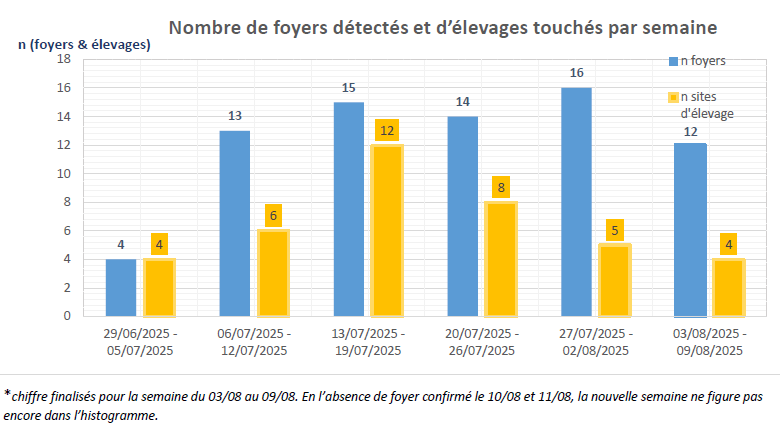
As of August 11, 2025, 74 outbreaks have been detected in France, spread across two departments: Savoie (31 outbreaks spread across the municipalities of Entrelacs and Hauteluce), Haute-Savoie (43 outbreaks spread across the municipalities of Rumilly, Massingy, Marigny-Saint-Marcel, Faverges-Seythenex, Saint-Ferréol, Les Combes-Seythenex, Boussy, Val-de-Chaise, Moye). These outbreaks concern 39 farms.
Graphique%20DNC%20au%2012-08-2025.png

See image description DNC - Graph of the number of outbreaks detected and affected farms per week

Control measures include prohibiting the movement of cattle within regulated zones , depopulation of cattle present in declared outbreaks, and vaccination. For more information on zoning and depopulation measures, see section 5. "Management measures" .

Vaccination projects, carried out by veterinarians with the support of breeders, began on July 18. The vaccination strategy concerns all cattle, regardless of age, located in the so-called "regulated" zone, which extends over a 50-kilometer radius around the outbreaks, or approximately 250,000 cattle. To date, this zone includes the majority of the territory of the two affected departments, Savoie and Haute-Savoie, as well as part of Ain and Isère. Vaccination of cattle in this zone is mandatory and fully covered by the State.

The vaccination deployment strategy is twofold:

  • from a line located 20 kilometers from the outbreaks, the vaccination campaign is carried out towards the heart of the regulated zone to limit the spread of the disease from the outbreaks and towards the outside of the regulated zone for a barrier effect.
  • vaccination around the homes.
The objective of this massive and rapid vaccination campaign, in addition to depopulation measures and movement restrictions, is the complete and rapid eradication of the disease.

...
https://agriculture.gouv.fr/dermato...dnc-point-de-situation-et-foire-aux-questions

 
France - Lumpy skin disease virus (Inf. with) - Follow up report 17
...
REPORT DATE
2025/08/22
...
EPIDEMIOLOGICAL COMMENTS

The epidemiological investigation on the first outbreak is still ongoing. At this stage, the origin of the infection has not been determined. As of 21/08/2025: 76 outbreaks have been confirmed among 41 different livestock farmers. Only 12 municipalities are affected.
...
image.png

...
NEW OUTBREAKS

ob_163254 - DNC20250245 - Chambéry
...
https://wahis.woah.org/#/in-review/6584​
 
France - Lumpy skin disease virus (Inf. with) - Follow up report 18
...
REPORT DATE
2025/08/25
...
EPIDEMIOLOGICAL COMMENTS

The epidemiological investigation on the first outbreak is still ongoing. At this stage, the origin of the infection has not been determined As of 25/08/2025: 77 outbreaks have been confirmed among 42 different livestock farmers. Only 13 municipalities are affected.
...
image.png

...
NEW OUTBREAKS

ob_163361 - DNC20250250 - Belley
...
https://wahis.woah.org/#/in-review/6584​
 
A new outbreak of lumpy skin disease declared in Ain, five cows slaughtered

Anabelle Gallotti
Published onSunday, September 7, 2025 at 6:55 AM
Updated onSunday, September 7, 2025 at 8:40 AM

A second outbreak of dermatosis was detected in Ain on Saturday, September 6. It involved five unvaccinated animals that were slaughtered the same day. The previous outbreak in Ain dates back to August 23.

Lumpy skin disease, a disease that has been affecting cows in our region since the beginning of summer, continues to circulate. It is a disease transmitted by certain insects only. It only affects cattle and is not transmissible to humans or other animals. It has been wreaking havoc since the beginning of summer in Savoie, Haute-Savoie, and to a lesser extent in Ain and Isère.

Second outbreak detected in Ain

On Saturday, September 6, a new outbreak of LSD was confirmed in the Ain department " in a batch of five unvaccinated animals ," according to the Ministry of Agriculture. The animals on this farm were slaughtered on the same day (September 6). This is the second case of LSD in this department since the start of the crisis. The previous outbreak, in Grand Colombier, was detected on August 23, after a continuous two-week period without any new outbreaks in France (it involved 80 cattle, editor's note).

The eradication goal has not yet been achieved

These sick cows, after a fortnight without new contamination, show that the virus is still locally present in our territory and that " the health situation is not yet completely stabilized . " Vaccination coverage is nevertheless high: more than 90% according to government services. But if we observe "a significant slowdown in the weekly number of outbreaks, the eradication objective has not yet been achieved ." The Ministry of Agriculture indicates in a press release that extreme vigilance remains essential "to avoid compromising the results of recent weeks."
...
https://www.francebleu.fr/infos/soc...tose-nodulaire-contagieuse-dans-l-ain-5629112
---------------------------------------------------
September 8, 2025 Info +

Lumpy skin disease of cattle (LSD): update and frequently asked questions
...
Update on the situation in France

As of September 8, 2025, 78 outbreaks have been detected in France, spread across three departments: Savoie (32 outbreaks spread across the municipalities of Entrelacs, Hauteluce and Chindrieux), Haute-Savoie (44 outbreaks spread across the municipalities of Rumilly, Massingy, Marigny-Saint-Marcel, Faverges-Seythenex, Saint-Ferréol, Les Combes-Seythenex, Boussy, Val-de-Chaise, Moye and Giez) and Ain (2 outbreaks spread across Culoz and Injoux-Génissiat). These outbreaks concern 46 farms.
...

https://agriculture.gouv.fr/dermato...dnc-point-de-situation-et-foire-aux-questions
 
New outbreak of lumpy skin disease worries cattle farmers

By Le Figaro with AFP
24 minutes ago

The detection of an outbreak of lumpy skin disease (LSD) in a cattle herd in the Rhône region, a good distance from the French epicentre of this animal disease, has revived fears of a wider spread but also tensions between unions over the systematic culling of infected outbreaks.

An outbreak of LSD was detected Thursday in a herd of dairy cows in the Rhône region, a first for this department, which had previously been free of the disease and was outside the regulated zone, the Ministry of Agriculture announced Friday. This brings to 79 the number of outbreaks detected in 47 farms since the first appearance in France at the end of June of this viral disease, which is not transmissible to humans, and which leads to significant losses in milk production and sometimes results in the death of part of the infected herd. The spread, which occurs between infected cattle or through insect bites, began in Savoie and Haute-Savoie, before affecting communes in Ain.

According to the ministry, a vaccination campaign and drastic movement restrictions in a restricted area helped stem its spread at the end of August. However, the total and systematic culling of infected areas caused strong emotions and heightened conflict between unions over the strategy to adopt. The government and the FNSEA-JA alliance supported this drastic measure, while the Rural Coordination and the Peasant Confederation, which attempted to block the culls, regret that other methods were not considered. The new outbreak was detected in Saint-Laurent-de-Chamousset, about thirty kilometers west of Lyon. The restricted area extended across Ain, Isère, Savoie, and Haute-Savoie, and ended a few kilometers east of the city. "Depopulation (culling, editor's note) is underway and a new regulated zone has been defined ," the ministry said on Friday, for whom this new case "illustrates the importance of maintaining increased vigilance . "

Tensions between unions

The last outbreak detected dates back to September 6, in a herd with unvaccinated animals despite the obligation in the area, a "negligence ," according to Arnaud Rousseau, the president of the FNSEA. This resets the 45-day counter from which, without new cases, movement restrictions can be lifted. The government has already allowed, under very strict conditions, descents from summer pastures. With the cooling temperatures, it is becoming complicated to leave cows at altitude, especially when they have had to calve in these areas where it is difficult to milk them, which leads to additional losses. At the Livestock Show held from Tuesday to Thursday in Rennes, all the breeders were praying not to learn of new cases. But criticism has been rife through conferences and union actions.

The Peasant Confederation simulated the murder of breeders on Tuesday at the ministry's stand, denouncing a "deadly" strategy that failed to take into account veterinary opinions that "diverged" from the state's strategy. Its spokesperson, Stéphane Galais, read the testimony of a breeder devastated by the slaughter of his animals: "This morning, the children had set their alarms to say goodbye to them ." On Wednesday, FNSEA president Arnaud Rousseau denounced the appearance of "Raoult professors of dermatosis ," claiming that his union and the state had relied on scientific expertise, unlike "self-proclaimed epidemiologists . "

"1,748 animals were slaughtered in a 50 km area around the outbreaks, which includes 275,000 to 290,000 animals. We're talking about 0.6%. Behind them, of course, are men and women, and it remains dramatic. But we did it responsibly ," he said at a press conference. The affected farmers, who have access to psychological support and have already received an advance from the state to compensate for the loss of animals, are also hoping for aid for indirect losses and to rebuild their herds.

https://www.lefigaro.fr/conjoncture...dulaire-inquiete-les-eleveurs-bovins-20250919
 
Back
Top Bottom