Follow along with the video below to see how to install our site as a web app on your home screen.
Note: This feature may not be available in some browsers.
FluTrackers.com Inc. does not provide medical advice. Information on this web site is collected from various internet resources, and the FluTrackers board of directors makes no warranty to the safety, efficacy, correctness or completeness of the information posted on this site by any author or poster.
The information collated here is for instructional and/or discussion purposes only and is NOT intended to diagnose or treat any disease, illness, or other medical condition. Every individual reader or poster should seek advice from their personal physician/healthcare practitioner before considering or using any interventions that are discussed on this website.
By continuing to access this website you agree to consult your personal physican before using any interventions posted on this website, and you agree to hold harmless FluTrackers.com Inc., the board of directors, the members, and all authors and posters for any effects from use of any medication, supplement, vitamin or other substance, device, intervention, etc. mentioned in posts on this website, or other internet venues referenced in posts on this website.
We are not asking for any donations. Do not donate to any entity who says they are raising funds for us.
Following the first case of indigenous dengue fever reported on July 4, the ARS Auvergne-Rhône-Alpes received a report of a second indigenous case on July 15, also in Saint-Chamond. Find all the information on this situation and the actions implemented by the ARS, Public Health France, and EIRAD.
Background on the second case of indigenous dengue fever in Saint-Chamond
On July 15, 2025, the ARS received a report of a second case of indigenous dengue fever . This is the second indigenous case of dengue fever identified this year in Saint-Chamond, in the Loire and Auvergne-Rhône-Alpes regions.
At this stage, it is not possible to establish a link with the first indigenous case identified in Saint-Chamond . Investigations are still ongoing.
Most of the time, dengue cases reported in mainland France involve people who were infected during a stay in a tropical region. If people return infected, these are considered imported cases.
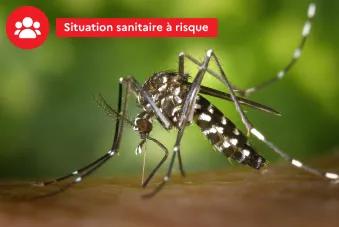
The tiger mosquito present in our territory can become infected by biting a person who has been infected in a tropical zone and, by biting them, contaminate a person who has not traveled. This is then a native case.
Dengue symptoms occur on average within 4 to 7 days after the infective bite.Health monitoring and actions implemented
The ARS and its partners are working to prevent tiger mosquitoes in the neighborhood from transmitting the disease to other people: several actions are being carried out within a well-defined perimeter.Clear mosquitoes from the area
An entomological survey was carried out on July 18, 2025: it confirmed the presence of tiger mosquitoes in the areas frequented by the infected person and informed residents of an adulticide treatment.
A mosquito control operation will take place during the night of Monday, July 21st to Tuesday, July 22nd to limit the risk of transmission. Residents in the affected areas have been informed by a flyer placed in their mailboxes. Around one hundred homes are affected.
These actions are carried out by EIRAD , an operator mandated by the ARS in the fight against vectors.
A door-to-door epidemiological survey will be carried out on July 22 by agents of the ARS and Public Health France among residents of the place frequented by the infected person.
The aim is to ensure that people living in the area have not been infected by a tiger mosquito bite, to raise awareness of the symptoms of dengue fever and to advise them on what to do if they experience symptoms.
Furthermore, the Gier-Saint-Chamond Hospital Center and healthcare professionals (doctors, pharmacists, and medical analysis laboratories, members of the Territorial Professional Health Community) in the Saint-Chamond area have been informed of the situation.
As a reminder, dengue fever is a notifiable disease : healthcare professionals must report any diagnosis of dengue fever to the Regional Health Agency (ARS). Context and actions implemented for the first case of indigenous dengue fever in Saint-ChamondRecommendations to the population
Monitor your health
People returning from travel to tropical areas should be particularly vigilant and:
People living in an area where tiger mosquitoes are present should also remain vigilant and consult a doctor if in doubt.
Symptoms suggestive of dengue fever are, in the absence of another established diagnosis: the sudden onset of a high fever (>38.5°C), associated with at least one other clinical sign such as:
headaches,
muscle, joint or lower back pain,
skin rashes,
in the absence of other infectious signs: respiratory signs, infected wounds, etc.
Limiting the proliferation of tiger mosquitoes
The best way to avoid tiger mosquito bites is to prevent them from taking up residence in your home!
Find all the information on the tiger mosquito in our dedicated section.
In the Auvergne-Rhône-Alpes region, between May 1 [SUP]( [/SUP] start of enhanced surveillance) and July 15, 2025, 92 cases of imported dengue fever were recorded, including 8 in the Loire.
/https://en.wikipedia.org/wiki/Belley
----------------------------------------------------------- Strong suspicion of an indigenous case of dengue in Belley (Ain): situation update
On July 21, 2025, the ARS Auvergne-Rhône-Alpes received a report of a highly suspected case of indigenous dengue fever in Belley (Ain). Find all the information on this situation and the actions implemented by the ARS, Public Health France, and EIRAD.
Context
On July 21, 2025, the ARS Auvergne-Rhône-Alpes received a report of a suspected case of indigenous dengue fever in the commune of Belley (Ain).
A native case is defined as a person who has contracted the disease without having traveled to a contaminated area within 15 days prior to the onset of symptoms. Dengue fever is transmitted from person to person through the bite of a tiger mosquito , which is itself infected with the virus.
In the Auvergne-Rhône-Alpes region, between May 1 [SUP]([/SUP] start of enhanced surveillance) and July 21, 2025, 97 cases of imported dengue fever were recorded, including 9 in the Ain department.
On July 21, 2025, the ARS Auvergne-Rhône-Alpes received a report of a highly suspected case of indigenous dengue fever in Belley (Ain). The case was confirmed on July 28. Find all the information on this situation and the actions implemented by the ARS, Public Health France, and EIRAD.
Context
On July 21, 2025, the ARS Auvergne-Rhône-Alpes received a report of a suspected case of indigenous dengue fever in the commune of Belley (Ain).
A native case is when a person has contracted the disease without having traveled to a contaminated area in the 15 days preceding the onset of symptoms. Dengue fever is transmitted from person to person through the bite of a tiger mosquito , itself infected with the virus.
In the Auvergne-Rhône-Alpes region, between May 1 [SUP]([/SUP] start of enhanced surveillance) and July 21, 2025, 97 cases of imported dengue fever were recorded, including 9 in the Ain department.
Lot (department)
/https://en.wikipedia.org/wiki/Lot_(department)
---------------------------------------------------------- Image translated by Google