

Pathfinder
Editor, Senior Moderator
Translation Google
Covid-19: third cause of death in France in 2020, when the other major causes of death are falling
The Department of Research, Studies and Evaluation of Statistics (DREES), the Inserm Center for the Epidemiology of Medical Causes of Death (CépiDc-Inserm) and Public Health France analyze the medical causes of death of people residents and deceased in France in 2020. This work is based on the national statistics of the causes of death produced by the CépiDc-Inserm from the exhaustive collection and analysis of the medical sections of death certificates. They provide information on the effects of the Covid-19 epidemic on mortality, by providing a complete overview of all the causes of death in 2020. The results of this study are jointly published in a Studies and Results (DREES) and the Weekly Epidemiological Bulletin (Public Health France).
Posted on December 14, 2022
Press contacts
DREES
DREES-PRESSE@sante.gouv.fr
Inserm
press@inserm.fr
Public health France
presse@santepubliquefrance.fr
The Covid-19 epidemic in 2020 constitutes a recent unprecedented health episode, both in terms of its health and societal impact, and in terms of the exceptional management and prevention measures that have been put in place to stem the spread of the virus in the population. The vaccination campaign against Covid-19 started on December 27, 2020 did not, however, concern the year 2020.
Covid-19, 69,000 deaths in 2020
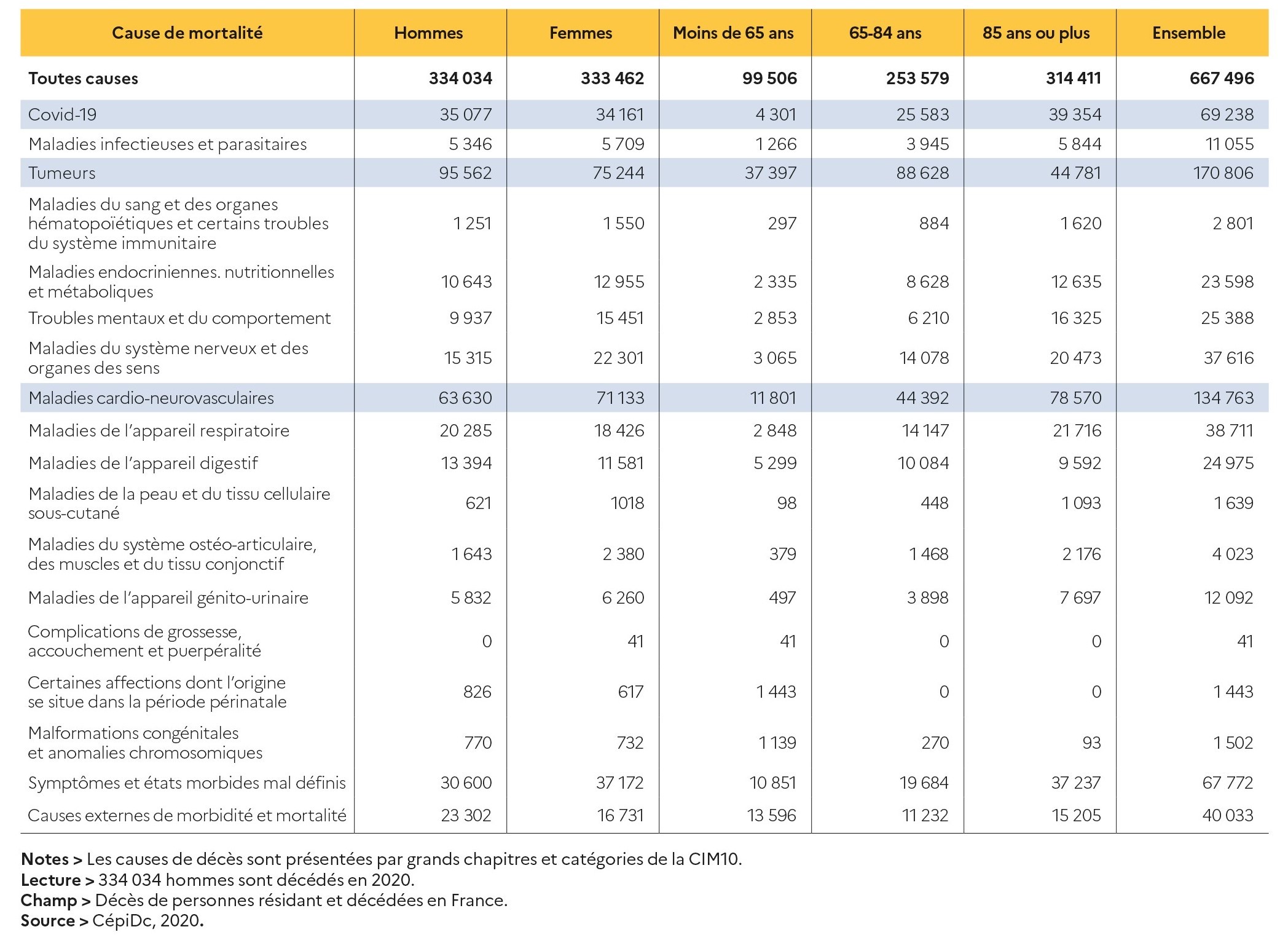
In 2020, the Covid-19 epidemic directly caused the death of 69,000 people in France (10.4% of deaths), making it the third leading cause of death behind tumors and cardio-neurovascular diseases. The most frequent causes of death in 2020 remain tumors (25.6%) and cardio-neurovascular diseases (20.2%).
Just over half of Covid-19 victims were 85 or older. If the deaths of Covid-19 include as many men as women, men have, at comparable ages, a mortality rate twice that of women. This excess mortality of men compared to women is not specific to Covid-19 but concerns most causes of death. It is nevertheless slightly more marked for Covid-19.
A decrease in mortality excluding Covid-19
The death rate for causes other than Covid-19 has fallen. Compared to the 2015-2017 period, mortality from tumours, cardio-neurovascular diseases, diseases of the nervous system, mental and behavioral disorders has decreased, especially among people aged 85 or over. Part of this decline could be explained by the fact that some people who would have died within the year due to these diseases may have died, instead, of an infection with SARS-CoV-2. In addition, the preventive measures accompanying the management of the health crisis may have had a protective effect, partly explaining the observed drop in mortality from respiratory or infectious diseases (excluding Covid-19) as well as from transport accidents. This partly explains why the excess number of deaths for the year 2020 compared to previous years, i.e. 47,000, is lower than the 69,000 deaths whose identified medical cause is Covid-19. Other impacts of this epidemic and its context in the short or medium term cannot be excluded.
Methodological box – Sources and methods
During the Covid-19 epidemic, with the aim of helping to manage the health crisis, several data sources made it possible to approach the number of deaths linked to Covid-19 in a more reactive way, but without certainty about the nature of the initial cause of death, that which triggered the process leading to death, nor without always being exhaustive. These estimates were based on death certificates containing a mention of Covid-19 in the free texts of the medical sections, whether or not the latter is the initial cause, as well as on the declarations of death reported by the surveillance systems of hospital services (SI-VIC system) and social medical establishments (SurvESMS).
The national cause of death statistics finally count, in 2020, 69,000 deaths whose initial cause of death is, according to the rules of the World Health Organization, Covid-19: this figure differs by less than 15% from the previous estimates.
Number of deaths by cause in 2020, by age group and sex
 Consult publications and related data
Weekly epidemiological bulletin, December 14, 2022, n°16 - Covid-19 series
LEARN MORE
About the DREES
Set up by the decree of November 30, 1998, the Department of Research, Studies, Evaluation and Statistics (DREES) is part, along with INSEE and the other ministerial statistical services, of the official statistical service (SSP). Its role is to provide reliable information and analyzes in the social and health fields. The action of the DREES has been based, for more than 20 years, on a deontological commitment whose principles, codified and shared at European level, are professional independence, commitment to quality, respect for statistical confidentiality, impartiality and objectivity. The DREES is also a ministerial statistical service whose priority mission is to support and evaluate public social and health policies.
About Public Health France
Santé publique France responds to the need to have a public health reference and expertise center in France. Based on the continuum between knowledge and action, our mission is to improve and protect the health of populations. Our action integrates the major public health issues over the long term, in the fields of protection against threats (in particular infectious risks, environmental risks, etc.) on the one hand, and the improvement of health (determinants of health , prevention, health promotion and reduction of the burden of chronic diseases, social and territorial inequalities, etc. on the other hand. Public Health France is a public institution under the supervision of the Ministry of Solidarity and Health.
https://www.santepubliquefrance.fr/p...deces-baissent
Covid-19: third cause of death in France in 2020, when the other major causes of death are falling
The Department of Research, Studies and Evaluation of Statistics (DREES), the Inserm Center for the Epidemiology of Medical Causes of Death (CépiDc-Inserm) and Public Health France analyze the medical causes of death of people residents and deceased in France in 2020. This work is based on the national statistics of the causes of death produced by the CépiDc-Inserm from the exhaustive collection and analysis of the medical sections of death certificates. They provide information on the effects of the Covid-19 epidemic on mortality, by providing a complete overview of all the causes of death in 2020. The results of this study are jointly published in a Studies and Results (DREES) and the Weekly Epidemiological Bulletin (Public Health France).
Posted on December 14, 2022
Press contacts
DREES
DREES-PRESSE@sante.gouv.fr
Inserm
press@inserm.fr
Public health France
presse@santepubliquefrance.fr
The Covid-19 epidemic in 2020 constitutes a recent unprecedented health episode, both in terms of its health and societal impact, and in terms of the exceptional management and prevention measures that have been put in place to stem the spread of the virus in the population. The vaccination campaign against Covid-19 started on December 27, 2020 did not, however, concern the year 2020.
Covid-19, 69,000 deaths in 2020
In 2020, the Covid-19 epidemic directly caused the death of 69,000 people in France (10.4% of deaths), making it the third leading cause of death behind tumors and cardio-neurovascular diseases. The most frequent causes of death in 2020 remain tumors (25.6%) and cardio-neurovascular diseases (20.2%).
Just over half of Covid-19 victims were 85 or older. If the deaths of Covid-19 include as many men as women, men have, at comparable ages, a mortality rate twice that of women. This excess mortality of men compared to women is not specific to Covid-19 but concerns most causes of death. It is nevertheless slightly more marked for Covid-19.
A decrease in mortality excluding Covid-19
The death rate for causes other than Covid-19 has fallen. Compared to the 2015-2017 period, mortality from tumours, cardio-neurovascular diseases, diseases of the nervous system, mental and behavioral disorders has decreased, especially among people aged 85 or over. Part of this decline could be explained by the fact that some people who would have died within the year due to these diseases may have died, instead, of an infection with SARS-CoV-2. In addition, the preventive measures accompanying the management of the health crisis may have had a protective effect, partly explaining the observed drop in mortality from respiratory or infectious diseases (excluding Covid-19) as well as from transport accidents. This partly explains why the excess number of deaths for the year 2020 compared to previous years, i.e. 47,000, is lower than the 69,000 deaths whose identified medical cause is Covid-19. Other impacts of this epidemic and its context in the short or medium term cannot be excluded.
Methodological box – Sources and methods
During the Covid-19 epidemic, with the aim of helping to manage the health crisis, several data sources made it possible to approach the number of deaths linked to Covid-19 in a more reactive way, but without certainty about the nature of the initial cause of death, that which triggered the process leading to death, nor without always being exhaustive. These estimates were based on death certificates containing a mention of Covid-19 in the free texts of the medical sections, whether or not the latter is the initial cause, as well as on the declarations of death reported by the surveillance systems of hospital services (SI-VIC system) and social medical establishments (SurvESMS).
The national cause of death statistics finally count, in 2020, 69,000 deaths whose initial cause of death is, according to the rules of the World Health Organization, Covid-19: this figure differs by less than 15% from the previous estimates.
Number of deaths by cause in 2020, by age group and sex
- Naouri, D., Fouillet, A., Ghosn, W., Coudin, E., (2022, December). Covid-19: third cause of death in France in 2020, when the other major causes of death are falling. DREES , Studies and Results, 1250.
- Fouillet A, Ghosn W, Naouri D, Coudin E. Covid-19: third cause of death in France in 2020, when the other major causes are declining. Bull Epidemiol Weekly . 2022;(Cov_16):2-12.
- Table A1- CépiDc – Inserm website: www.cepidc.inserm.fr
Weekly epidemiological bulletin, December 14, 2022, n°16 - Covid-19 series
LEARN MORE
About the DREES
Set up by the decree of November 30, 1998, the Department of Research, Studies, Evaluation and Statistics (DREES) is part, along with INSEE and the other ministerial statistical services, of the official statistical service (SSP). Its role is to provide reliable information and analyzes in the social and health fields. The action of the DREES has been based, for more than 20 years, on a deontological commitment whose principles, codified and shared at European level, are professional independence, commitment to quality, respect for statistical confidentiality, impartiality and objectivity. The DREES is also a ministerial statistical service whose priority mission is to support and evaluate public social and health policies.
About Public Health France
Santé publique France responds to the need to have a public health reference and expertise center in France. Based on the continuum between knowledge and action, our mission is to improve and protect the health of populations. Our action integrates the major public health issues over the long term, in the fields of protection against threats (in particular infectious risks, environmental risks, etc.) on the one hand, and the improvement of health (determinants of health , prevention, health promotion and reduction of the burden of chronic diseases, social and territorial inequalities, etc. on the other hand. Public Health France is a public institution under the supervision of the Ministry of Solidarity and Health.
https://www.santepubliquefrance.fr/p...deces-baissent
