• FluTrackers.com Inc. does not provide medical advice. Information on this web site is collected from various internet resources, and the FluTrackers board of directors makes no warranty to the safety, efficacy, correctness or completeness of the information posted on this site by any author or poster. The information collated here is for instructional and/or discussion purposes only and is NOT intended to diagnose or treat any disease, illness, or other medical condition. Every individual reader or poster should seek advice from their personal physician/healthcare practitioner before considering or using any interventions that are discussed on this website. By continuing to access this website you agree to consult your personal physican before using any interventions posted on this website, and you agree to hold harmless FluTrackers.com Inc., the board of directors, the members, and all authors and posters for any effects from use of any medication, supplement, vitamin or other substance, device, intervention, etc. mentioned in posts on this website, or other internet venues referenced in posts on this website.
  • We are not asking for any donations. Do not donate to any entity who says they are raising funds for us.

France - Acute respiratory infections (influenza, bronchiolitis, COVID-19). Bulletin of March 12, 2025

Pathfinder

Editor, Senior Moderator
Translation Google
Acute respiratory infections (influenza, bronchiolitis, COVID-19). Bulletin of December 26, 2024.


Published on December 26, 2024
Updated on December 26, 2024

Print Share

Key points

Acute respiratory infections (ARI)
  • Increased activity in town and in hospital in all age groups.
Flu
  • Sharp increase in all influenza indicators in the city and in hospitals, in all age groups. All regions in epidemic in mainland France. Pre-epidemic in Martinique.
Bronchiolitis
  • Decrease in the majority of indicators. Continuation of the epidemic in twelve regions of mainland France, the Antilles, Guyana and Mayotte. Pre-epidemic in Corsica and Reunion.
COVID-19
  • Activity generally stable at low levels.

PDF 2.89 MB

https://www.santepubliquefrance.fr/...olite-covid-19-.-bulletin-du-26-decembre-2024
------------------
Excerpt form the PDF link:

...
Situation update

In week 51, activity related to acute respiratory infections was significantly increasing in community medicine and in hospitals in all age groups. Hospitalizations after visits to the emergency room were particularly frequent among those aged 65 and over (58% of hospitalizations for acute respiratory infections) and those under 5 (23% of hospitalizations).

In mainland France, all influenza indicators increased sharply in week 51 in all age groups. The A(H1N1)pdm09 and B/Victoria viruses continued to co-circulate. Children under 15 were the most affected in the community and in hospitals, but a marked increase in visits to the emergency room and hospitalizations among people aged 65 and over was observed. In addition, the number of grouped cases attributed to influenza since week 49 was increasing in ESMS. Finally, the proportion of deaths with a mention of influenza among electronically certified deaths increased significantly in S51 (2% vs. 0.9% in S50). All of these indicators reveal an increasing circulation of influenza viruses within the general population, particularly affecting older people, who are particularly vulnerable to influenza.

A decrease in syndromic indicators of bronchiolitis was observed in the community and in hospitals in S51. These elements support the passage of the epidemic peak this week, which will be confirmed in the coming weeks. The epidemic continues to follow a similar dynamic to those of the epidemics preceding the COVID-19 pandemic, with an intensity at a low level compared to these previous epidemics. The RSV (respiratory syncytial virus) positivity rate began to decrease in hospitals, but increased in community medicine. In mainland France, all regions are in an epidemic except Corsica, which became pre-epidemic in W51. In the DROMs, Réunion has been in a pre-epidemic since W50, Guadeloupe and Martinique in an epidemic since W43 and Guyana in an epidemic since the end of July (W31). In Mayotte, the bronchiolitis epidemic began in W49 and was ongoing when Cyclone Chido passed through.

Concerning COVID-19, syndromic indicators remained generally stable in the city and in the hospital compared to the previous week. The positivity rate for SARS-CoV-2 among samples tested in city laboratories and taken by doctors in the city decreased in W51 compared to the previous week, but increased in the hospital. The number of new episodes of ARI in medico-social establishments (EMS) increased in week 50, a trend mainly driven by the increase in episodes related to influenza and RSV. These data have not yet been consolidated.
...​
 
Acute respiratory infections (influenza, bronchiolitis, COVID-19). Bulletin of January 2, 2025.


Published on January 2, 2025
Updated on January 2, 2025

Print Share

Key points

Acute respiratory infections
  • Activity has increased significantly in town and in hospital in all age groups.
Flu
  • Continued sharp increase in all influenza indicators in the city and in hospitals in all age groups. All regions in epidemic in mainland France. Martinique in epidemic, Guadeloupe and Guyana in pre-epidemic.
Bronchiolitis
  • Decrease in the majority of indicators. Continuation of the epidemic in eleven regions of mainland France, the Antilles, Mayotte and Guyana. Pre-epidemic in Corsica and Reunion. Post-epidemic in Île-de-France.
COVID-19
  • Activity generally stable at low levels.

PDF 4.87 MB

https://www.santepubliquefrance.fr/...hiolite-covid-19-.-bulletin-du-2-janvier-2025

------------------------------------
From the PDF link above:
...
Situation update

In week 52, activity related to acute respiratory infections was significantly increasing in community medicine and in hospital in all age groups. Hospitalizations after emergency visits particularly concerned those aged 65 and over (63% of hospitalizations for acute respiratory infections).

In mainland France, the flu epidemic is intensifying. All flu indicators were still rising sharply in week 52 in all age groups. Children under 15 were the most affected in community medicine and in hospital, and there was a sharp increase in hospitalizations among people aged 65 and over. Compared to the five previous epidemics, the level of intensity in hospital this week went from moderate to high for all ages and to a very high level for those under 15. The number of clustered cases attributed to influenza continued to increase in medico-social establishments (EMS) since W49. In addition, the share of deaths with a mention of influenza among electronically certified deaths increased (3.8% in W52 vs. 1.9% in W51). The positivity rate was increasing sharply in the city and in hospital. The A(H1N1)pdm09 virus was circulating predominantly with co-circulation to a lesser extent of the B/Victoria virus. Overseas, Guadeloupe had moved to pre-epidemic and Martinique to epidemic in week 51. French Guiana moved to pre-epidemic this week.

A decrease in bronchiolitis syndromic indicators was observed in the city and in hospital in W52 for the second consecutive week, confirming the passage of the epidemic peak that occurred in W50 in mainland France. The epidemic continued to follow a similar dynamic to those of the epidemics preceding the COVID-19 pandemic, with a lower intensity than previous epidemics for the youngest infants on hospital indicators. The RSV (respiratory syncytial virus) positivity rate tended to stabilize in hospitals and decreased in community medicine. In mainland France, eleven regions remained in epidemic. Île-de-France moved to post-epidemic in W52 and Corsica remained in pre-epidemic. In the DROMs, Réunion had been in pre-epidemic since W50, Mayotte in epidemic since W49, Guadeloupe and Martinique since W43 and Guyana in epidemic since the end of July (W31).

The syndromic indicators of COVID-19 remained generally stable in cities and hospitals compared to the previous week and at low levels. SARS-CoV-2 positivity rates decreased slightly in community medicine and laboratories and remained stable in hospitals in week 52.

The number of new ARI episodes in nursing homes has been increasing since week 50, a trend mainly driven by the increase in influenza and RSV-related episodes. These data are not yet consolidated.
...​

 
Translation Google
Acute respiratory infections (influenza, bronchiolitis, COVID-19). Bulletin of January 8, 2025.


Published on January 8, 2025
Updated on January 8, 2025

Print Share

Key points

Acute respiratory infections (ARI)
  • Activity still increasing in town and in hospital for all ages.
Flu
  • Continued increase in influenza activity in mainland France with an exceptionally high level of intensity in hospitals. Martinique and Guadeloupe in epidemic. Guyana and Mayotte in pre-epidemic.
Bronchiolitis
  • Decrease in all indicators. Continuation of the epidemic in eleven regions of mainland France, in the Antilles, in Guyana and in Mayotte. Pre-epidemic in Corsica. Post-epidemic in Île-de-France.
COVID-19
  • Stable syndromic activity at low levels. Decrease in positivity rate in city, hospital and wastewater.
PDF 3.21 MB

https://www.santepubliquefrance.fr/...hiolite-covid-19-.-bulletin-du-8-janvier-2025

-------------------------------

From the PDF link above:
...
Situation update

In week 01, activity related to acute respiratory infections was increasing in general practice and in hospitals in all age groups except for those under 15. This increase was mainly driven by influenza activity.

In mainland France, the influenza epidemic was increasing in S01. In the city, the increase in activity was less significant compared to the previous two weeks, probably linked to the holiday period. On the other hand, in hospitals, a sharp increase in indicators was still observed in all age groups except for those aged 5-14. The share of hospitalizations for influenza/influenza-like illness among all-cause hospitalizations was at an exceptionally high level of intensity compared to previous seasons. In medical-social establishments, the number of grouped cases attributed to influenza continued to increase. In addition, the share of deaths with a mention of influenza among electronically certified deaths was still rising sharply (6.0% in S01 vs. 3.9% in S52). The A(H1N1)pdm09 virus was still most often detected but the B/Victoria and A(H3N2) viruses were also actively circulating. Virus characterization analyses indicated that the A(H1N1)pdm09 and B/Victoria viral strains currently circulating in France are related to the strains present in the 2024-25 influenza vaccines. However, these data will have to be compared with the first estimates of vaccine efficacy in real life that will be available soon. Overseas, Guadeloupe and Martinique were in an epidemic in S52. French Guiana and Mayotte were in a pre-epidemic situation.

A decrease in bronchiolitis syndromic indicators was observed in the city and in the hospital in S01 for the third consecutive week. The epidemic peak occurred in S50 in mainland France. The epidemic continued to follow a dynamic similar to that of the epidemics preceding the COVID-19 pandemic, with a lower intensity for the youngest infants in hospital at this stage of the epidemic.

The RSV (respiratory syncytial virus) positivity rate decreased in both community medicine and hospital. In mainland France, eleven regions remained in epidemic, Île-de-France in post-epidemic and Corsica in pre-epidemic. In the DROMs, Guadeloupe and Martinique had been in epidemic since S43, Mayotte since S49 and Guyana since the end of July (S31). Réunion had returned to a baseline level in S01. COVID-19 syndromic indicators remained generally stable in the city and in the hospital in W01 compared to the previous week and at low levels. SARS-CoV-2 positivity rates decreased in the city and in the hospital. A decrease in the SARS-CoV-2 monitoring indicator in wastewater was observed.

The number of new episodes of ARI in medico-social establishments (EMS) increased in W51 and W52, a trend mainly driven by the increase in the number of episodes related to influenza and, to a lesser extent, to RSV. These data are not yet consolidated.

Vaccination remains the best way to protect against influenza and COVID-19, particularly severe forms of these diseases. It is essential to recommend vaccination to all eligible people, in order to protect them and those around them: people aged 65 and over; people over 6 months old, with comorbidities with a high risk of severe disease; immunocompromised people; pregnant women; residents in follow-up care facilities or medico-social facilities regardless of their age, as well as people living in the entourage or in regular contact with people who are immunocompromised or vulnerable to severe forms of infection, including health professionals. The passive immunisation campaign for newborns against RSV infections is underway. Two strategies are possible: either vaccination of pregnant women to protect newborns or infants under 6 months of age or immunisation of infants with a monoclonal antibody.

In addition to existing vaccinations and preventive treatments, the adoption of barrier gestures remains essential to protect oneself from all winter illnesses: washing hands, ventilating rooms and wearing a mask in the event of symptoms (fever, sore throat or cough), in crowded places and in the presence of vulnerable people.
...​
 
Translation Google

Acute respiratory infections (influenza, bronchiolitis, COVID-19). Bulletin of January 15, 2025.


Published on January 15, 2025
Updated on January 15, 2025

Print Share

Key points

Acute respiratory infections (ARI)
  • Increasing activity in the city, particularly among children, and decreasing in the hospital.
Flu
  • Intensification of influenza activity in cities in mainland France. Marked severity of the epidemic, with very high hospital activity and a clear increase in deaths. Co-circulation of the three influenza viruses A(H1N1)pdm09, A(H3N2) and B/Victoria.
Bronchiolitis
  • Decrease in the majority of indicators. In mainland France, 5 regions in epidemic, 7 regions in post-epidemic. In the DROMs, continuation of the epidemic in Martinique, Guyana and Mayotte. Guadeloupe in post-epidemic.
COVID-19
  • Stable activity at low levels.


PDF 3.27 MB

https://www.santepubliquefrance.fr/...iolite-covid-19-.-bulletin-du-15-janvier-2025
---------------------------------------
From the PDF link above:
...
​Situation update

In week 02, activity related to acute respiratory infections in community medicine was increasing among those under 15 and stable or slightly decreasing among adults. Hospital indicators decreased in all age groups

In mainland France, the influenza epidemic intensified in S02, with different dynamics depending on the data sources and age groups. In the community, activity increased among those under 65, particularly among children, and slowed slightly among those aged 65 and over. It reached a high level of intensity in all age groups. In hospitals, a decrease in influenza/influenza-like illness indicators was observed among emergency room visits and hospitalizations in all age groups, except among those under five, where these indicators increased sharply. The share of hospitalizations for influenza/influenza-like illness among all-cause hospitalizations was still at a very high level of intensity in all age groups. The number of reports of clustered cases attributed to influenza was also rising sharply in medical-social establishments, as was the share of deaths with a mention of influenza among electronically certified deaths (7.3% in S02 vs. 6% in S01), indicating a marked severity of the epidemic. The regions in which the hospital indicators and deaths related to influenza were the highest were Auvergne-Rhône-Alpes, Bourgogne-Franche-Comté, Grand Est and Provence-Alpes-Côte d'Azur. The three viruses A(H1N1)pdm09, A(H3N2) and B/Victoria were co-circulating. An increase in the share of the A(H3N2) virus had been observed for three weeks in hospital. In Overseas, Guadeloupe and Martinique were in epidemic and Guyana became an epidemic in S02. Mayotte was in pre-epidemic.

A decrease in bronchiolitis syndromic indicators was observed in the city and in the hospital in S02 for the fourth consecutive week. The epidemic peak occurred in S50 in mainland France. For the youngest infants, the intensity remained lower than that of previous epidemics. The RSV (respiratory syncytial virus) positivity rate decreased in mainland medicine and in the hospital. In mainland France, in S02, 4 regions remained in epidemic and Corsica became an epidemic. The regions of Brittany, Bourgogne-Franche-Comté, Centre-Val de Loire, Normandy, Nouvelle-Aquitaine, Occitanie and Pays de la Loire moved to post-epidemic status and Île-de-France returned to baseline status. In the DROMs, Guadeloupe moved to post-epidemic status, Martinique, Guyana and Mayotte remained in epidemic status

The syndromic indicators of COVID-19 remained generally stable in cities and hospitals compared to the previous week and at low levels. The positivity rates for SARS-CoV-2 among city and hospital laboratories continued to decrease, but increased slightly in community medicine. The indicator for monitoring SARS-CoV-2 in wastewater also decreased. At the national level, the number of deaths from all causes transmitted by INSEE is in excess between S51 and S01 among 15-64 year-olds and 65-84 year-olds. Among those aged 85 or over, a marked excess is observed in S01. This excess mortality is probably linked to the flu epidemic.

The flu vaccination coverage as of November 30, 2024 (interim data) was 35.2% among all people targeted by vaccination, 41.0% among people aged 65 and over, and 19.0% among those aged under 65 at risk of severe flu. These vaccination coverages are lower than those estimated for the 2023-2024 season on the same date.

Vaccination remains the best way to protect yourself against flu and COVID-19, particularly against severe forms of these diseases. Vaccination is recommended for all eligible persons, particularly persons aged 65 and over and persons aged over 6 months, with comorbidities with a high risk of severe disease. The passive immunisation campaign for newborns against RSV
infections is still ongoing.

In addition to existing vaccinations and preventive treatments, the adoption of barrier gestures remains essential to protect oneself from all winter illnesses: washing hands, ventilating rooms and wearing a mask in the event of symptoms (fever, sore throat or cough), in crowded places and in the presence of vulnerable people.​
...
Influenza

Despite a decrease in hospital influenza indicators in all age groups except in the under-fives (in whom they increased), the level of intensity reached for these indicators in S02 was still at a very high level in all age groups. The 65 and over age group accounted for 67% of hospitalizations after emergency visits for influenza/influenza-like illness in S02. In S02, 22% of emergency visits for influenza/influenza-like illness resulted in hospitalization for all ages combined. This proportion was highest in the 65 and over age group (60%). It represented 11% in the 15-64 age group, 9% in the under-5 age group and 5% in the 5-14 age group.
...
Serious cases in intensive care

Since week 40, 532 cases of influenza, 230 cases of COVID-19 and 138 cases of RSV* infections have been reported by the intensive care units participating in the surveillance (non- exhaustive surveillance). Twelve cases of influenza/SARS-CoV-2 co-infections have also been reported.
...
Among the 532 cases of influenza, 46% were aged 65 or over. Among them, the presence of at least one comorbidity was reported for 87% of cases. A type A virus was identified in 93% of cases where the virus was typed (437/472). Among the 348 cases for which vaccination status was reported, 79% were not vaccinated against influenza. Forty-five deaths were reported, including 29 in those aged 65 or over (unconsolidated data).

Among the 230 cases of COVID-19, 67% were aged 65 and over. Among them, the majority were men and the presence of at least one comorbidity was reported for 89% of cases. Among the 154 cases for which vaccination status was reported, 90% had not been vaccinated against COVID-19 in the last 6 months. Forty-nine deaths were reported, including 44 in those aged 65 and over (unconsolidated data). Among the 138 cases of RSV infections, 57% were aged 65 or over. Patients with at least one comorbidity accounted for 99% of cases. Thirteen deaths were reported, including 11 in those aged 65 and over (unconsolidated data).​
 
Acute respiratory infections (influenza, bronchiolitis, COVID-19). Bulletin of January 22, 2025.


Published on January 22, 2025
Updated on January 22, 2025

Print Share

Key points

Acute respiratory infections
  • Activity generally stable in town and decreasing in hospital.
Flu
  • Continued high influenza activity in France. Indicators on the rise among under-15s.
  • Marked severity of the epidemic, with hospital activity still high and still significant impact in terms of deaths.
  • Co-circulation of the 3 influenza viruses A(H1N1)pdm09, A(H3N2) and B/Victoria.
Bronchiolitis
  • Decrease in indicators.
  • In mainland France, 1 region in epidemic, 11 regions in post-epidemic.
  • In the DROMs, the epidemic continues in Mayotte. Guadeloupe, Martinique and Guyana in post-epidemic.
COVID-19
  • Stable activity at low levels.
PDF 3.41 MB

https://www.santepubliquefrance.fr/...iolite-covid-19-.-bulletin-du-22-janvier-2025

 
Translation Google
Acute respiratory infections (influenza, bronchiolitis, COVID-19). Bulletin of January 29, 2025.


Published on January 29, 2025
Updated on January 29, 2025

Print Share


Key points

Acute respiratory infections
  • Increased activity in town and at the hospital.
Flu
  • Sharp intensification of the epidemic in mainland France.
  • Increased indicators in all age groups in the city and in the hospital. Exceptionally high activity among children.
  • Hospital indicators on the rise again among adults and high mortality.
Bronchiolitis
  • Decrease in indicators.
  • In mainland France, 1 region in epidemic, 7 regions in post-epidemic.
  • In the DROMs, the epidemic continues in Mayotte. Guadeloupe and Martinique in post-epidemic.
COVID-19
  • Activity still stable at low levels.


PDF 3.33 MB


https://www.santepubliquefrance.fr/...iolite-covid-19-.-bulletin-du-29-janvier-2025

-----------------------------
From the PDF link above:
...
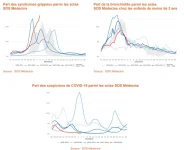
image.png - Click image for larger version  Name:	image.png Views:	1 Size:	96.0 KB ID:	1006158

...
Situation update


In week 04, indicators related to acute respiratory infections increased in the community and in hospitals in all age groups. This activity was mainly driven by influenza.

In mainland France, influenza activity continued to intensify in S04 in the community and in hospitals. The indicators were up in all age groups. Activity in the community reached a very high level this week, particularly among children. In hospitals, the share of hospitalizations for influenza/influenza-like illness among all-cause hospitalizations was at a very high level of intensity among children and high among those aged 15 and over. The grouped cases of ARI reported in medical-social establishments remained mainly attributed to influenza. The share of deaths with a mention of influenza among electronically certified deaths remained very high compared to previous epidemics (7.1% in S04). The three viruses A(H1N1)pdm09, A(H3N2) and B/Victoria continued to co-circulate. Overseas, Guadeloupe, Martinique and Guyana were in epidemic. Mayotte was in pre-epidemic.

For bronchiolitis, a decrease in syndromic indicators continued in the city and in the hospital in S04, this trend being less marked than that observed the previous week. For the youngest infants, the intensity remained lower than that of previous epidemics. The RSV (respiratory syncytial virus) positivity rate decreased among samples tested in city laboratories and in the hospital. It was stable among samples taken by doctors in the city. In mainland France, in S04, only Corsica remained in epidemic. The regions of Brittany, Centre-Val de Loire, Normandy and Pays de la Loire moved to the basic level, bringing the total number of post-epidemic regions to 7. In the DROMs, Martinique and Guadeloupe remained in post-epidemic. French Guiana moved to the basic level this week. Mayotte remained in epidemic

The syndromic indicators of COVID-19 remained stable in cities and hospitals in S04 compared to the previous week and at low levels. The positivity rate for SARS-CoC-2 has stabilized in community medicine and continued to decrease among laboratories in cities and hospitals. The indicator for monitoring SARS-CoV-2 in water continued to decline.

Vaccination remains the best way to protect yourself against influenza and COVID-19, in particular from severe forms of these diseases. These vaccinations are recommended for all eligible people, including people aged 65 and over; people aged over 6 months with comorbidities at high risk of severe disease; pregnant women; residents of follow-up care facilities or medico-social facilities regardless of their age. The flu and COVID-19 vaccination campaign has been extended until February 28, 2025. There is still time to get vaccinated. Influenza vaccination coverage as of December 31, 2024 (interim data) is estimated at 49.8% among people aged 65 and over, and 22.7% among those under 65 at risk of severe flu. These vaccination coverages are lower than those estimated for the 2023-2024 season at the same date (52.7% among people aged 65 and over, and 24.5% among those aged under 65 at risk of severe influenza).

The first estimates of the effectiveness of the influenza vaccine produced by the Sentinelles network from data in community medicine indicate moderate effectiveness (46% [95% CI: 16-65]) for all risk groups targeted by vaccination, higher among those under 65 (62% [95% CI: 21-82]) than among those aged 65 and over (31% [95% CI: -20-61]). These preliminary data will be consolidated in the coming weeks. Given the low effectiveness of the flu vaccine in those aged 65 and over for this season (preliminary data), the systematic adoption of barrier gestures within the general population remains essential to help limit the circulation of respiratory viruses, including among people most at risk of severe forms: hand washing, ventilating rooms and wearing a mask in the event of symptoms (fever, sore throat or cough), in busy places and in the presence of vulnerable people.​

 
Translation Google
Acute respiratory infections (influenza, bronchiolitis, COVID-19). Bulletin of February 5, 2025.


Published on February 5, 2025
Updated on February 5, 2025


Key points

Acute respiratory infections (ARI)
  • Indicators slightly decreasing in all age groups.
  • High activity in the city and moderate in the hospital.
Flu
  • Slowdown of the epidemic in mainland France.
  • Decrease in indicators in all age groups in the city and in the hospital.
  • Influenza activity still very high, particularly among children.
  • Mayotte in epidemic.
Bronchiolitis
  • Decrease in most indicators.
  • In France, Corsica in epidemic, 5 regions in post-epidemic.
  • In the DROMs, the epidemic continues in Mayotte.
COVID-19
  • Activity generally stable at low levels.


PDF 3.29 MB


https://www.santepubliquefrance.fr/...hiolite-covid-19-.-bulletin-du-5-fevrier-2025

--------------------------------
From the PDF link above:
...
Situation update

In week 05, the indicators related to acute respiratory infections decreased slightly in
all age groups. However, this activity remained at a high level in the city and moderate in
the hospital, still mainly driven by influenza.

In mainland France, the indicators indicated a slight slowdown in influenza activity in S05,
the 9th week of the epidemic. The indicators were decreasing in all age groups.
However, activity in the city remained at a very high level this week, driven
particularly by children. In the hospital, the share of hospitalizations for influenza/influenza-like illness
among all-cause hospitalizations returned to a high level of intensity but remained
very high among children. The grouped cases of ARI reported in medico-social establishments
remained mainly attributed to influenza. The share of deaths with a mention of influenza
among electronically certified deaths was slightly down but remained very high (6.4% in
W05) compared to previous epidemics. The three viruses A(H1N1)pdm09, A(H3N2) and B/Victoria
continued to co-circulate. Overseas, Guadeloupe, Martinique and Guyana were in
epidemic. Mayotte became an epidemic in W05.​
​...
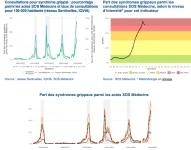
image.png

...
 
Translation Google
Acute respiratory infections (influenza, bronchiolitis, COVID-19). Bulletin of February 19, 2025.


Published on February 19, 2025
Updated on February 19, 2025

Print Share


Key points

Acute respiratory infections (ARI)
  • Indicators decreasing in all age groups.
Flu
  • In mainland France, continued decrease in influenza indicators in all age groups in the city and in hospital.
  • Flu activity still intense, particularly among children.
Bronchiolitis
  • Syndromic indicators at their baseline level at the national level.
  • In mainland France, Corsica is in an epidemic situation and 3 regions are in a post-epidemic situation.
COVID-19
  • Activity generally stable at low levels.


PDF 3.34 MB

https://www.santepubliquefrance.fr/...iolite-covid-19-.-bulletin-du-19-fevrier-2025

​---------------------------------------------------
From the PDF link above:
...​
Severe cases in intensive care

Since week 40, 1,375 cases of influenza, 287 cases of COVID-19 and 256 cases of RSV infections*
have been reported by the intensive care units participating in the surveillance (non-exhaustive surveillance).
Twenty-one cases of influenza/SARS-CoV-2 co-infections; 14 cases of influenza/RSV co-infections and 4
cases of SARS-CoV-2/RSV co-infections have also been reported.
* Surveillance of RSV infections only concerns people aged 18 and over.
...
Among the 1,375 cases of influenza, 47% were aged 65 or over. Among them, the presence of at least one
comorbidity was reported for 87% of cases. A type A virus was identified in 91% of cases
where the virus was typed (1,126/1,237). Among the 860 cases for which vaccination status was reported, 77%
were not vaccinated against influenza. A total of 174 deaths were reported, including 101 in those
aged 65 years or older (unconsolidated data).

Among the 287 COVID-19 cases, 68% were aged 65 years and older. Among them, the majority were
men and the presence of at least one comorbidity was reported for 88% of cases. Among the
725 cases for which vaccination status was reported, 85% were not vaccinated against COVID19 in the
last 6 months. Fifty-nine deaths were reported, including 53 in those aged 65 years and
older (unconsolidated data).

Among the 256 cases of RSV infections, 63% were aged 65 years or older. Patients with
at least one comorbidity accounted for 97% of cases. Thirty-five deaths were reported, including 28
in those aged 65 years and older (unconsolidated data).
...
Mortality

Electronic certification


In week 07, among the 7272 deaths reported by electronic certificate, 5.0% were reported with
a mention of influenza as the morbid condition that directly caused or contributed to the death (vs
5.5% in W06). COVID-19 was mentioned in 0.8% of deaths (vs 0.6% in W06).

In W07, the share of deaths with a mention of influenza among all electronically certified deaths
decreased slightly and remained at a very high level for influenza. Among the
influenza-related deaths reported in S07, 93% concerned people aged 65 and over.
...
All-cause mortality

At the national level, the number of deaths from all causes transmitted by INSEE has
been decreasing since S03, and a return to normal values ​​is noted among those aged 85 and over
in S06-2025.

An excess of deaths is observed among those aged 15-64 and 65-84 between S51 and S04. Among
people aged 85 and over, the numbers are in excess from S01 to S05. These trends are to be
confirmed with the consolidation of the data. This excess of all-cause mortality is concomitant
with the very high level of activity observed in hospitals in connection with influenza.
...
Prevention
Influenza vaccination

...
Data from the Sentinelles network and the CNR Respiratory Infection Viruses make it possible to
produce an estimate of the vaccine's effectiveness in preventing an influenza infection leading to
a consultation with a general practitioner since October 2024. The preliminary results
available on 02/18/2025 estimate the vaccine effectiveness (VE) at 38% [95% CI: 11-57] for all
risk groups, at 52% [95% CI: 12-73] in those under 65 with long-term illness
and at 26% [95% CI: -20-54] in those aged 65 and over, against all influenza viruses
circulating in mainland France. These data are preliminary and will be consolidated over the
coming weeks.
...​
 
Translation Google
Acute respiratory infections (influenza, bronchiolitis, COVID-19). Bulletin of March 5, 2025.


Published on March 5, 2025
Updated on March 5, 2025

Print Share


Key points

Acute respiratory infections (ARI)
  • Indicators decreasing in all age groups.
Flu
  • Continued decline in influenza indicators in mainland France, with three regions moving into post-epidemic status.
  • All other French regions in epidemic, except Reunion.
Bronchiolitis
  • Syndromic indicators at baseline levels at national level.
  • In France, three regions in post-epidemic.
  • Mayotte still in epidemic.
COVID-19
  • Activity generally stable at low levels.
PDF 3.36 MB


https://www.santepubliquefrance.fr/...onchiolite-covid-19-.-bulletin-du-5-mars-2025

----------------------------------------
From the PDF link above:
...


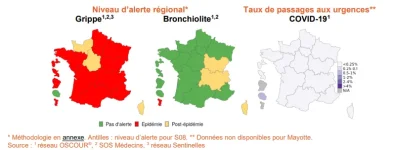
image.png - Click image for larger version  Name:	image.png Views:	1 Size:	85.1 KB ID:	1009155

...
Situation update

In week 09, indicators related to acute respiratory infections were still decreasing
in all age groups, in the city and in hospital. This activity was still mainly driven
by the influenza epidemic.

In mainland France, the decrease in influenza indicators continued in all
age groups. Three regions moved to post-epidemic status in S09 (Centre-Val-de-Loire,
Corsica and Normandy),but the other 10 regions remained in epidemic status. The level of intensity of
syndromic indicators was low in the city and in hospital, regardless of age group. The number of
reports of grouped cases of ARI (including influenza-related) in medical-social establishments continued
to decrease, as did the share of deaths with a mention of influenza among
deaths certified electronically. However, the flu positivity rate still exceeded 20%
in the community (city laboratories), 40% in city medicine and 10% in hospital, indicating
still active circulation of influenza viruses. The three viruses A(H1N1)pdm09, A(H3N2) and B/Victoria
continued to co-circulate, with however a clear increase in the share of type B viruses
observed in recent weeks, including in hospital.
In Overseas, Guadeloupe, Martinique, Guyana and
Mayotte remained in epidemic.

Syndromic indicators of bronchiolitis were at baseline levels in the city and in hospital
in S09 at the national level. The RSV (respiratory syncytial virus) positivity rate decreased among
samples tested in city laboratories and in hospital. It was increasing moderately at a
low level among the samples taken by doctors in the city. In mainland France, in S09, the
Grand Est region moved to the basic level and the Auvergne-Rhône-Alpes, Bourgogne-Franche-Comté
and Corsica regions remained in post-epidemic. In the DROMs, Mayotte was still in
epidemic.

Concerning COVID-19, the syndromic indicators remained generally stable at
low levels in the city and in the hospital compared to the previous week. The positivity rate for SARS-CoV-2
was stable among laboratories in the city and in the hospital and slightly increasing in
the city medicine. The indicator for monitoring SARS-CoV-2 in water was also increasing but
remained low. Given the sustained circulation of respiratory viruses, the systematic adoption of
barrier gestures within the general population remains essential to help limit the circulation of
respiratory viruses, including among people most at risk of severe forms: hand washing, ventilating
rooms and wearing a mask in the event of symptoms (fever, sore throat or cough), in crowded places
and in the presence of vulnerable people.
...​​
 
Translation Google
Acute respiratory infections (flu, bronchiolitis, COVID-19). Bulletin of March 12, 2025.


Published on March 12, 2025
Updated on March 12, 2025

Print Share

Key points

Acute respiratory infections (ARI)
  • Decreased indicators in all age groups, with low intensity activity.
Flu
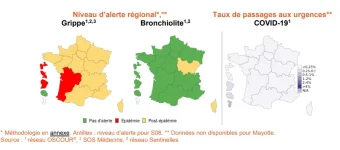
  • Flu indicators continue to decline in mainland France across all age groups. All regions of mainland France are in post-epidemic status, except for Nouvelle-Aquitaine. The Antilles and French Guiana are in epidemic status.
Bronchiolitis
  • Syndromic indicators at their baseline level at the national level. In mainland France, two regions are in post-epidemic phase.
COVID-19
  • Activity generally stable at low levels.
PDF 5.34 MB

https://www.santepubliquefrance.fr/...nchiolite-covid-19-.-bulletin-du-12-mars-2025
-----------------------------------------------

From the PDF link above:
...


image.png - Click image for larger version  Name:	image.png Views:	1 Size:	110.1 KB ID:	1009715
​​
 
Back
Top