
Install the app
How to install the app on iOS
Follow along with the video below to see how to install our site as a web app on your home screen.
Note: This feature may not be available in some browsers.
-
FluTrackers.com Inc. does not provide medical advice. Information on this web site is collected from various internet resources, and the FluTrackers board of directors makes no warranty to the safety, efficacy, correctness or completeness of the information posted on this site by any author or poster. The information collated here is for instructional and/or discussion purposes only and is NOT intended to diagnose or treat any disease, illness, or other medical condition. Every individual reader or poster should seek advice from their personal physician/healthcare practitioner before considering or using any interventions that are discussed on this website. By continuing to access this website you agree to consult your personal physican before using any interventions posted on this website, and you agree to hold harmless FluTrackers.com Inc., the board of directors, the members, and all authors and posters for any effects from use of any medication, supplement, vitamin or other substance, device, intervention, etc. mentioned in posts on this website, or other internet venues referenced in posts on this website.
-
We are not asking for any donations. Do not donate to any entity who says they are raising funds for us.
You are using an out of date browser. It may not display this or other websites correctly.
You should upgrade or use an alternative browser.
You should upgrade or use an alternative browser.
France: 2022-2026 H5N1 in wild birds
- Thread starter Shiloh
- Start date

Pathfinder
Editor, Senior Moderator

Location of Aisne in France
/https://en.wikipedia.org/wiki/Aisne
----------------------------------
Translation Google
Confirmation of two cases of highly pathogenic avian influenza in wild birds in Aisne
Updated on 27/02/2025

The highly pathogenic avian influenza (HPAI) virus was identified on 24/02/2025 in black-headed gulls found dead, in Saint-Quentin on 13/02 and in Tergnier on 17/02. This virus, which circulates actively in Europe via migratory birds, is particularly contagious and pathogenic for birds.
To prevent the virus from spreading to other birds, it is reminded that the general public must avoid picking up birds found dead and handling sick birds. Any mortality of wild birds in this area, without an obvious cause, must be reported to the departmental service of the French Office for Biodiversity at the following number: 03 23 23 41 60 or at the following email address: sd02@ofb.gouv.fr.
Due to the high level of risk of HPAI throughout the national territory, it is recalled that health protection measures must be put in place, in all places, by any owner or holder of poultry or captive birds. These are:
• Provide shelter for detained animals to prevent them from coming into contact with wild birds;
• Water and feed birds and poultry, strictly inside buildings;
• Prohibit all access to water points, unless they are completely covered with netting;
• Use dedicated shoes and clothing to access the part of the farm where poultry are kept;
• Monitor birds daily and, if necessary, report any abnormal behaviour or signs of illness to a veterinarian without delay.
The Aisne Departmental Directorate for the Protection of Populations calls for vigilance from all stakeholders, in particular breeders, bird keepers (farmyards, farms, parks, etc.) and veterinarians in order to do everything possible to limit the spread of this virus. This involves, in particular, the flawless application of biosecurity measures that you will find at the following address: https://agriculture.gouv.fr/influen...operateurs-professionnels-et-les-particuliers
As a reminder, avian influenza is not transmissible to humans through the consumption of meat of avian origin, eggs and more generally any food product derived from poultry.
...
https://www.aisne.gouv.fr/Publicati...utement-pathogene-sur-des-oiseaux-de-la-faune
Pathfinder
Editor, Senior Moderator

Location of Nord in France
/https://en.wikipedia.org/wiki/Nord_(French_department)
---------------------------------------
Translation Google
Highly pathogenic avian influenza: a case of wildlife detected in the North
Updated on 28/02/2025

On February 26, 2025, a first case of wildlife infected with highly pathogenic avian influenza (HPAI) was identified in the Nord department. It was a black-headed gull found dead on February 22 in the commune of Bray-Dunes (Dunkirk district);
On February 24, the same virus was identified in black-headed gulls found dead in the Aisne department in Saint-Quentin and Tergnier (Laon district).
In Europe, particularly along the Channel, the North Sea and the Baltic Sea, the number of cases has been increasing in wildlife for several weeks and since February 17, several outbreaks have been identified in poultry farms: 2 in Belgium, 2 in the Netherlands, 1 in Northern Ireland.
The virus, which is highly contagious and pathogenic to birds, is currently circulating in Europe, among migratory birds and local wildlife. It can persist in contaminated droppings and stagnant water, increasing the risk of contamination.
Let us recall that since November 9, 2024, the Ministry of Agriculture has placed France at the “high risk” level concerning HPAI.
This decision leads to the establishment of reinforced preventive measures across the entire metropolitan area.
All owners of poultry or captive birds, both professionally (poultry farmers) and non-professionals (farmyards, ornamental birds) must apply the following measures:
- Sheltering animals to avoid contact with wild birds.
- Feed and water birds exclusively inside buildings.
- Access to water points is prohibited , unless they are completely protected by nets.
- Use of dedicated shoes and clothing when accessing the poultry farm.
- Daily monitoring of animals: any abnormality or sign of illness must be immediately reported to a veterinarian.
Essential precautions regarding the carcasses of wild birds
It is important to remember that the public should not pick up dead birds or handle sick birds.
In the event of suspicious mortality of wild birds within a geographical area, without an obvious cause, it is imperative to report the incident immediately to the French Office for Biodiversity (OFB) via the following number: 03 27 49 70 54 or by e-mail to sd59@ofb.gouv.fr .
Vigilance and collaboration essential
The Departmental Directorate for the Protection of Populations of the North calls for the greatest vigilance on the part of all stakeholders concerned: breeders, bird keepers (farmyards, farms, parks, etc.) and veterinarians. It is crucial to implement all biosecurity measures to limit the spread of the virus. To find out more, consult the full recommendations on: https://agriculture.gouv.fr/influen...operateurs-professionnels-et-les-particuliers
Important reminder: Avian influenza is not transmissible to humans through the consumption of meat or eggs of avian origin, or other food products derived from poultry.
https://www.nord.gouv.fr/Actualites...-un-cas-de-faune-sauvage-detecte-dans-le-Nord
Pathfinder
Editor, Senior Moderator

Location of Pas-de-Calais in France
/https://en.wikipedia.org/wiki/Pas-de-Calais
----------------------------------
Translation Google
Berck-sur-mer: a laughing gull discovered dead from bird flu on the beach
ELISE CAUCHIN 07:34 - March 06, 2025
The Pas-de-Calais prefecture is calling on poultry farmers to be vigilant following the discovery of a black-headed gull that died of bird flu on Berck beach on February 27.
This is the first case of Highly Pathogenic Avian Influenza discovered in wild birds in 2025 in Pas-de-Calais. Since February 22, 3 cases have also been identified in black-headed gulls in the North in Bray-Dunes and in Aisne in the Saint-Quentin and Laon areas.
This virus, which is particularly contagious and pathogenic for birds, is actively circulating in Europe via migratory birds or local wildlife. In Europe, wild birds are affected along the English Channel, the North Sea and the Baltic. Poultry farms have also been impacted recently: Belgium (2 outbreaks), the Netherlands (2 outbreaks) and Northern Ireland (1 outbreak).
https://www.radio6.fr/article-72161...-morte-de-la-grippe-aviaire-sur-la-plage.html
--------------------------
A seagull found dead on the beach of Berck, it had bird flu
On February 27, a seagull infected with bird flu was discovered dead on the beach at Berck. The prefecture has therefore announced a strengthening of health measures.
By RD
Published:
March 6, 2025 at 9:17 a.m.
The avian influenza virus is contagious to birds . It is actively circulating in Europe via migratory birds or local wildlife.
Since February 22, in addition to Berck, three other cases of seagulls contaminated by avian flu have been reported in Bray-Dunes near Dunkirk and in the districts of Saint-Quentin and Laon (02).
Drastic measures
Due to the high level of risk, the Pas-de-Calais prefecture requires the implementation of reinforced prevention and surveillance measures: daily surveillance of birds , any sign of illness must be reported immediately to a veterinarian, sheltering of poultry including in private homes (farmyards), covering of duck transport vehicles and restrictions on the transport and use of decoys and hunting.
The public should not pick up dead birds or handle birds that appear to be sick. A report should be made immediately to municipal services or the French Office for Biodiversity (OFB).
https://www.lavoixdunord.fr/1561580...a-plage-de-berck-elle-avait-la-grippe-aviaire
Pathfinder
Editor, Senior Moderator
/https://en.wikipedia.org/wiki/S%C3%A9n%C3%A9
----------------------------------------------------------------------------
Translation Google
In Séné, birds are victims of avian flu in the reserve
At the end of August 2025, 23 dead birds were found in the Séné Marshes Nature Reserve (Morbihan). Ten of them were analyzed and found to be carriers of avian flu.
Ouest France
Isabelle JÉGOUZO
Published on03/09/2025 at 5:29 p.m.
After the Suscinio pond in Sarzeau (Morbihan) , it is the turn of the Séné marshes nature reserve to note a mortality among two species of birds: swans and spoonbills. We found 23 dead birds last week, swans and spoonbills , comments Guillaume Gélinaud. 10 of them have been analyzed and they are all carriers of avian flu.
Testing is continuing. They may also have been contaminated with botulism; we hope to have results this week. This was confirmed last week. Since then, the reserve's teams have continued field checks. This week's monitoring has not revealed any other dead birds.
Visitors are prohibited from entering the reserve. Only authorized personnel are allowed to carry out inspections and collect dead birds, while wearing masks and gloves
https://www.ouest-france.fr/sante/g...-reserve-5b17e8be-88ca-11f0-880b-e0751d6521a8
----------------------------
See also:
France - Sarzeau: analyses underway after the discovery of weakened wild birds on the castle grounds - presence of avian botulism in several species
https://flutrackers.com/forum/forum/europe-aj/1018130-france-sarzeau-analyses-underway-after-the-discovery-of-weakened-wild-birds-on-the-castle-grounds-presence-of-avian-botulism-in-several-species
Pathfinder
Editor, Senior Moderator
Translation Google
BIRD FLU IS BACK IN BRITTANY
Following the discovery of several wild bird carcasses in the Séné Nature Reserve in Morbihan (7 swans and 4 spoonbills), analyses have shown contamination by the highly pathogenic avian influenza virus type H5. The virus is therefore circulating in Brittany.
Brittany.

Environment
Published on Thursday, September 11, 2025
BIRD FLU IS BACK IN BRITTANY
Following the discovery of several wild bird carcasses in the Séné Nature Reserve in Morbihan (7 swans and 4 spoonbills), analyses have shown contamination by the highly pathogenic avian influenza virus type H5. The virus is therefore circulating in Brittany.
Biosecurity measures to be applied in poultry yards
FOR OWNERS OF POULTRY OR OTHER CAPTIVE BIRDS
BIRD FLU IS BACK IN BRITTANY
Following the discovery of several wild bird carcasses in the Séné Nature Reserve in Morbihan (7 swans and 4 spoonbills), analyses have shown contamination by the highly pathogenic avian influenza virus type H5. The virus is therefore circulating in Brittany.
Brittany.

Environment
Published on Thursday, September 11, 2025
BIRD FLU IS BACK IN BRITTANY
Following the discovery of several wild bird carcasses in the Séné Nature Reserve in Morbihan (7 swans and 4 spoonbills), analyses have shown contamination by the highly pathogenic avian influenza virus type H5. The virus is therefore circulating in Brittany.
Biosecurity measures to be applied in poultry yards
FOR OWNERS OF POULTRY OR OTHER CAPTIVE BIRDS
- Monitor your birds daily .
- No poultry (webbed and gallinaceous) in the farmyard should come into direct contact with or have access to poultry from a professional farm.
- Limit access to the farmyard (the place where you keep your birds) to those people who are essential to its maintenance.
- Protect your feed stock from wild birds as well as your poultry's access to feed and drinking water.
- Protect and store new bedding away from moisture and contamination, and avoid possible contact with carcasses.
- Never use surface water : pond water, stream water, collected rainwater, etc. to clean your farm.
- If droppings and manure are composted near the farmyard, they must not be transported outside the farm before a storage period of 2 months . Beyond this period, spreading is possible.
- Carry out regular cleaning of buildings and equipment used for the farmyard.
- Wear boots, a dedicated blouse and possibly gloves when caring for your birds.
- When you leave your farmyard, leave your equipment (boots, coat, gloves, etc.) at the entrance to it.
- In all cases, regularly wash your boots, coats, and gloves with hot water and detergent or disinfect them. No dirt should remain. Also regularly wash livestock equipment (forks, feeders, etc.).
- Wash your hands thoroughly with soap and warm water after contact with birds.
- Do not visit other farms without taking special precautions.
Pathfinder
Editor, Senior Moderator
Translation Google
In Sarzeau, swans are victims of an epidemic of avian flu variant
September 25, 2025 at 8:02 p.m.
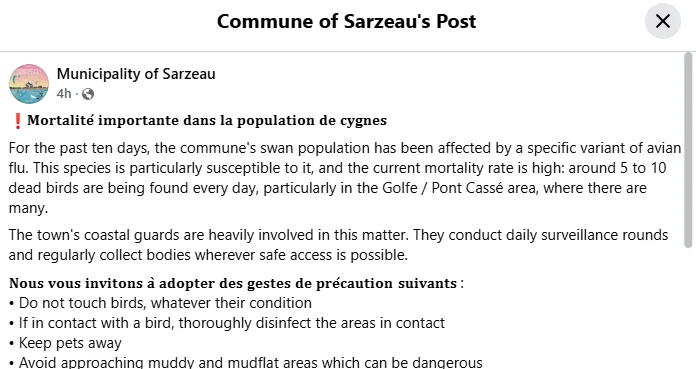
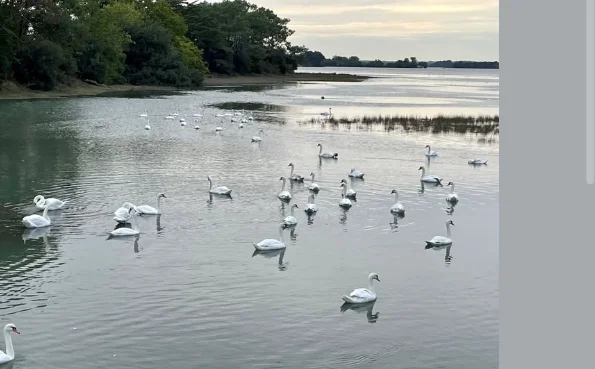
In Sarzeau (56), the town hall is raising the alarm about an epidemic of a variant of avian flu affecting swans. For the past ten days, coastal guards have been collecting carcasses daily.
They are affected by a variant of avian flu. In Sarzeau, coastal guards are finding five to ten swan carcasses every day, especially in the Gulf of Morbihan and Pont Cassé area. The town hall posted an alert on its Facebook account this Thursday evening. It explained that coastal guards are conducting daily patrols to collect the carcasses. But it is urging walkers to take precautionary measures: keep their pets away, and do not touch the birds, regardless of their condition. If they do go ahead and touch the bird, the contact areas must be thoroughly disinfected. And finally, "avoid approaching muddy areas and mudflats, which can be dangerous."
At the end of August, avian botulism hit the bird populations in Sarzeau.
https://www.letelegramme.fr/morbiha...mie-dun-variant-de-grippe-aviaire-6897415.php
--------------------------------------------------------------------------
Screenshot:
https://www.facebook.com/permalink....rBpYcrpySmqUN1ZQeP52HiRLXl&id=100064543397926
In Sarzeau, swans are victims of an epidemic of avian flu variant
September 25, 2025 at 8:02 p.m.
In Sarzeau (56), the town hall is raising the alarm about an epidemic of a variant of avian flu affecting swans. For the past ten days, coastal guards have been collecting carcasses daily.
They are affected by a variant of avian flu. In Sarzeau, coastal guards are finding five to ten swan carcasses every day, especially in the Gulf of Morbihan and Pont Cassé area. The town hall posted an alert on its Facebook account this Thursday evening. It explained that coastal guards are conducting daily patrols to collect the carcasses. But it is urging walkers to take precautionary measures: keep their pets away, and do not touch the birds, regardless of their condition. If they do go ahead and touch the bird, the contact areas must be thoroughly disinfected. And finally, "avoid approaching muddy areas and mudflats, which can be dangerous."
At the end of August, avian botulism hit the bird populations in Sarzeau.
https://www.letelegramme.fr/morbiha...mie-dun-variant-de-grippe-aviaire-6897415.php
--------------------------------------------------------------------------
Screenshot:
https://www.facebook.com/permalink....rBpYcrpySmqUN1ZQeP52HiRLXl&id=100064543397926
Pathfinder
Editor, Senior Moderator
/https://en.wikipedia.org/wiki/Vienne_(department)
----------------------------------------------------------
Translation Google
Vienna: Why are swallows flapping their wings?
By EDITORIAL STAFF
Published on 02/10/2025 at 7:17 p.m.
updated on03/10/2025 at 10:25
In Saint-Pierre-de-Maillé, Nalliers and Chauvigny, residents have noted excess mortality and unusual behavior among swallows since Wednesday, September 24, 2025.
" I've been practicing since 2008, I've never seen anything like this ." On Wednesday, September 24, 2025, calls about barn swallows or house swallows quickly worried Lydia Bourdeau, from the Poitevine Wildlife Care Center. From 8:30 a.m., in the region of Saint-Pierre-de-Maillé , Nalliers and Chauvigny , the species experienced a peak in mortality and strange behavior. Dead birds on sidewalks and in gutters, others that tapped on windows to enter homes.
In the fields, farmers were surprised by their low flight, to the point where they hit tractor tires. " It started to alarm me ," confided the keeper. So she contacted the mayor of Saint-Pierre-de-Maillé, the French Office for Biodiversity (OFB) , and the Departmental Veterinary Services Directorate (DDSV).
Analyses are underway
Health centers in the Haute-Vienne and Creuse departments have reported cases, including in the Sologne region. " Their mucous membranes are very red ," Lydia Bourdeau reportedly observed. She noted that these young migrating swallows were hypothermic, below the 41°C normal for the species. For her part, she considered the effects of an insecticide, or a weakened third brood.
Contacted, the OFB assured that analyses are underway on individuals sampled on Wednesday, September 24. In particular, to determine whether it could be an avian virus, which is rare in this species. The organization suspects a phenomenon of exhaustion linked to the sudden drop in temperatures and rainfall. The results of the analyses should be known within ten days.
...
https://www.lanouvellerepublique.fr...-les-hirondelles-battent-de-l-aile-1759425424
Pathfinder
Editor, Senior Moderator
Translation Google
In the region ,Morbihan
Bird flu is shaking the Gulf of Morbihan Regional Natural Park for geese
The bird flu that is decimating swans in the Gulf of Morbihan Regional Natural Park risks affecting other species.
By Solenne Durox
October 7 , 2025 at 3:18 p.m.
Over the past three weeks, more than sixty swans have died, struck down by a variant of avian flu near Sarzeau (Morbihan).
Coastal guards discover 5 to 10 of them a day and regularly collect the carcasses. The situation could worsen further with the arrival of migratory wild birds in the Gulf of Morbihan Regional Natural Park.
Ornithologist David Ledan has serious concerns about Canada geese, a large bird species in the Anatidae family, like swans. The very first ones appeared at the end of September, and within a few days, there will be 10,000 of them in the Gulf of Morbihan. "It's a very fragile population. If the epizootic affects them, we won't be able to do anything other than observe and count the deaths," he explains.
Do not touch the birds
Faced with the virus, the professional feels helpless. "We don't know how it's transmitted, and vaccination isn't an option," he adds. Bird flu has already severely affected Brittany in the past. Three years ago, the gannet colony was decimated in the Sept-Iles nature reserve (Côtes d'Armer). In the summer of 2023, bird flu killed nearly 400 terns on the Rhuys peninsula.
To prevent the spread of the virus, Sarzeau City Hall recommends "not touching birds, regardless of their condition, and keeping pets away." In case of contact, thoroughly disinfect the area. All stakeholders in the poultry industry are also urged to be extremely vigilant and strictly adhere to biosecurity measures.
https://www.leparisien.fr/morbihan-...hes-07-10-2025-XFT7YAS52FDSNJPUWICQNY4VJI.php
In the region ,Morbihan
Bird flu is shaking the Gulf of Morbihan Regional Natural Park for geese
The bird flu that is decimating swans in the Gulf of Morbihan Regional Natural Park risks affecting other species.
By Solenne Durox
October 7 , 2025 at 3:18 p.m.
Over the past three weeks, more than sixty swans have died, struck down by a variant of avian flu near Sarzeau (Morbihan).
Coastal guards discover 5 to 10 of them a day and regularly collect the carcasses. The situation could worsen further with the arrival of migratory wild birds in the Gulf of Morbihan Regional Natural Park.
Ornithologist David Ledan has serious concerns about Canada geese, a large bird species in the Anatidae family, like swans. The very first ones appeared at the end of September, and within a few days, there will be 10,000 of them in the Gulf of Morbihan. "It's a very fragile population. If the epizootic affects them, we won't be able to do anything other than observe and count the deaths," he explains.
Do not touch the birds
Faced with the virus, the professional feels helpless. "We don't know how it's transmitted, and vaccination isn't an option," he adds. Bird flu has already severely affected Brittany in the past. Three years ago, the gannet colony was decimated in the Sept-Iles nature reserve (Côtes d'Armer). In the summer of 2023, bird flu killed nearly 400 terns on the Rhuys peninsula.
To prevent the spread of the virus, Sarzeau City Hall recommends "not touching birds, regardless of their condition, and keeping pets away." In case of contact, thoroughly disinfect the area. All stakeholders in the poultry industry are also urged to be extremely vigilant and strictly adhere to biosecurity measures.
https://www.leparisien.fr/morbihan-...hes-07-10-2025-XFT7YAS52FDSNJPUWICQNY4VJI.php

Commonground
Senior Moderator
France raises bird flu alert level to 'high' after new cases
October 21, 2025
PARIS (Reuters) -France has raised its bird flu alert level to 'high' from 'moderate', requiring poultry farms nationwide to keep birds indoors as Europe faces a seasonal resurgence of the disease.
-snip-
"This decree... was issued following evidence of infection among migratory wild birds in Europe, including France, and the confirmation of several outbreaks in poultry farms," the agriculture ministry said in the government's official journal.
The change in status will take effect on Wednesday.
The upgrade to risk status in the seasonal assessment is kicking in earlier than previous years, taking effect in October compared to November last year and December in 2023.
https://www.yahoo.com/news/articles/france-raises-bird-flu-alert-081411872.html
October 21, 2025
PARIS (Reuters) -France has raised its bird flu alert level to 'high' from 'moderate', requiring poultry farms nationwide to keep birds indoors as Europe faces a seasonal resurgence of the disease.
-snip-
"This decree... was issued following evidence of infection among migratory wild birds in Europe, including France, and the confirmation of several outbreaks in poultry farms," the agriculture ministry said in the government's official journal.
The change in status will take effect on Wednesday.
The upgrade to risk status in the seasonal assessment is kicking in earlier than previous years, taking effect in October compared to November last year and December in 2023.
https://www.yahoo.com/news/articles/france-raises-bird-flu-alert-081411872.html
Pathfinder
Editor, Senior Moderator
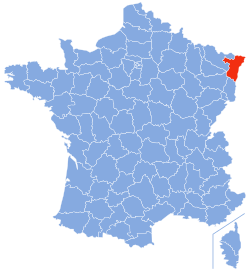
Location of Bas-Rhin in France
/https://en.wikipedia.org/wiki/Bas-Rhin
--------------------------------------------------------------------------
Translation Google
Bas-Rhin
Wild geese carcasses: avian flu outbreak strongly suspected near Molsheim
The existence of an outbreak of avian flu is strongly suspected in Avolsheim, near Molsheim, following the discovery on Tuesday, October 21, of two dead greylag geese, the town's mayor, Pascal Géhin, confirmed this Friday. The level of vigilance is now "high" in the department.
Hervé Miclo - Today at 5:44 PM | Updated today at 7:14 PM - Reading time: 2 min
"I was informed on Tuesday of the presence of two dead geese, one in the Bruche near the dam and the other on the banks of the Bruche," explains the mayor of Avolsheim, who immediately alerted the French Office for Biodiversity (OFB). "The results of the analyses came in on Thursday: for at least one of the geese, it is a case of avian flu," continues Pascal Géhin. Further analyses are to be carried out, but there is little doubt, especially since "we had a new case of mortality today," continues the mayor. On Friday evening, the prefecture confirmed that the birds were "strongly suspected of being carriers of the HPAI (Highly Pathogenic Avian Influenza) virus." After contacting the authorities, the elected official also alerted the neighboring municipalities of "Soultz-les-Bains, Ergersheim, and Wolxheim, which also host wild geese."
On Friday evening, the prefecture also reiterated that the vigilance level had increased since Tuesday, October 21, from "moderate" to "high" and issued some safety instructions. In the event of the discovery of a new carcass, it is recommended not to touch it and to "notify the OFB at 06 07 69 91 31 or by email: sd67@ofb.gouv.fr." "The general public is strongly advised not to approach or feed wild birds. Similarly, it is advisable to avoid visiting wetlands (edges of ponds, pools, and rivers) where wild birds are found, even in their absence, due to the possible presence of viruses in droppings and contaminated soil," the prefecture continued. However, the consumption of bird meat or eggs does not pose any danger to human health.
Farmyard birds must also be confined. In his commune of 760 inhabitants, Pascal Géhin says he is worried about "the local residents who keep chickens" and the ducks that share the waters and banks of the Bruche with the greylag geese. Geese that have been delighting residents and visitors for decades and are "part of our heritage," he points out.
https://www.dna.fr/faits-divers-justice/2025/10/24/un-foyer-de-grippe-aviaire-detecte

Location of Bas-Rhin in France
/https://en.wikipedia.org/wiki/Bas-Rhin
--------------------------------------------------------------------------
Translation Google
Bas-Rhin
Wild geese carcasses: avian flu outbreak strongly suspected near Molsheim
The existence of an outbreak of avian flu is strongly suspected in Avolsheim, near Molsheim, following the discovery on Tuesday, October 21, of two dead greylag geese, the town's mayor, Pascal Géhin, confirmed this Friday. The level of vigilance is now "high" in the department.
Hervé Miclo - Today at 5:44 PM | Updated today at 7:14 PM - Reading time: 2 min
"I was informed on Tuesday of the presence of two dead geese, one in the Bruche near the dam and the other on the banks of the Bruche," explains the mayor of Avolsheim, who immediately alerted the French Office for Biodiversity (OFB). "The results of the analyses came in on Thursday: for at least one of the geese, it is a case of avian flu," continues Pascal Géhin. Further analyses are to be carried out, but there is little doubt, especially since "we had a new case of mortality today," continues the mayor. On Friday evening, the prefecture confirmed that the birds were "strongly suspected of being carriers of the HPAI (Highly Pathogenic Avian Influenza) virus." After contacting the authorities, the elected official also alerted the neighboring municipalities of "Soultz-les-Bains, Ergersheim, and Wolxheim, which also host wild geese."
On Friday evening, the prefecture also reiterated that the vigilance level had increased since Tuesday, October 21, from "moderate" to "high" and issued some safety instructions. In the event of the discovery of a new carcass, it is recommended not to touch it and to "notify the OFB at 06 07 69 91 31 or by email: sd67@ofb.gouv.fr." "The general public is strongly advised not to approach or feed wild birds. Similarly, it is advisable to avoid visiting wetlands (edges of ponds, pools, and rivers) where wild birds are found, even in their absence, due to the possible presence of viruses in droppings and contaminated soil," the prefecture continued. However, the consumption of bird meat or eggs does not pose any danger to human health.
Farmyard birds must also be confined. In his commune of 760 inhabitants, Pascal Géhin says he is worried about "the local residents who keep chickens" and the ducks that share the waters and banks of the Bruche with the greylag geese. Geese that have been delighting residents and visitors for decades and are "part of our heritage," he points out.
https://www.dna.fr/faits-divers-justice/2025/10/24/un-foyer-de-grippe-aviaire-detecte
Pathfinder
Editor, Senior Moderator
/https://en.wikipedia.org/wiki/Marne_(department)
-----------------------------------------------------------------------
Translation Google
Avian flu: “Around 500 corpses”… Common cranes decimated in the Marne
Massacre• The risk level linked to avian flu has been raised to its highest level in metropolitan France
20 Minutes with AFP
Published on 10/24/2025 at 5:13 p.m.• Updated on 10/24/2025 at 5:16 p.m.
An unprecedented excess mortality rate linked to avian flu is currently affecting common cranes at Lac du Der (Marne), a crossroads for their migration south, according to the department's prefecture and the League for the Protection of Birds (LPO).
Since last weekend, when 42,000 common cranes arrived around the large lake, "around 500 crane corpses have been counted," the Marne prefecture told AFP on Friday.
The same source stated that the presence of avian flu was "confirmed" in this population on Wednesday, the day the risk level linked to this disease was raised to its highest level in metropolitan France. Until now, the avian flu virus had never affected the common cranes of Lake Der, according to the prefecture.
Deaths in Germany too
This large artificial lake between Marne and Haute-Marne is a key crossing point on the migratory route of cranes, which arrive from northern Europe and seek to spend the winter in the warmth of Spain or North Africa. Crane deaths linked to the avian flu epidemic have also been noted in recent days in Germany, noted Aurélien Deschatres, head of the LPO Champagne-Ardenne. Other cases are also beginning to be reported following the cranes' passage, particularly in southwest France, he added. However, "for the time being, no excess mortality has been observed among other bird species present on the lake," according to the Marne prefecture.
At Lake Der, where the first cranes arrived on October 14, the LPO has counted at this stage "approximately 120,000 arrivals, out of a population (total, editor's note) of 400,000 to 450,000," according to Aurélien Deschatres. "Other large movements are expected until the end of November." In recent years, due to global warming , these migratory birds , however, tend to stop longer on the shores of Lake Der, or even to spend the winter there for 20,000 to 30,000 of them, according to the LPO. The common crane has been a protected species throughout France since 1976.
https://www.20minutes.fr/planete/41...on-500-cadavres-grues-cendrees-decimees-marne
-----------------------------------------------------------------
Image translated by Google
...
https://www.marne.gouv.fr/contenu/t...5774/file/CP_+Influenza+aviaire_+octobre.pdf
Pathfinder
Editor, Senior Moderator
/https://en.wikipedia.org/wiki/Landes_(department)
-----------------------------------------------------
Translation Google
Lake Arjuzanx - Common cranes infected with avian flu
Updated on 10/24/2025

Lake Arjuzanx - Common cranes infected with avian flu
Common cranes have been found dead near Lake Arjuzanx.
After investigations, it turned out that they were carriers of the highly pathogenic avian influenza virus .
In this context and in accordance with the applicable protocol, the collection of these birds is underway.
... [TABLE="width: 792"]
[TR]
[TD]It is important to adopt the right behaviors in order to limit the spread of the virus and to preserve wildlife and domestic livestock.
If you observe a sick or dead crane (or other bird):
- Do not touch the animal , even with gloves;
- Do not approach wild birds, whether alone or in groups;
- Keep pets away , especially dogs;
- Report your observation immediately :
- at the town hall of the municipality concerned, or
- to the departmental federation of hunters or to the French Office for Biodiversity - OFB) at the following email address: sd40@ofb.gouv.fr / 05 58 05 07 00.
- Do not collect or move dead birds;
- Do not attempt to treat or transport them;
- Do not throw carcasses in garbage or move them to other locations.
[/TR]
[/TABLE]
...
https://www.landes.gouv.fr/Actualit...es-cendrees-contaminees-par-la-grippe-aviaire
Pathfinder
Editor, Senior Moderator
/https://en.wikipedia.org/wiki/Valleroy,_Meurthe-et-Moselle
-----------------------------------------------------------------------------
Translation Google
Valleroy
Metz
Avian flu: "Between 2,000 and 2,500 dead cranes in Lorraine, it's quite catastrophic"
Natacha Kadur
Published onMonday, October 27, 2025 at 3:22 p.m.
The Lorraine Wildlife Rescue Center (CSFL) has reported a fairly high mortality rate among cranes migrating overhead, victims of avian flu. If you find a dead or sick animal in your home, it is advisable to call specialists.
Dozens of cases of dead birds are being reported daily at the end of October to the Wildlife Rescue Center (CSFL) located in Valleroy, in the Pays Haut region: " We must have reached 2,000 or 2,500 crane deaths in the Lorraine region. The epidemic is spreading from Germany to Spain, with mortality across this entire diagonal, which corresponds to the species' migration line," comments Alexandre Portmann, director of the organization. An impressive mortality rate, " a lot all at once ," but compared to the hundreds of thousands of birds currently flying overhead in Lorraine, he adds.
Cranes crashing in mid-air
Animals found dead in migratory stopover areas, such as the Lachaussée nature reserve or the Hamel pond, but also in the woods and sometimes in inhabited areas : " We are contacted about individuals that even fall from the sky since avian flu causes neurological disorders. We have birds that no longer know what they are doing, they fly off in migration and crash on roofs or in courtyards in the city center while trying to land. It's quite catastrophic," adds the wildlife specialist.
Do not touch a dead or sick animal
If you see a dead or sick animal in your garden, you should avoid touching it, Alexandre Portmann reminds us: " The only thing to do is to notify the French Office for Biodiversity (OFB) or the fire brigade, which has an animal section, and discuss with them what to do, whether the bird is dead or alive. For dying birds that have fallen in the open countryside, there is not much that can be done: there is a vaccine against avian flu for domestic animals, but no treatment," he adds.
https://www.francebleu.fr/infos/env...n-lorraine-c-est-assez-catastrophique-6987206
Pathfinder
Editor, Senior Moderator
Translation Google
"We're getting into the hard stuff": abnormal mortality of common cranes, the avian flu virus is early and virulent
France 3 Aquitaine
Written by
Camille Michelland and Guillaume Ployé
Published on
10/28/2025 at 11:59 AM
As cranes begin their winter migration from northern to southern Europe, this year they are carrying the avian flu virus with them. Several were found dead in the Landes region, contaminated. This massacre is indicative of the virus's early and global circulation.
They announce the arrival of winter. Common cranes have begun their migration from northern European countries to Spain. They often stop over or decide to spend the winter in the Southwest. There is one place they particularly covet: the Arjuzanx Nature Reserve in the Landes region, ideally located on their migration route. Here, they easily find food, between the wetlands and cornfields. The reserve is also an excellent resting place before continuing their journey further south.
Abnormal mortality
Every year during the winter, nearly 30,000 cranes pass through the Arjuzanx Nature Reserve, making it one of the most important migratory sites in Europe. But this year, the very first cranes arrived sick, contaminated by avian flu. "We have observed an abnormal mortality of cranes ," confides Sophie Laugareil, curator at the Arjuzanx Nature Reserve, in the Landes region.
"This year, cranes are particularly affected throughout Europe."
Sophie Laugareil
Curator at the Arjuzanx Nature Reserve
Further north, at Lac du Der in Champagne, another stopover for common cranes, cases of avian flu have already been reported. The Arjuzanx nature reserve was therefore expecting to see sick cranes arrive with the migration phenomenon. "We knew that the migratory corridor was affected, and we were no exception," Sophie Laugareil saddened.
As the migration of common cranes is just beginning, this massacre is not a good sign. "Cranes migrate in groups, which further encourages contamination and mass mortality ," explains Jean-Luc Guérin, a lecturer and researcher specializing in avian influenza.
While this mortality phenomenon is occurring everywhere in France, and can be impressive, it is not "a new phenomenon ," assures Jean-Luc Guérin. This has already been observed in seabirds, he explains. On the other hand, "common cranes are very large birds whose corpses are easily spotted compared to small birds," the researcher qualifies.
Revealing birds
Since October 17, the risk level for bird flu has risen from "moderate" to "high" in France, the highest level. The discovery of several outbreaks across the country has prompted health authorities to raise the level. "It's early for the season ," explains Jean-Luc Guérin.
Cases of bird flu among cranes have also prompted the government to raise the bar. "The fact that cranes are starting to become infected shows that the virus is already circulating intensely ," the bird flu specialist explains. "We can expect even higher mortality rates in the coming weeks ," he says.
According to the specialist, this phenomenon of avian flu among common cranes is revealing. "It shows that there is active circulation throughout Europe, with introductions into farms reported almost daily in France and Europe ," explains Jean-Luc Guérin.
"We must be extra vigilant in the coming weeks."
Jean-Luc Guérin
Teacher-researcher specializing in avian flu
"We're getting to the hard part," says Jean-Luc Guérin. While a vaccine against avian flu has existed for two years, it is only intended for farmed birds. Since common cranes are wild animals, it is not possible to vaccinate them. "The goal of the vaccine is to achieve territorial immunity to block transmission chains," explains Jean-Luc Guérin. He assures that the vaccine has proven its effectiveness even if "we cannot prevent a few outbreaks from occurring."
https://france3-regions.franceinfo....-aviaire-est-precoce-et-virulent-3240271.html
"We're getting into the hard stuff": abnormal mortality of common cranes, the avian flu virus is early and virulent
France 3 Aquitaine
Written by
Camille Michelland and Guillaume Ployé
Published on
10/28/2025 at 11:59 AM
As cranes begin their winter migration from northern to southern Europe, this year they are carrying the avian flu virus with them. Several were found dead in the Landes region, contaminated. This massacre is indicative of the virus's early and global circulation.
They announce the arrival of winter. Common cranes have begun their migration from northern European countries to Spain. They often stop over or decide to spend the winter in the Southwest. There is one place they particularly covet: the Arjuzanx Nature Reserve in the Landes region, ideally located on their migration route. Here, they easily find food, between the wetlands and cornfields. The reserve is also an excellent resting place before continuing their journey further south.
Abnormal mortality
Every year during the winter, nearly 30,000 cranes pass through the Arjuzanx Nature Reserve, making it one of the most important migratory sites in Europe. But this year, the very first cranes arrived sick, contaminated by avian flu. "We have observed an abnormal mortality of cranes ," confides Sophie Laugareil, curator at the Arjuzanx Nature Reserve, in the Landes region.
"This year, cranes are particularly affected throughout Europe."
Sophie Laugareil
Curator at the Arjuzanx Nature Reserve
Further north, at Lac du Der in Champagne, another stopover for common cranes, cases of avian flu have already been reported. The Arjuzanx nature reserve was therefore expecting to see sick cranes arrive with the migration phenomenon. "We knew that the migratory corridor was affected, and we were no exception," Sophie Laugareil saddened.
As the migration of common cranes is just beginning, this massacre is not a good sign. "Cranes migrate in groups, which further encourages contamination and mass mortality ," explains Jean-Luc Guérin, a lecturer and researcher specializing in avian influenza.
While this mortality phenomenon is occurring everywhere in France, and can be impressive, it is not "a new phenomenon ," assures Jean-Luc Guérin. This has already been observed in seabirds, he explains. On the other hand, "common cranes are very large birds whose corpses are easily spotted compared to small birds," the researcher qualifies.
Revealing birds
Since October 17, the risk level for bird flu has risen from "moderate" to "high" in France, the highest level. The discovery of several outbreaks across the country has prompted health authorities to raise the level. "It's early for the season ," explains Jean-Luc Guérin.
Cases of bird flu among cranes have also prompted the government to raise the bar. "The fact that cranes are starting to become infected shows that the virus is already circulating intensely ," the bird flu specialist explains. "We can expect even higher mortality rates in the coming weeks ," he says.
According to the specialist, this phenomenon of avian flu among common cranes is revealing. "It shows that there is active circulation throughout Europe, with introductions into farms reported almost daily in France and Europe ," explains Jean-Luc Guérin.
"We must be extra vigilant in the coming weeks."
Jean-Luc Guérin
Teacher-researcher specializing in avian flu
"We're getting to the hard part," says Jean-Luc Guérin. While a vaccine against avian flu has existed for two years, it is only intended for farmed birds. Since common cranes are wild animals, it is not possible to vaccinate them. "The goal of the vaccine is to achieve territorial immunity to block transmission chains," explains Jean-Luc Guérin. He assures that the vaccine has proven its effectiveness even if "we cannot prevent a few outbreaks from occurring."
https://france3-regions.franceinfo....-aviaire-est-precoce-et-virulent-3240271.html
Pathfinder
Editor, Senior Moderator
/https://fr.wikipedia.org/wiki/Gironde_(d%C3%A9partement)
----------------------------------------------------------------------------------------
Translation Google
Avian influenza: taking action to prevent it
Updated on 30/10/2025

Situation update in Nouvelle-Aquitaine
Significant mortality cases due to Highly Pathogenic Avian Influenza (HPAI) have been observed in common cranes during their migration from northeastern to southwestern France. France has been classified as high-risk since October 22, 2025 .
Common crane migrations take place in mainland France from the Northeast to the Southwest until the end of November, with a peak between October 20 and November 15.
- Cases of HPAI have been observed in recent days in Nouvelle-Aquitaine. Four cranes have been diagnosed as carriers of the virus in different locations within the Gironde department (as of October 30, 2025).
- The services of the French Office for Biodiversity, as well as the Federations of hunters and the managers of nature reserves carry out a count of bird mortalities and inform the bodies responsible for animal health monitoring.
Biosecurity measures for individuals
Although the risk to humans remains low, the HPAI virus has zoonotic potential (meaning that a risk to human health may exist). The virus also impacts poultry production. Finally, it poses a challenge for the conservation of wild populations.
In this context, certain measures should be taken:
→ If you find yourself facing a sick bird:
- Do not approach it.
- Do not touch it.
- Do not transport them.
- If you own a backyard flock, do not come into contact with your birds without prior sanitary precautions (cleaning and disinfecting shoes, boots, etc.).
- It is recommended to note the location and where you found it and to report it to your local town hall or to a hunting federation near you.
- Do not pick it up
- Note the location of your discovery
- Notify the town hall, or a hunters' federation near you.
Downloadable brochure: "The right reflexes in the face of avian and swine flu"
Recommendations for professionals
Certain measures are necessary to protect animals:
From the farmers' perspective, it is necessary to:
- Respect biosecurity measures,
- Shelter poultry and captive birds
- protect feeding areas, watering areas, and bedding areas.
- Do not organize gatherings of birds, due to the high level of risk.
- Ensure compliance with the necessary biosecurity measures
- To prevent the spread of the virus and the contamination of other animals present.
What should you do if you are exposed to a sick bird?
In case of direct exposure to these animals, it is advisable to monitor your health for 10 days after exposure. If symptoms occur during this period (fatigue, fever, body aches, headache, runny nose, cough, red eyes, difficulty breathing, disorientation, dizziness, etc.), the person should consult a doctor immediately and mention the potential exposure.
...
https://www.gironde.gouv.fr/Actions...animales/Influenza-aviaire-agir-pour-prevenir
Pathfinder
Editor, Senior Moderator
Translation Google

Highly pathogenic avian influenza in common cranes (press release)
Updated on 29/10/2025

Highly pathogenic avian influenza in common cranes: First case detected in the Loiret
An outbreak of Highly Pathogenic Avian Influenza (HPAI) has been observed since October 18, 2025, along the migration route of common cranes in the departments stretching from northeastern to southwestern France. Common crane migrations are expected to peak in the coming weeks and continue until the end of November . Other species of wild birds may also be affected.
In the Loiret region, a common crane specimen has just been identified as infected with Highly Pathogenic Avian Influenza (HPAI) in the town of Gien.
This discovery necessitates taking additional precautionary measures, even though the situation appears favorable given that it concerns only one bird, in an area with low poultry farming density and not known as a gathering area for wild birds.
For the municipalities surrounding the location where this infected bird was discovered, that is to say:
As a reminder, since France has been placed at a high level with regard to the epizootic risk of HPAI since October 22, biosecurity measures must be strictly respected throughout the department and primarily the sheltering, confinement or netting of poultry or captive birds, including backyard flocks.
The public is reminded that if a sick or dead wild bird is found, it is imperative not to touch the animal. Protective measures are essential to prevent the risk of human contamination. Bird carcasses must be reported to the town hall, which will arrange for their collection. Dying birds must be reported to the French Office for Biodiversity (OFB).
...
https://www.loiret.gouv.fr/Actions-...-chez-les-grues-cendrees-communique-de-presse
Highly pathogenic avian influenza in common cranes (press release)
Updated on 29/10/2025
Highly pathogenic avian influenza in common cranes: First case detected in the Loiret
An outbreak of Highly Pathogenic Avian Influenza (HPAI) has been observed since October 18, 2025, along the migration route of common cranes in the departments stretching from northeastern to southwestern France. Common crane migrations are expected to peak in the coming weeks and continue until the end of November . Other species of wild birds may also be affected.
In the Loiret region, a common crane specimen has just been identified as infected with Highly Pathogenic Avian Influenza (HPAI) in the town of Gien.
This discovery necessitates taking additional precautionary measures, even though the situation appears favorable given that it concerns only one bird, in an area with low poultry farming density and not known as a gathering area for wild birds.
For the municipalities surrounding the location where this infected bird was discovered, that is to say:
- ARRABLOY,
- BRIARE,
- GIEN,
- POILLY-LEZ-GIEN,
- SAINT-BRISSON-SUR-LOIRE,
- SAINT-FIRMIN-SUR-LOIRE and
- SAINTMARTIN-SUR-OCRE
- reminder of biosecurity measures to be respected in livestock farming, backyards and by hunters: use dedicated clothing and wash hands and put on boots before entering your farm, do not introduce into your farm materials or food that could have been contaminated by wild birds, do not let your dog approach poultry for two days after a hunt;
- carrying out self-checks in certain categories of professional farms (duck farms, game bird farms and breeder farms): it should be noted that none of the farms known to the administration in these municipalities are part of these categories;
- prohibition of movement and release of any game birds;
- Prohibition on the transport and use of decoys for waterfowl hunting.
As a reminder, since France has been placed at a high level with regard to the epizootic risk of HPAI since October 22, biosecurity measures must be strictly respected throughout the department and primarily the sheltering, confinement or netting of poultry or captive birds, including backyard flocks.
The public is reminded that if a sick or dead wild bird is found, it is imperative not to touch the animal. Protective measures are essential to prevent the risk of human contamination. Bird carcasses must be reported to the town hall, which will arrange for their collection. Dying birds must be reported to the French Office for Biodiversity (OFB).
...
https://www.loiret.gouv.fr/Actions-...-chez-les-grues-cendrees-communique-de-presse
