

Michael Coston
Editor, Senior Moderator
For Everything There Is A Seasonality
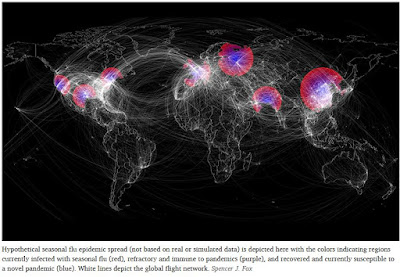
Credit Spencer J. Fox
#18,383
With a harsh 2024-2025 flu season having peaked and now seemingly on the decline - and the spring bird migration starting to shift some of the avian H5 burden north - on this first day of spring one might be tempted to assume we've dodged a viral bullet until the fall.
But influenza pandemic history suggests otherwise.
Eight years ago, in PLoS Comp. Bio.: Spring & Early Summer Most Likely Time For A Pandemic, we looked at a study, published in PLoS Computational Biology, that looked at the history of 6 pandemics in the Northern Hemisphere since 1889 (see chart below) which found they all first emerged in spring and early summer.

Using a computer model, the authors found evidence of a narrow window of opportunity for pandemic emergence. The authors proposed two possible factors behind this trend, one of which long time readers of this blog will recall was a frequent topic of conversation after the last (2009) pandemic (see Eurosurveillance: The Temporary Immunity Hypothesis).
We've covered this idea often (see EID Journal Perspective: Viral Interference Between Respiratory Viruses), but in its simplest form it states that any respiratory infection (influenza, rhinovirus, COVID, etc.) - or a receipt of a flu/COVID vaccine - temporarily ramps up a person's immune system, making them less susceptible to infection by another virus for weeks or even months.
As a result, between the fall flu vaccine campaign and a barrage of winter respiratory virus infections, a novel flu virus has a hard time getting traction.
But as the flu season wanes, so does the increased level of community immunity.
First, an excerpt from the press release from the University of Texas at Austin, after which I'll return with more.
Despite these 6 examples, spring certainly doesn't have an exclusive handle on emerging respiratory diseases. And admittedly, many of these viruses may have been circulating at low levels for months before reaching `critical mass' and therefore our notice.
Some non-spring outbreaks of note include:
While there could be other factors we don't know about that might override this proposed narrow window of opportunity for pandemics - based on the historical record and the growing evidence for the temporary immunity hypothesis - late spring and early summer do seem the most likely time for pandemic emergence.
Given the ongoing and increasing threat from H5Nx, this is certainly no time for us to let down our guard.
https://afludiary.blogspot.com/2025/03/for-everything-there-is-seasonality.html
Credit Spencer J. Fox
#18,383
With a harsh 2024-2025 flu season having peaked and now seemingly on the decline - and the spring bird migration starting to shift some of the avian H5 burden north - on this first day of spring one might be tempted to assume we've dodged a viral bullet until the fall.
But influenza pandemic history suggests otherwise.
Eight years ago, in PLoS Comp. Bio.: Spring & Early Summer Most Likely Time For A Pandemic, we looked at a study, published in PLoS Computational Biology, that looked at the history of 6 pandemics in the Northern Hemisphere since 1889 (see chart below) which found they all first emerged in spring and early summer.
Using a computer model, the authors found evidence of a narrow window of opportunity for pandemic emergence. The authors proposed two possible factors behind this trend, one of which long time readers of this blog will recall was a frequent topic of conversation after the last (2009) pandemic (see Eurosurveillance: The Temporary Immunity Hypothesis).
We've covered this idea often (see EID Journal Perspective: Viral Interference Between Respiratory Viruses), but in its simplest form it states that any respiratory infection (influenza, rhinovirus, COVID, etc.) - or a receipt of a flu/COVID vaccine - temporarily ramps up a person's immune system, making them less susceptible to infection by another virus for weeks or even months.
As a result, between the fall flu vaccine campaign and a barrage of winter respiratory virus infections, a novel flu virus has a hard time getting traction.
But as the flu season wanes, so does the increased level of community immunity.
First, an excerpt from the press release from the University of Texas at Austin, after which I'll return with more.
You might expect that the risk of a new flu pandemic — or worldwide disease outbreak — is greatest at the peak of the flu season in winter, when viruses are most abundant and most likely to spread. Instead, all six flu pandemics that have occurred since 1889 emerged in spring and summer months. And that got some University of Texas at Austin scientists wondering, why is that?
Based on their computational model that mimics viral spread during flu season, graduate student Spencer Fox and his colleagues found strong evidence that the late timing of flu pandemics is caused by two opposing factors:
Based on their computational model that mimics viral spread during flu season, graduate student Spencer Fox and his colleagues found strong evidence that the late timing of flu pandemics is caused by two opposing factors:
- Flu spreads best under winter environmental and social conditions.
- However, people who are infected by one flu virus can develop temporary immune protection against other flu viruses, slowing potential pandemics.
Together, this leaves a narrow window toward the end of the flu season for new pandemics to emerge.
The researchers’ model assumes that people infected with seasonal flu gain long-term immunity to seasonal flu and short-term immunity to emerging pandemic viruses. The model incorporates data on flu transmission from the 2008-2009 flu season and correctly predicted the timing of the 2009 H1N1 pandemic.
The researchers’ model assumes that people infected with seasonal flu gain long-term immunity to seasonal flu and short-term immunity to emerging pandemic viruses. The model incorporates data on flu transmission from the 2008-2009 flu season and correctly predicted the timing of the 2009 H1N1 pandemic.
Despite these 6 examples, spring certainly doesn't have an exclusive handle on emerging respiratory diseases. And admittedly, many of these viruses may have been circulating at low levels for months before reaching `critical mass' and therefore our notice.
Some non-spring outbreaks of note include:
- The 2003 SARS epidemic appears to have started in China in November of 2022 but was covered up by Chinese authorities until it jumped to Vietnam and Hong Kong in March.
- The 2019 COVID outbreak also started in China - likely in November or December.
While there could be other factors we don't know about that might override this proposed narrow window of opportunity for pandemics - based on the historical record and the growing evidence for the temporary immunity hypothesis - late spring and early summer do seem the most likely time for pandemic emergence.
Given the ongoing and increasing threat from H5Nx, this is certainly no time for us to let down our guard.
https://afludiary.blogspot.com/2025/03/for-everything-there-is-seasonality.html