• FluTrackers.com Inc. does not provide medical advice. Information on this web site is collected from various internet resources, and the FluTrackers board of directors makes no warranty to the safety, efficacy, correctness or completeness of the information posted on this site by any author or poster. The information collated here is for instructional and/or discussion purposes only and is NOT intended to diagnose or treat any disease, illness, or other medical condition. Every individual reader or poster should seek advice from their personal physician/healthcare practitioner before considering or using any interventions that are discussed on this website. By continuing to access this website you agree to consult your personal physican before using any interventions posted on this website, and you agree to hold harmless FluTrackers.com Inc., the board of directors, the members, and all authors and posters for any effects from use of any medication, supplement, vitamin or other substance, device, intervention, etc. mentioned in posts on this website, or other internet venues referenced in posts on this website.
  • We are not asking for any donations. Do not donate to any entity who says they are raising funds for us.

[fluWho] WHO: Concerns over Chair's text on sharing of flu viruses and benefits

Re: [fluWho] WHO: Concerns over Chair's text on sharing of flu viruses and benefits

A call to the CDC regarding this issue by "bird flu" blogger Sophie Zoe. Thank you to all of commentators, owners, members, and moderators who lead the various sites and generously share their information and work with all of us:

http://pandemicchronicle.com/


Swallowing a spoon-fed lie

As I was diligently working at my ?day job? today I had a google alert come into my email notifying me another piece on H5N1 had ?hit the net?. Being somewhat a strange mix of ADD/OCD of course I opened it up even while assuming it was just another ?re-publish? of some minor news item. Imagine my surprise when the blurb indicated it could be found at Salon.com.


Needless to say I had to follow the link, eye-bleeding spreadsheet begging to be completed be damned. To my great displeasure I encountered a serious piece sympathetically addressing Hammond?s [sensationalist and inaccurate] essay on the supposed uncovering of the <acronym title="Centers for Disease Control">CDC </acronym>patenting Indonesian H5N1 genes, or to use Mr. Hammond?s own words, ?the US Centres for Disease Control (CDC) and US National Institutes of Health claim ownership of Indonesian influenza genes.?


Before I quite knew what I was doing I had looked up the phone number for the US <acronym title="Centers for Disease Control">CDC </acronym>and was ringing up Media Relations.


My simple, even if somewhat inarticulate question: Are the claims of Mr. Hammond correct? Of course I knew they were not but I wanted to hear it out right and ?from the source?. Before an hour had elapsed I received an email response?


Response to Query on the recent Edward Hammond Blog, ?WHO-linked centre lays patent claim on bird flu virus?
Unfortunately, this blog is not correct and offers misinformation.
The National Institutes of Health has filed for a patent; a CDC scientist is listed on this patent application.
The patent is for a prime boost vaccine strategy where you receive two vaccines; the first is a prime which contains a DNA vaccine for the HA sequence of the influenza virus only, the second is a boost vaccine with a protein. The two together are intended to offer amplified and focused protection against the influenza virus.
So the patent is, in principle, for a method of vaccination and is definitely not specific to H5.
It is definitely not a patent on a virus from Indonesia.
[my emphasis]

As Jay S. commented on the previous post:


As much as I bristle at Mr. Hammond?s misleading statements and the potential to do harm to the integrity of Flublogia and especially these fine agencies maligned in his report, I am more angered at these news media that lend platforms for these types of ?drive by? reporting without due diligence on their part for accuracy thereof.
[my emphasis]


On my drive home this evening I thought about a little quip Craig Ferguson often says on The Late Late Show on CBS. ?If it?s on the internet it must be true?, said with exaggerated emphasis on the ?true?. How the World Works seems to think so in this case. The truly stunning and sad thing is the essay even links the actual patent filing that Mr. Hammond is on about in his inaccurate and sensationalist essay, or ?scoop?, as it is called on How the World Works, and yet the essay belies any apparent ?fact checking? having been done.


Winston Churchill, paraphrasing an old adage, once said: ?A lie gets halfway around the world before the truth has a chance to get its pants on? and that was even before the internet. Be that as it may, the age of the internet allows each of us to vet information we are served up, Craig Ferguson notwithstanding, and we who comment, even if only in our ?private citizen platforms? have a certain responsibility to make sure we are not spreading falsehoods that have the potential to do real harm to real people.


Is it really so simple a thing as to self-label as an ?expert? and no matter the drivel you espouse your information is not vetted? Or is it that many of us want to believe the US government, and those employed by it, are blatantly stupid, ignorant, and ignoble?


Sometimes people, even government employees, make bad decisions, after all, no one is perfect, no matter how hard we might try. When people who are in positions of authority or responsibility make a mistake, bad decision, or act in ways that are decidedly not in our best interest it?s important and a good thing that we have those who are ever watchful for them and who will alert the wider world to a ?bad thing?. However, when one spreads lies about an organization and the important work they are doing for nothing more than the furtherance of a personal agenda [anti-genetic engineering] then everyone is ill-served.


To be well served:
  • We need open and honest debate.
  • We need insightful and inspired research.
  • We need dedicated and ethical scientists.
  • We need adequate funding for basic public health.
  • We need technology and knowledge transfer to developing countries.
  • We need open access biological samples and research findings.
  • We need answers to our antiquated vaccine manufacturing process.
  • We don?t need someone spoon feeding us lies.

Lies such as those spread by Mr. Hammond directly undermine all of what we do need.


SZ


? Posted <abbr class="published" title="2008-08-22T21:19:05-0400">22 August 2008</abbr> ? SophiaZoe
 
Re: [fluWho] WHO: Concerns over Chair's text on sharing of flu viruses and benefits

Edward Hammon is dangerous to Flu Blog community?

This is a great new!

But, clearly, I DO NOT AGREE AT ALL.
 
Re: [fluWho] WHO: Concerns over Chair's text on sharing of flu viruses and benefits

Edward Hammon is dangerous to Flu Blog community?

This is a great new!

But, clearly, I DO NOT AGREE AT ALL.
Sorry IOH but I am not sure what you are saying here.
 
Re: [fluWho] WHO: Concerns over Chair's text on sharing of flu viruses and benefits

Sorry IOH but I am not sure what you are saying here.

I am against an indiscriminate attack to a person that is trying to battle part of a non-equal system of benefit sharing, for corporate aggressive behaviour / ...
 
Re: [fluWho] WHO: Concerns over Chair's text on sharing of flu viruses and benefits

Aah.

I am happy for anyone to be attacked is they are posting/printing incorrect information. There is more than enough genuine evidence of inequalities in the system. The problem is if someone prints a false claim then the naysayer will point to it and try and use it to weaken the genuine arguments so it is important to self police ourselves.

I thinks we are probably on the same side of the argument regarding some of the inequalities created by IP rights laws etc. I dare say Mr. Hammond's heart is in the right place but on this occasion he may have scored an own goal.
 
Re: [fluWho] WHO: Concerns over Chair's text on sharing of flu viruses and benefits

The things go all right.

The problem with fluWho or Immunocompetent is about the attitude of the owner toward a severe critic on current practices in business and strategic policies of certain Nations. It is a dangerous game.

For my point of view, since I don't aim to create a case at FT, the rightful critics from E. Hammond cannot longer take into account by me.

Thus, I am not going to post longer his commentary / articles at FT.

For people interested, please follow the URL to EH sites / blogs.
 
Re: [fluWho] WHO: Concerns over Chair's text on sharing of flu viruses and benefits

Thank you everyone for participating on this thread.

FT does not shy away from controversy. We want to see all sides to an issue. This is the best way to seek the truth.

We have promoted some of the most "radical" ideas regarding "bird flu" and internet discussion forums since our inception.

We do not retract from this "bio-piracy" controversy either.


:yinyang:
 
Re: [fluWho] WHO: Concerns over Chair's text on sharing of flu viruses and benefits

A response on A Pandemic Chronicle:

http://pandemicchronicle.com/2008/08/swallowing-spoon-fed-lie/#comments


Edmund wrote:

The patent in question is a vaccine which includes genes from Indonesian virus samples. Indonesia provided the samples freely through the WHO. The WHO then provided the samples freely to the CDC. It doesn’t appear Indonesia stands to benefit from this exchange. It appears the CDC is contesting Hammond’s characterization that the patented vaccine–because it contains genes from an Indonesian virus–is a patent on an Indonesian virus. That’s all. The CDC is not contesting that genes from Indonesian virus samples (provided freely to the WHO) are being included in the vaccine.

Is Hammond correct to characterize things this way? Is it fair for the CDC, through its special access to WHO materials, to patent things which have components that were provided freely by the WHO? Should Indonesia stand to benefit monetarily, or otherwise? These are the questions we need to be asking. I don’t think your simple query to the CDC does digs deep enough.

Posted <abbr class="comment-published" title="2008-08-22T21:19:05-0400">23 Aug 2008 at 4:39 pm</abbr>
 
Re: [fluWho] WHO: Concerns over Chair's text on sharing of flu viruses and benefits

I believe this is the "patent" under discussion:

(WO/2007/100584) ANTIVIRAL AGENTS AND VACCINES AGAINST INFLUENZA


see: http://www.wipo.int/pctdb/en/wo.jsp?WO=2007100584

from Documents page:​


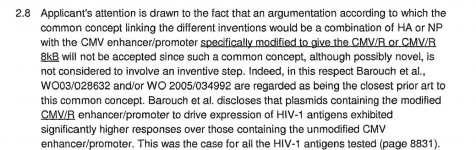
Perhaps someone that understands patent application can comment on this excerpt from the August 19, 2008, International Preliminary Report on Patentability at:
http://www.wipo.int/pctdb/images4/PATENTSCOPE/89/5f/8b/025f8b.pdf

Patent info.jpg
 
Re: [fluWho] WHO: Concerns over Chair's text on sharing of flu viruses and benefits

In the interest of the pursuit of the truth we like to present all sides to an issue. We have done this many times in the past with "hot" issues.


A response on A Pandemic Chronicle:

http://pandemicchronicle.com/2008/08/h5n1-drive-agendas/#comments


Perezoso wrote:

I’ll stick to my guns. I think that SZ is the one that doesn’t know how to read a patent. Lord knows, I’ve read thousands.
If anything, I am embarrassed to say that I understated the scope of the claims, in particular Claim 1, which on close read is even more of a problem than I initially thought. Bottom line: Yep, the US government is claiming Indonesian (and Thai and other) flu materials as its property. These are materials given to WHO for public health purposes, not proprietary claims. Deal with it. Because we have to, in order to fix the GISN.

Posted <abbr class="comment-published" title="2008-08-21T19:50:18-0400">26 Aug 2008 at 12:15 am</abbr>

Perezoso wrote:

Oh wait, by the way:
What is my other agenda?
I hope you can enlighten me.

Posted <abbr class="comment-published" title="2008-08-21T19:50:18-0400">26 Aug 2008 at 12:25 am</abbr>
 
Re: [fluWho] WHO: Concerns over Chair's text on sharing of flu viruses and benefits

A Pandemic Chronicle -

http://pandemicchronicle.com/


Follow-on: CDC patent controversy

This blog carries this quote prominently at the top:
If any one, concerned really for truth, undertake the confutation of my Hypothesis, I promise him either to recant my mistake, upon fair conviction; or to answer his difficulties. Two Treaties on Government John Locke

There is a reason for its prominent position, I am a person who has a few opinions and I am generally not shy in expressing them. However, this journey that I am on finds me learning as I go, or minimally, at least making an attempt to learn. Sometimes I get things wrong and I would rather someone correct my error than to continue to operate under a misapprehension. Over these three years I?ve learned a lot from readers and some of my Fellow Flubies who have taken the time to help me along, correcting when I err or nudging when I am not quite ?on target?, and always I am grateful for it.


Today finds me with the opportunity to publicly correct an error I made very publicly. Serendipitously, I also received these comments on ?Swallowing a spoon-fed lie? from Mr. Hammond shortly before I got home from my ?day job?:


From the international patent application:
Applicants: THE GOVERMENT OF THE UNITED STATES OF AMERICA, AS REPRESENTED BY THE SECRETARY, DEPARTMENT OF HEALTH AND HUMAN SERVICES [US/US]; Centers for Disease Control and Prevention, 4770 Biford Hwy (K79), Atlanta, Georgia 30333 (US) (All Except US).
(NIH too? besides, they are both HHS.)
Need I say more. Sorry, SZ, you might know about flu; but you don?t know about patents.
and?

Also, SZ, you need to study up on the distinctions between sovereignty and ownership.
I suggest that you study this issue more carefully before you continue to post. You seem to misunderstand a number of basic concepts about patents, international law, and US government organization (or lack thereof).
Mr. Hammond is correct, I don?t know much about patents, but I have a reasonable working conceptual framework, so I?m comfortable with both what I know and what I don?t know. I am not the one presenting myself as a patent and biologicals expert, rather, just an opinionated semi-know-it-all.

You see, I made a mistake when I interpreted the patent to include ?biologicals? as part of the patent, or at least that is what I was informed today (and I have absolutely no reason to believe I was either lied to or received less than truthful information). But let me restate that I?m a neophyte, self-admitted and unashamed, when it comes to patents so it would be a simple matter to mislead me if one where motivated to do so, but I?ll come back to that, but first let me tell you about a phone call I received today.

I was slaving away [really] at my ?day job? when my cell phone rang, but I just let it drop to voice mail because I didn?t recognize the number and I didn?t want to lose the momentum on the task at hand. Retrieving the message a bit later I learned that someone by the name of Shaw from the CDC had called as a follow on to my inquiry last week. Thinking it was an intern with the public relations office wishing to close some sort of public relations ?file? I waited a few more minutes until I felt reasonably sure that Shaw would be out to lunch so I could leave him a voice mail in turn saying that my inquiry had been handled to my satisfaction and thank you [blah - blah - blah] because I really was too busy and distracted to deal with ?required governmental niceties? for the ?inquiring public?, which in this case would be me.

To my momentary annoyance a Mr. Michael Shaw answered the phone. Annoyance quickly turned to embarrassed ?Oh Crap? when I asked him if he was very familiar with the ?patent controversy? and with the H5N1 vaccine in general, still assuming I was speaking to someone from the public relations department, and the rather exasperated gentleman informed me that he was familiar with both because he was the associate director for laboratory science - influenza division.


I was embarrassed that Mr. Shaw had to take time out of his day, a day that was probably even busier than my own, and follow up on what had been a simple question to the media relations department. Well, live and learn, as they say, and I learned that the CDC takes their very serious ?business? very seriously. Serious enough to even answer stupid questions fired off in a moment of reactionary anger. And, Mr. Shaw, should you happen to ever read this: I do apologize that you had to take time out to follow up on this [ridiculous] issue that should not even be an issue.

So, anyway, Mr. Shaw was kind enough to briefly explain what the patent was so that I, as a neophyte, would understand. In a nutshell, and paraphrasing:

It?s a patent for a vaccine technique with no biological agents included in the patenting process [or however that would be stated]. The technique being a two-shot strategy ?prime/prime-boost? with all that ?virus - protein - plasmid stuff? that at this point in time is irrelevant. The ?relevant issue? is whether or not the CDC and/or the NIH patented any biologicals.

The influenza virus was used because A) it was relevant to current scientific endeavors, B) They have to use something, and C) Test animals are easily and meaningfully [translatable to human beings] utilized with the influenza virus. The CDC was involved because H5N1 was included in the testing [a currently relevant disease] and H5N1 can only be worked on in labs meeting a certain <acronym title="Bio-safety Level">BSL </acronym>level. So, I was in error when I stated that it a genetic ?construct? was in any way or manner included in the patent.

Mr. Shaw also stated that the US Centers for Disease Control [CDC] is fundamentally opposed to the patenting of any biologicals. The CDC?s interests lie in public health and it is in the best interest of public health to have open access, and patenting biologicals is directly counter to the open access that is needed. This makes sense if given honest consideration.


I have belabored this issue for a few very simple, but I feel very important, reasons. First, although I would not recommend anyone just ?pick up the phone? and ask the CDC a stupid question [like someone we all know did] if there is genuine concern or a genuine question this incident has concretely demonstrated that those questions and concerns will be openly addressed. Now, I suppose it would be easy to think that I was lied to, and nothing I could say would dissuade that opinion, but I have no sense of anything other than an honest and forthright attempt to address my question. Besides, silence would have better served than any lie deliberately delivered? after all, most folk believe Mr. Hammond, and I am nothing more than a self-admitted neophyte so what the hell do I know. In other words? who would believe a denial coming from someone such as myself? Save a lie, with all of the included career enders and public discredit that come with one, for someone who would be able to meaningfully counter Mr. Hammond?s claims.

I would even hazard the guess that Mr. Hammond?s concerns and questions would be answered if he would just ?pick up the phone?, though I will admit that I assume Mr. Hammond isn?t very interested in the truth of this matter.

Which reminds me, Mr. Hammond there is a book that I would like to recommend to you: Mistakes were made (but not by me): why we justify foolish beliefs, bad decisions, and hurtful acts Tavris and Aronson.

I don?t expect I have changed anyone?s mind on this issue. To change someone?s mind is an extremely difficult task and I have neither the time nor the energy to put into it. I did, however, feel it was important to set right my error and to give ?voice? to the CDC?s response. And with this posting I will be done with this issue, because as I say in my less than patient moments, anything more would only be mental masturbation.

SZ
 
Re: [fluWho] WHO: Concerns over Chair's text on sharing of flu viruses and benefits

From Immunocompetent

http://immunocompetent.com/index.php?op=ViewArticle&articleId=14&blogId=1


<!-- Header End --> <!-- <rdf:RDF xmlns:rdf="http://www.w3.org/1999/02/22-rdf-syntax-ns#" xmlns:dc="http://purl.org/dc/elements/1.1/" xmlns:trackback="http://madskills.com/public/xml/rss/module/trackback/"><rdf:Description rdf:about="http://immunocompetent.com/index.php?op=ViewArticle&articleId=14&blogId=1" dc:identifier="http://immunocompetent.com/index.php?op=ViewArticle&articleId=14&blogId=1" dc:title="Are CDC's PR Hacks Lying about Patent Claims?" trackback:ping="http://immunocompetent.com/trackback.php?id=14"/></rdf:RDF> --> Are CDC's PR Hacks Lying about Patent Claims?

Posted by perezoso on 27 August, 2008 07:45

If secondary sources are to be believed, such as this one, then CDC's PR hacks have sallied forth with a pack of lies about their patent claims on Indonesian, Thai, and other H5N1 genes, which were first brought into the public eye by this blog.
There are two main arguments that CDC has been quoted to me as making with respect to my article and related items that have come out in the press. I will refute both of CDC's claims.
First, CDC is said to have rather remarkably claimed that they aren't part of the patent application. This is patent bullshit, as I will show. Secondly, and somewhat contradictorily, CDC's hacks are said to claim that the patent application is (to paraphrase), "for a vaccine and not a virus, so the Indonesian and other strains aren't claimed." This too is wrong. To demonstrate that, I will walk readers through the text of one of the (many) claims, so you can read it for yourself. The claims analysis is a bit tedious; but it's not rocket science. Wade through it, and you will be rewarded with a clear explanation of why CDC is wrong. We'll deal with the CDC arguments one by one:
First, CDC is said to have bizarrely claimed that they aren't part of the patent application. This would be a remarkable thing for the CDC hack to say, because CDC is indicated as a patent applicant on the first page of patent application (quoting directly):
[FONT=courier new,courier]APPLICANTS: THE GOVERMENT OF THE UNITED STATES OF AMERICA, AS REPRESENTED BY THE SECRETARY, DEPARTMENT OF HEALTH AND HUMAN SERVICES [US/US]; National Institutes of Health,, Office of Technology Transfer, 6011 Executive Blvd., Suite 325, Rockvillle, Maryland 20852-3804 (US) (All Except US).
[/FONT]
[FONT=courier new,courier]THE GOVERMENT OF THE UNITED STATES OF AMERICA, AS REPRESENTED BY THE SECRETARY, DEPARTMENT OF HEALTH AND HUMAN SERVICES [US/US]; Centers for Disease Control and Prevention, 4770 Biford Hwy (K79), Atlanta, Georgia 30333 (US) (All Except US).
[/FONT]
Clear as can be. Is there really a need to say more? There shouldn't be; but I'm afraid there is.
That's because an ancillary argument that the CDC hacks are said to be advancing is that the US National Institutes of Health (NIH) is really responsible for this and CDC should not be held accountable for its name on the patent.
Off the top, I find it very hard to believe that a patent application can be submitted in CDC's name without CDC knowing about it. But more importantly, this CDC red herring needs to be put into context. Both CDC and NIH are part of the US Department of Health and Human Services (i.e. the health ministry). CDC hosts the WHO Collaborating Centre, and both it and NIH conduct flu research. And while it is true that most of the inventors listed in the application are from NIH, it's more than slightly disingenuous for CDC to try to beg off by foisting the blame on its HHS sister institute. In the international context, it's simply not credible to have one half of the health ministry (CDC) saying "no patents", while it is passing the material to the other half of the health ministry which is patenting away. So, in many senses, whether it is CDC or NIH or both is immaterial, because they are ultimately part of the same organzation (HHS) that has a WHO Collaborating Centre.
Turning to the claims analysis: CDC's hacks are said to have claimed that the patent application is (to paraphrase), "for a vaccine and not a virus, so the Indonesian and other strains aren't claimed."
The government spokesman bullshit detector of anyone with a whit of common sense would start ringing loudly just looking at the cover page of the patent (click it), which has an illustration of a genetic construct, claimed in the patent, that incorporates the "codon optimized" HA gene of A/Indonesia/5/05. It even says so right on the picture.
Could it be any clearer? Not really; but just be sure, we can turn to the most important part of patent, the claims, where the applicants specifically articulate the alleged invention that they are seeking patent for. Typically (but not always), the first claims are the most important in a patent. Let's turn to Claim 1 of the CDC/NIH application:

[FONT=courier new,courier]WHAT IS CLAIMED IS:

1. A nucleic acid molecule comprising a polynucleotide encoding an influenza
protein selected from the group consisting of hemagglutinin A (HA),
neuraminidase (NA), M2 Protein, and nucleoprotein (NP), wherein said
polynucleotide comprises

(a) a plasmid taken from Table 1 (or its insert), or

(b) an analog of said plasmid or insert having at least 95% identity thereto.[/FONT]
</pre>​
The first thing to note about this claim is that it is a claim on matter. That is, it is not merely a claim on the use of a particular type of matter (not that that would make it innocuous), it is a claim to the thing itself, full stop. Specifically this claim is for any polynucleotide (i.e. DNA or RNA) that encodes specific polypeptides (i.e. proteins), including some specific HA, NA, M2, and NP genes from influenza. And for good measure, anything 95% or more like those claimed.
But which specific DNA or RNA is claimed, it's not spelled out in the claim? Good question.
And what does that phrase "or its insert" mean? Another good question.
Here, if you read the claim again, you will see that have to refer to "Table 1" and to look at the patent text (the "specification") in order to establish what "insert" means in the context of this patent application.
The meaning of insert can be quickly clarified by reading the patent, and see what the term "insert" means when it is used there. It is this: The plasmids refered to in Claim 1 are the longer DNA constructs designed as vaccines, and which have been pieced together with genes from multiple organisms, including flu. The picture on the cover page (click above) is one of these plasmids. "Insert" in this context means the influenza pieces that are placed into the longer plasmid.
So, what's in Table 1? I have extracted Table 1 from the patent application, and you can click here to read it yourself (PDF format). It is 6 pages long, and includes no fewer than 151 separate genetic constructs claimed by NIH/CDC, most of which are either "plasmids" or "inserts" (and, of course, the plasmids incorporate the inserts).
Remeber, if it's a plasmid or a construct ("insert") in Table 1, then it is claimed. On the first page of the six page Table 1, there are eight different constructs incorporating Thai H5N1 genetic material and one plasmid incorporating (i.e. with an "insert") of Indonesian genetic material. On the second page, there are four more constructs with Thai material. On the third page, there are six plasmids with Chinese (Hong Kong) genetic material, two with sequences from South Korea, and another Thai one. On the fourth and fifth pages there are eight more with Thai genenic material. On the sixth page, there are two constructs with Thai genetic material, six with Hong Kong genetic material, and two with South Korean genetic materials.
The Indonesian construct is the first listed and is the exemplary construct of the invention. Also, because the Indonesian HA gene is an "insert", it is claimed both as part of a longer plasmid and as itself, alone. The same hold true for the other H5N1 genes in Table 1.
And then NIH/CDC goes a step further, and says anything 95% or more like those genes is also claimed.
I hope that clarifies the nature and scope of CDC's patent claims. If CDC representatives have been accurately quoted as saying that they are not part of the patent application and that the application in any event does not claim Indonesian (and other) H5N1 materials, then the CDC representatives are spreading clearly false information, and the leadership of CDC should be reprimanded for permitting them to do so.
 
Re: [fluWho] WHO: Concerns over Chair's text on sharing of flu viruses and benefits

From Effect Measure:

http://scienceblogs.com/effectmeasure/2008/08/cdc_and_st_judes_worse_than_in.php#comments


CDC and St. Jude's: worse than Indonesia?

Category: Bird flu ? CDC ? Intellectual property ? Surveillance ? Vaccines
Posted on: August 27, 2008 7:09 AM, by revere
<!--proximic_content_on--> I have been severely critical (many posts among those here) of the Indonesian government's irresponsible assertions of ownership of potentially pandemic pathogenic viruses isolated from their citizens. The question of Intellectual Property is a difficult one in many instances but when it comes to a public good involving a global scourge, some of the gray areas become more black and white. The world has been struggling with the issue regarding the global influenza surveillance system for two years now, precipitated by Indonesia's refusal to cooperate any longer, resulting in a significant gap in scientific knowledge about the genetics and biology of avian influenza in humans. Indonesia is now the world's hotspot for the disease so its non-cooperation is a potentially serious problem.
Hence the news, revealed by Ed Hammond, that the US CDC and St. Jude's Children's Hospital in Memphis, Tennessee, are stoking the fires of resentment by their own irresponsible and outrageous behavior is more than dismaying. It is utterly infuriating:
In a development that is likely to raise more pressing questions about reform of the WHO Global Influenza Surveillance Network (GISN), an international patent application has surfaced in which the US Centres for Disease Control (CDC) and US National Institutes of Health claim ownership of Indonesian influenza genes. A recent patent search has revealed that the CDC, which is a WHO collaborating centre, is applying for a patent for a new vaccine against influenza, particularly for bird flu (H5N1). The vaccine incorporates genes from a H5N1 strain isolated from an Indonesian human victim of bird flu in 2005.
The strain that contains the genes was transferred to the WHO GISN by Indonesia for characterization for public health purposes, but may wind up as the property of the US government.
Under US law, the US government agencies would offer licenses to the technology to pharmaceutical companies. The patent application indicates that the US government intends to pursue the claim in most countries of the world, including Indonesia itself, as well as neighboring countries.
The application was first lodged in the United States on 16 February 2006, and then filed with the World Intellectual Property Organization (WIPO) on 16 February 2007. It was first published as application WO2007/100584 on 7 September 2007 on a WIPO internet database, but is only now coming into public light.
[snip]
The US patent claims are especially relevant to the ongoing discussions of the WHO Pandemic Influenza Preparedness Inter-Governmental Meeting (WHO PIP IGM). The WHO PIP IGM was formed by the World Health Assembly in 2007, in response to developing country concerns about the WHO GISN, particularly the appropriation of GISN materials for making commercial vaccines that are costly and un-affordable to developing countries, and a lack of benefit sharing related to influenza viruses. The next negotiating session of the PIP IGM is scheduled to begin in Geneva on 9 November.
The question of WHO Collaborating Centres asserting patents related to WHO system viruses has been raised repeatedly in the PIP IGM's deliberations. In addition to the US CDC, there is evidence that another US-based WHO Collaborating Centre, St. Jude Children's Research Hospital in Memphis, Tennessee, has improperly capitalized on its WHO status in order to make proprietary claims.
According to sources, in a closed session at the WHO Interdisciplinary Working Group on Pandemic Influenza Preparedness, convened in Singapore from 31 July through 4 August 2007, the Director of the WHO Collaborating Centre at the US CDC stated to governments that the Centre had no interest in patents related to GISN materials. The Working Group meeting took place more than a year after the US CDC filed for patent related to the Indonesian, Thai, Hong Kong, and Korean H5N1 genes.(Ed Hammond, Third World Network)
The CDC patent application is for a DNA vaccine. In this technology, DNA sequences that code for viral proteins are injected into the subject's cells, using various kinds of technologies. Once inside the human cells in the person being vaccinated, the cell's own protein synthesizing machinery makes viral protein which is seen by the immune system and antibodies produced. Some of the patent covers genetic tweaking of the Indonesian virus (and some other viruses) to enhance this process. But access to the relevant genes is possible because both CDC and St. Jude's are WHO Collaborating Centers, i.e., among a handful of laboratories that receive influenza virus strains from all over the world for characterization, research, and as a source of vaccine seed strains. These seed strains are made available to pharmaceutical companies, free of charge, who then make vaccines from them, vaccines that the virus donor countries fear they will not be able to afford. Now we find these two WHO reference laboratories are improperly taking advantage of their status as Collaborating Centers to potentially profit by privatizing the "property" freely given to them by impoverished countries like Indonesia.
Maybe there is more to this story than appears in this account. If so, let's hear it from CDC and St. Jude's. Because what we see is something that is so inimical to ethical standards it demands a public defense -- if there is one. These institutions have world class scientists who wouldn't dream of committing scientific misconduct. Apparently they don't mind committing public health misconduct, however. If even some of this is true, they are bringing shame and deserved loss of credibility and trust onto their respective institutions and themselves.
I am disgusted.

<!--proximic_content_off--><!-- This is a linked template. Don't mess with it. --> <script type="text/javascript" src="http://w.sharethis.com/widget/?tabs=web%2Cpost%2Cemail&charset=utf-8&style=rotate&publisher=f5d369e4-d10b-48d8-9015-ee0c80d2c43f"></script>ShareThis Find more posts in: Medicine & Health
Comments

Ah, why are you disgusted?
The patent systems works perfectly in it's intended way.
Preserving monopolies and keeping those pesky third world nations down in the gutter.
(A bit oversimplified of course, but still...)
Posted by: student_b | August 27, 2008 8:06 AM


student_b: Not the point. I am disgusted by who used it for that purpose, not the purpose for which it was uesd.
Posted by: revere | August 27, 2008 8:20 AM


I am reminded of the hoopla over the HIV virus between le France and the Americans back in the early days of the disease. Did that accomplish anything? Who cares who "owns" the **** thing?! If these games keep being played, the only people hurt will be the rest of us. How can anyone really hold genes as property? Maybe the technique being used, or even the instruction manual? There is something very sneaky about it all... Very sneaky indeed.
Anyone remember the whole mess CDC had going a few years back with the antiretroviral trials in Africa?
Posted by: Ren | August 27, 2008 9:27 AM


CDC denies it.
Others are apparantly equally (or even more)
disgusted about Ed Hammond.
CDC and St.Jude's didn't take advantage of being WHO-reference-laboratories. The sequences are freely available
Posted by: anon | August 27, 2008 10:46 AM


I have posted more detail concerng the patent claims and the denials attributed to CDC at Immunocompetent.
In a nutshell, there is simply no question that CDC is a patent applicant, and the patent application covers Indonesian, Thai, and other H5N1 genes.
One clarification: The patent claims the genes BOTH as incorporated into a DNA vaccine plasmid and apart from the plasmid (i.e. as bare complementary DNA transcribed from the viral RNA). The key phrase in the patent's Claim #1 is "or its insert". (The "insert" is the H5N1 gene.)
Notably, it also claims any DNA or RNA that is 95% or more homologous to either the "insert" or the entire vaccine plasmid.
In patent terms, these are both use and "composition of matter" claims.
This is serious problem, because the US has stated to Indonesia and other countries that it has no interest in patenting WHO GISN materials. Well, those claims are looking more and more like lies, especially as CDC seems to be going into denial mode rather than stepping forward and admitting that they've got a major problem on their hands.
Posted by: Perezoso | August 27, 2008 11:26 AM


anon, Perezoso: Let's clear the air and find out who is right. I have no automatic reason to give CDC the benefit of the doubt any longer. Sadly.
Posted by: revere | August 27, 2008 11:29 AM
 
Re: [fluWho] WHO: Concerns over Chair's text on sharing of flu viruses and benefits

Luckily, Louis Pasteur was born in XIX century.... (1822)
:D
:(
Well said Iron.

Frankly, after so many worldwide docs and nothing concrete, seems that we caN't make any substantial difference, and that things would go on precisely at the same way concepted before, or worst.

No matter that 100 milion people x 1$ ticket = 100 milion$
___
From #...:
"There is only then 10 years to get back the development costs and put the company into profit. Development costs to license may be as much as $100million for a drug, and many will fail before ever reaching market."
 
Back
Top