

JimO
Well-known member
http://www.azdhs.gov/phs/oids/epi/flu/pdf/influenza/influenza_2010-11_wk11.pdf
Arizona might be the place that will reveal the pattern of pH1N1 in states where seasonal flu dominated, but where pH1N1 has been present in notable numbers. The %ILI in Arizona has dropped sharply to nearly baseline levels in the past two weeks. The total number of confirmed influenza cases has followed a pretty typical peak (at Week 7) and indicates that Arizona is well into the post-peak period. The recent substantial decrease in RSV cases has contributed significantly to the decrease in %ILI.
However, the isolates data might hint at the potential for another pH1N1 peak (and I truly hope I am wrong). Allow me to make a few points first. Recall that pH1N1 showed a tendancy to persist well into the summer months. In fact, this was about the time it just got started in 2009. There is no reason to believe that this characteristic has changed. Also, some people theorize that if a person is exposed to one strain of Type A flu, that there is a period during which the body has a heightened resistance to other Type A flu strains. This could explain why pH1N1 numbers have remained relatively small while H3N2 is the dominant stran. So, pH1N1 has co-circulated with both Flu B and H3N2 without becoming dominant until H3N2 has run its course.
A quick look at the following isolates charts reveals three things:
1) the percent positive specimens has remained very high (75%);
2) although the total number of pH1N1 cases is about half in Week 11 (31) as compared with Week 7 (64), it has persisted and increased by 25% from Week 10 and 11; and
3) the ratio of pH1N1 to H3N2 has increased dramatically since Week 7.
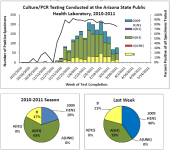
What does this mean? Well, I don't really know because I am only a self-educated (via FT) amateur epidemiologist/statistician/public health professional. But, I believe that either all three strains will decrease and disappear over the next few weeks (hopefully), or with no "competition", pH1N1 might persist and generate another wave of illness along the lines of that seen in 2009, accompanied by more severe cases and deaths among young, healthy individuals. I believe that the height and severity of the wave will depend upon whether the variant that has evaded the immunity derived from the vaccine or prior infection is circulating broadly.
Arizona might be the place that will reveal the pattern of pH1N1 in states where seasonal flu dominated, but where pH1N1 has been present in notable numbers. The %ILI in Arizona has dropped sharply to nearly baseline levels in the past two weeks. The total number of confirmed influenza cases has followed a pretty typical peak (at Week 7) and indicates that Arizona is well into the post-peak period. The recent substantial decrease in RSV cases has contributed significantly to the decrease in %ILI.
However, the isolates data might hint at the potential for another pH1N1 peak (and I truly hope I am wrong). Allow me to make a few points first. Recall that pH1N1 showed a tendancy to persist well into the summer months. In fact, this was about the time it just got started in 2009. There is no reason to believe that this characteristic has changed. Also, some people theorize that if a person is exposed to one strain of Type A flu, that there is a period during which the body has a heightened resistance to other Type A flu strains. This could explain why pH1N1 numbers have remained relatively small while H3N2 is the dominant stran. So, pH1N1 has co-circulated with both Flu B and H3N2 without becoming dominant until H3N2 has run its course.
A quick look at the following isolates charts reveals three things:
1) the percent positive specimens has remained very high (75%);
2) although the total number of pH1N1 cases is about half in Week 11 (31) as compared with Week 7 (64), it has persisted and increased by 25% from Week 10 and 11; and
3) the ratio of pH1N1 to H3N2 has increased dramatically since Week 7.
What does this mean? Well, I don't really know because I am only a self-educated (via FT) amateur epidemiologist/statistician/public health professional. But, I believe that either all three strains will decrease and disappear over the next few weeks (hopefully), or with no "competition", pH1N1 might persist and generate another wave of illness along the lines of that seen in 2009, accompanied by more severe cases and deaths among young, healthy individuals. I believe that the height and severity of the wave will depend upon whether the variant that has evaded the immunity derived from the vaccine or prior infection is circulating broadly.