• FluTrackers.com Inc. does not provide medical advice. Information on this web site is collected from various internet resources, and the FluTrackers board of directors makes no warranty to the safety, efficacy, correctness or completeness of the information posted on this site by any author or poster. The information collated here is for instructional and/or discussion purposes only and is NOT intended to diagnose or treat any disease, illness, or other medical condition. Every individual reader or poster should seek advice from their personal physician/healthcare practitioner before considering or using any interventions that are discussed on this website. By continuing to access this website you agree to consult your personal physican before using any interventions posted on this website, and you agree to hold harmless FluTrackers.com Inc., the board of directors, the members, and all authors and posters for any effects from use of any medication, supplement, vitamin or other substance, device, intervention, etc. mentioned in posts on this website, or other internet venues referenced in posts on this website.
  • We are not asking for any donations. Do not donate to any entity who says they are raising funds for us.

Florida - Zika tracking

Miami Beach Botanical Garden closes for mosquito inspection amid Zika scare

AUGUST 29, 2016 12:25 PM

Miami Beach Botanical Garden closes for mosquito inspection amid Zika scare

Flechas, Joey - Miami
BY JOEY FLECHAS
jflechas@miamiherald.com
...
Amid concerns about local transmission of Zika virus in the heart of South Beach, the Miami Beach Botanical Garden is closing for the next few days to inspect for mosquitoes.
...
http://www.miamiherald.com/news/local/community/miami-dade/miami-beach/article98583782.html
 
Florida - ​Locally transmitted Zika case in Pinellas County identified as Tampa firefighter

Locally transmitted Zika case identified as Tampa firefighter

By: FOX 13 News staff
POSTED:AUG 30 2016 12:10PM EDT
UPDATED:AUG 30 2016 12:21PM EDT

TAMPA, Fla. - Tampa Fire officials said Tuesday the person who contracted the non-travel-related case of Zika virus in Pinellas County was a Tampa firefighter.

The firefighter's name was not released but the firefighter lives in Pinellas County, said Jason Penny with Tampa Fire Rescue.

The firefighter works at station No. 3 on Kennedy Blvd., Penny said, and the other firefighters from the station tested have negative for Zika.
...
http://www.fox13news.com/news/local-news/197331158-story
 
[FONT=&quot]
DOH_logo.png
[/FONT]

[FONT=&quot]August 29, 2016[/FONT]
[h=2]Department of Health Daily Zika Update[/h] [FONT=&quot]Contact:
Communications Office
NewsMedia@flhealth.gov
(850) 245-4111
[/FONT]

[FONT=&quot]Tallahassee, Fla.? In an effort to keep Florida residents and visitors safe and aware about the status of the Zika virus, the department will issue a Zika virus update each week day. Updates will include a Zika case count by county and information to keep Floridians informed and prepared.[/FONT]
[FONT=&quot]There are no new travel related cases today. Please visit our website to see the full list of travel-related cases.[/FONT]
[FONT=&quot]There is one new non-travel related case today in Miami-Dade County, associated with the Miami-Beach investigation.

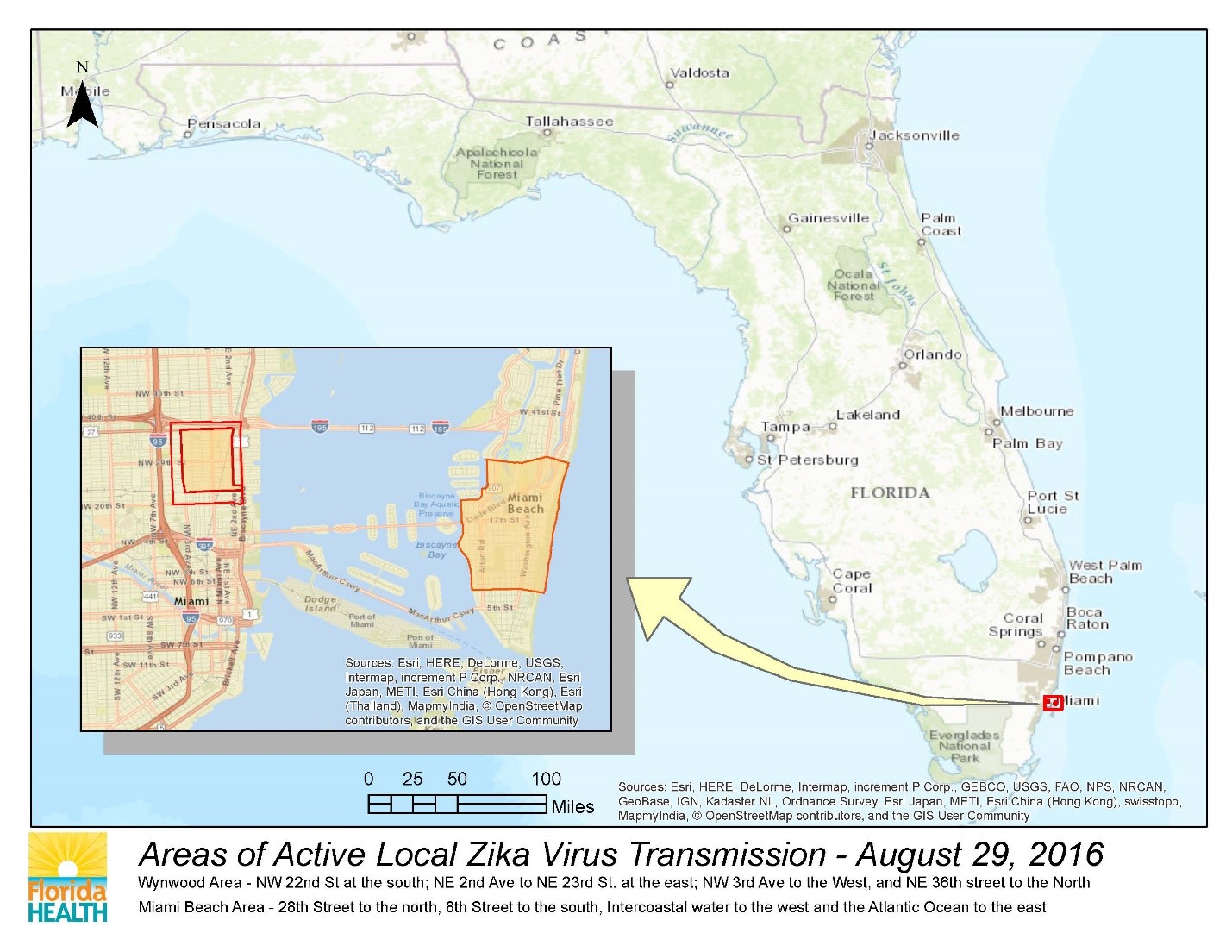
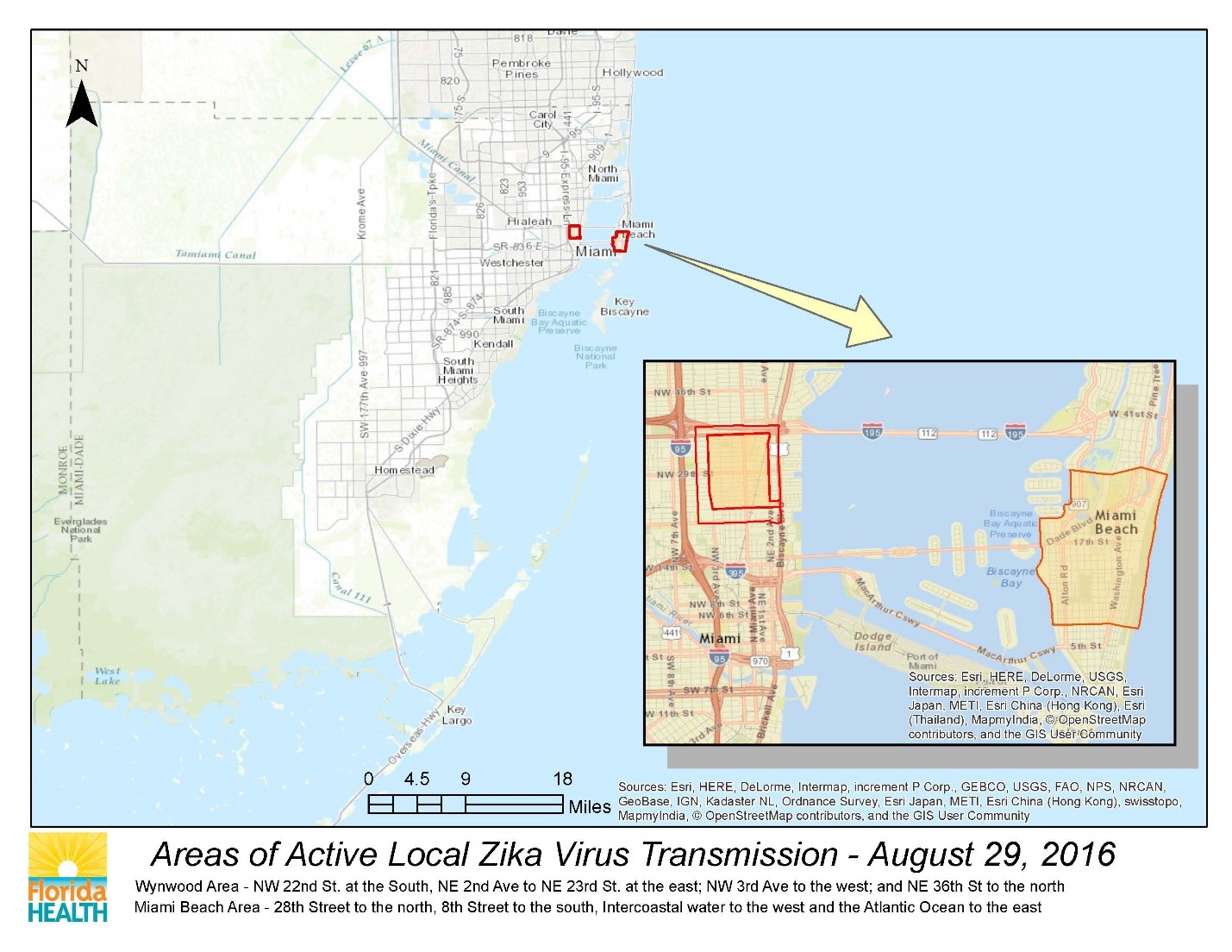
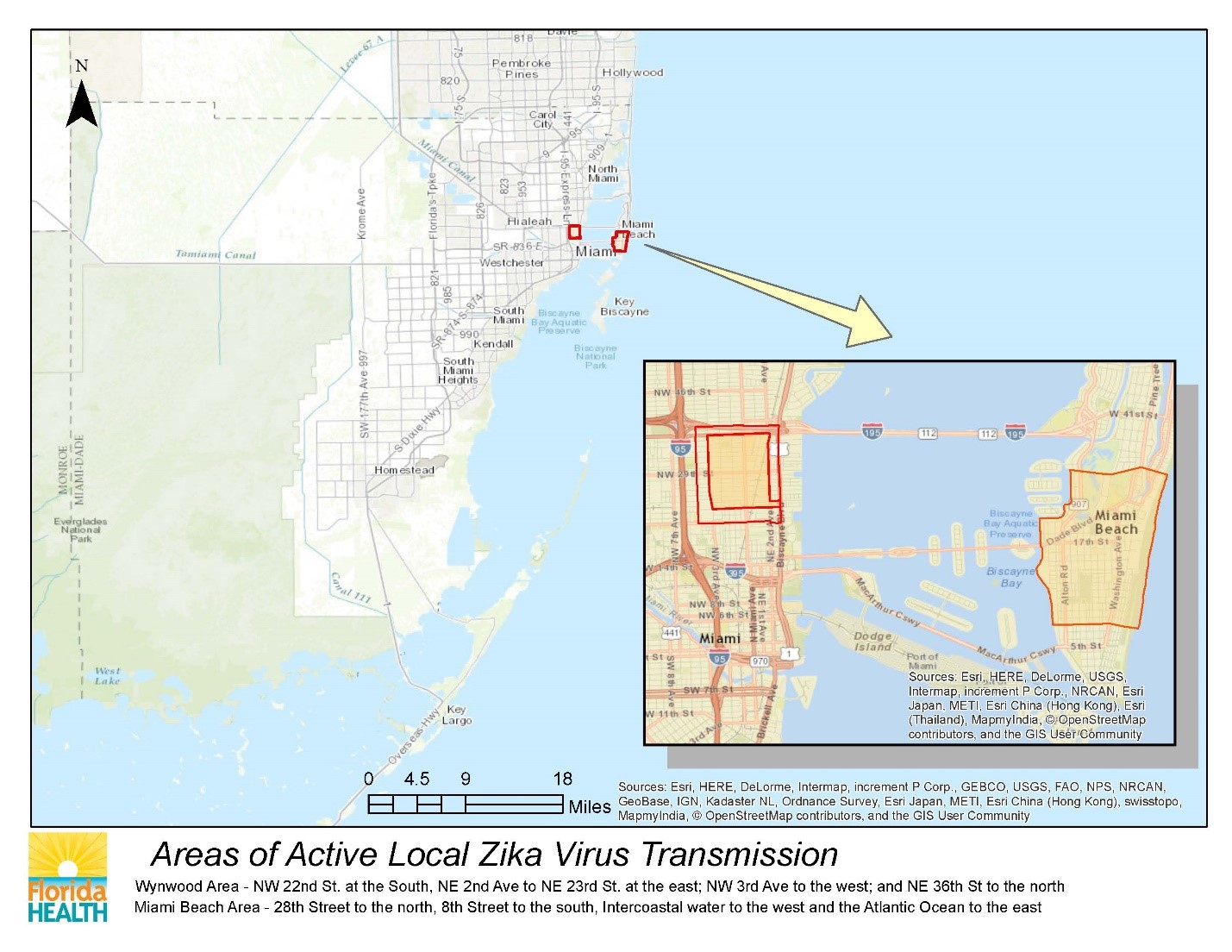
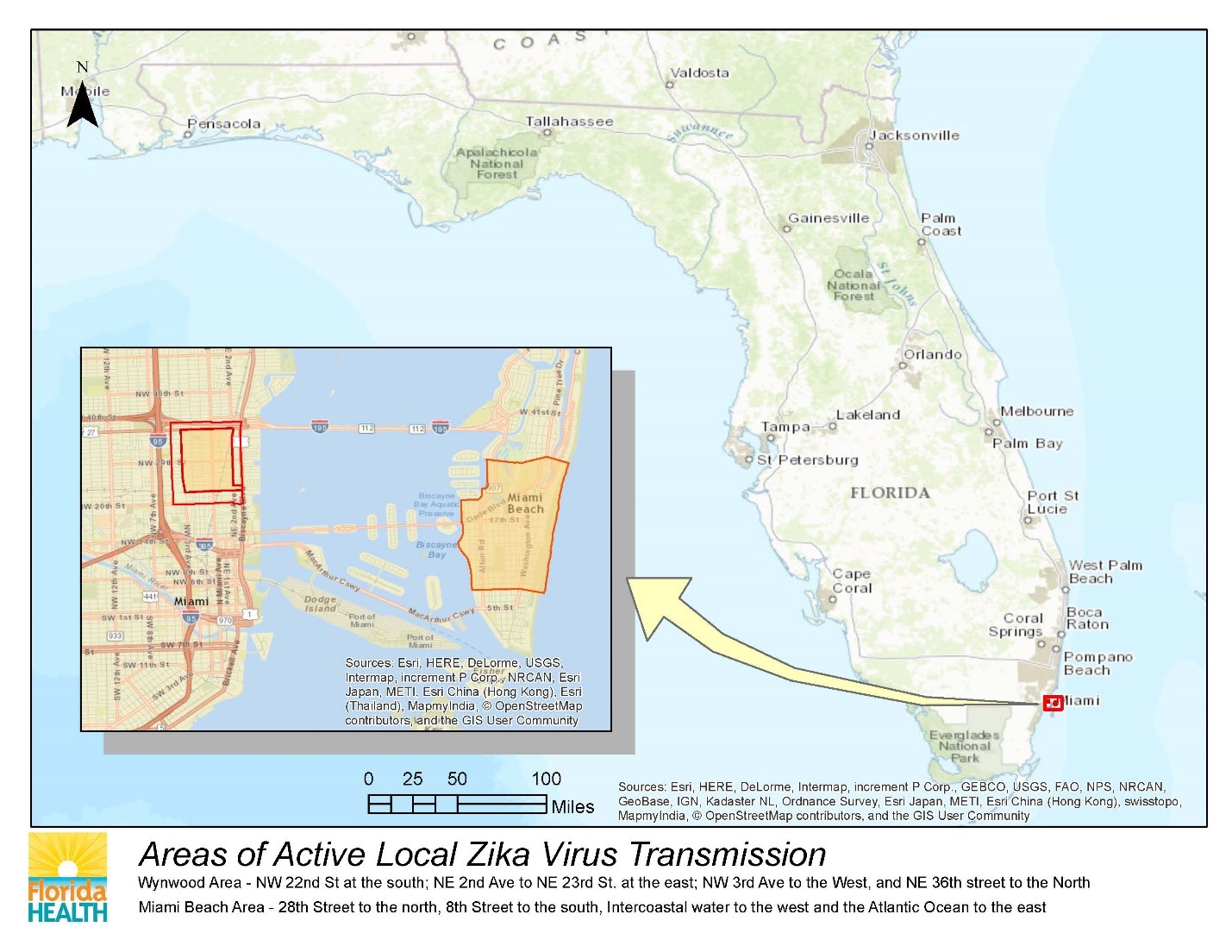
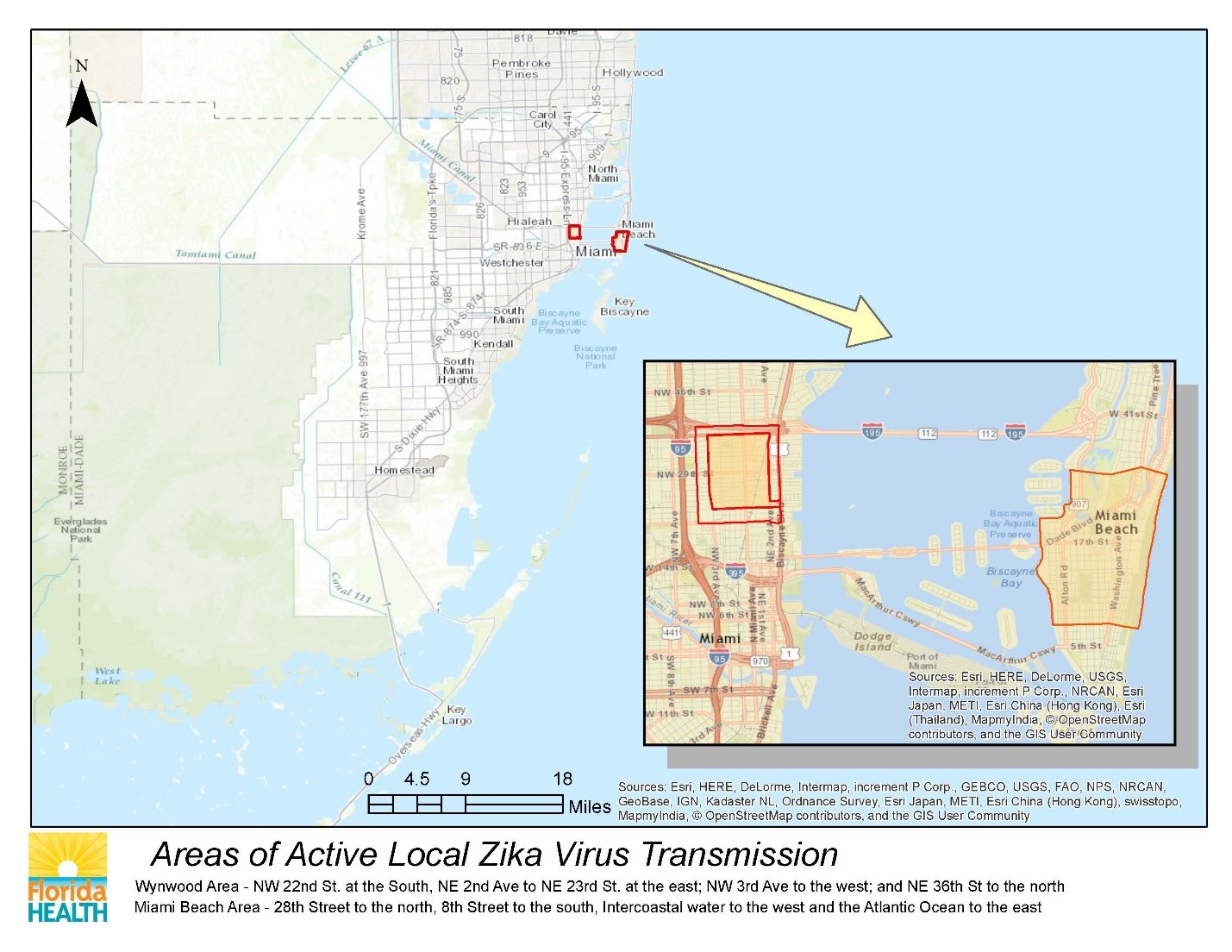
DOH continues door-to-door outreach and targeted testing in Pinellas, Palm Beach and Miami-Dade counties and mosquito abatement and reduction activities are also taking place around the locations that are being investigated. DOH believes ongoing transmission is only taking place within the small identified areas in Wynwood and Miami Beach in Miami-Dade County, see maps below.
[/FONT]

[FONT=&quot]One case does not mean ongoing active transmission is taking place. DOH conducts a thorough investigation by sampling close contacts and community members around each case to determine if additional people are infected. If DOH finds evidence that active transmission is occurring in an area, the media and the public will be notified.[/FONT]
[FONT=&quot]For a complete breakdown of non-travel and travel-related Zika infections to-date, please see below.[/FONT]
[TABLE="border: 1, cellpadding: 0, cellspacing: 0, height: 19"]
[TR]
[TD="width: 390"] Infection Type
[/TD]
[TD="width: 390"] Infection Count
[/TD]
[/TR]
[TR]
[TD="width: 390"] Travel-Related Infections of Zika
[/TD]
[TD="width: 390"] 545
[/TD]
[/TR]
[TR]
[TD="width: 390"] Non-Travel Related Infections of Zika
[/TD]
[TD="width: 390"] 43
[/TD]
[/TR]
[TR]
[TD="width: 390"] Infections Involving Pregnant Women
[/TD]
[TD="width: 390"] 75
[/TD]
[/TR]
[/TABLE]
[FONT=&quot]The department is currently conducting 10 investigations. Information regarding the investigations can be found here. If investigations reveal additional areas of active transmission, the department will announce a defined area of concern. [/FONT]
[FONT=&quot]The department has conducted Zika virus testing for more than 4,172 people statewide. Florida currently has the capacity to test 6,125 people for active Zika virus and 7,237 for Zika antibodies. At Governor Scott?s direction, all county health departments now offer free Zika risk assessment and testing to pregnant women.[/FONT]
[FONT=&quot]Florida?s small case cluster is not considered widespread transmission, however, pregnant women are advised to avoid non-essential travel to the impacted area in Miami-Dade County (see map below). If you are pregnant and must travel or if you live or work in the impacted area, protect yourself from mosquito bites by wearing insect repellent, long clothing and limiting your time outdoors. [/FONT]
[FONT=&quot]According to CDC guidance, providers should consider testing all pregnant women with a history of travel to a Zika affected area for the virus. It is also recommended that all pregnant women who reside in or travel frequently to the area where active transmission is likely occurring be tested for Zika in the first and second trimester. Pregnant women in the identified area can contact their medical provider or their local county health department to be tested and receive a Zika prevention kit. CDC recommends that a pregnant woman with a history of Zika virus and her provider should consider additional ultrasounds. Additionally, the department is working closely with the Healthy Start Coalition of Miami-Dade County to identify pregnant women in the impacted areas to ensure they have access to resources and information to protect themselves. CDC recommends that a pregnant woman with a history of Zika virus and her provider should consider additional ultrasounds. [/FONT]
[FONT=&quot]Pregnant women can contact their local county health department for Zika risk assessment and testing hours and information. A Zika risk assessment will be conducted by county health department staff and blood and/or urine samples may be collected and sent to labs for testing. It may take one to two weeks to receive results.[/FONT]
[FONT=&quot]Florida has been monitoring pregnant women with evidence of Zika regardless of symptoms. The total number of pregnant women who have been or are being monitored is 75.[/FONT]
[FONT=&quot]On Feb. 12, Governor Scott directed the State Surgeon General to activate a Zika Virus Information Hotline for current Florida residents and visitors, as well as anyone planning on traveling to Florida in the near future. The hotline, managed by the Department of Health, has assisted 5,083 callers since it launched. The number for the Zika Virus Information Hotline is 1-855-622-6735.[/FONT]
[FONT=&quot]The department urges Floridians to drain standing water weekly, no matter how seemingly small. A couple drops of water in a bottle cap can be a breeding location for mosquitoes. Residents and visitors also need to use repellents when enjoying the Florida outdoors.[/FONT]
[FONT=&quot]For more information on DOH action and federal guidance, please click here.[/FONT]
[FONT=&quot]For resources and information on Zika virus, click here.[/FONT]
[FONT=&quot]State of Florida[/FONT]
[FONT=&quot]
082916-zika-state-map.jpg
[/FONT]

[FONT=&quot]Miami-Dade County[/FONT]
[FONT=&quot]
082916-zika-county-map.jpg
[/FONT]

[FONT=&quot]About the Florida Department of Health[/FONT]
[FONT=&quot]The department, nationally accredited by the Public Health Accreditation Board, works to protect, promote, and improve the health of all people in Florida through integrated state, county and community efforts.[/FONT]
[FONT=&quot]Follow us on Twitter at @HealthyFla and on Facebook. For more information about the Florida Department of Health, please visit www.FloridaHealth.gov.


http://www.floridahealth.gov/newsroom/2016/08/082916-zika-update.html
[/FONT]
 
From: DOH COMMUNICATIONS OFFICE <DOHCOMMUNICATIONSOFFICE@flheal...
To:
Subject: Department of Health Daily Zika Update
Date: Aug 30, 2016 5:47 PM
[TABLE="border: 0, cellpadding: 0, cellspacing: 0"]
[TR]
[TD] [TABLE="border: 0, cellpadding: 0, width: 963"]
[TR]
[TD]Aug.30, 2016[/TD]
[TD] [/TD]
[/TR]
[TR]
[TD] [/TD]
[/TR]
[TR]
[TD]DEPARTMENT OF HEALTH DAILY ZIKA UPDATE[/TD]
[/TR]
[TR]
[TD] [/TD]
[/TR]
[TR]
[TD] [/TD]
[/TR]
[TR]
[TD="colspan: 2"]Contact:
Communications Office
NewsMedia@flhealth.gov
850-245-4111[/TD]
[/TR]
[TR]
[TD="colspan: 2"] [/TD]
[/TR]
[TR]
[TD="colspan: 2"]Tallahassee, Fla. &#151;In an effort to keep Florida residents and visitors safe and aware about the status of the Zika virus, the department will issue a Zika virus update each week day. Updates will include a Zika case count by county and information to keep Floridians informed and prepared.
There are 16 new travel related cases today, five in Miami-Dade, three in Palm Beach, two in Broward, two in Orange, one in Polk and three involving pregnant women. Please visit our website to see the full list of travel-related cases.

There are three new non-travel related cases today in Miami-Dade County, one is associated with the Miami-Beach investigation. The department is currently conducting an investigation into the other two cases to determine where exposure occurred.

DOH continues door-to-door outreach and targeted testing in Pinellas, Palm Beach and Miami-Dade counties and mosquito abatement and reduction activities are also taking place around the locations that are being investigated. DOH believes ongoing transmission is only taking place within the small identified areas in Wynwood and Miami Beach in Miami-Dade County, see maps below.
One case does not mean ongoing active transmission is taking place. DOH conducts a thorough investigation by sampling close contacts and community members around each case to determine if additional people are infected. If DOH finds evidence that active transmission is occurring in an area, the media and the public will be notified.
For a complete breakdown of non-travel and travel-related Zika infections to-date, please see below. [TABLE="border: 1, cellpadding: 0, cellspacing: 0"]
[TR]
[TD]Infection Type[/TD]
[TD]Infection Count[/TD]
[/TR]
[TR]
[TD]Travel-Related Infections of Zika[/TD]
[TD]558[/TD]
[/TR]
[TR]
[TD]Non-Travel Related Infections of Zika[/TD]
[TD]46[/TD]
[/TR]
[TR]
[TD]Infections Involving Pregnant Women[/TD]
[TD]78[/TD]
[/TR]
[/TABLE]
The department is currently conducting 12 investigations. Information regarding the investigations can be found here. If investigations reveal additional areas of active transmission, the department will announce a defined area of concern.
The department has conducted Zika virus testing for more than 4,625 people statewide. Florida currently has the capacity to test 6,027 people for active Zika virus and 7,064 for Zika antibodies. At Governor Scott&#146;s direction, all county health departments now offer free Zika risk assessment and testing to pregnant women.
Florida&#146;s small case cluster is not considered widespread transmission, however, pregnant women are advised to avoid non-essential travel to the impacted area in Miami-Dade County (see map below). If you are pregnant and must travel or if you live or work in the impacted area, protect yourself from mosquito bites by wearing insect repellent, long clothing and limiting your time outdoors.
According to CDC guidance, providers should consider testing all pregnant women with a history of travel to a Zika affected area for the virus. It is also recommended that all pregnant women who reside in or travel frequently to the area where active transmission is likely occurring be tested for Zika in the first and second trimester. Pregnant women in the identified area can contact their medical provider or their local county health department to be tested and receive a Zika prevention kit. CDC recommends that a pregnant woman with a history of Zika virus and her provider should consider additional ultrasounds. Additionally, the department is working closely with the Healthy Start Coalition of Miami-Dade County to identify pregnant women in the impacted areas to ensure they have access to resources and information to protect themselves. CDC recommends that a pregnant woman with a history of Zika virus and her provider should consider additional ultrasounds.
Pregnant women can contact their local county health department for Zika risk assessment and testing hours and information. A Zika risk assessment will be conducted by county health department staff and blood and/or urine samples may be collected and sent to labs for testing. It may take one to two weeks to receive results.
Florida has been monitoring pregnant women with evidence of Zika regardless of symptoms. The total number of pregnant women who have been or are being monitored is 78
On Feb. 12, Governor Scott directed the State Surgeon General to activate a Zika Virus Information Hotline for current Florida residents and visitors, as well as anyone planning on traveling to Florida in the near future. The hotline, managed by the Department of Health, has assisted 5,178 callers since it launched. The number for the Zika Virus Information Hotline is 1-855-622-6735.
The department urges Floridians to drain standing water weekly, no matter how seemingly small. A couple drops of water in a bottle cap can be a breeding location for mosquitoes. Residents and visitors also need to use repellents when enjoying the Florida outdoors.
For more information on DOH action and federal guidance, please click here.
For resources and information on Zika virus, click here.
State of Florida
3717731472593243062.png

Miami-Dade County
3717731472593326949.png


About the Florida Department of Health

The department, nationally accredited by the Public Health Accreditation Board, works to protect, promote and improve the health of all people in Florida through integrated state, county and community efforts.

Follow us on Twitter at @HealthyFla and on Facebook. For more information about the Florida Department of Health please visitwww.FloridaHealth.gov.[/TD]
[/TR]
[/TABLE]
[/TD]
[/TR]
[/TABLE]
 
From: DOH COMMUNICATIONS OFFICE <DOHCOMMUNICATIONSOFFICE@flheal...
To:
Subject: Department of Health Daily Zika Update
Date: Aug 31, 2016 6:00 PM

[TABLE="border: 0, cellpadding: 0, cellspacing: 0"]
[TR]
[TD] [TABLE="border: 0, cellpadding: 0, cellspacing: 3, width: 989"]
[TR]
[TD]Aug. 31 2016[/TD]
[/TR]
[/TABLE]

[/TD]
[/TR]
[/TABLE]


[TABLE="border: 0, cellpadding: 0, cellspacing: 3, width: 989"]
[TR]
[TD]DEPARTMENT OF HEALTH DAILY ZIKA UPDATE[/TD]
[/TR]
[TR]
[TD] [/TD]
[/TR]
[TR]
[TD="colspan: 2"]Contact:
Communications Office
NewsMedia@flhealth.gov
850-245-4111[/TD]
[/TR]
[TR]
[TD="colspan: 2"] [/TD]
[/TR]
[TR]
[TD="colspan: 2"]Tallahassee, Fla. ? In an effort to keep Florida residents and visitors safe and aware about the status of the Zika virus, the department will issue a Zika virus update each week day. Updates will include a Zika case count by county and information to keep Floridians informed and prepared. In order to keep the public informed, the department has posted our investigation process here.
There are 13 new travel related cases today, five in Miami-Dade, two in Osceola, one in Broward, one in Lee, one in Orange, one in Seminole and two involving pregnant women. Please visit our website to see the full list of travel-related cases.
There is one new non-travel related case today in Palm Beach County. The individual identified today experienced symptoms during the same time frame as the Palm Beach County case announced last week. The department has found no evidence of active transmission in the area.
DOH continues door-to-door outreach and targeted testing in Pinellas, Palm Beach and Miami-Dade counties and mosquito abatement and reduction activities are also taking place around the locations that are being investigated. DOH believes ongoing transmission is only taking place within the small identified areas in Wynwood and Miami Beach in Miami-Dade County, see maps below.
One case does not mean ongoing active transmission is taking place. DOH conducts a thorough investigation by sampling close contacts and community members around each case to determine if additional people are infected. If DOH finds evidence that active transmission is occurring in an area, the media and the public will be notified.
For a complete breakdown of non-travel and travel-related Zika infections to-date, please see below. [TABLE="border: 1, cellpadding: 0, cellspacing: 0"]
[TR]
[TD]Infection Type[/TD]
[TD]Infection Count[/TD]
[/TR]
[TR]
[TD]Travel-Related Infections of Zika[/TD]
[TD]569[/TD]
[/TR]
[TR]
[TD]Non-Travel Related Infections of Zika[/TD]
[TD]47[/TD]
[/TR]
[TR]
[TD]Infections Involving Pregnant Women[/TD]
[TD]80[/TD]
[/TR]
[/TABLE]
The department is currently conducting 12 investigations. Information regarding the investigations can be found here. If investigations reveal additional areas of active transmission, the department will announce a defined area of concern.
The department has conducted Zika virus testing for more than 4,330 people statewide. Florida currently has the capacity to test 5,899 people for active Zika virus and 6,918 for Zika antibodies. At Governor Scott?s direction, all county health departments now offer free Zika risk assessment and testing to pregnant women.
Florida?s small case cluster is not considered widespread transmission, however, pregnant women are advised to avoid non-essential travel to the impacted area in Miami-Dade County (see map below). If you are pregnant and must travel or if you live or work in the impacted area, protect yourself from mosquito bites by wearing insect repellent, long clothing and limiting your time outdoors.
According to CDC guidance, providers should consider testing all pregnant women with a history of travel to a Zika affected area for the virus. It is also recommended that all pregnant women who reside in or travel frequently to the area where active transmission is likely occurring be tested for Zika in the first and second trimester. Pregnant women in the identified area can contact their medical provider or their local county health department to be tested and receive a Zika prevention kit. CDC recommends that a pregnant woman with a history of Zika virus and her provider should consider additional ultrasounds. Additionally, the department is working closely with the Healthy Start Coalition of Miami-Dade County to identify pregnant women in the impacted areas to ensure they have access to resources and information to protect themselves. CDC recommends that a pregnant woman with a history of Zika virus and her provider should consider additional ultrasounds.
Pregnant women can contact their local county health department for Zika risk assessment and testing hours and information. A Zika risk assessment will be conducted by county health department staff and blood and/or urine samples may be collected and sent to labs for testing. It may take one to two weeks to receive results.
Florida has been monitoring pregnant women with evidence of Zika regardless of symptoms. The total number of pregnant women who have been or are being monitored is 80.
On Feb. 12, Governor Scott directed the State Surgeon General to activate a Zika Virus Information Hotline for current Florida residents and visitors, as well as anyone planning on traveling to Florida in the near future. The hotline, managed by the Department of Health, has assisted 5,256 callers since it launched. The number for the Zika Virus Information Hotline is 1-855-622-6735.
The department urges Floridians to drain standing water weekly, no matter how seemingly small. A couple drops of water in a bottle cap can be a breeding location for mosquitoes. Residents and visitors also need to use repellents when enjoying the Florida outdoors.
For more information on DOH action and federal guidance, please click here.
For resources and information on Zika virus, click here.

State of Florida
3717731472680531451.jpg

Miami-Dade County

3717731472680584230.jpg

About the Florida Department of Health

The department, nationally accredited by the Public Health Accreditation Board, works to protect, promote and improve the health of all people in Florida through integrated state, county and community efforts.

Follow us on Twitter at @HealthyFla and on Facebook. For more information about the Florida Department of Health please visit www.FloridaHealth.gov.[/TD]
[/TR]
[/TABLE]

 
Government report:

Miami-Dade Mosquitoes Test Positive for Zika

Sep 1, 2016

TALLAHASSEE, Fla. &#151;

The Florida Department of Agriculture and Consumer Services has detected Zika in three mosquito samples from a small area in Miami Beach. The mosquitoes from Miami Beach that tested positive for Zika are from an area where increased trapping and intensified mosquito control measures are occurring due to the investigation of local transmission led by the Florida Department of Health.

Ninety-five additional samples have been submitted by Miami-Dade County after the date of the positive submission, and the mosquitoes have tested negative for Zika.
&#147;This find is disappointing, but not surprising. Florida is among the best in the nation when it comes to mosquito surveillance and control, and this detection enables us to continue to effectively target our resources. Miami-Dade County, the City of Miami Beach, and state and federal partners will continue to work aggressively to prevent the spread of Zika,&#148; stated Commissioner of Agriculture Adam H. Putnam.
&#147;Miami-Dade County's Mosquito Control team continues its proactive and aggressive response to reducing the mosquito population throughout the County,&#148; said Miami-Dade County Mayor Carlos A. Gimenez. &#147;As it has been from the beginning, our goal is to eliminate the cycle of transmission by eliminating the mosquitoes. In the 1.5-square-mile area of Miami Beach where locally-acquired cases of Zika were confirmed, Miami-Dade County's Mosquito Control team conducted nearly 2,000 proactive inspections, abatement and treatment of mosquito breeding and adult mosquito activity, and three truck sprayings throughout the area, and in an additional extended area. I am confident that by working together with our community, with the City of Miami Beach and Mayor Levine, the Department of Agriculture, the Florida Department of Health, and the Centers for Disease Control and Prevention, we will continue to reduce the mosquito population and keep our community safe.&#148;
"Miami Beach will continue to take a hardline in our fight against Zika. We are aggressively working to eliminate any and all potential mosquito breeding grounds. We are also working closely with our partners at the state and the county to ensure all resources are effectively deployed. Together we can contain and eliminate all cases of Zika. We need Congress to do its part to provide the necessary emergency resources to properly combat the spread of this virus," stated Miami Beach Mayor Philip Levine.
The positive mosquito pools were collected in Miami Beach within the current zone that has been treated for local transmission. Scientists with the Florida Department of Agriculture and Consumer Services tested the samples at the Bronson Animal Disease Diagnostic Laboratory in Kissimmee, and the samples were then sent to the Centers for Disease Control and Prevention and Florida Gulf Coast University for confirmation.
Florida's proactive efforts, which are conducted by local mosquito control programs and supported by the expertise provided by the Florida Department of Agriculture and Consumer Services, include: eliminating larval habitats by emptying standing water, treating water-holding containers with long-lasting larvicide, providing outdoor residual and spatial insecticide treatments to reduce adult vectors, and conducting adult mosquito surveillance to evaluate the effectiveness of treatments.
Now that Zika-positive mosquitoes have been identified in surveillance traps in Miami Beach, Miami-Dade County's Mosquito Control team will continue to conduct inspections to reduce mosquito breeding and perform spray treatments as necessary in a 1/8-mile radius around the trap location.
Floridians can help prevent the spread of Zika by eliminating mosquito breeding grounds by draining standing water around their homes, businesses and communities.
On February 2, 2016, the Florida Surgeon General declared a public health emergency in regards to the Zika virus. Floridians can assist in Zika-related response efforts by draining standing water and allowing officials who are conducting mosquito control efforts to access their property.
The Florida Department of Agriculture and Consumer Services has tested more than 2,470 mosquito samples, consisting of more than 40,000 mosquitoes, since May, and these three samples are the first to test positive.
Access a copy of the mosquito declaration [
pdf.png
939.54 KB ].
For more information on the Zika virus, visit the Florida Department of Health's website at FloridaHealth.gov.


http://www.freshfromflorida.com/News...itive-for-Zika


hat tip Michael Coston for the link
 
I agree. I am not surprised. I think we all knew that once there were some local cases, mosquitoes would be found that test positive for Zika.

My family is still doing our normal routine, living life, etc. I did some yard work last weekend and when I sprayed myself with repellent, over my clothes and the top of my head. ankles, & hands - I did not get any bites. So it is possible to avoid bites, but it takes some work. My daughter is still waiting to start a family until after this fall.
 
[FONT=&quot] [h=1]Department of Health Daily Zika Update[/h] By Florida Department of Health, Office of Communications
September 01, 2016
[/FONT]

[FONT=&quot] Press Release[/FONT]
[FONT=&quot]
DOH_logo.png

September 1, 2016
[h=2]Department of Health Daily Zika Update[/h] Contact:
Communications Office
NewsMedia@flhealth.gov
(850) 245-4111

Tallahassee, Fla.?In an effort to keep Florida residents and visitors safe and aware about the status of the Zika virus, the department will issue a Zika virus update each week day. Updates will include a Zika case count by county and information to keep Floridians informed and prepared. In order to keep the public informed, the department has posted our investigation process here.
There are seven new travel related cases today, three in Miami-Dade, two in Broward, one in Osceola and one in Sarasota. Please visit our website to see the full list of travel-related cases.
There are two new non-travel related cases today in Miami-Dade County. One is associated with the area in Miami-Beach. The other is associated with Wynwood and experienced symptoms in July. CDC results to rule out other mosquito-borne illness were just received.
DOH continues door-to-door outreach and targeted testing in Pinellas, Palm Beach and Miami-Dade counties and mosquito abatement and reduction activities are also taking place around the locations that are being investigated. DOH believes ongoing transmission is only taking place within the small identified areas in Wynwood and Miami Beach in Miami-Dade County, see maps below.
One case does not mean ongoing active transmission is taking place. DOH conducts a thorough investigation by sampling close contacts and community members around each case to determine if additional people are infected. If DOH finds evidence that active transmission is occurring in an area, the media and the public will be notified.
For a complete breakdown of non-travel and travel-related Zika infections to-date, please see below.
[TABLE="border: 1, cellpadding: 0, cellspacing: 0"]
[TR]
[TD="width: 390"] Infection Type
[/TD]
[TD="width: 390"] Infection Count
[/TD]
[/TR]
[TR]
[TD="width: 390"] Travel-Related Infections of Zika
[/TD]
[TD="width: 390"] 576
[/TD]
[/TR]
[TR]
[TD="width: 390"] Non-Travel Related Infections of Zika
[/TD]
[TD="width: 390"] 49
[/TD]
[/TR]
[TR]
[TD="width: 390"] Infections Involving Pregnant Women
[/TD]
[TD="width: 390"] 80
[/TD]
[/TR]
[/TABLE]
The department is currently conducting 13 investigations. Information regarding the investigations can be found here. If investigations reveal additional areas of active transmission, the department will announce a defined area of concern.
The department has conducted Zika virus testing for more than 4,452 people statewide. Florida currently has the capacity to test 5,755 people for active Zika virus and 6,852 for Zika antibodies. At Governor Scott?s direction, all county health departments now offer free Zika risk assessment and testing to pregnant women.
Florida?s small case cluster is not considered widespread transmission, however, pregnant women are advised to avoid non-essential travel to the impacted area in Miami-Dade County (see map below). If you are pregnant and must travel or if you live or work in the impacted area, protect yourself from mosquito bites by wearing insect repellent, long clothing and limiting your time outdoors.
According to CDC guidance, providers should consider testing all pregnant women with a history of travel to a Zika affected area for the virus. It is also recommended that all pregnant women who reside in or travel frequently to the area where active transmission is likely occurring be tested for Zika in the first and second trimester. Pregnant women in the identified area can contact their medical provider or their local county health department to be tested and receive a Zika prevention kit. CDC recommends that a pregnant woman with a history of Zika virus and her provider should consider additional ultrasounds. Additionally, the department is working closely with the Healthy Start Coalition of Miami-Dade County to identify pregnant women in the impacted areas to ensure they have access to resources and information to protect themselves. CDC recommends that a pregnant woman with a history of Zika virus and her provider should consider additional ultrasounds.
Pregnant women can contact their local county health department for Zika risk assessment and testing hours and information. A Zika risk assessment will be conducted by county health department staff and blood and/or urine samples may be collected and sent to labs for testing. It may take one to two weeks to receive results.
Florida has been monitoring pregnant women with evidence of Zika regardless of symptoms. The total number of pregnant women who have been or are being monitored is 80.
On Feb. 12, Governor Scott directed the State Surgeon General to activate a Zika Virus Information Hotline for current Florida residents and visitors, as well as anyone planning on traveling to Florida in the near future. The hotline, managed by the Department of Health, has assisted 5,329 callers since it launched. The number for the Zika Virus Information Hotline is 1-855-622-6735.
...
http://www.floridahealth.gov/newsroom/2016/09/090116-zika-update.html

[/FONT]
 
Statement from Mayor Carlos A. Gimenez regarding continued mosquito control efforts in Miami Beach

[h=1]Statement from Mayor Carlos A. Gimenez regarding continued mosquito control efforts in Miami Beach[/h] MIAMI (September 06, 2016) ? Miami-Dade County's Mosquito Control team continues to monitor the number of mosquitoes found in traps throughout the County. As it has been from the beginning, our goal is to reduce the cycle of Zika transmission by reducing the number of mosquitoes.

Over the weekend, the number of mosquitoes found in traps in the 1.5-square-mile area in Miami Beach where mosquitoes have tested positive for Zika has increased. Despite the increase, it is important to note that all subsequent test results from mosquitoes in the same three trap locations have been negative for Zika. In order to continue our aggressive and proactive mosquito-control surveillance, monitoring and response, I, in consultation with Governor Rick Scott?s Office, the Centers for Disease Control and Prevention, the Florida Department of Health and the Department of Agriculture, have directed Miami-Dade County Mosquito Control to begin four cycles of adulticide aerial spraying using EPA-approved naled in the 1.5-square-mile area where mosquitoes have tested positive for Zika. Weather permitting, the aerial spraying will begin Thursday at approximately 5 a.m. for the next four weeks and will be completed within a half hour. We will keep the number of adulticide missions to a minimum on school days, and parents may prefer to keep students indoors until 6:30 a.m. following aerial spraying.

Due to the unique topography, high-rise buildings and construction sites on Miami Beach, at this time, we will focus our aerial spraying only on adulticide treatment and larvicide application on the ground by truck or by hand during inspections. This treatment differs slightly from the larvicide treatment we were able to perform both aerially and on the ground in the area north of downtown Miami where local transmission was first identified.

This morning, Miami-Dade County Mosquito Control also began an innovative ground-control larvicide treatment in Miami Beach using trucks equipped with Buffalo Turbines. As far as we know, Miami-Dade is one of the first counties in the nation to use this state-of-the-art equipment using EPA-approved Bti to target breeding areas and reduce the mosquito population. The truck sprayings will also take place over the next four weeks during early morning hours. The truck spraying events will be west of Washington Avenue between the hours of 2 a.m. and 6 a.m., and east of Washington Avenue between the hours of 5 a.m. and 6 a.m., approximately every seven days.

I thank City of Miami Beach leaders for their ongoing collaboration as we continue to work to reduce the mosquito population, both aerially and on the ground.

Miami-Dade County is fully mobilized and we continue our proactive and aggressive response to reducing the Aedes Aegypti mosquito population. Prevention is the most important tool in our arsenal to keep our community safe from the Zika virus. Therefore, we continue to ask all residents and visitors to do their part to keep our community safe by draining standing water, wearing clothing that covers the skin and applying mosquito repellant when going outdoors, especially during early morning and evening hours.

http://www.miamidade.gov/releases/2..._campaign=release-distribution&utm_term=mayor
 
From: DOH COMMUNICATIONS OFFICE <DOHCOMMUNICATIONSOFFICE@flheal...
To:
Subject: Department of Health Daily Zika Update
Date: Sep 6, 2016 3:56 PM
[TABLE="border: 0, cellpadding: 0, cellspacing: 0"]
[TR]
[TD] [TABLE="border: 0, cellpadding: 0, width: 923"]
[TR]
[TD]Sept. 6, 2016[/TD]
[TD] [/TD]
[/TR]
[TR]
[TD] [/TD]
[/TR]
[TR]
[TD]DEPARTMENT OF HEALTH DAILY ZIKA UPDATE[/TD]
[/TR]
[TR]
[TD] [/TD]
[/TR]
[TR]
[TD] [/TD]
[/TR]
[TR]
[TD="colspan: 2"]Contact:
Communications Office
NewsMedia@flhealth.gov
850-245-4111[/TD]
[/TR]
[TR]
[TD="colspan: 2"] [/TD]
[/TR]
[TR]
[TD="colspan: 2"]Tallahassee, Fla. &#151;In an effort to keep Florida residents and visitors safe and aware about the status of the Zika virus, the department will issue a Zika virus update each week day. Updates will include a Zika case count by county and information to keep Floridians informed and prepared.In order to keep the public informed, the department has posted our investigation process here .
There is one new travel related case today in Orange County. Please visit our website to see the full list of travel-related cases.

There are seven new non-travel related cases today. Six are associated with the Miami Beach investigation. One is a new investigation in Miami-Dade County. The six new cases associated with Miami Beach were confirmed Friday, but are being formally announced today due to Hurricane Hermine closing state offices on Friday.

DOH continues door-to-door outreach and targeted testing in Pinellas, Palm Beach and Miami-Dade counties and mosquito abatement and reduction activities are also taking place around the locations that are being investigated. DOH believes ongoing transmission is only taking place within the small identified areas in Wynwood and Miami Beach in Miami-Dade County, see maps below.
One case does not mean ongoing active transmission is taking place. DOH conducts a thorough investigation by sampling close contacts and community members around each case to determine if additional people are infected. If DOH finds evidence that active transmission is occurring in an area, the media and the public will be notified.
For a complete breakdown of non-travel and travel-related Zika infections to-date, please see below. [TABLE="border: 1, cellpadding: 0, cellspacing: 0"]
[TR]
[TD]Infection Type[/TD]
[TD]Infection Count[/TD]
[/TR]
[TR]
[TD]Travel-Related Infections of Zika[/TD]
[TD]577[/TD]
[/TR]
[TR]
[TD]Non-Travel Related Infections of Zika[/TD]
[TD]56[/TD]
[/TR]
[TR]
[TD]Infections Involving Pregnant Women[/TD]
[TD]80[/TD]
[/TR]
[/TABLE]
The department is currently conducting 14 investigations. Information regarding the investigations can be found here. If investigations reveal additional areas of active transmission, the department will announce a defined area of concern.
The department has conducted Zika virus testing for more than 5,910 people statewide. Florida currently has the capacity to test 5,678 people for active Zika virus and 6,748 for Zika antibodies. At Governor Scott&#146;s direction, all county health departments now offer free Zika risk assessment and testing to pregnant women.
Florida&#146;s small case cluster is not considered widespread transmission, however, pregnant women are advised to avoid non-essential travel to the impacted area in Miami-Dade County (see map below). If you are pregnant and must travel or if you live or work in the impacted area, protect yourself from mosquito bites by wearing insect repellent, long clothing and limiting your time outdoors.
According to CDC guidance, providers should consider testing all pregnant women with a history of travel to a Zika affected area for the virus. It is also recommended that all pregnant women who reside in or travel frequently to the area where active transmission is likely occurring be tested for Zika in the first and second trimester. Pregnant women in the identified area can contact their medical provider or their local county health department to be tested and receive a Zika prevention kit. CDC recommends that a pregnant woman with a history of Zika virus and her provider should consider additional ultrasounds. Additionally, the department is working closely with the Healthy Start Coalition of Miami-Dade County to identify pregnant women in the impacted areas to ensure they have access to resources and information to protect themselves. CDC recommends that a pregnant woman with a history of Zika virus and her provider should consider additional ultrasounds.
Pregnant women can contact their local county health department for Zika risk assessment and testing hours and information. A Zika risk assessment will be conducted by county health department staff and blood and/or urine samples may be collected and sent to labs for testing. It may take one to two weeks to receive results.
Florida has been monitoring pregnant women with evidence of Zika regardless of symptoms. The total number of pregnant women who have been or are being monitored is 80.
On Feb. 12, Governor Scott directed the State Surgeon General to activate a Zika Virus Information Hotline for current Florida residents and visitors, as well as anyone planning on traveling to Florida in the near future. The hotline, managed by the Department of Health, has assisted 5,541 callers since it launched. The number for the Zika Virus Information Hotline is 1-855-622-6735.
The department urges Floridians to drain standing water weekly, no matter how seemingly small. A couple drops of water in a bottle cap can be a breeding location for mosquitoes. Residents and visitors also need to use repellents when enjoying the Florida outdoors.
For more information on DOH action and federal guidance, please click here.
For resources and information on Zika virus, click here.
State of Florida
3717731473191420310.png

Miami-Dade County
3717731473191466081.png


About the Florida Department of Health

The department, nationally accredited by the Public Health Accreditation Board, works to protect, promote and improve the health of all people in Florida through integrated state, county and community efforts.

Follow us on Twitter at @HealthyFla and on Facebook. For more information about the Florida Department of Health please visitwww.FloridaHealth.gov.[/TD]
[/TR]
[/TABLE]
[/TD]
[/TR]
[/TABLE]
 
Florida - ​Amid concerns, spraying of Naled delayed in Miami Beach?s Zika fight

Amid Concerns, Spraying Of Naled Delayed In Miami Beach?s Zika Fight

September 7, 2016 2:30 PM

MIAMI BEACH (CBSMiami) ? ...

Mosquito control crews were set to spray Naled over Miami Beach, just like they did in Wynwood, starting Thursday but growing concerns from residents and local leaders prompted a delay. According to the CDC, Miami-Dade County will delay spraying for one day, until Friday, to make sure all residents are informed.
...
http://miami.cbslocal.com/2016/09/0...eaders-concerned-over-spraying-in-zika-fight/
 
Florida - ​Second baby born with Zika in Miami-Dade County

Second baby born with Zika in Miami-Dade County
...
Dr. Christine Curry made the revelation at an emergency Zika meeting held at Miami Beach City Hall. She did not disclose when the baby was born or the severity of the symptoms.

Dr. Curry said the mother of the infected baby has declined to talked to the media.
...
Published 2 hours ago

http://www.nbcmiami.com/news/local/Second-Baby-Born-with-Zika-in-Miami-Dade-County-392627061.html
 
[FONT=&quot] [h=1]Department of Health Daily Zika Update[/h] By Florida Department of Health, Office of Communications
September 07, 2016
[/FONT]

[FONT=&quot] Press Release[/FONT]
[FONT=&quot]
DOH_logo.png

September 7, 2016
[h=2]Department of Health Daily Zika Update[/h] Contact:
Communications Office
NewsMedia@flhealth.gov
(850) 245-4111

Tallahassee, Fla.?In an effort to keep Florida residents and visitors safe and aware about the status of the Zika virus, the department will issue a Zika virus update each week day. Updates will include a Zika case count by county and information to keep Floridians informed and prepared. In order to keep the public informed, the department has posted our investigation process here.
There are 19 new travel related cases today including 11 in Miami-Dade, four in Broward, one in Brevard, one in Monroe, one in Pasco and one in St. Johns. Please visit ourwebsite to see the full list of travel-related cases.
There are no new non-travel related cases today.
DOH continues door-to-door outreach and targeted testing in Pinellas, Palm Beach and Miami-Dade counties and mosquito abatement and reduction activities are also taking place around the locations that are being investigated. DOH believes ongoing transmission is only taking place within the small identified areas in Wynwood and Miami Beach in Miami-Dade County, see maps below.
One case does not mean ongoing active transmission is taking place. DOH conducts a thorough investigation by sampling close contacts and community members around each case to determine if additional people are infected. If DOH finds evidence that active transmission is occurring in an area, the media and the public will be notified.
For a complete breakdown of non-travel and travel-related Zika infections to-date, please see below.
[TABLE="border: 1, cellpadding: 0, cellspacing: 0"]
[TR]
[TD="width: 390"] Infection Type
[/TD]
[TD="width: 390"] Infection Count
[/TD]
[/TR]
[TR]
[TD="width: 390"] Travel-Related Infections of Zika
[/TD]
[TD="width: 390"] 596
[/TD]
[/TR]
[TR]
[TD="width: 390"] Non-Travel Related Infections of Zika
[/TD]
[TD="width: 390"] 56
[/TD]
[/TR]
[TR]
[TD="width: 390"] Infections Involving Pregnant Women
[/TD]
[TD="width: 390"] 80
[/TD]
[/TR]
[/TABLE]
The department is currently conducting 14 investigations. Information regarding the investigations can be found here. If investigations reveal additional areas of active transmission, the department will announce a defined area of concern.
The department has conducted Zika virus testing for more than 6,089 people statewide. Florida currently has the capacity to test 5,589 people for active Zika virus and 6,392 for Zika antibodies. At Governor Scott?s direction, all county health departments now offer free Zika risk assessment and testing to pregnant women.
Florida?s small case cluster is not considered widespread transmission, however, pregnant women are advised to avoid non-essential travel to the impacted area in Miami-Dade County (see map below). If you are pregnant and must travel or if you live or work in the impacted area, protect yourself from mosquito bites by wearing insect repellent, long clothing and limiting your time outdoors.
According to CDC guidance, providers should consider testing all pregnant women with a history of travel to a Zika affected area for the virus. It is also recommended that all pregnant women who reside in or travel frequently to the area where active transmission is likely occurring be tested for Zika in the first and second trimester. Pregnant women in the identified area can contact their medical provider or their local county health department to be tested and receive a Zika prevention kit. CDC recommends that a pregnant woman with a history of Zika virus and her provider should consider additional ultrasounds. Additionally, the department is working closely with the Healthy Start Coalition of Miami-Dade County to identify pregnant women in the impacted areas to ensure they have access to resources and information to protect themselves. CDC recommends that a pregnant woman with a history of Zika virus and her provider should consider additional ultrasounds.
Pregnant women can contact their local county health department for Zika risk assessment and testing hours and information. A Zika risk assessment will be conducted by county health department staff and blood and/or urine samples may be collected and sent to labs for testing. It may take one to two weeks to receive results.
Florida has been monitoring pregnant women with evidence of Zika regardless of symptoms. The total number of pregnant women who have been or are being monitored is 80.
On Feb. 12, Governor Scott directed the State Surgeon General to activate a Zika Virus Information Hotline for current Florida residents and visitors, as well as anyone planning on traveling to Florida in the near future. The hotline, managed by the Department of Health, has assisted 5,613 callers since it launched. The number for the Zika Virus Information Hotline is 1-855-622-6735.
The department urges Floridians to drain standing water weekly, no matter how seemingly small. A couple drops of water in a bottle cap can be a breeding location for mosquitoes. Residents and visitors also need to use repellents when enjoying the Florida outdoors.
For more information on DOH action and federal guidance, please click here.
For resources and information on Zika virus, click here.
State of Florida
090716-state-map.jpg

Miami-Dade County
090716-county-map.jpg

About the Florida Department of Health
The department, nationally accredited by the Public Health Accreditation Board, works to protect, promote, and improve the health of all people in Florida through integrated state, county and community efforts.
Follow us on Twitter at @HealthyFla and on Facebook. For more information about the Florida Department of Health, please visit www.FloridaHealth.gov.

http://www.floridahealth.gov/newsroom/2016/09/090716-zika-update.html

[/FONT]
 
Baby born with Zika virus at Jackson Memorial Hospital
...
By Paradise Afshar - Digital Editor
Posted: 9:11 PM, September 07, 2016

MIAMI - A baby has been born at Jackson Memorial Hospital with microcephaly, according to Dr. Christine Curry.

In total, 15 pregnant women who have delivered at the hospital have tested positive for the mosquito-borne virus, Curry said.
...
http://www.local10.com/health/zika-virus/baby-born-with-zika-at-jackson-memorial-hospital
 
Florida health officials confirm 80 pregnant women test positive for Zika virus

TALLAHASSEE, Fla. - Florida health officials confirmed Wednesday in their daily report that 80 pregnant women have tested positive for the Zika virus in the state.
The announcement came the same day doctors confirmed that a baby was born with microcephaly at Jackson Memorial Hospital.
In total, 15 pregnant women who have delivered at the hospital have tested positive for the mosquito-borne virus, Dr. Christine Curry said.
Those women are being monitored by doctors at the hospital.
"Zika is a thing. Zika is real, and while we don't understand it fully, that is not a reason to dismiss its impact," Curry said Wednesday at a Miami Beach Commission meeting.
So far, there have been 596 travel-related infections confirmed in the state and 56 locally acquired cases, with the majority being contracted in Miami-Dade County.

http://www.local10.com/health/zika-...-pregnant-women-test-positive-for-zika-virus-
 
[FONT=&quot] [h=1]Department of Health Daily Zika Update[/h] By Florida Department of Health, Office of Communications
September 08, 2016
[/FONT]

[FONT=&quot] Press Release[/FONT]
[FONT=&quot]
DOH_logo.png

September 8, 2016
[h=2]Department of Health Daily Zika Update[/h] Contact:
Communications Office
NewsMedia@flhealth.gov
(850) 245-4111

Tallahassee, Fla.?In an effort to keep Florida residents and visitors safe and aware about the status of the Zika virus, the department will issue a Zika virus update each week day. Updates will include a Zika case count by county and information to keep Floridians informed and prepared. In order to keep the public informed, the department has posted our investigation process here.
There are 12 new travel related cases today including three in Miami-Dade, two in Alachua, one in Marion, one in Orange, one in Palm Beach and four involving pregnant women. Please visit our website to see the full list of travel-related cases.
There are no new non-travel related cases today.
DOH continues door-to-door outreach and targeted testing in Pinellas, Palm Beach and Miami-Dade counties and mosquito abatement and reduction activities are also taking place around the locations that are being investigated. DOH believes ongoing transmission is only taking place within the small identified areas in Wynwood and Miami Beach in Miami-Dade County, see maps below.
One case does not mean ongoing active transmission is taking place. DOH conducts a thorough investigation by sampling close contacts and community members around each case to determine if additional people are infected. If DOH finds evidence that active transmission is occurring in an area, the media and the public will be notified.
For a complete breakdown of non-travel and travel-related Zika infections to-date, please see below.
[TABLE="border: 1, cellpadding: 0, cellspacing: 0"]
[TR]
[TD="width: 390"] Infection Type
[/TD]
[TD="width: 390"] Infection Count
[/TD]
[/TR]
[TR]
[TD="width: 390"] Travel-Related Infections of Zika
[/TD]
[TD="width: 390"] 604
[/TD]
[/TR]
[TR]
[TD="width: 390"] Non-Travel Related Infections of Zika
[/TD]
[TD="width: 390"] 56
[/TD]
[/TR]
[TR]
[TD="width: 390"] Infections Involving Pregnant Women
[/TD]
[TD="width: 390"] 84
[/TD]
[/TR]
[/TABLE]
The department is currently conducting 13 investigations. Information regarding the investigations can be found here. The department now has enough information to close the first Palm Beach County investigation. There were no additional infections related to this case. If investigations reveal additional areas of active transmission, the department will announce a defined area of concern.
The department has conducted Zika virus testing for more than 6,321 people statewide. Florida currently has the capacity to test 5,510 people for active Zika virus and 6,340 for Zika antibodies. At Governor Scott?s direction, all county health departments now offer free Zika risk assessment and testing to pregnant women.
Florida?s small case cluster is not considered widespread transmission, however, pregnant women are advised to avoid non-essential travel to the impacted area in Miami-Dade County (see map below). If you are pregnant and must travel or if you live or work in the impacted area, protect yourself from mosquito bites by wearing insect repellent, long clothing and limiting your time outdoors.
According to CDC guidance, providers should consider testing all pregnant women with a history of travel to a Zika affected area for the virus. It is also recommended that all pregnant women who reside in or travel frequently to the area where active transmission is likely occurring be tested for Zika in the first and second trimester. Pregnant women in the identified area can contact their medical provider or their local county health department to be tested and receive a Zika prevention kit. CDC recommends that a pregnant woman with a history of Zika virus and her provider should consider additional ultrasounds. Additionally, the department is working closely with the Healthy Start Coalition of Miami-Dade County to identify pregnant women in the impacted areas to ensure they have access to resources and information to protect themselves. CDC recommends that a pregnant woman with a history of Zika virus and her provider should consider additional ultrasounds.
Pregnant women can contact their local county health department for Zika risk assessment and testing hours and information. A Zika risk assessment will be conducted by county health department staff and blood and/or urine samples may be collected and sent to labs for testing. It may take one to two weeks to receive results.
Florida has been monitoring pregnant women with evidence of Zika regardless of symptoms. The total number of pregnant women who have been or are being monitored is 84.
On Feb. 12, Governor Scott directed the State Surgeon General to activate a Zika Virus Information Hotline for current Florida residents and visitors, as well as anyone planning on traveling to Florida in the near future. The hotline, managed by the Department of Health, has assisted 5,702 callers since it launched. The number for the Zika Virus Information Hotline is 1-855-622-6735.
The department urges Floridians to drain standing water weekly, no matter how seemingly small. A couple drops of water in a bottle cap can be a breeding location for mosquitoes. Residents and visitors also need to use repellents when enjoying the Florida outdoors.
For more information on DOH action and federal guidance, please click here.
For resources and information on Zika virus, click here.
State of Florida
090816-state-map.jpg

Miami-Dade County
090816-county-map.jpg

About the Florida Department of Health
The department, nationally accredited by the Public Health Accreditation Board, works to protect, promote, and improve the health of all people in Florida through integrated state, county and community efforts.
Follow us on Twitter at @HealthyFla and on Facebook. For more information about the Florida Department of Health, please visit www.FloridaHealth.gov.
http://www.floridahealth.gov/newsroom/2016/09/090816-zika-update.html

[/FONT]
 
SEP 9 2016, 11:14 AM ET

Miami Beach Starts Spraying for Zika Mosquitoes After Protest

by MAGGIE FOX

Small aircraft started predawn spraying of insecticide to kill Zika-carrying mosquitoes in Miami Beach Friday morning.

The spraying had been delayed a day after worried and angry residents complained to city officials and organized a small protest outside City Hall.
...
http://www.nbcnews.com/storyline/zik...rotest-n645516

--------------------------------------------------------------------------------------------------------------------------------------

Aerial Spraying

Miami-Dade County is using aerial spraying to actively control the mosquito population in Miami Beach. This is an area of confirmed locally transmitted Zika cases, the other being the Wynwood area north of downtown Miami. Mayor Carlos A. Gimenez has issued a statement on aerial spraying in Miami Beach for mosquito control.

*Click on the location icons to view a map of the Mosquito Aerial Spraying Zone.
...

Back to Top
Page Last Edited: Thu Sep 8, 2016 9:12:31 AM

http://www.miamidade.gov/solidwaste/aerial-spraying.asp
 
Florida - Another mosquito sample tests positive for Zika in Miami-Dade

[h=1]Miami-Dade Mosquitoes Test Positive for Zika[/h] [FONT=pt_sansregular]Sep 9, 2016
[/FONT]

[FONT=pt_sansregular][FONT=pt_sansbold]TALLAHASSEE, Fla. ? The Florida Department of Agriculture and Consumer Services announced today that it has detected Zika in another mosquito sample from the same small area in Miami Beach, where it was announced on Sept. 1 that three other samples had tested positive for Zika. All samples have consisted of [FONT=pt_sansitalic]Aedes aeqypti[/FONT] mosquitoes and are from an area where increased trapping and intensified mosquito control measures have already been underway since the Florida Department of Health determined local transmission had occurred. [/FONT]
[FONT=pt_sansregular]Commissioner Putnam issued a mosquito declaration [
pdf.png
939.54 KB ] on July 29 when local transmission first occurred in Florida, and today he has extended this declaration [
pdf.png
819.05 KB ] for another 45-day period.[/FONT]

[FONT=pt_sansregular]?This find underscores the continued need already underway in Miami-Dade to employ an aggressive and comprehensive mosquito control strategy,? stated Commissioner of Agriculture Adam H. Putnam. ?Only with a multi-faceted approach to controlling the Zika-carrying mosquito will we be able to protect Floridians and visitors.?[/FONT]
[FONT=pt_sansregular]?The fact that we have identified a fourth Zika-positive mosquito pool in Miami Beach serves as further confirmation that we must continue our proactive and aggressive approach to controlling the mosquito population, including our recent decision to begin aerial spraying in combination with larvicide treatment by truck,? said Miami-Dade County Mayor Carlos A. Gimenez. ?We will continue to work in close collaboration with the health and environmental experts and the City of Miami Beach to keep our community safe from the Zika virus.?[/FONT]
[FONT=pt_sansregular]The sample announced positive for Zika today was first tested at the Bronson Animal Disease Diagnostic Laboratory in Kissimmee and has undergone three quality control tests, all with the same results. Next, the Centers for Disease Control and Prevention will perform additional testing for further confirmation.[/FONT]
[FONT=pt_sansregular]?Despite relentless efforts by the city and the county, this new discovery shows that the Zika threat continues to grow. Today's announcement reinforces the need for us to continue being as aggressive as we can be against Zika,? said Miami Beach Mayor Philip Levine. ?I will continue working closely with state and county officials, as well as with city staff to ensure that I am doing everything in my power to protect the health and wellbeing of our residents and visitors.?[/FONT]
[FONT=pt_sansregular]Like the three positive mosquito samples announced on Sept. 1, this fourth positive mosquito pool was also collected in Miami Beach within the current zone that has been treated for local transmission.[/FONT]
[FONT=pt_sansregular]Florida's proactive efforts, which are conducted by local mosquito control programs and supported by the expertise provided by the Florida Department of Agriculture and Consumer Services, include: eliminating larval habitats by emptying standing water, treating water-holding containers with long-lasting larvicide, providing outdoor residual and spatial insecticide treatments to reduce adult vectors, and conducting adult mosquito surveillance to evaluate the effectiveness of treatments.[/FONT]
[FONT=pt_sansregular]Miami-Dade County's Mosquito Control team will continue to conduct inspections to reduce mosquito breeding and perform spray treatments as necessary in a 1/8-mile radius around the trap location.[/FONT]
[FONT=pt_sansregular]On Feb. 2, 2016, the Florida Surgeon General declared a public health emergency in regards to the Zika virus. Floridians can help prevent the spread of Zika by eliminating mosquito breeding grounds by draining standing water around their homes, businesses and communities.[/FONT]
[FONT=pt_sansregular]Floridians can also assist by allowing officials who are conducting mosquito control efforts to access their property.[/FONT]
[FONT=pt_sansregular]The Florida Department of Agriculture and Consumer Services has tested more than 2,900 mosquito samples, consisting of nearly 48,000 mosquitoes, since May, and these four total samples from a small area in Miami Beach are the only samples to test positive.[/FONT]
[FONT=pt_sansregular]For more information on the Zika virus, visit the Florida Department of Health's website at FloridaHealth.gov.[/FONT]
[/FONT]
 
Florida?s Zika undercount hides extent of virus? spread, experts say

For months, Florida Gov. Rick Scott and state agencies have reported almost daily on the public health crisis posed by the spread of Zika.
From the first three travel-related cases identified in January, to the emergence of local Zika infections in Miami?s Wynwood neighborhood in July, followed by the discovery of mosquitoes infected with the virus in Miami Beach in September, the governor and state officials have vowed to keep Floridians informed so they can prepare.
?We're going to put out accurate and timely information,? Scott told a group of reporters following a Zika roundtable with civic leaders in Miami Beach in August. ?We want everybody to be prepared. We all have to take this seriously.? But the information issued by the governor and state agencies has not been timely or accurate ? cases announced as ?new? are often several weeks old, due to a time lag in diagnosis ? and excludes details that public health experts say would allow people to make informed decisions and provide a complete picture of Zika?s foothold in Florida.


...


http://www.miamiherald.com/news/health-care/article100939277.html
 
Back
Top Bottom