• FluTrackers.com Inc. does not provide medical advice. Information on this web site is collected from various internet resources, and the FluTrackers board of directors makes no warranty to the safety, efficacy, correctness or completeness of the information posted on this site by any author or poster. The information collated here is for instructional and/or discussion purposes only and is NOT intended to diagnose or treat any disease, illness, or other medical condition. Every individual reader or poster should seek advice from their personal physician/healthcare practitioner before considering or using any interventions that are discussed on this website. By continuing to access this website you agree to consult your personal physican before using any interventions posted on this website, and you agree to hold harmless FluTrackers.com Inc., the board of directors, the members, and all authors and posters for any effects from use of any medication, supplement, vitamin or other substance, device, intervention, etc. mentioned in posts on this website, or other internet venues referenced in posts on this website.
  • We are not asking for any donations. Do not donate to any entity who says they are raising funds for us.

Florida - Zika tracking

[FONT=&quot]November 29, 2016[/FONT]
[h=2]Department of Health Daily Zika Update[/h] [FONT=&quot]Contact:
Communications Office
NewsMedia@flhealth.gov
(850) 245-4111
[/FONT]

[FONT=&quot]Tallahassee, Fla.?In an effort to keep Florida residents and visitors safe and aware about the status of the Zika virus, the department will issue a Zika virus update each week day. Updates will include a Zika case count by county and information to keep Floridians informed and prepared. In order to keep the public informed, the department has posted our investigation process here.[/FONT]
[FONT=&quot]There are five new travel-related cases today with two in Miami-Dade, one in Broward, one in Monroe and one in Orange.[/FONT]
[FONT=&quot]There are two new locally acquired cases today both in Miami-Dade County residents. The department is investigating to determine where exposure occurred. [/FONT]
[FONT=&quot]The total number of Zika cases reported in Florida as of today is 1,213.[/FONT]
[TABLE="border: 1, cellpadding: 0, cellspacing: 0"]
[TR]
[TD="width: 318"] Infection Type
[/TD]
[TD="width: 306"] Infection Count
[/TD]
[/TR]
[TR]
[TD="width: 318"] Travel-Related Infections of Zika
[/TD]
[TD="width: 306"] 958
[/TD]
[/TR]
[TR]
[TD="width: 318"] Locally Acquired Infections of Zika
[/TD]
[TD="width: 306"] 240
[/TD]
[/TR]
[TR]
[TD="width: 318"] Undetermined
[/TD]
[TD="width: 306"] 15
[/TD]
[/TR]
[TR]
[TD="width: 623, colspan: 2"]
[/TD]
[/TR]
[TR]
[TD="width: 318"] Pregnant Women with Lab-Evidence of Zika
[/TD]
[TD="width: 306"] 173
[/TD]
[/TR]
[/TABLE]
[FONT=&quot]Note, these categories are not mutually exclusive and cannot be added together. Please visit our website to see the full list of travel-related cases by county.[/FONT]
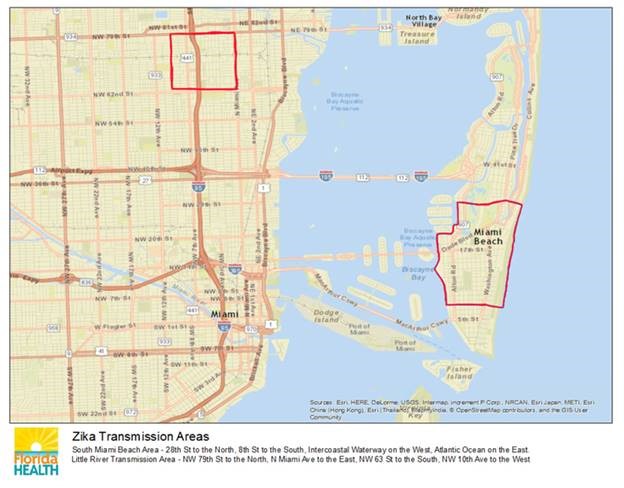
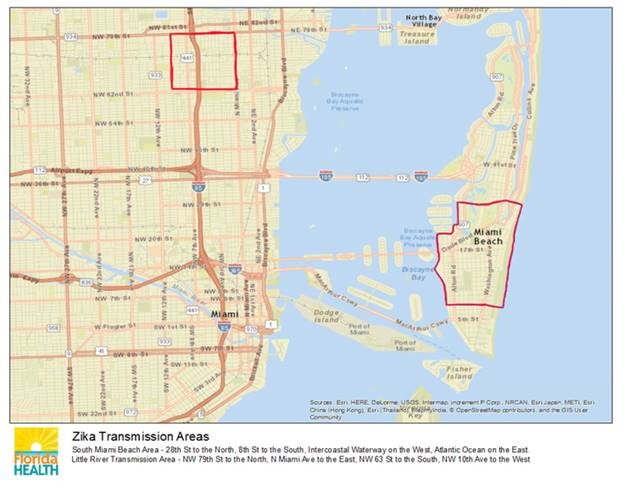
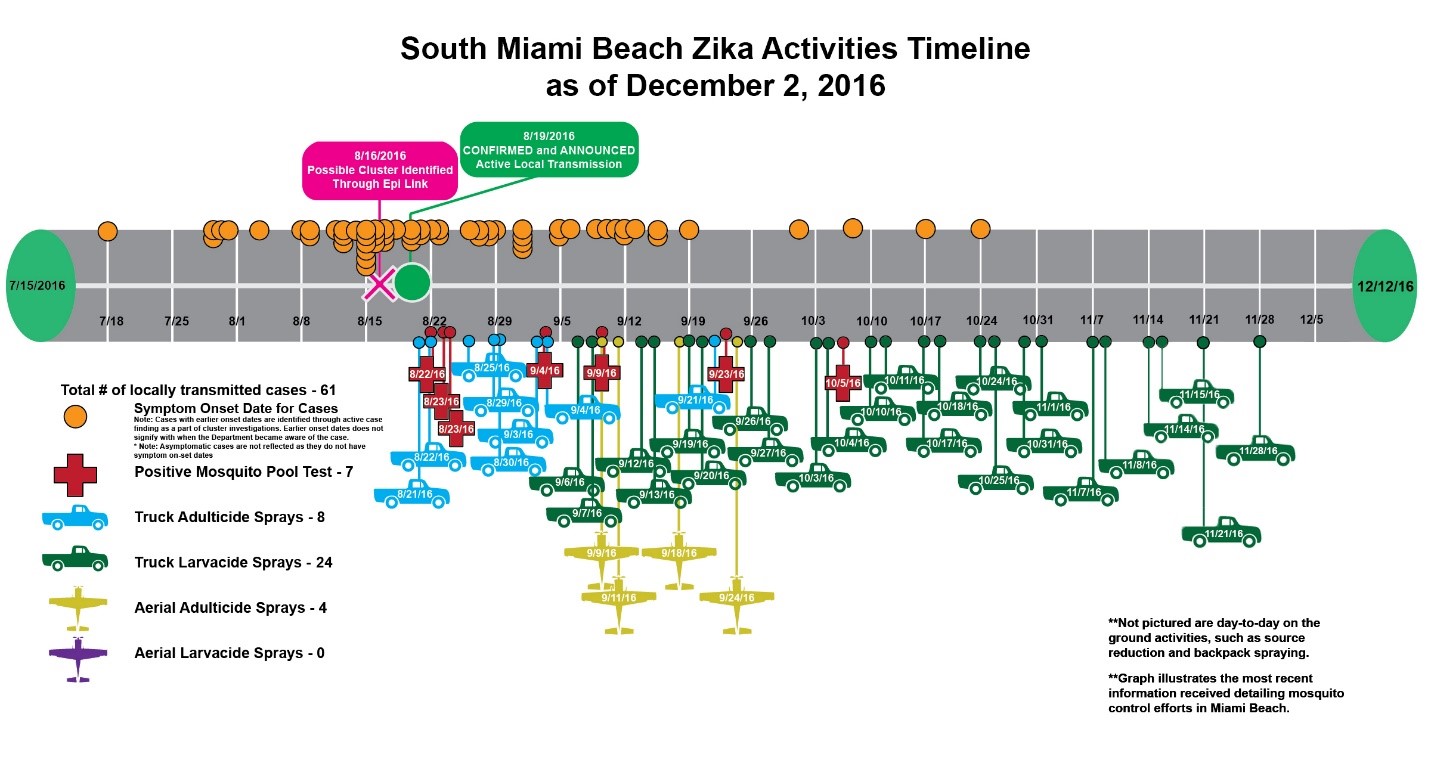
[FONT=&quot]DOH continues outreach and targeted testing in Miami-Dade County and mosquito abatement and reduction activities are also taking place around the locations that are being investigated. DOH believes ongoing transmission is only taking place within the identified area in Miami Beach and Little River in Miami-Dade County, see maps below.[/FONT]
[FONT=&quot]One case does not mean ongoing active transmission is taking place. DOH conducts a thorough investigation by sampling close contacts and community members around each case to determine if additional people are infected. If DOH finds evidence that active transmission is occurring in an area, the media and the public will be notified.[/FONT]
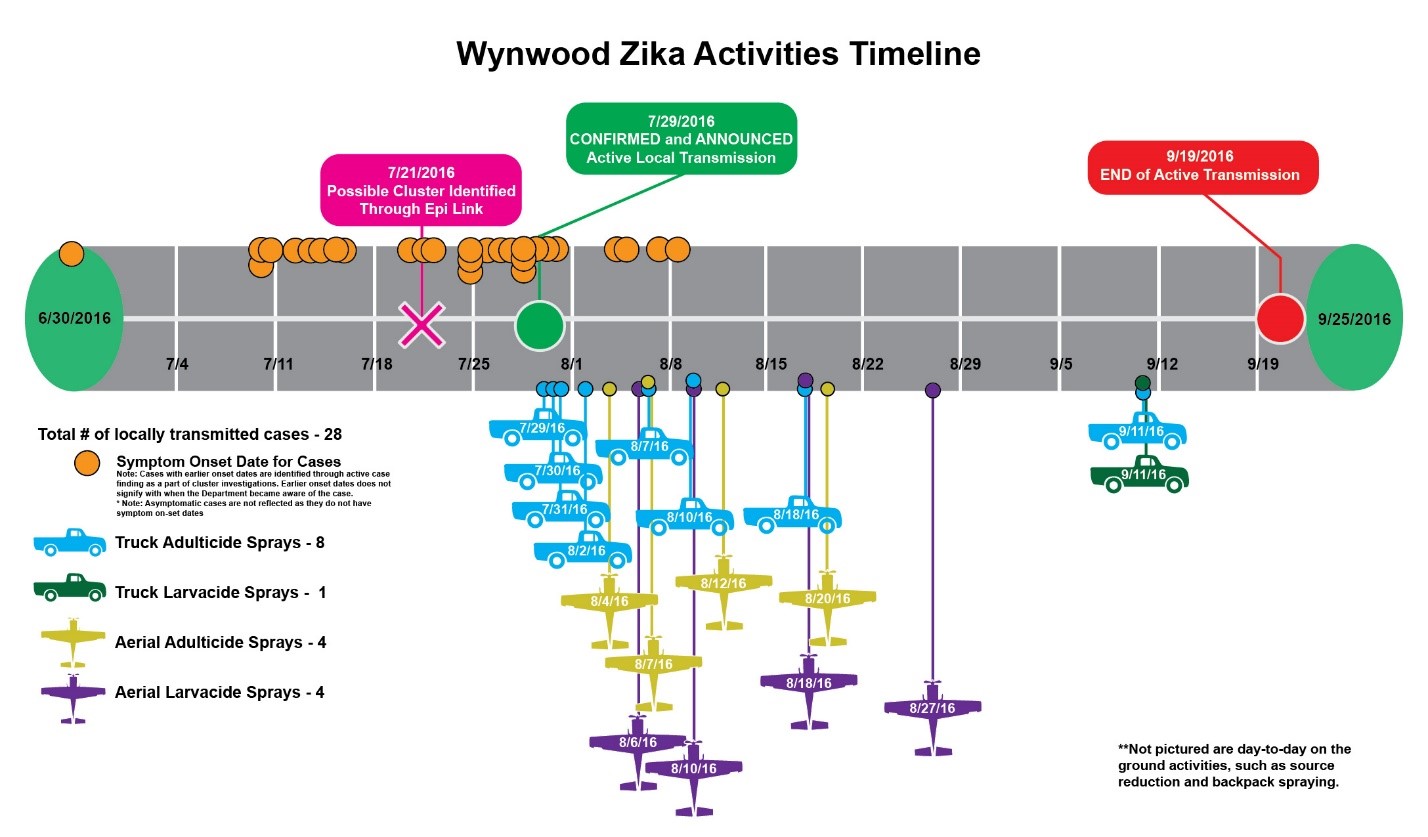
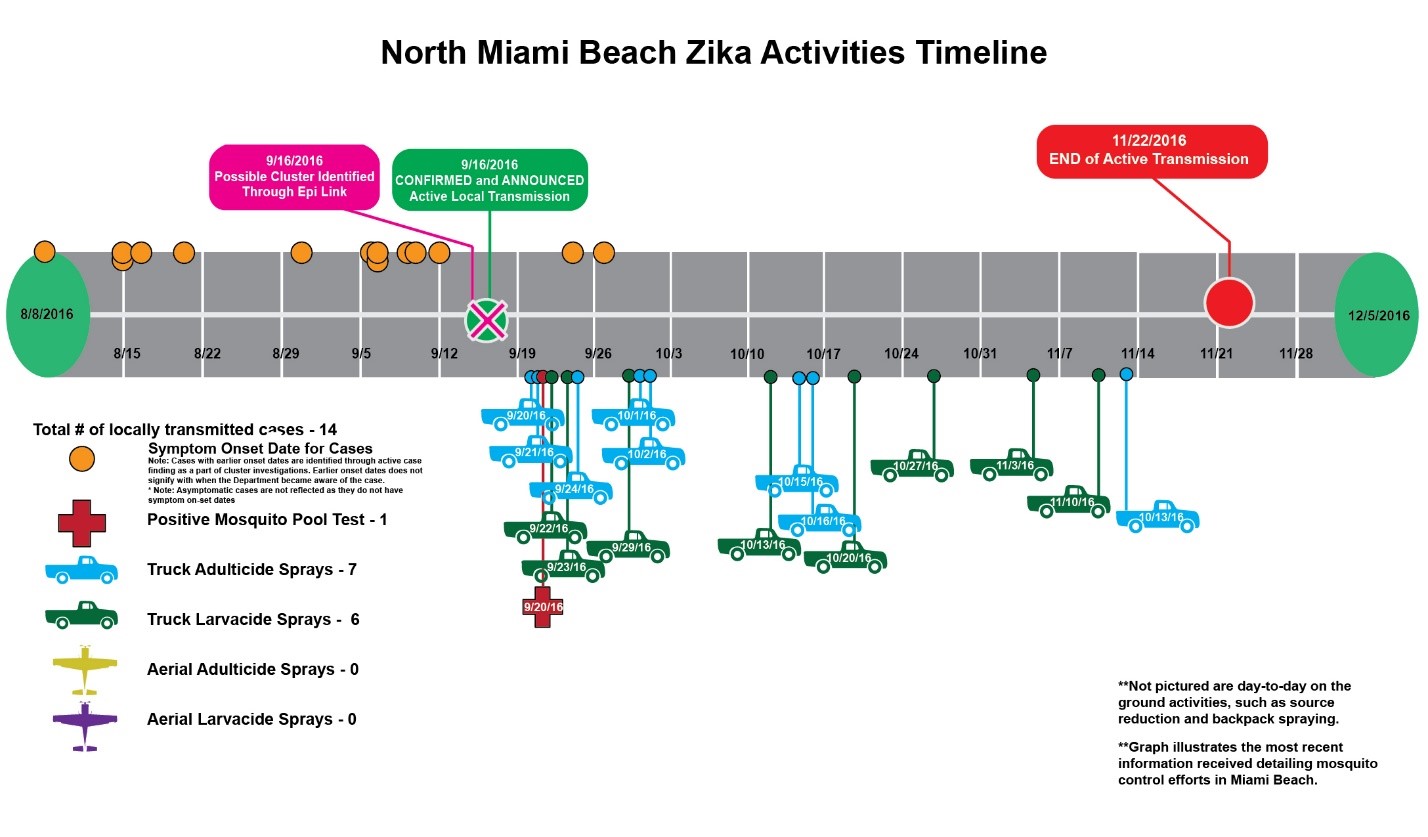
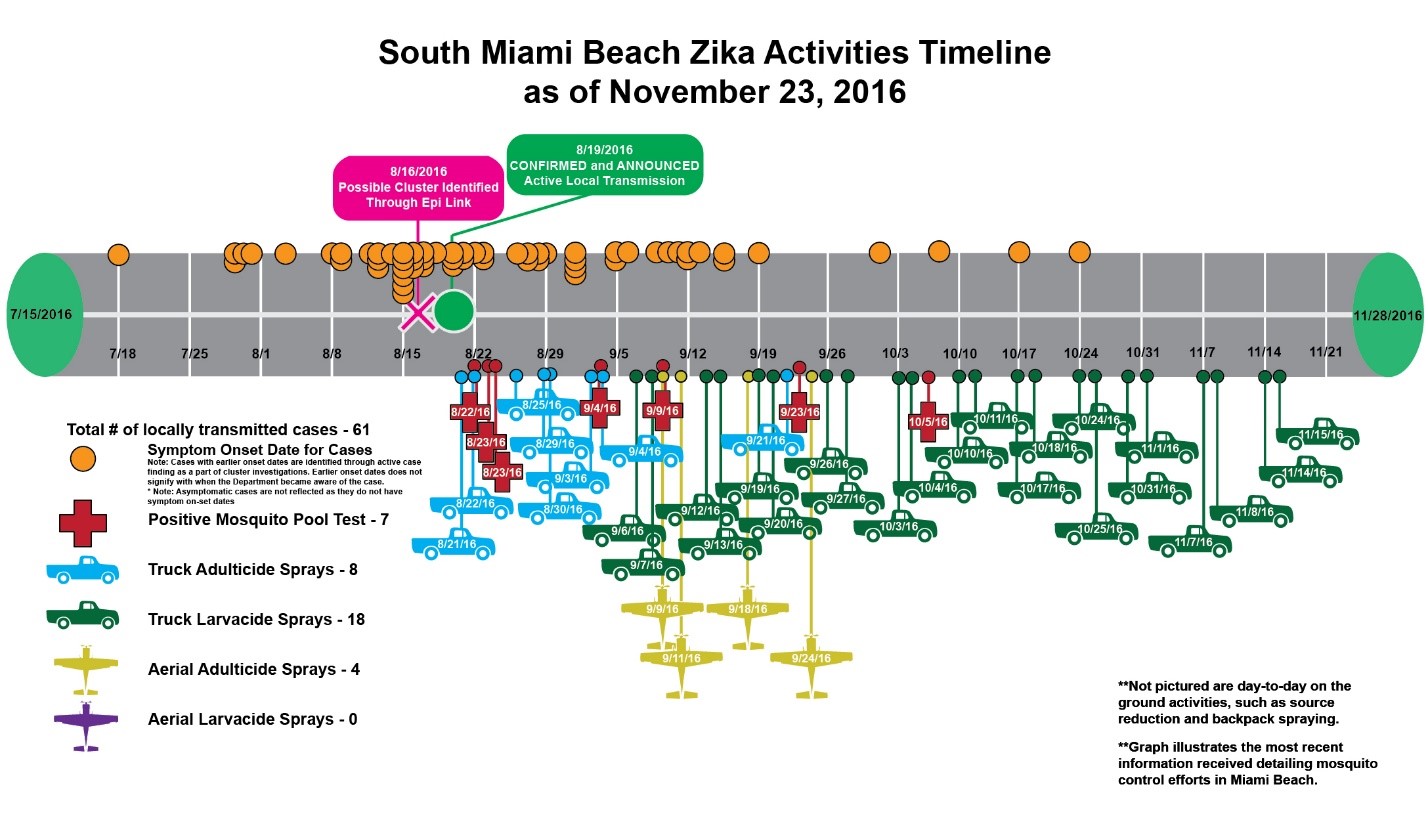
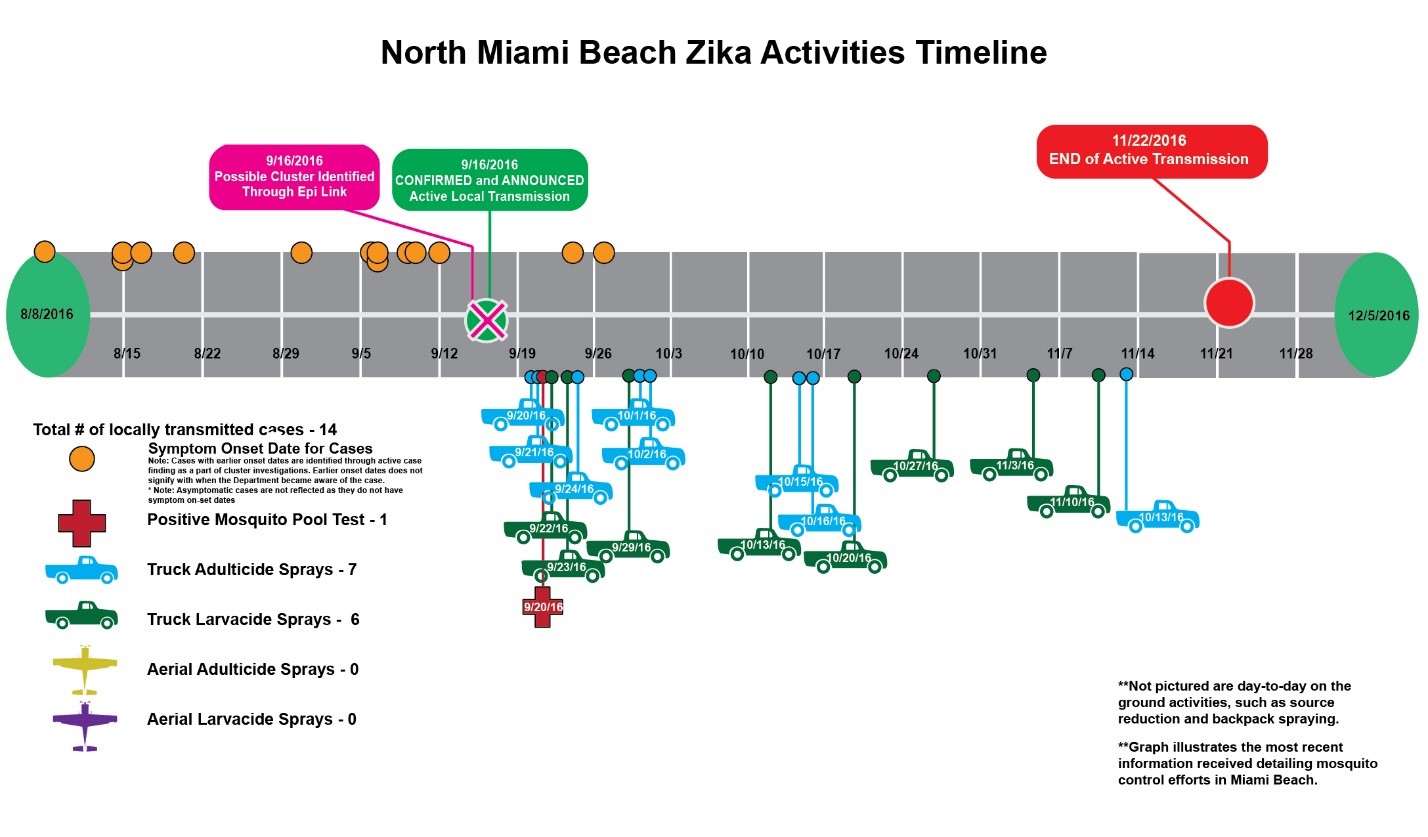
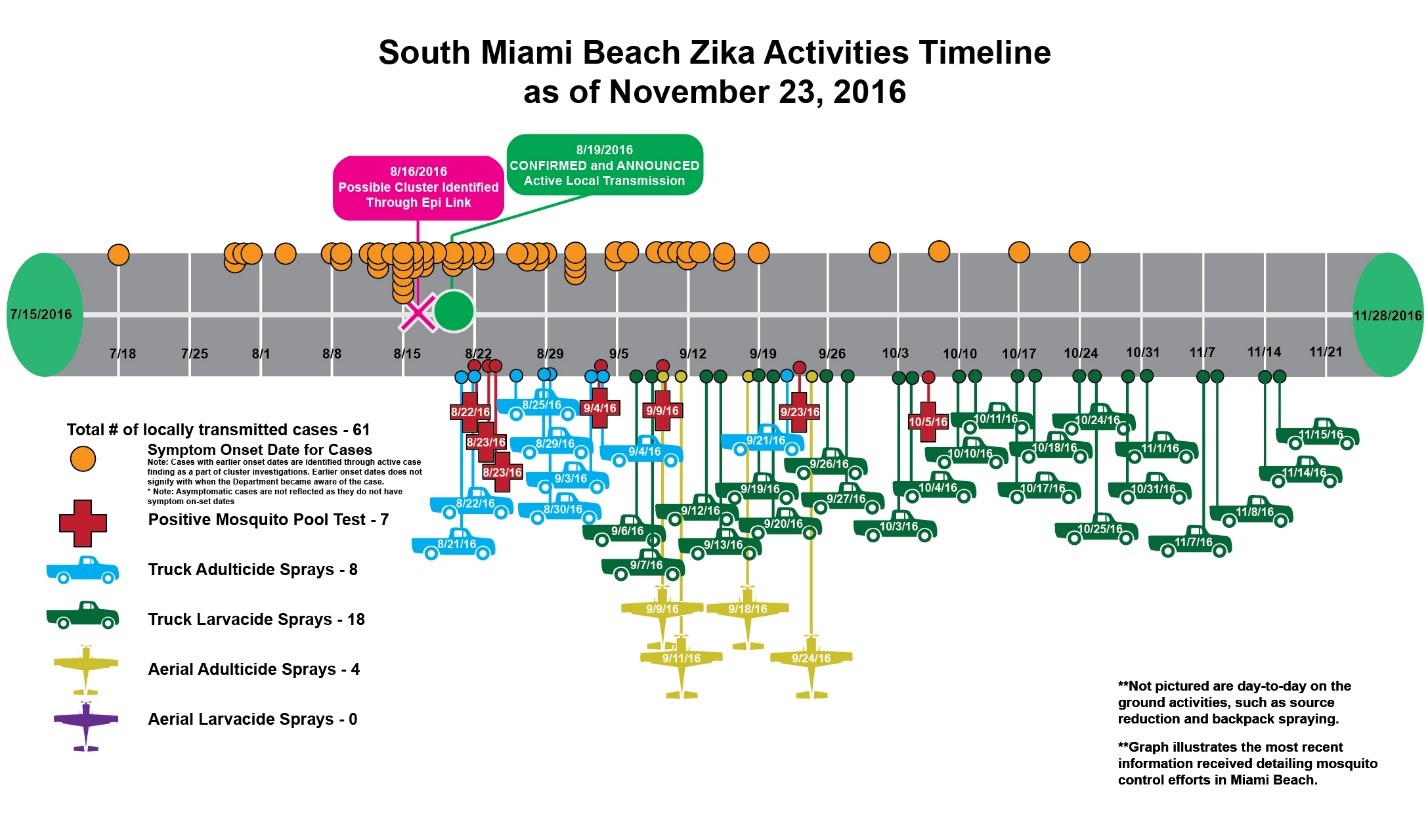
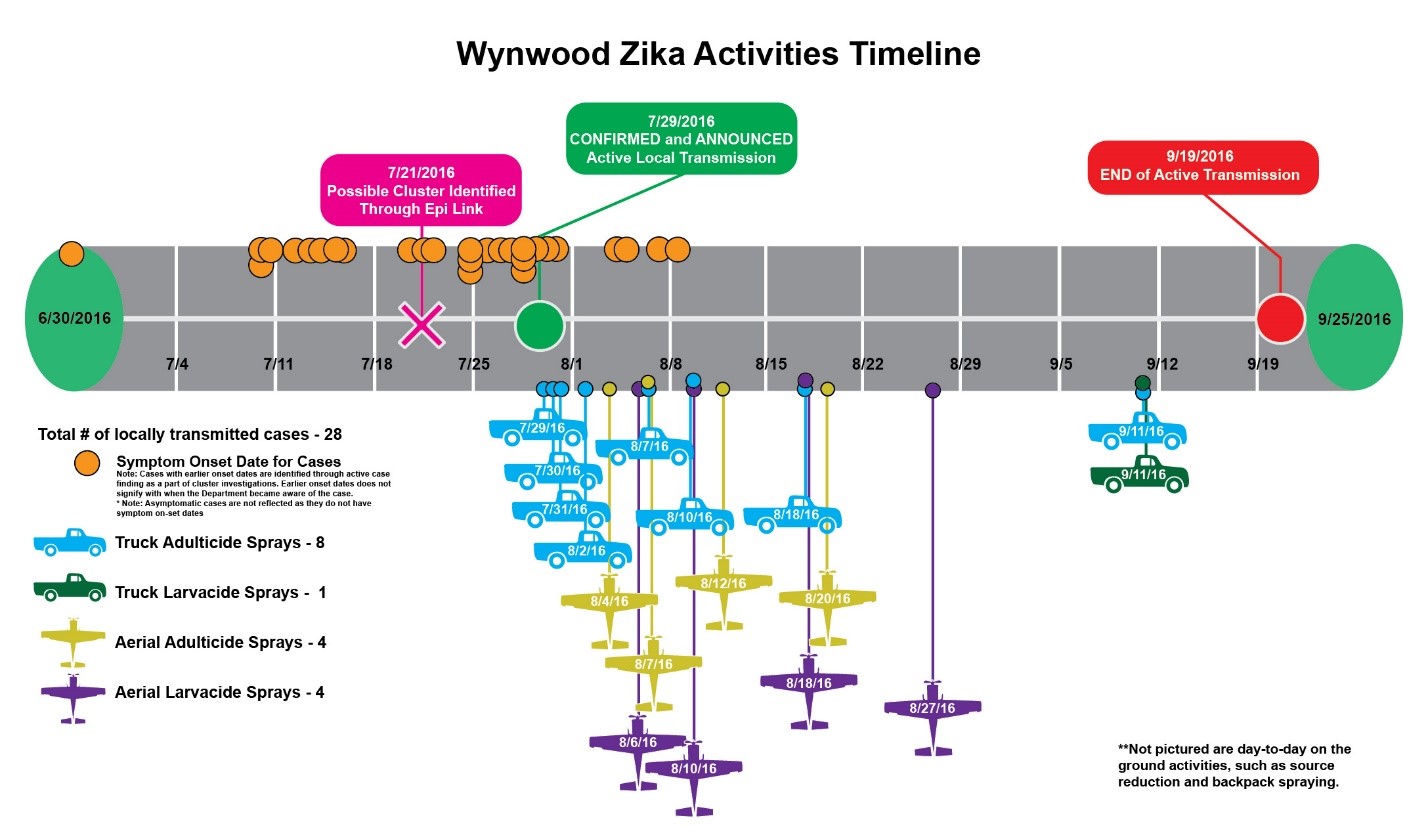
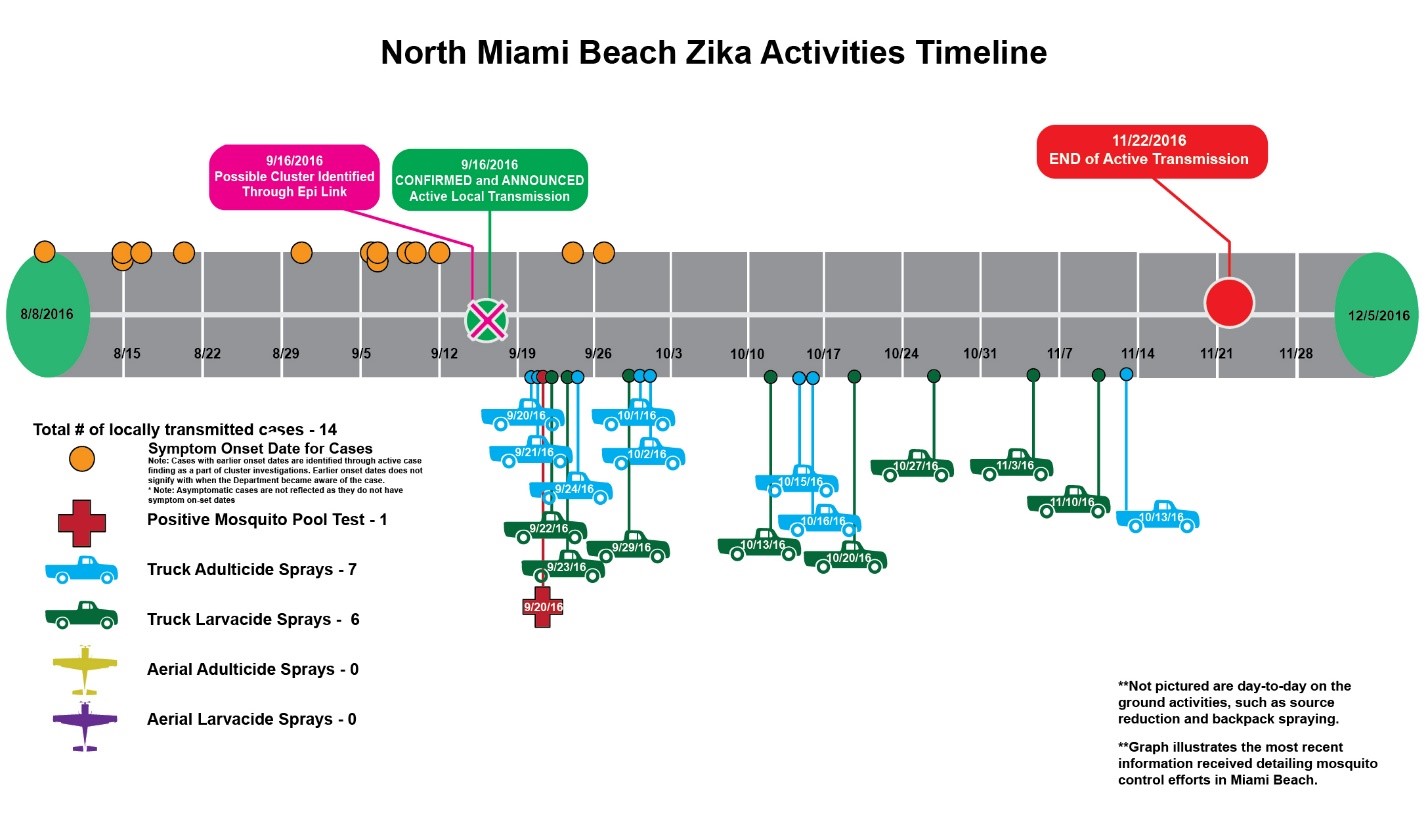
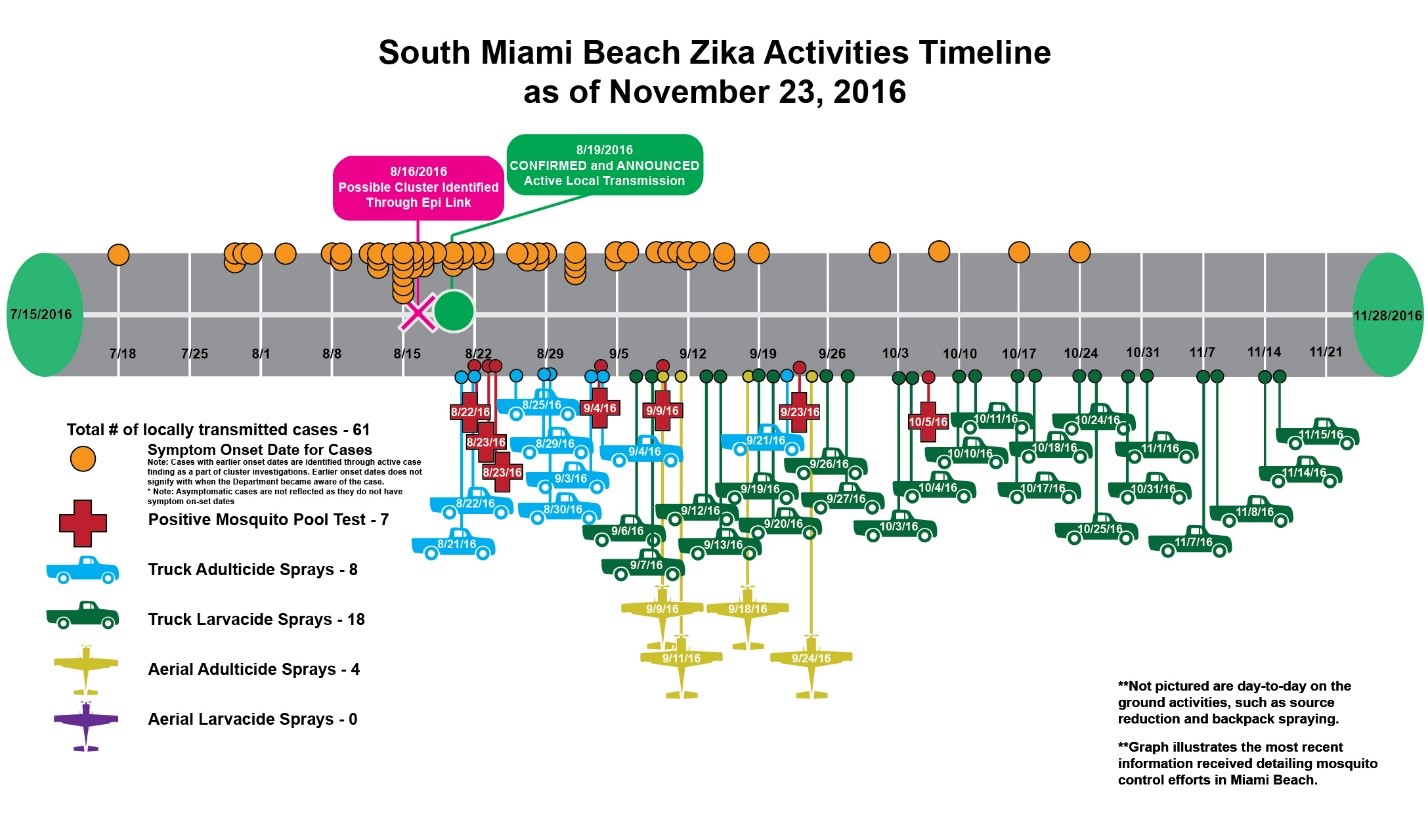
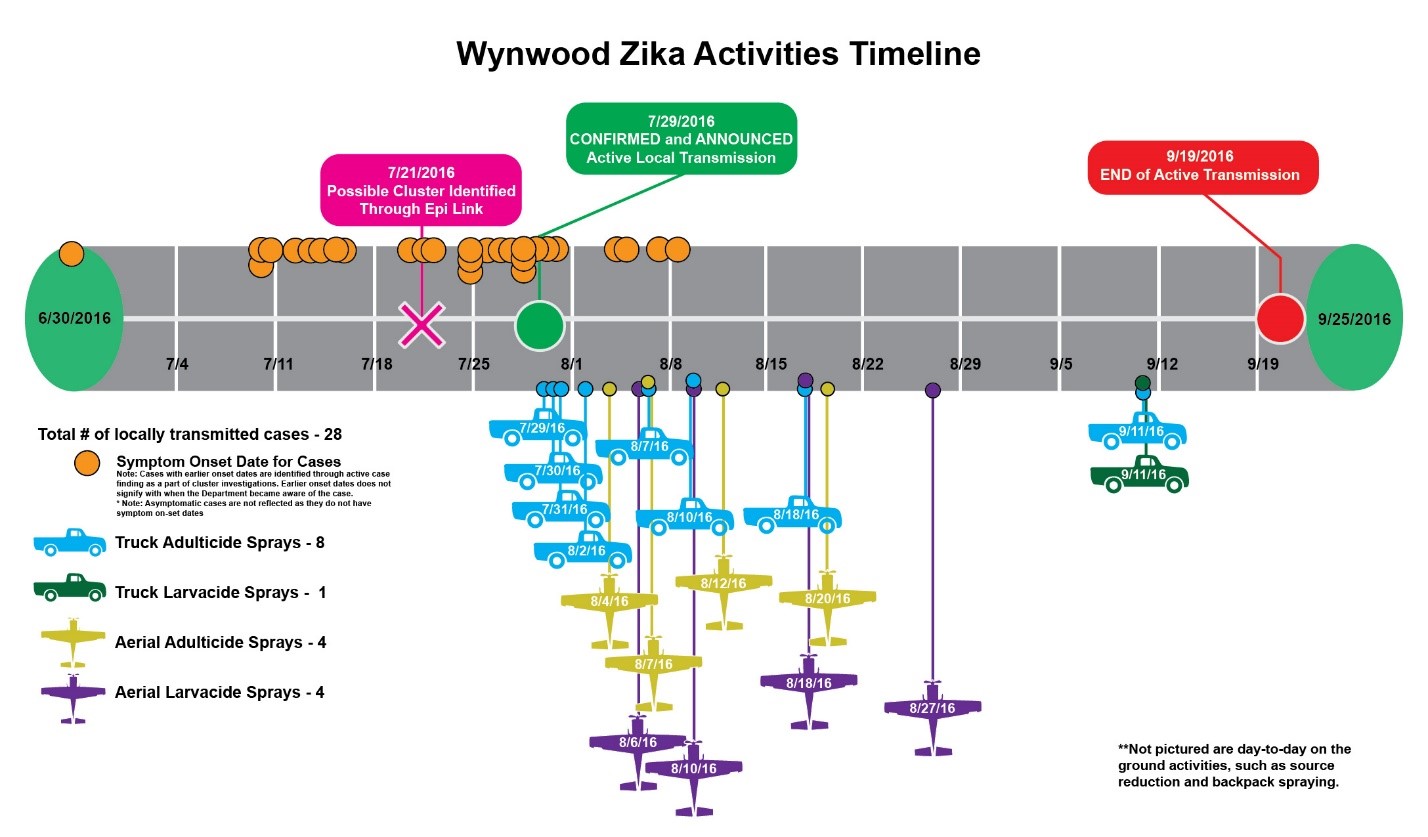
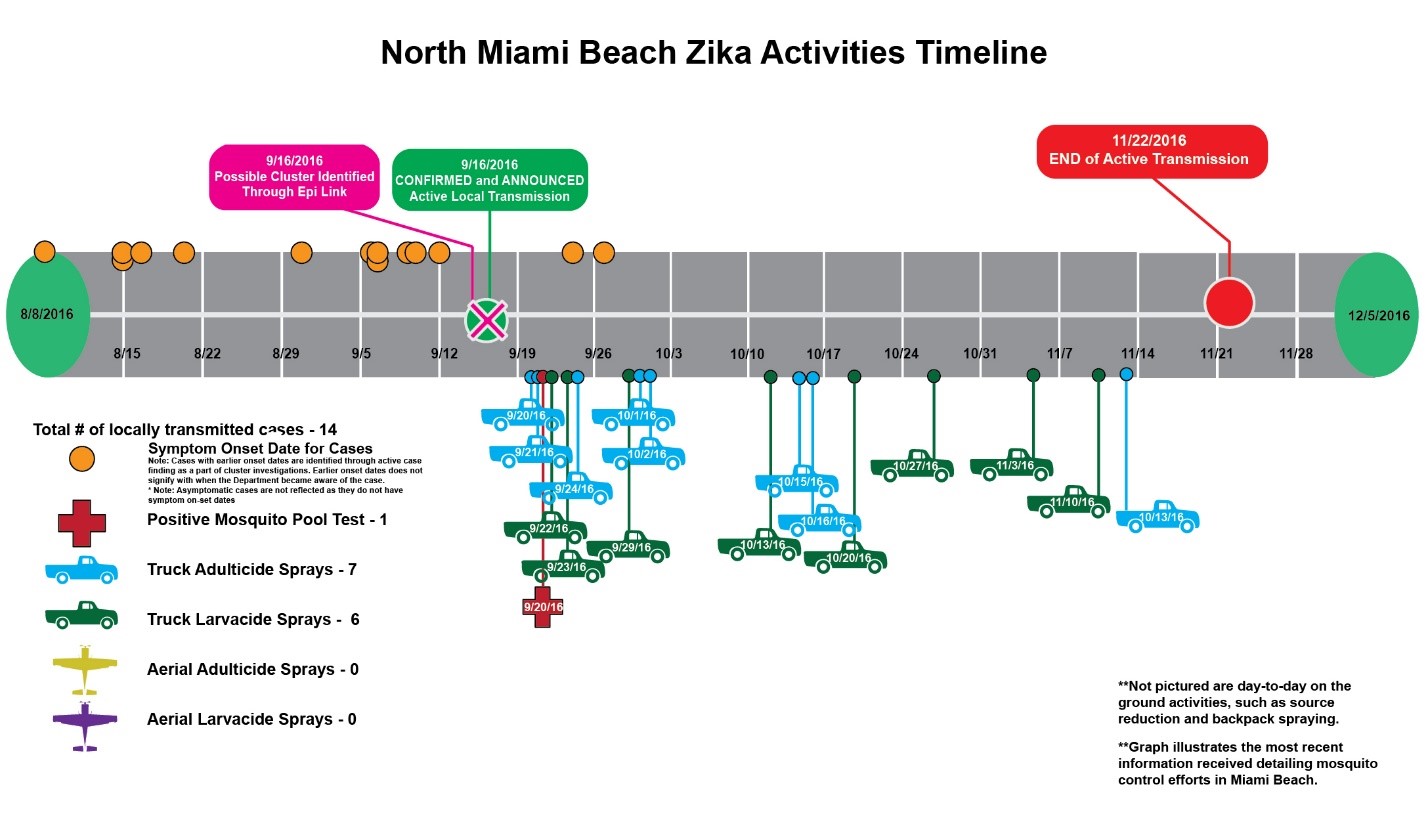
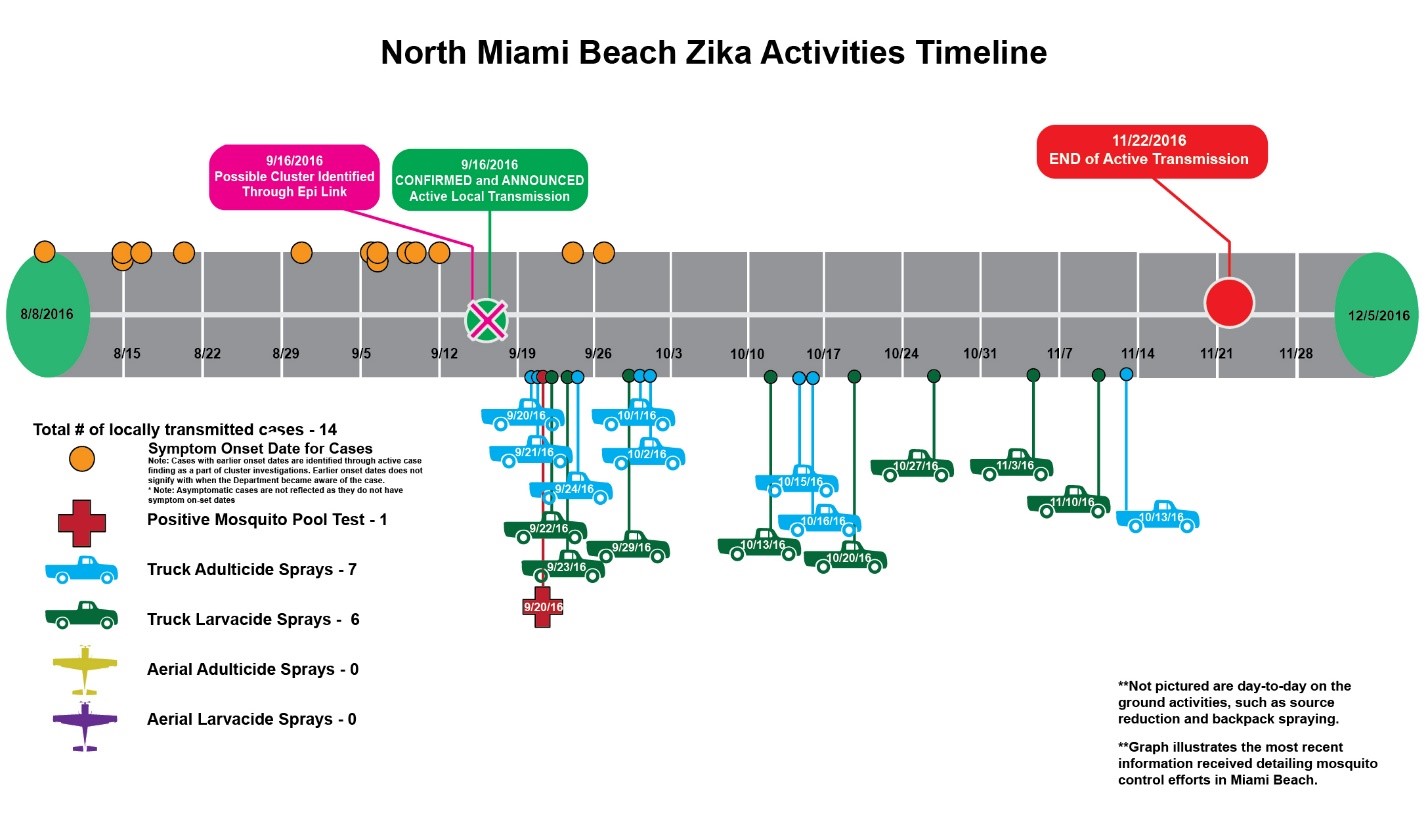
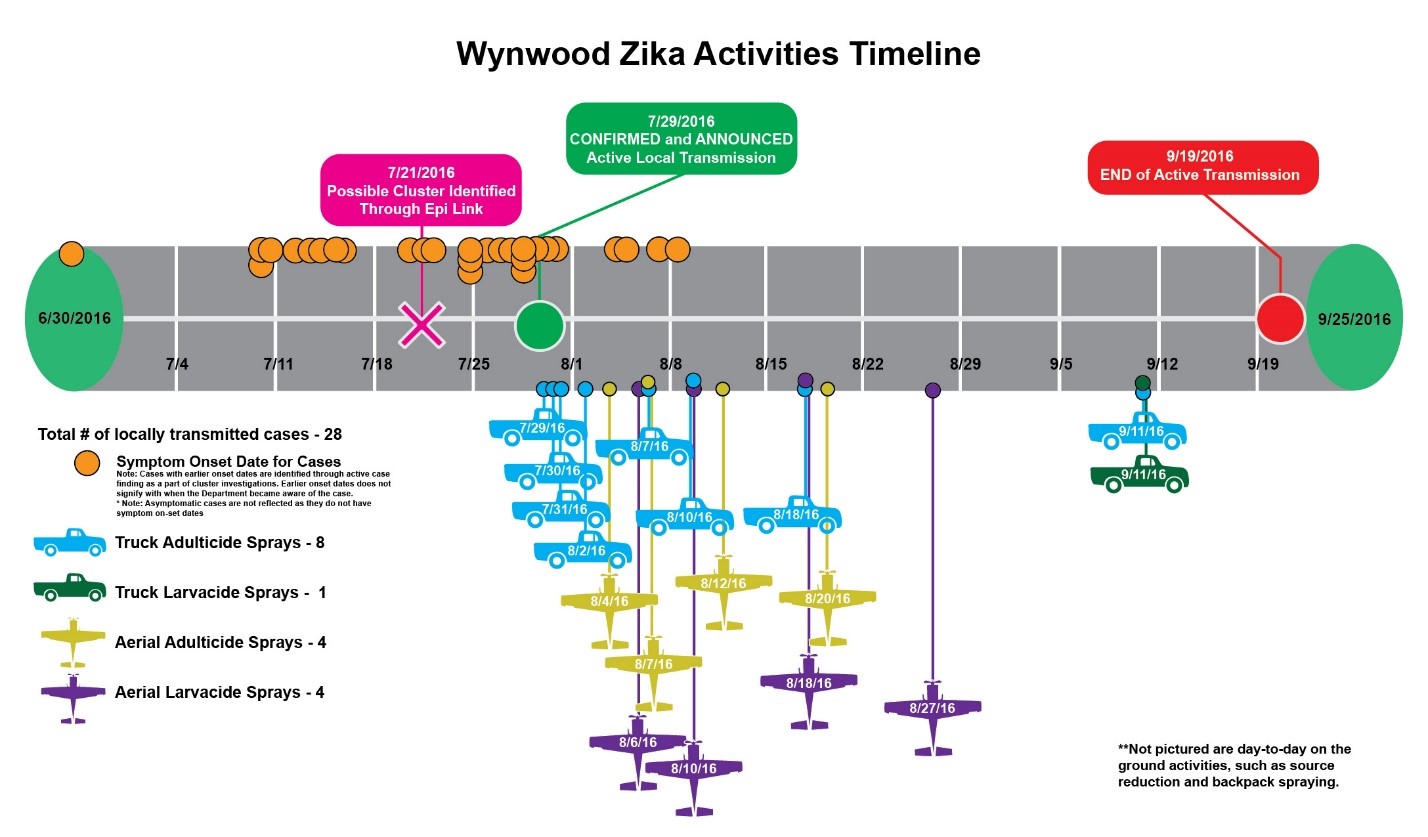
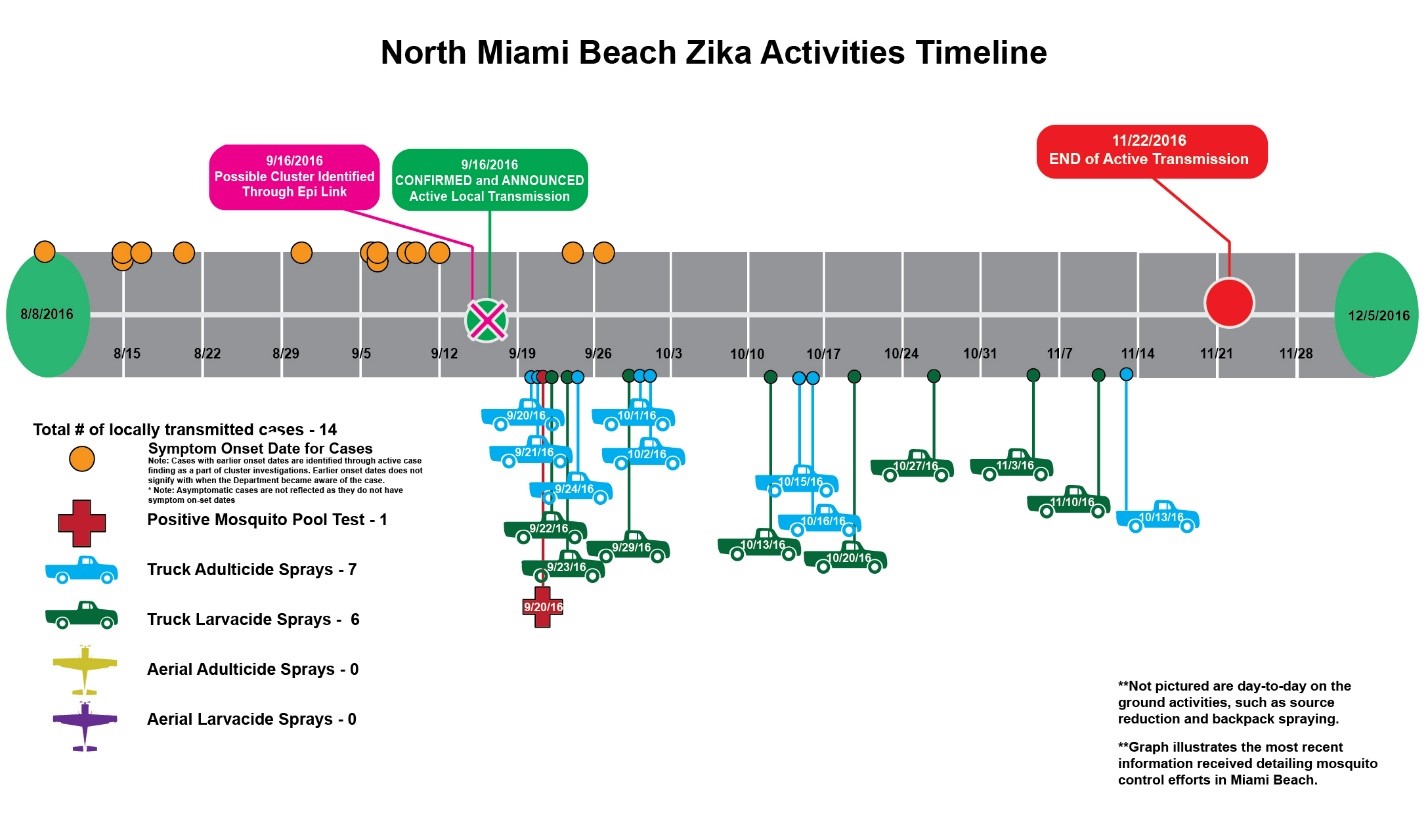
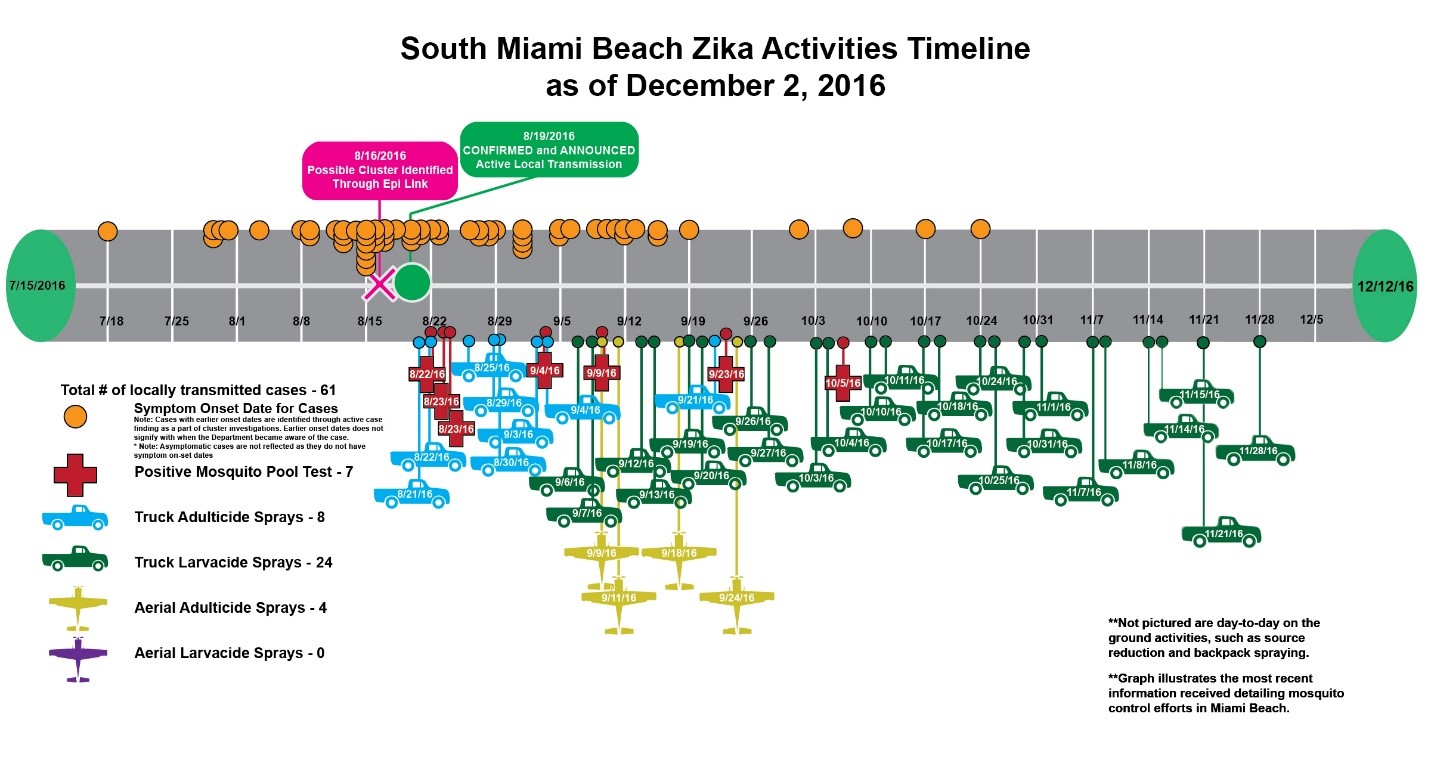
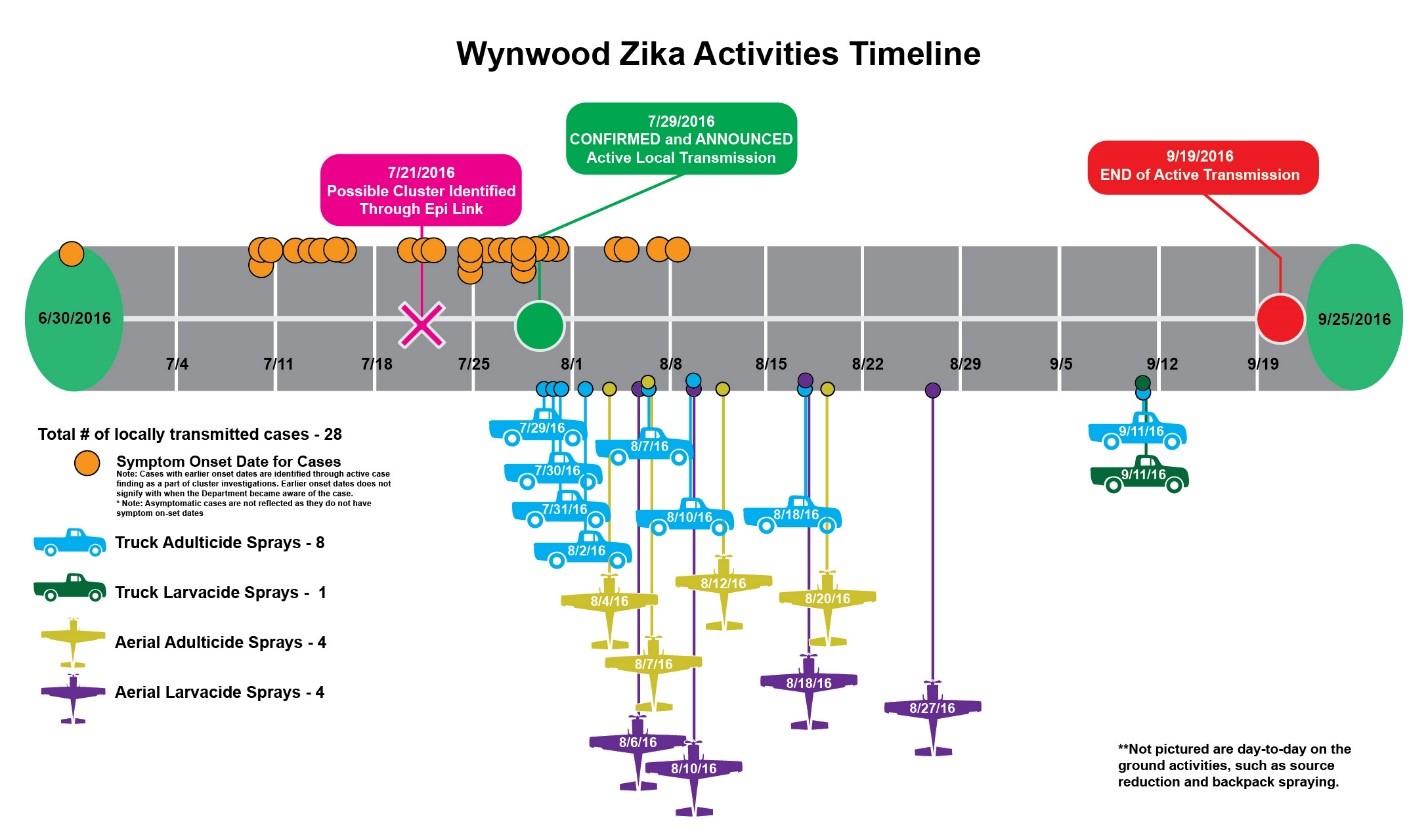
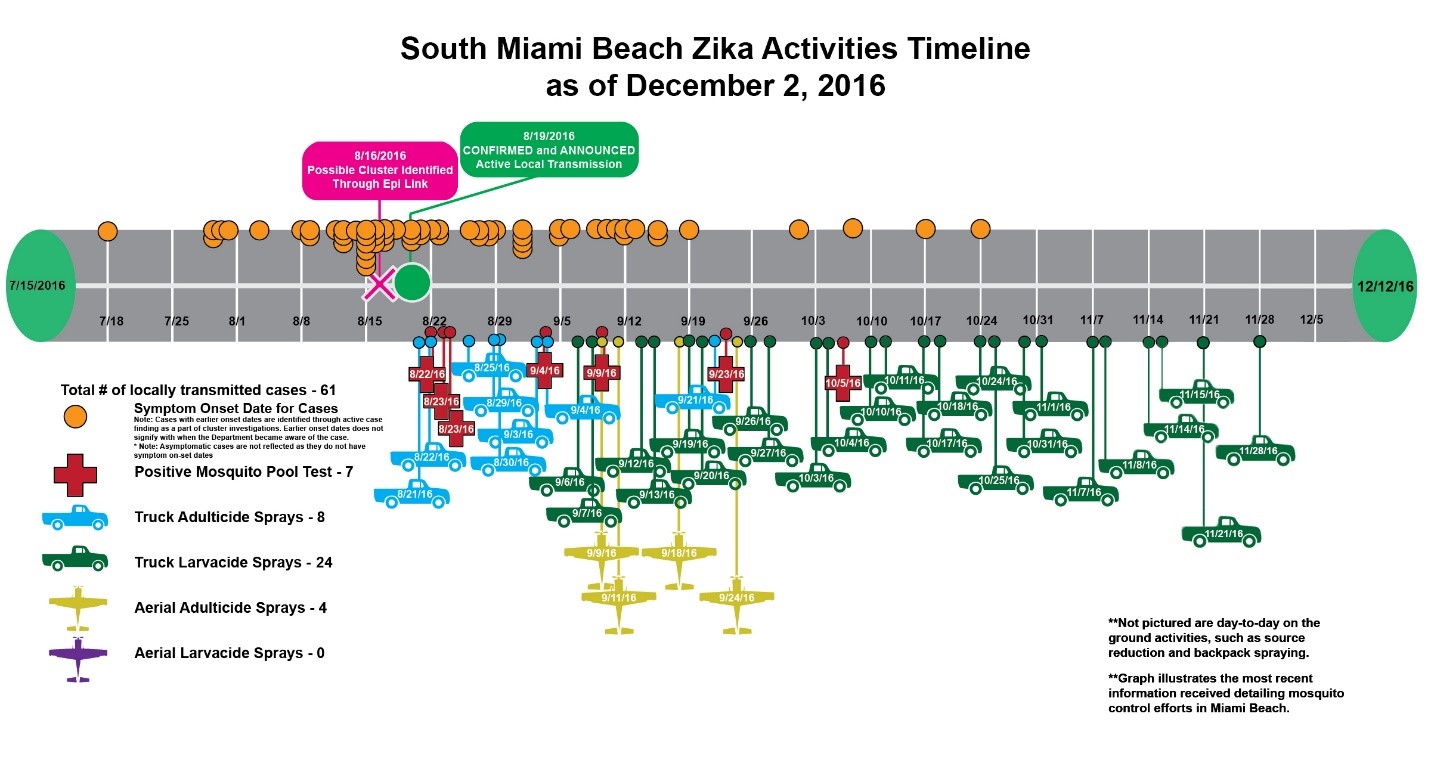
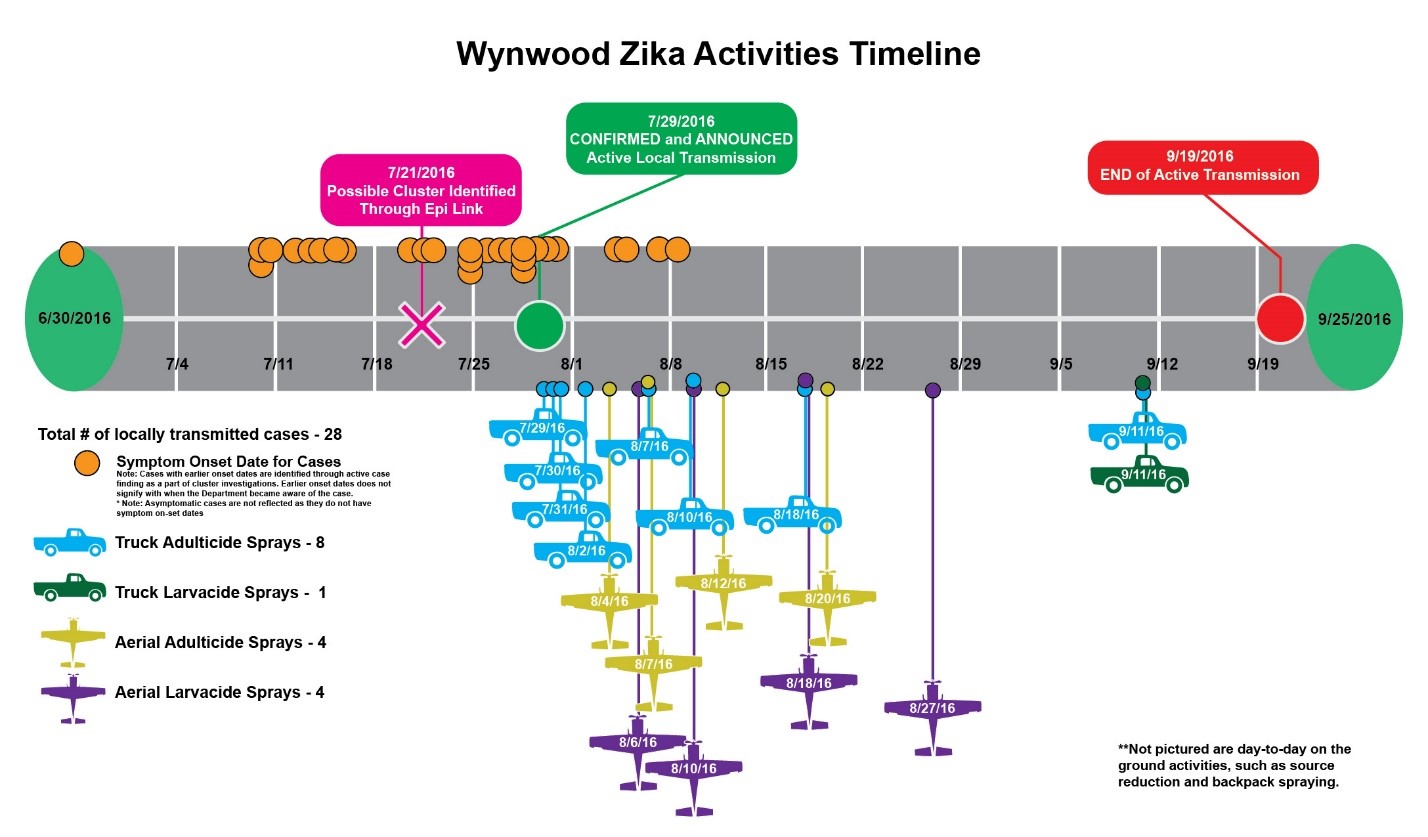
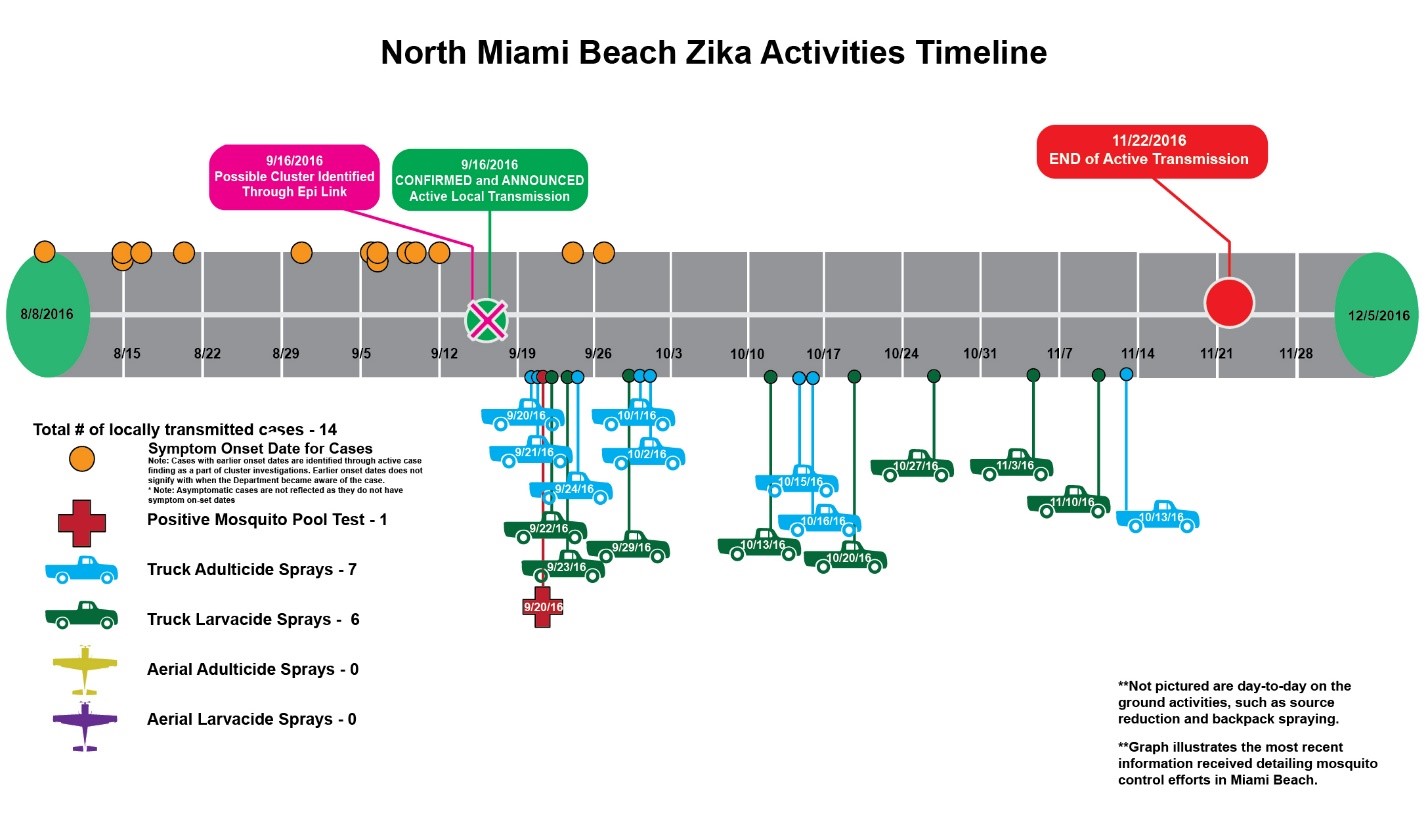
[FONT=&quot]The timelines below are as of Nov. 23. Note: asymptomatic cases are not reflected as they do not have symptom on-set dates.[/FONT]
[FONT=&quot]click image above to enlarge[/FONT]
[FONT=&quot]click image above to enlarge[/FONT]
[FONT=&quot]click image above to enlarge[/FONT]
[FONT=&quot]The department is currently conducting 14 active investigations. The department has closed 38 investigations. Information regarding the investigations can be found here. If investigations reveal additional areas of active transmission, the department will announce a defined area of concern. [/FONT]
[FONT=&quot]The department has conducted Zika virus testing for more than 10,585 people statewide. Florida currently has the capacity to test 5,913 people for active Zika virus and 5,114 for Zika antibodies. At Governor Scott?s direction, all county health departments now offer free Zika risk assessment and testing to pregnant women.[/FONT]
[FONT=&quot]Florida?s small case cluster is not considered widespread transmission, however, pregnant women are advised to avoid non-essential travel to the impacted area in Miami-Dade County (see map below). If you are pregnant and must travel or if you live or work in the impacted area, protect yourself from mosquito bites by wearing insect repellent, long clothing and limiting your time outdoors. [/FONT]
[FONT=&quot]According to CDC guidance, providers should test all pregnant women who lived in, traveled to or whose partner traveled to Miami-Dade County after Aug. 1, 2016. It is also recommended that all pregnant women who reside in or travel frequently to the area where active transmission is likely occurring be tested for Zika in the first and second trimester. Pregnant women in the identified area can contact their medical provider or their local county health department to be tested and receive a Zika prevention kit. CDC recommends that a pregnant woman with a history of Zika virus and her provider should consider additional ultrasounds. Additionally, the department is working closely with the Healthy Start Coalition of Miami-Dade County to identify pregnant women in the impacted areas to ensure they have access to resources and information to protect themselves. CDC recommends that a pregnant woman with a history of Zika virus and her provider should consider additional ultrasounds. [/FONT]
[FONT=&quot]Pregnant women can contact their local county health department for Zika risk assessment and testing hours and information. A Zika risk assessment will be conducted by county health department staff and blood and/or urine samples may be collected and sent to labs for testing. It may take one to two weeks to receive results.[/FONT]
[FONT=&quot]Florida has been monitoring pregnant women with evidence of Zika regardless of symptoms. The total number of pregnant women who have been or are being monitored is 173.[/FONT]
[FONT=&quot]On Feb. 12, Governor Scott directed the State Surgeon General to activate a Zika Virus Information Hotline for current Florida residents and visitors, as well as anyone planning on traveling to Florida in the near future. The hotline, managed by the Department of Health, has assisted 7,681 callers since it launched. The number for the Zika Virus Information Hotline is 1-855-622-6735.[/FONT]
[FONT=&quot]The department urges Floridians to drain standing water weekly, no matter how seemingly small. A couple drops of water in a bottle cap can be a breeding location for mosquitoes. Residents and visitors also need to use repellents when enjoying the Florida outdoors.[/FONT]
[FONT=&quot]For more information on DOH action and federal guidance, please click here.[/FONT]
[FONT=&quot]For resources and information on Zika virus, click here.[/FONT]
[FONT=&quot]click image above to enlarge[/FONT]
[FONT=&quot]click image above to enlarge

http://www.floridahealth.gov/newsroom/2016/11/112916-zika-update.html
[/FONT]
 
[FONT=&quot]November 30, 2016[/FONT]
[h=2]Department of Health Daily Zika Update[/h] [FONT=&quot]Contact:
Communications Office
NewsMedia@flhealth.gov
(850) 245-4111
[/FONT]

[FONT=&quot]Tallahassee, Fla.?In an effort to keep Florida residents and visitors safe and aware about the status of the Zika virus, the department will issue a Zika virus update each week day. Updates will include a Zika case count by county and information to keep Floridians informed and prepared. In order to keep the public informed, the department has posted our investigation process here.[/FONT]
[FONT=&quot]There are two new travel-related cases today with one in Osceola and one in Orange.[/FONT]
[FONT=&quot]There are four new locally acquired cases today. All four involve Miami-Dade County residents and the department is investigating to determine where exposure occurred.[/FONT]
[FONT=&quot]The total number of Zika cases reported in Florida as of today is 1,219.[/FONT]
[TABLE="border: 1, cellpadding: 0, cellspacing: 0"]
[TR]
[TD="width: 318"] Infection Type
[/TD]
[TD="width: 306"] Infection Count
[/TD]
[/TR]
[TR]
[TD="width: 318"] Travel-Related Infections of Zika
[/TD]
[TD="width: 306"] 960
[/TD]
[/TR]
[TR]
[TD="width: 318"] Locally Acquired Infections of Zika
[/TD]
[TD="width: 306"] 244
[/TD]
[/TR]
[TR]
[TD="width: 318"] Undetermined
[/TD]
[TD="width: 306"] 15
[/TD]
[/TR]
[TR]
[TD="width: 623, colspan: 2"]
[/TD]
[/TR]
[TR]
[TD="width: 318"] Pregnant Women with Lab-Evidence of Zika
[/TD]
[TD="width: 306"] 173
[/TD]
[/TR]
[/TABLE]
[FONT=&quot]Note, these categories are not mutually exclusive and cannot be added together. Please visit our website to see the full list of travel-related cases by county.[/FONT]
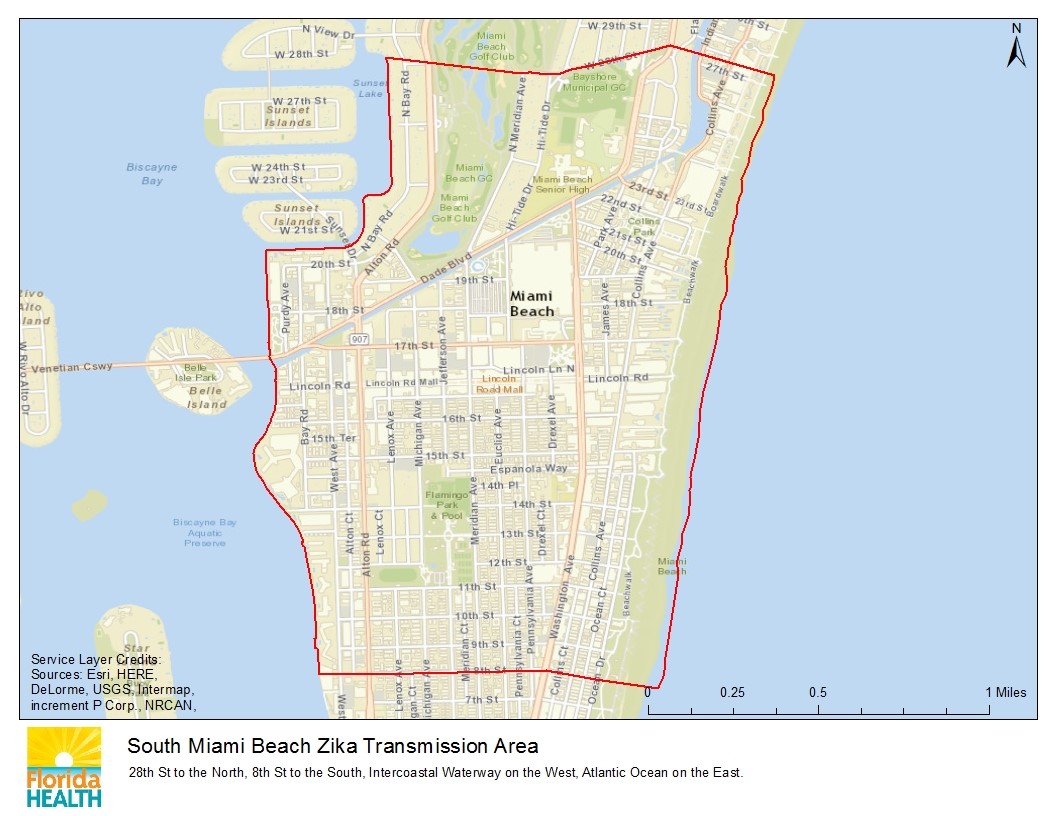
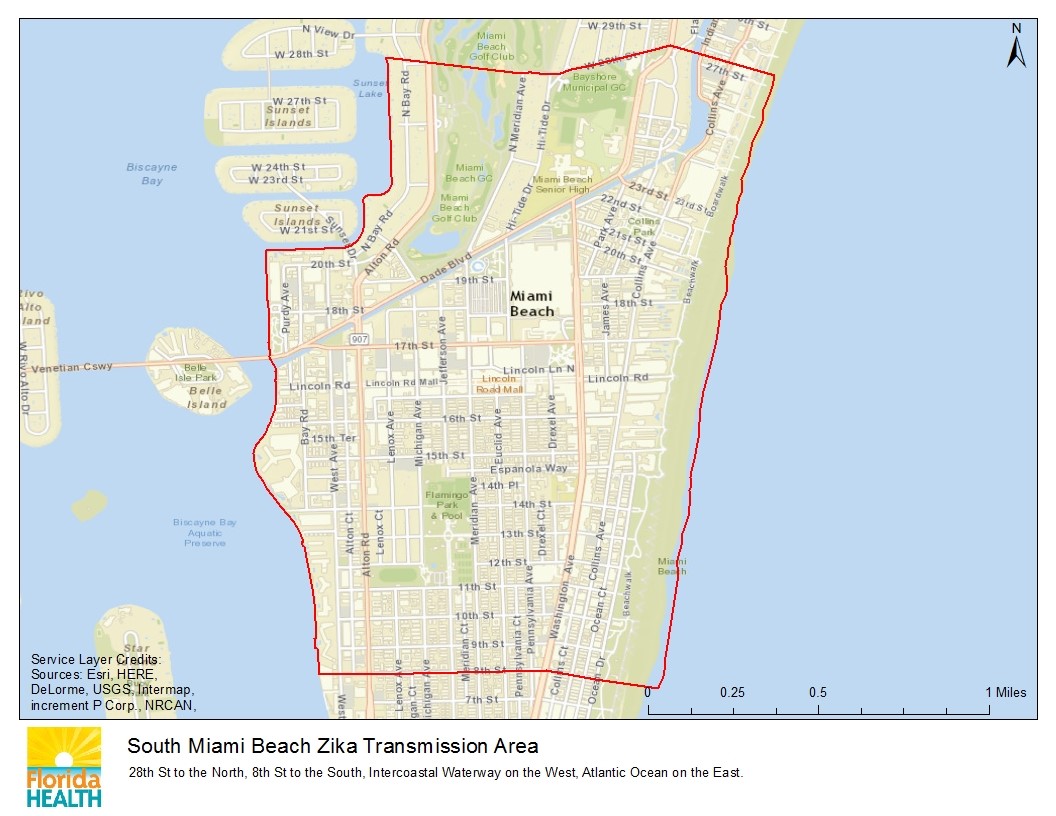
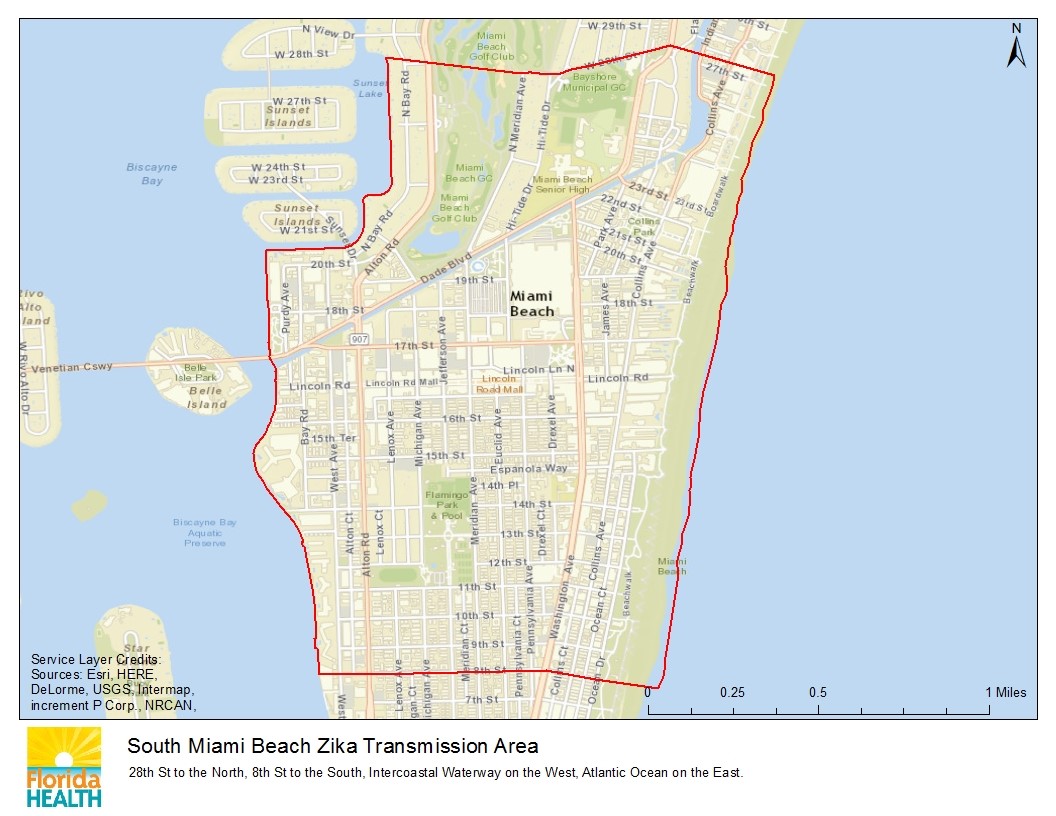
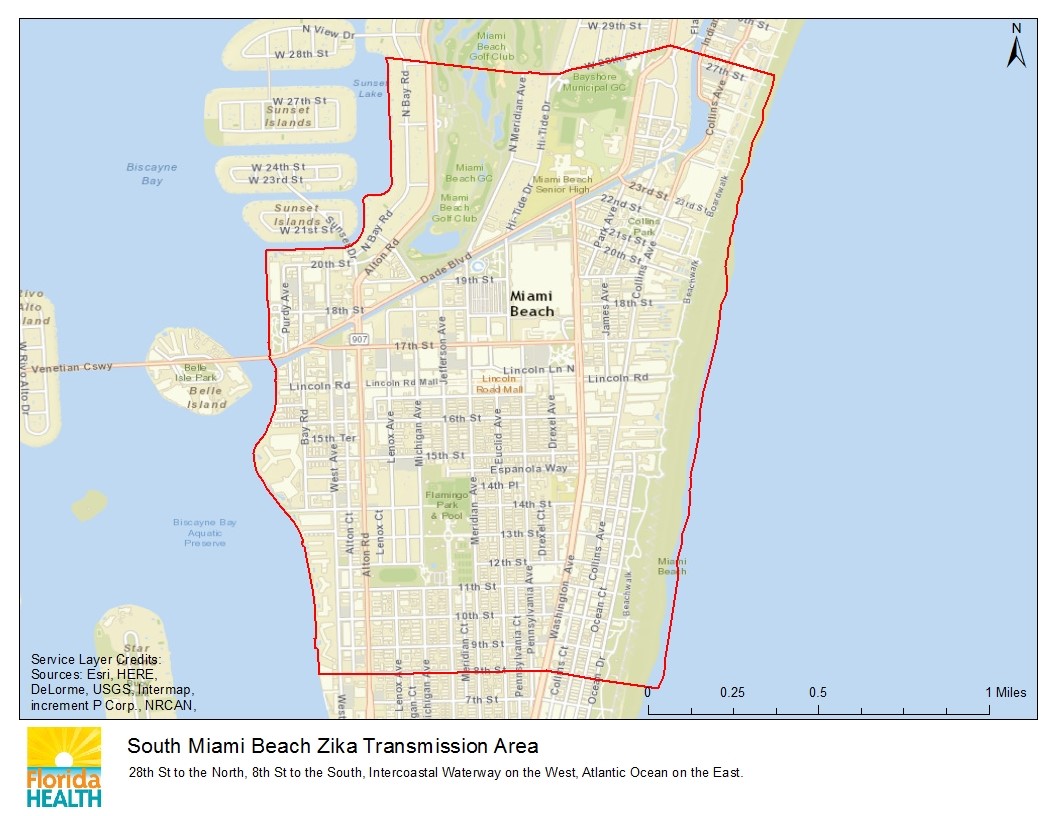
[FONT=&quot]Recently, Governor Rick Scott announced that the department had not detected any additional local transmissions of Zika in the north portion of Miami Beach in more than 45 days. That portion of the zone has been lifted. The lifted area is about three miles, from 28th street to 63rd street. The remaining area of active Zika transmission in Miami Beach is about 1.5 square miles between 8th and 28th streets. The remaining area of active Zika transmission in Little River is about one square mile.[/FONT]
[FONT=&quot]DOH continues outreach and targeted testing in Miami-Dade County and mosquito abatement and reduction activities are also taking place around the locations that are being investigated. DOH believes ongoing transmission is only taking place within the identified area in Miami Beach and Little River in Miami-Dade County, see maps below.[/FONT]
[FONT=&quot]One case does not mean ongoing active transmission is taking place. DOH conducts a thorough investigation by sampling close contacts and community members around each case to determine if additional people are infected. If DOH finds evidence that active transmission is occurring in an area, the media and the public will be notified.[/FONT]
[FONT=&quot]The timelines below are as of Nov. 23. Note: asymptomatic cases are not reflected as they do not have symptom on-set dates.[/FONT]
[FONT=&quot]click image above to enlarge[/FONT]
[FONT=&quot]click image above to enlarge[/FONT]
[FONT=&quot]click image above to enlarge[/FONT]
[FONT=&quot]The department is currently conducting 14 active investigations. The department has closed 38 investigations. Information regarding the investigations can be found here. If investigations reveal additional areas of active transmission, the department will announce a defined area of concern. [/FONT]
[FONT=&quot]The department has conducted Zika virus testing for more than 10,620 people statewide. Florida currently has the capacity to test 5,810 people for active Zika virus and 5,055 for Zika antibodies. At Governor Scott?s direction, all county health departments now offer free Zika risk assessment and testing to pregnant women.[/FONT]
[FONT=&quot]Florida?s small case cluster is not considered widespread transmission, however, pregnant women are advised to avoid non-essential travel to the impacted area in Miami-Dade County (see map below). If you are pregnant and must travel or if you live or work in the impacted area, protect yourself from mosquito bites by wearing insect repellent, long clothing and limiting your time outdoors. [/FONT]
[FONT=&quot]According to CDC guidance, providers should test all pregnant women who lived in, traveled to or whose partner traveled to Miami-Dade County after Aug. 1, 2016. It is also recommended that all pregnant women who reside in or travel frequently to the area where active transmission is likely occurring be tested for Zika in the first and second trimester. Pregnant women in the identified area can contact their medical provider or their local county health department to be tested and receive a Zika prevention kit. CDC recommends that a pregnant woman with a history of Zika virus and her provider should consider additional ultrasounds. Additionally, the department is working closely with the Healthy Start Coalition of Miami-Dade County to identify pregnant women in the impacted areas to ensure they have access to resources and information to protect themselves. CDC recommends that a pregnant woman with a history of Zika virus and her provider should consider additional ultrasounds. [/FONT]
[FONT=&quot]Pregnant women can contact their local county health department for Zika risk assessment and testing hours and information. A Zika risk assessment will be conducted by county health department staff and blood and/or urine samples may be collected and sent to labs for testing. It may take one to two weeks to receive results.[/FONT]
[FONT=&quot]Florida has been monitoring pregnant women with evidence of Zika regardless of symptoms. The total number of pregnant women who have been or are being monitored is 173.[/FONT]
[FONT=&quot]On Feb. 12, Governor Scott directed the State Surgeon General to activate a Zika Virus Information Hotline for current Florida residents and visitors, as well as anyone planning on traveling to Florida in the near future. The hotline, managed by the Department of Health, has assisted 7,743 callers since it launched. The number for the Zika Virus Information Hotline is 1-855-622-6735.[/FONT]
[FONT=&quot]The department urges Floridians to drain standing water weekly, no matter how seemingly small. A couple drops of water in a bottle cap can be a breeding location for mosquitoes. Residents and visitors also need to use repellents when enjoying the Florida outdoors.[/FONT]
[FONT=&quot]For more information on DOH action and federal guidance, please click here.[/FONT]
[FONT=&quot]For resources and information on Zika virus, click here.[/FONT]
[FONT=&quot]click image above to enlarge[/FONT]
[FONT=&quot]click image above to enlarge

http://www.floridahealth.gov/newsroom/2016/11/113016-zika-update.html
[/FONT]
 
[FONT=&quot]December 1, 2016[/FONT]
[h=2]Department of Health Daily Zika Update[/h] [FONT=&quot]Contact:
Communications Office
NewsMedia@flhealth.gov
(850) 245-4111
[/FONT]

[FONT=&quot]Tallahassee, Fla.?In an effort to keep Florida residents and visitors safe and aware about the status of the Zika virus, the department will issue a Zika virus update each week day. Updates will include a Zika case count by county and information to keep Floridians informed and prepared. In order to keep the public informed, the department has posted our investigation process here.[/FONT]
[FONT=&quot]There is one new travel-related case today in Miami-Dade County.[/FONT]
[FONT=&quot]There no new locally acquired cases today.[/FONT]
[FONT=&quot]The total number of Zika cases reported in Florida as of today is 1,220.[/FONT]
[TABLE="border: 1, cellpadding: 0, cellspacing: 0"]
[TR]
[TD="width: 318"] Infection Type
[/TD]
[TD="width: 306"] Infection Count
[/TD]
[/TR]
[TR]
[TD="width: 318"] Travel-Related Infections of Zika
[/TD]
[TD="width: 306"] 961
[/TD]
[/TR]
[TR]
[TD="width: 318"] Locally Acquired Infections of Zika
[/TD]
[TD="width: 306"] 244
[/TD]
[/TR]
[TR]
[TD="width: 318"] Undetermined
[/TD]
[TD="width: 306"] 15
[/TD]
[/TR]
[TR]
[TD="width: 623, colspan: 2"]
[/TD]
[/TR]
[TR]
[TD="width: 318"] Pregnant Women with Lab-Evidence of Zika
[/TD]
[TD="width: 306"] 173
[/TD]
[/TR]
[/TABLE]
[FONT=&quot]Note, these categories are not mutually exclusive and cannot be added together. Please visit our website to see the full list of travel-related cases by county.[/FONT]
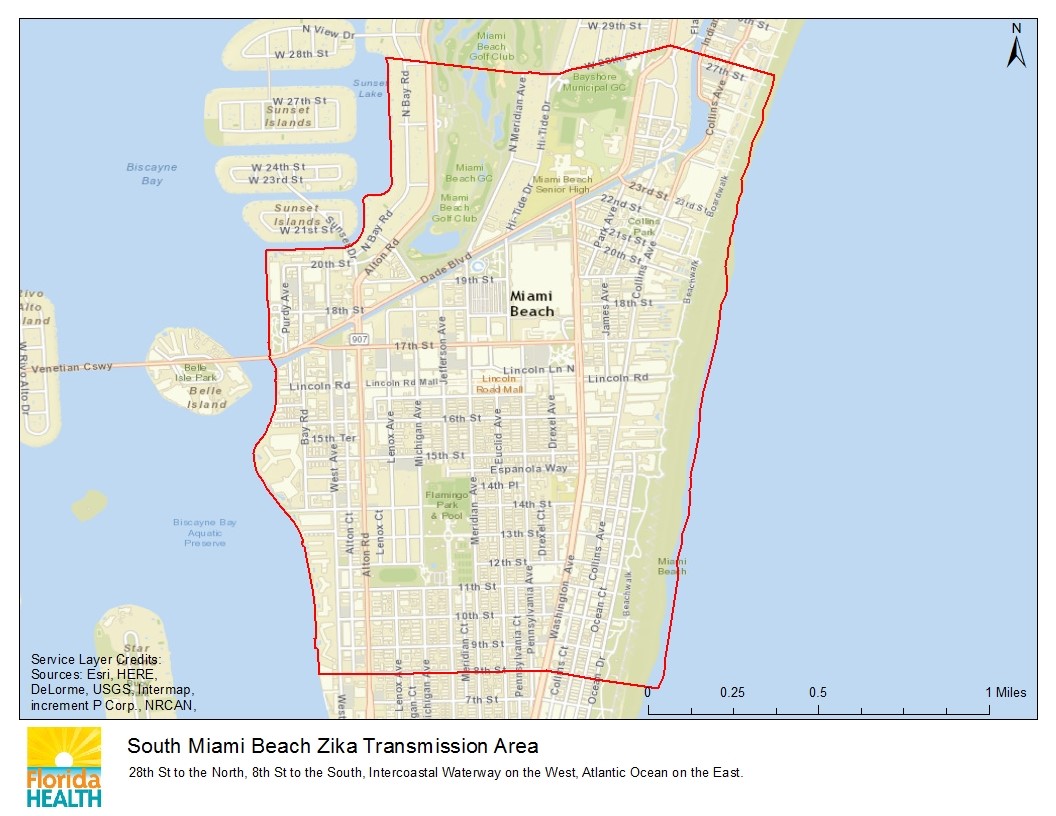
[FONT=&quot]Recently, Governor Rick Scott announced that the department had not detected any additional local transmissions of Zika in the north portion of Miami Beach in more than 45 days. That portion of the zone has been lifted. The lifted area is about three miles, from 28th street to 63rd street. The remaining area of active Zika transmission in Miami Beach is about 1.5 square miles between 8th and 28th streets. The remaining area of active Zika transmission in Little River is about one square mile.[/FONT]
[FONT=&quot]DOH continues outreach and targeted testing in Miami-Dade County and mosquito abatement and reduction activities are also taking place around the locations that are being investigated. DOH believes ongoing transmission is only taking place within the identified area in Miami Beach and Little River in Miami-Dade County, see maps below.[/FONT]
[FONT=&quot]One case does not mean ongoing active transmission is taking place. DOH conducts a thorough investigation by sampling close contacts and community members around each case to determine if additional people are infected. If DOH finds evidence that active transmission is occurring in an area, the media and the public will be notified.[/FONT]
[FONT=&quot]The timelines below are as of Nov. 23. Note: asymptomatic cases are not reflected as they do not have symptom on-set dates.[/FONT]
[FONT=&quot]click image above to enlarge[/FONT]
[FONT=&quot]click image above to enlarge[/FONT]
[FONT=&quot]click image above to enlarge[/FONT]
[FONT=&quot]The department is currently conducting 14 active investigations. The department has closed 38 investigations. Information regarding the investigations can be found here. If investigations reveal additional areas of active transmission, the department will announce a defined area of concern. [/FONT]
[FONT=&quot] [/FONT]
[FONT=&quot]The department has conducted Zika virus testing for more than 10,665 people statewide. Florida currently has the capacity to test 5,753 people for active Zika virus and 4,997 for Zika antibodies. At Governor Scott?s direction, all county health departments now offer free Zika risk assessment and testing to pregnant women.[/FONT]
[FONT=&quot]Florida?s small case cluster is not considered widespread transmission, however, pregnant women are advised to avoid non-essential travel to the impacted area in Miami-Dade County (see map below). If you are pregnant and must travel or if you live or work in the impacted area, protect yourself from mosquito bites by wearing insect repellent, long clothing and limiting your time outdoors. [/FONT]
[FONT=&quot]According to CDC guidance, providers should test all pregnant women who lived in, traveled to or whose partner traveled to Miami-Dade County after Aug. 1, 2016. It is also recommended that all pregnant women who reside in or travel frequently to the area where active transmission is likely occurring be tested for Zika in the first and second trimester. Pregnant women in the identified area can contact their medical provider or their local county health department to be tested and receive a Zika prevention kit. CDC recommends that a pregnant woman with a history of Zika virus and her provider should consider additional ultrasounds. Additionally, the department is working closely with the Healthy Start Coalition of Miami-Dade County to identify pregnant women in the impacted areas to ensure they have access to resources and information to protect themselves. CDC recommends that a pregnant woman with a history of Zika virus and her provider should consider additional ultrasounds. [/FONT]
[FONT=&quot]Pregnant women can contact their local county health department for Zika risk assessment and testing hours and information. A Zika risk assessment will be conducted by county health department staff and blood and/or urine samples may be collected and sent to labs for testing. It may take one to two weeks to receive results.[/FONT]
[FONT=&quot]Florida has been monitoring pregnant women with evidence of Zika regardless of symptoms. The total number of pregnant women who have been or are being monitored is 173.[/FONT]
[FONT=&quot]On Feb. 12, Governor Scott directed the State Surgeon General to activate a Zika Virus Information Hotline for current Florida residents and visitors, as well as anyone planning on traveling to Florida in the near future. The hotline, managed by the Department of Health, has assisted 7,776 callers since it launched. The number for the Zika Virus Information Hotline is 1-855-622-6735.[/FONT]
[FONT=&quot]The department urges Floridians to drain standing water weekly, no matter how seemingly small. A couple drops of water in a bottle cap can be a breeding location for mosquitoes. Residents and visitors also need to use repellents when enjoying the Florida outdoors.[/FONT]
[FONT=&quot]For more information on DOH action and federal guidance, please click here.[/FONT]
[FONT=&quot]For resources and information on Zika virus, click here.[/FONT]
[FONT=&quot]click image above to enlarge[/FONT]
[FONT=&quot]click image above to enlarge

http://www.floridahealth.gov/newsroom/2016/12/120116-zika-update.html
[/FONT]
 
[FONT=&quot]December 2, 2016[/FONT]
[h=2]Department of Health Daily Zika Update[/h] [FONT=&quot]Contact:
Communications Office
NewsMedia@flhealth.gov
(850) 245-4111
[/FONT]

[FONT=&quot]Tallahassee, Fla.?In an effort to keep Florida residents and visitors safe and aware about the status of the Zika virus, the department will issue a Zika virus update each week day. Updates will include a Zika case count by county and information to keep Floridians informed and prepared. In order to keep the public informed, the department has posted our investigation process here.[/FONT]
[FONT=&quot]There are two new travel-related cases today with one in Collier and one in Hillsborough.[/FONT]
[FONT=&quot]There no new locally acquired cases today.[/FONT]
[FONT=&quot]The total number of Zika cases reported in Florida as of today is 1,222.[/FONT]
[TABLE="border: 1, cellpadding: 0, cellspacing: 0"]
[TR]
[TD="width: 318"] Infection Type
[/TD]
[TD="width: 306"] Infection Count
[/TD]
[/TR]
[TR]
[TD="width: 318"] Travel-Related Infections of Zika
[/TD]
[TD="width: 306"] 963
[/TD]
[/TR]
[TR]
[TD="width: 318"] Locally Acquired Infections of Zika
[/TD]
[TD="width: 306"] 244
[/TD]
[/TR]
[TR]
[TD="width: 318"] Undetermined
[/TD]
[TD="width: 306"] 15
[/TD]
[/TR]
[TR]
[TD="width: 623, colspan: 2"]
[/TD]
[/TR]
[TR]
[TD="width: 318"] Pregnant Women with Lab-Evidence of Zika
[/TD]
[TD="width: 306"] 174
[/TD]
[/TR]
[/TABLE]
[FONT=&quot]Note, these categories are not mutually exclusive and cannot be added together. Please visit our website to see the full list of travel-related cases by county.[/FONT]
[FONT=&quot]Today, Governor Rick Scott announced that the department has cleared the Little River area of local Zika transmission. The department has not detected any cases of local transmission of the Zika virus in 45 days in this area. The newly cleared area, which is about one square mile, is located NW 79th St. to the North, NW 63rd St. to the South, NW 10th Ave. to the West and N. Miami Ave. to the East.[/FONT]
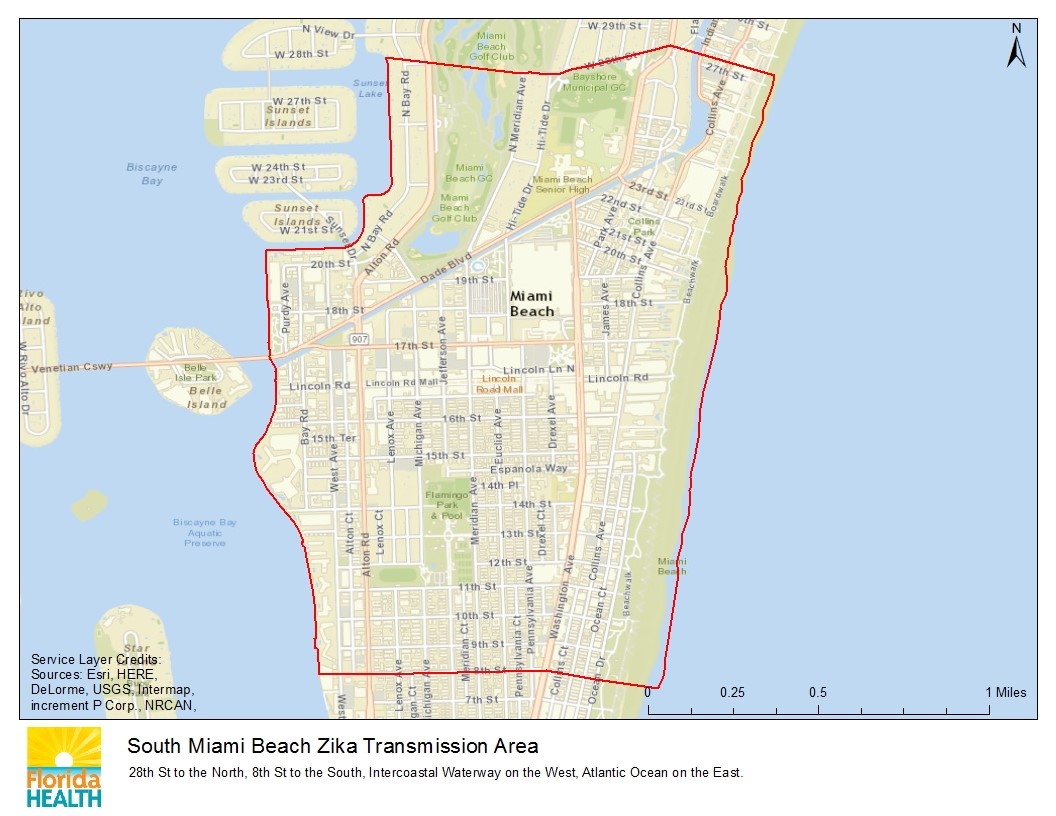
[FONT=&quot]DOH continues outreach and targeted testing in Miami-Dade County and mosquito abatement and reduction activities are also taking place around the locations that are being investigated. DOH believes ongoing transmission is only taking place within the identified area in Miami Beach, see map below.[/FONT]
[FONT=&quot]One case does not mean ongoing active transmission is taking place. DOH conducts a thorough investigation by sampling close contacts and community members around each case to determine if additional people are infected. If DOH finds evidence that active transmission is occurring in an area, the media and the public will be notified.[/FONT]
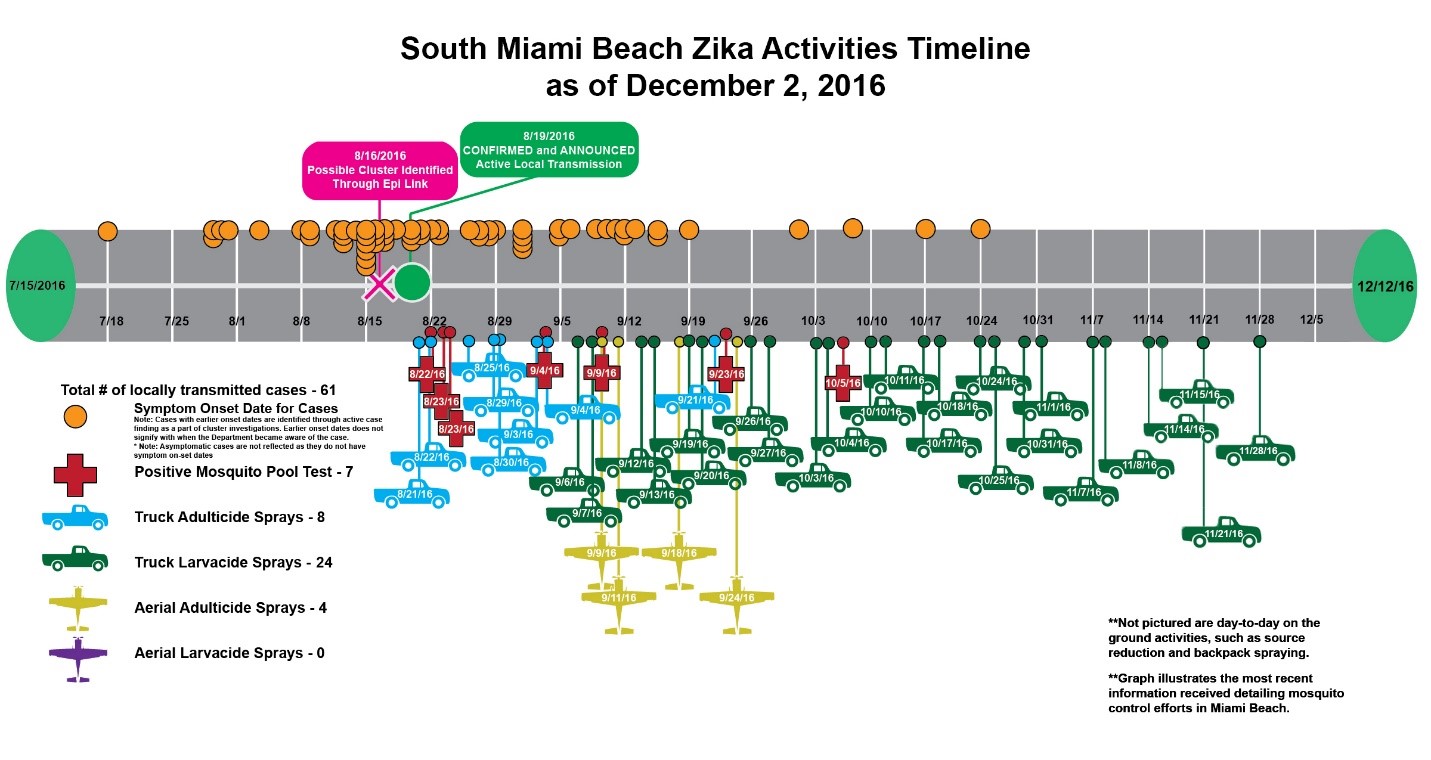
[FONT=&quot]The timelines below are as of Dec. 2. Note: asymptomatic cases are not reflected as they do not have symptom on-set dates.[/FONT]
[FONT=&quot]click image above to enlarge[/FONT]
[FONT=&quot]click image above to enlarge[/FONT]
[FONT=&quot]click image above to enlarge[/FONT]
[FONT=&quot]The department is currently conducting 13 active investigations. The department has closed 39 investigations. Information regarding the investigations can be found here. If investigations reveal additional areas of active transmission, the department will announce a defined area of concern. [/FONT]
[FONT=&quot]The department has conducted Zika virus testing for more than 10,712 people statewide. Florida currently has the capacity to test 5,652 people for active Zika virus and 4,929 for Zika antibodies. At Governor Scott?s direction, all county health departments now offer free Zika risk assessment and testing to pregnant women.[/FONT]
[FONT=&quot]Florida?s small case cluster is not considered widespread transmission, however, pregnant women are advised to avoid non-essential travel to the impacted area in Miami-Dade County (see map below). If you are pregnant and must travel or if you live or work in the impacted area, protect yourself from mosquito bites by wearing insect repellent, long clothing and limiting your time outdoors. [/FONT]
[FONT=&quot]According to CDC guidance, providers should test all pregnant women who lived in, traveled to or whose partner traveled to Miami-Dade County after Aug. 1, 2016. It is also recommended that all pregnant women who reside in or travel frequently to the area where active transmission is likely occurring be tested for Zika in the first and second trimester. Pregnant women in the identified area can contact their medical provider or their local county health department to be tested and receive a Zika prevention kit. CDC recommends that a pregnant woman with a history of Zika virus and her provider should consider additional ultrasounds. Additionally, the department is working closely with the Healthy Start Coalition of Miami-Dade County to identify pregnant women in the impacted areas to ensure they have access to resources and information to protect themselves. CDC recommends that a pregnant woman with a history of Zika virus and her provider should consider additional ultrasounds. [/FONT]
[FONT=&quot]Pregnant women can contact their local county health department for Zika risk assessment and testing hours and information. A Zika risk assessment will be conducted by county health department staff and blood and/or urine samples may be collected and sent to labs for testing. It may take one to two weeks to receive results.[/FONT]
[FONT=&quot]Florida has been monitoring pregnant women with evidence of Zika regardless of symptoms. The total number of pregnant women who have been or are being monitored is 174.[/FONT]
[FONT=&quot]On Feb. 12, Governor Scott directed the State Surgeon General to activate a Zika Virus Information Hotline for current Florida residents and visitors, as well as anyone planning on traveling to Florida in the near future. The hotline, managed by the Department of Health, has assisted 7,805 callers since it launched. The number for the Zika Virus Information Hotline is 1-855-622-6735.[/FONT]
[FONT=&quot]The department urges Floridians to drain standing water weekly, no matter how seemingly small. A couple drops of water in a bottle cap can be a breeding location for mosquitoes. Residents and visitors also need to use repellents when enjoying the Florida outdoors.[/FONT]
[FONT=&quot]For more information on DOH action and federal guidance, please click here.[/FONT]
[FONT=&quot]For resources and information on Zika virus, click here.[/FONT]
[FONT=&quot]click image above to enlarge

http://www.floridahealth.gov/newsroom/2016/12/120216-zika-update.html
[/FONT]
 
[FONT=&quot]December 5, 2016[/FONT]
[h=2]Department of Health Daily Zika Update[/h] [FONT=&quot]Contact:
Communications Office
NewsMedia@flhealth.gov
(850) 245-4111
[/FONT]

[FONT=&quot]Tallahassee, Fla.?In an effort to keep Florida residents and visitors safe and aware about the status of the Zika virus, the department will issue a Zika virus update each week day. Updates will include a Zika case count by county and information to keep Floridians informed and prepared. In order to keep the public informed, the department has posted our investigation process here.[/FONT]
[FONT=&quot]There are two new travel-related cases today with one in Bay and one in Duval.[/FONT]
[FONT=&quot]There no new locally acquired cases today.[/FONT]
[FONT=&quot]The total number of Zika cases reported in Florida as of today is 1,224.[/FONT]
[TABLE="border: 1, cellpadding: 0, cellspacing: 0"]
[TR]
[TD="width: 318"] Infection Type
[/TD]
[TD="width: 306"] Infection Count
[/TD]
[/TR]
[TR]
[TD="width: 318"] Travel-Related Infections of Zika
[/TD]
[TD="width: 306"] 965
[/TD]
[/TR]
[TR]
[TD="width: 318"] Locally Acquired Infections of Zika
[/TD]
[TD="width: 306"] 244
[/TD]
[/TR]
[TR]
[TD="width: 318"] Undetermined
[/TD]
[TD="width: 306"] 15
[/TD]
[/TR]
[TR]
[TD="width: 623, colspan: 2"]
[/TD]
[/TR]
[TR]
[TD="width: 318"] Pregnant Women with Lab-Evidence of Zika
[/TD]
[TD="width: 306"] 175
[/TD]
[/TR]
[/TABLE]
[FONT=&quot]Note, these categories are not mutually exclusive and cannot be added together. Please visit our website to see the full list of travel-related cases by county.[/FONT]
[FONT=&quot]Last week, Governor Rick Scott announced that the department has cleared the Little River area of local Zika transmission. The department has not detected any cases of local transmission of the Zika virus in 45 days in this area. The cleared area, which is about one square mile, is located NW 79th St. to the North, NW 63rd St. to the South, NW 10th Ave. to the West and N. Miami Ave. to the East.[/FONT]
[FONT=&quot]DOH continues outreach and targeted testing in Miami-Dade County and mosquito abatement and reduction activities are also taking place around the locations that are being investigated. DOH believes ongoing transmission is only taking place within the identified area in Miami Beach, see map below.[/FONT]
[FONT=&quot]One case does not mean ongoing active transmission is taking place. DOH conducts a thorough investigation by sampling close contacts and community members around each case to determine if additional people are infected. If DOH finds evidence that active transmission is occurring in an area, the media and the public will be notified.[/FONT]
[FONT=&quot]The timelines below are as of Dec. 2. Note: asymptomatic cases are not reflected as they do not have symptom on-set dates.[/FONT]
[FONT=&quot]click image above to enlarge[/FONT]
[FONT=&quot]click image above to enlarge[/FONT]
[FONT=&quot]click image above to enlarge[/FONT]
[FONT=&quot]The department is currently conducting 13 active investigations. The department has closed 39 investigations. Information regarding the investigations can be found here. If investigations reveal additional areas of active transmission, the department will announce a defined area of concern. [/FONT]
[FONT=&quot]The department has conducted Zika virus testing for more than 10,780 people statewide. Florida currently has the capacity to test 6,564 people for active Zika virus and 4,929 for Zika antibodies. At Governor Scott?s direction, all county health departments now offer free Zika risk assessment and testing to pregnant women.[/FONT]
[FONT=&quot]Florida?s small case cluster is not considered widespread transmission, however, pregnant women are advised to avoid non-essential travel to the impacted area in Miami-Dade County (see map below). If you are pregnant and must travel or if you live or work in the impacted area, protect yourself from mosquito bites by wearing insect repellent, long clothing and limiting your time outdoors. [/FONT]
[FONT=&quot]According to CDC guidance, providers should test all pregnant women who lived in, traveled to or whose partner traveled to Miami-Dade County after Aug. 1, 2016. It is also recommended that all pregnant women who reside in or travel frequently to the area where active transmission is likely occurring be tested for Zika in the first and second trimester. Pregnant women in the identified area can contact their medical provider or their local county health department to be tested and receive a Zika prevention kit. CDC recommends that a pregnant woman with a history of Zika virus and her provider should consider additional ultrasounds. Additionally, the department is working closely with the Healthy Start Coalition of Miami-Dade County to identify pregnant women in the impacted areas to ensure they have access to resources and information to protect themselves. CDC recommends that a pregnant woman with a history of Zika virus and her provider should consider additional ultrasounds. [/FONT]
[FONT=&quot]Pregnant women can contact their local county health department for Zika risk assessment and testing hours and information. A Zika risk assessment will be conducted by county health department staff and blood and/or urine samples may be collected and sent to labs for testing. It may take one to two weeks to receive results.[/FONT]
[FONT=&quot]Florida has been monitoring pregnant women with evidence of Zika regardless of symptoms. The total number of pregnant women who have been or are being monitored is 175.[/FONT]
[FONT=&quot]On Feb. 12, Governor Scott directed the State Surgeon General to activate a Zika Virus Information Hotline for current Florida residents and visitors, as well as anyone planning on traveling to Florida in the near future. The hotline, managed by the Department of Health, has assisted 7,861 callers since it launched. The number for the Zika Virus Information Hotline is 1-855-622-6735.[/FONT]
[FONT=&quot]The department urges Floridians to drain standing water weekly, no matter how seemingly small. A couple drops of water in a bottle cap can be a breeding location for mosquitoes. Residents and visitors also need to use repellents when enjoying the Florida outdoors.[/FONT]
[FONT=&quot]For more information on DOH action and federal guidance, please click here.[/FONT]
[FONT=&quot]For resources and information on Zika virus, click here.[/FONT]
[FONT=&quot]click image above to enlarge

http://www.floridahealth.gov/newsroom/2016/12/120516-zika-update.html
[/FONT]
 
[FONT=&quot]December 6, 2016[/FONT]
[h=2]Department of Health Daily Zika Update[/h] [FONT=&quot]Contact:
Communications Office
NewsMedia@flhealth.gov
(850) 245-4111
[/FONT]

[FONT=&quot]Tallahassee, Fla.?In an effort to keep Florida residents and visitors safe and aware about the status of the Zika virus, the department will issue a Zika virus update each week day. Updates will include a Zika case count by county and information to keep Floridians informed and prepared. In order to keep the public informed, the department has posted our investigation process here.[/FONT]
[FONT=&quot]There are four new travel-related cases today with two in Broward, one in Miami-Dade and one in Pinellas counties.[/FONT]
[FONT=&quot]There no new locally acquired cases today.[/FONT]
[FONT=&quot]The total number of Zika cases reported in Florida as of today is 1,228.[/FONT]
[TABLE="border: 1, cellpadding: 0, cellspacing: 0"]
[TR]
[TD="width: 318"] Infection Type
[/TD]
[TD="width: 306"] Infection Count
[/TD]
[/TR]
[TR]
[TD="width: 318"] Travel-Related Infections of Zika
[/TD]
[TD="width: 306"] 969
[/TD]
[/TR]
[TR]
[TD="width: 318"] Locally Acquired Infections of Zika
[/TD]
[TD="width: 306"] 244
[/TD]
[/TR]
[TR]
[TD="width: 318"] Undetermined
[/TD]
[TD="width: 306"] 15
[/TD]
[/TR]
[TR]
[TD="width: 623, colspan: 2"]
[/TD]
[/TR]
[TR]
[TD="width: 318"] Pregnant Women with Lab-Evidence of Zika
[/TD]
[TD="width: 306"] 178
[/TD]
[/TR]
[/TABLE]
[FONT=&quot]Note, these categories are not mutually exclusive and cannot be added together. Please visit our website to see the full list of travel-related cases by county. [/FONT]
[FONT=&quot]Last week, Governor Rick Scott announced that the department has cleared the Little River area of local Zika transmission. The department has not detected any cases of local transmission of the Zika virus in 45 days in this area. The cleared area, which is about one square mile, is located NW 79th St. to the North, NW 63rd St. to the South, NW 10th Ave. to the West and N. Miami Ave. to the East.[/FONT]
[FONT=&quot]DOH continues outreach and targeted testing in Miami-Dade County and mosquito abatement and reduction activities are also taking place around the locations that are being investigated. DOH believes ongoing transmission is only taking place within the identified area in Miami Beach, see map below.[/FONT]
[FONT=&quot]One case does not mean ongoing active transmission is taking place. DOH conducts a thorough investigation by sampling close contacts and community members around each case to determine if additional people are infected. If DOH finds evidence that active transmission is occurring in an area, the media and the public will be notified.[/FONT]
[FONT=&quot]The timelines below are as of Dec. 2. Note: asymptomatic cases are not reflected as they do not have symptom on-set dates.[/FONT]
[FONT=&quot]click image above to enlarge[/FONT]
[FONT=&quot]click image above to enlarge[/FONT]
[FONT=&quot]click image above to enlarge[/FONT]
[FONT=&quot]The department is currently conducting 13 active investigations. The department has closed 39 investigations. Information regarding the investigations can be found here. If investigations reveal additional areas of active transmission, the department will announce a defined area of concern. [/FONT]
[FONT=&quot]The department has conducted Zika virus testing for more than 10,793 people statewide. Florida currently has the capacity to test 6,465 people for active Zika virus and 4,826 for Zika antibodies. At Governor Scott?s direction, all county health departments now offer free Zika risk assessment and testing to pregnant women.[/FONT]
[FONT=&quot]Florida?s small case cluster is not considered widespread transmission, however, pregnant women are advised to avoid non-essential travel to the impacted area in Miami-Dade County (see map below). If you are pregnant and must travel or if you live or work in the impacted area, protect yourself from mosquito bites by wearing insect repellent, long clothing and limiting your time outdoors. [/FONT]
[FONT=&quot]According to CDC guidance, providers should test all pregnant women who lived in, traveled to or whose partner traveled to Miami-Dade County after Aug. 1, 2016. It is also recommended that all pregnant women who reside in or travel frequently to the area where active transmission is likely occurring be tested for Zika in the first and second trimester. Pregnant women in the identified area can contact their medical provider or their local county health department to be tested and receive a Zika prevention kit. CDC recommends that a pregnant woman with a history of Zika virus and her provider should consider additional ultrasounds. Additionally, the department is working closely with the Healthy Start Coalition of Miami-Dade County to identify pregnant women in the impacted areas to ensure they have access to resources and information to protect themselves. CDC recommends that a pregnant woman with a history of Zika virus and her provider should consider additional ultrasounds. [/FONT]
[FONT=&quot]Pregnant women can contact their local county health department for Zika risk assessment and testing hours and information. A Zika risk assessment will be conducted by county health department staff and blood and/or urine samples may be collected and sent to labs for testing. It may take one to two weeks to receive results.[/FONT]
[FONT=&quot]Florida has been monitoring pregnant women with evidence of Zika regardless of symptoms. The total number of pregnant women who have been or are being monitored is 178.[/FONT]
[FONT=&quot]On Feb. 12, Governor Scott directed the State Surgeon General to activate a Zika Virus Information Hotline for current Florida residents and visitors, as well as anyone planning on traveling to Florida in the near future. The hotline, managed by the Department of Health, has assisted 7,895 callers since it launched. The number for the Zika Virus Information Hotline is 1-855-622-6735.[/FONT]
[FONT=&quot]The department urges Floridians to drain standing water weekly, no matter how seemingly small. A couple drops of water in a bottle cap can be a breeding location for mosquitoes. Residents and visitors also need to use repellents when enjoying the Florida outdoors.[/FONT]
[FONT=&quot]For more information on DOH action and federal guidance, please click here.[/FONT]
[FONT=&quot]For resources and information on Zika virus, click here.[/FONT]
[FONT=&quot]click image above to enlarge

http://www.floridahealth.gov/newsroom/2016/12/120616-zika-update.html
[/FONT]
 
[FONT=&quot]December 7, 2016[/FONT]
[h=2]Department of Health Daily Zika Update[/h] [FONT=&quot]Contact:
Communications Office
NewsMedia@flhealth.gov
(850) 245-4111
[/FONT]

[FONT=&quot]Tallahassee, Fla.?In an effort to keep Florida residents and visitors safe and aware about the status of the Zika virus, the department will issue a Zika virus update each week day. Updates will include a Zika case count by county and information to keep Floridians informed and prepared. In order to keep the public informed, the department has posted our investigation process here.[/FONT]
[FONT=&quot]There are three new travel-associated cases today with one in Miami-Dade, one in Hillsborough and one in Martin counties.[/FONT]
[FONT=&quot]There are five new locally acquired cases today in Miami-Dade County. All five cases had symptom on-set in September and October and they do not impact the lifting of Zika zones in Little River, North Miami Beach or Wynwood. The department recently concluded the investigation process for these cases to rule out travel and classify the cases as locally acquired.[/FONT]
[FONT=&quot]The total number of Zika cases reported in Florida as of today is 1,236.[/FONT]
[TABLE="border: 1, cellpadding: 0, cellspacing: 0"]
[TR]
[TD="width: 318"] Infection Type
[/TD]
[TD="width: 306"] Infection Count
[/TD]
[/TR]
[TR]
[TD="width: 318"] Travel-Related Infections of Zika
[/TD]
[TD="width: 306"] 972
[/TD]
[/TR]
[TR]
[TD="width: 318"] Locally Acquired Infections of Zika
[/TD]
[TD="width: 306"] 249
[/TD]
[/TR]
[TR]
[TD="width: 318"] Undetermined
[/TD]
[TD="width: 306"] 15
[/TD]
[/TR]
[TR]
[TD="width: 623, colspan: 2"]
[/TD]
[/TR]
[TR]
[TD="width: 318"] Pregnant Women with Lab-Evidence of Zika
[/TD]
[TD="width: 306"] 180
[/TD]
[/TR]
[/TABLE]
[FONT=&quot]Note, these categories are not mutually exclusive and cannot be added together. Please visit our website to see the full list of travel-related cases by county.
[/FONT]

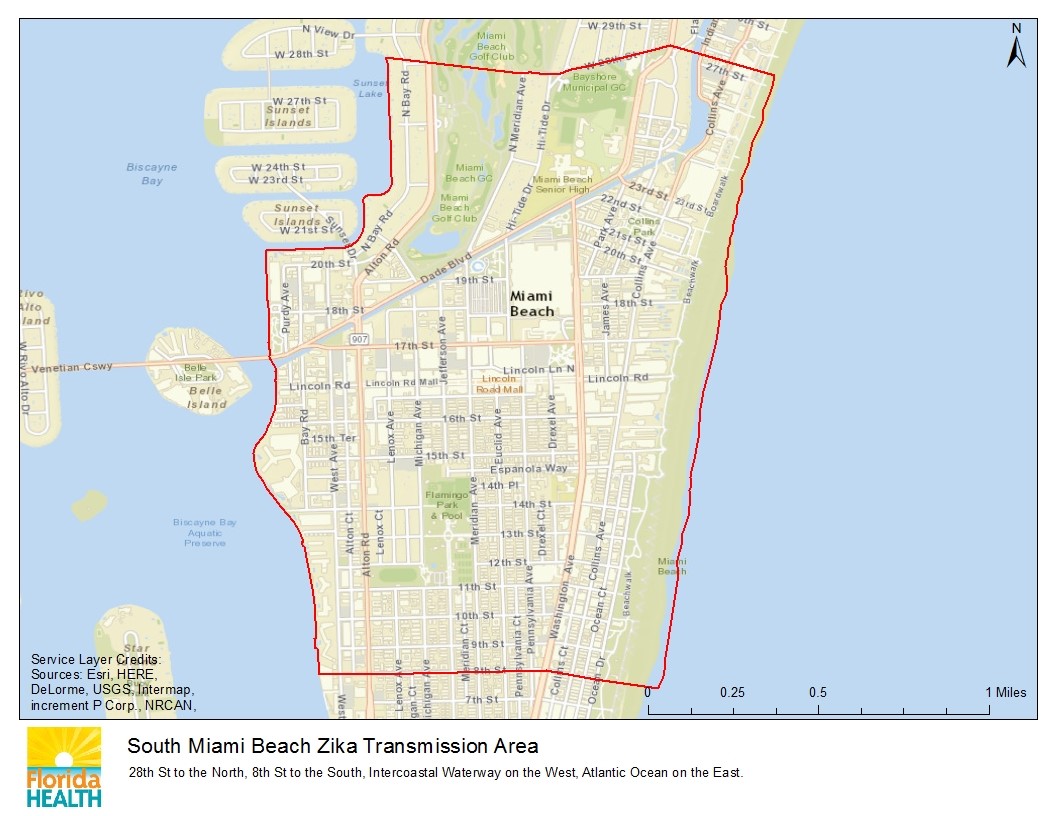
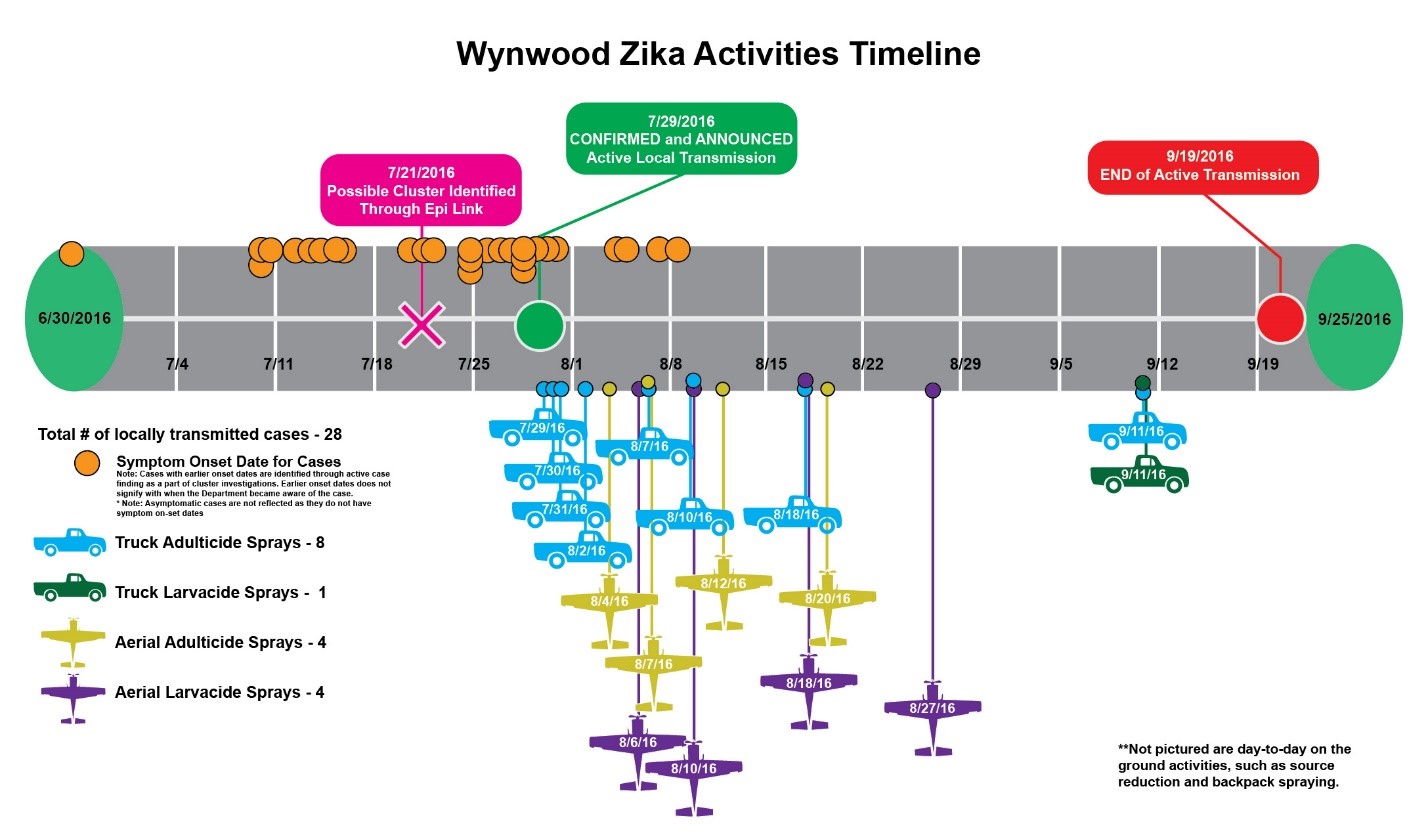
[FONT=&quot]To date, the Zika zones in Wynwood, North Miami Beach and Little River have been lifted after 45 days with no evidence of active transmission and no additional people infected. The Wynwood zone was lifted September 19, the North Miami Beach zone was lifted November 22 and the Little River zone was lifted December 2. The only remaining area of active transmission is approximately 1.5 square miles in South Miami Beach, please see map below.[/FONT]
[FONT=&quot]DOH continues outreach and targeted testing in Miami-Dade County and mosquito abatement and reduction activities are also taking place around the locations that are being investigated.[/FONT]
[FONT=&quot]One case does not mean ongoing active transmission is taking place. DOH conducts a thorough investigation by sampling close contacts and community members around each case to determine if additional people are infected. If DOH finds evidence that active transmission is occurring in an area, the media and the public will be notified.[/FONT]
[FONT=&quot]The timelines below are as of Dec. 2. Note: asymptomatic cases are not reflected as they do not have symptom on-set dates.[/FONT]
[FONT=&quot]click image above to enlarge[/FONT]
[FONT=&quot]click image above to enlarge[/FONT]
[FONT=&quot]click image above to enlarge[/FONT]
[FONT=&quot]The department is currently conducting 11 active investigations. The department has closed 41 investigations. Information regarding the investigations can be found here. If investigations reveal additional areas of active transmission, the department will announce a defined area of concern. [/FONT]
[FONT=&quot]The department has conducted Zika virus testing for more than 10,839 people statewide. Florida currently has the capacity to test 6,321 people for active Zika virus and 4,786 for Zika antibodies. At Governor Scott?s direction, all county health departments now offer free Zika risk assessment and testing to pregnant women.[/FONT]
[FONT=&quot]Florida?s small case cluster is not considered widespread transmission, however, pregnant women are advised to avoid non-essential travel to the impacted area in Miami-Dade County (see map below). If you are pregnant and must travel or if you live or work in the impacted area, protect yourself from mosquito bites by wearing insect repellent, long clothing and limiting your time outdoors. [/FONT]
[FONT=&quot]According to CDC guidance, providers should test all pregnant women who lived in, traveled to or whose partner traveled to Miami-Dade County after Aug. 1, 2016. It is also recommended that all pregnant women who reside in or travel frequently to the area where active transmission is likely occurring be tested for Zika in the first and second trimester. Pregnant women in the identified area can contact their medical provider or their local county health department to be tested and receive a Zika prevention kit. CDC recommends that a pregnant woman with a history of Zika virus and her provider should consider additional ultrasounds. Additionally, the department is working closely with the Healthy Start Coalition of Miami-Dade County to identify pregnant women in the impacted areas to ensure they have access to resources and information to protect themselves. CDC recommends that a pregnant woman with a history of Zika virus and her provider should consider additional ultrasounds. [/FONT]
[FONT=&quot]Pregnant women can contact their local county health department for Zika risk assessment and testing hours and information. A Zika risk assessment will be conducted by county health department staff and blood and/or urine samples may be collected and sent to labs for testing. It may take one to two weeks to receive results.[/FONT]
[FONT=&quot]Florida has been monitoring pregnant women with evidence of Zika regardless of symptoms. The total number of pregnant women who have been or are being monitored is 180.[/FONT]
[FONT=&quot]On Feb. 12, Governor Scott directed the State Surgeon General to activate a Zika Virus Information Hotline for current Florida residents and visitors, as well as anyone planning on traveling to Florida in the near future. The hotline, managed by the Department of Health, has assisted 7,930 callers since it launched. The number for the Zika Virus Information Hotline is 1-855-622-6735.[/FONT]
[FONT=&quot]The department urges Floridians to drain standing water weekly, no matter how seemingly small. A couple drops of water in a bottle cap can be a breeding location for mosquitoes. Residents and visitors also need to use repellents when enjoying the Florida outdoors.[/FONT]
[FONT=&quot]For more information on DOH action and federal guidance, please click here.[/FONT]
[FONT=&quot]For resources and information on Zika virus, click here.[/FONT]
[FONT=&quot]click image above to enlarge

http://www.floridahealth.gov/newsroom/2016/12/120716-zika-update.html
[/FONT]
 
Florida - DoH Zika Updates 2017 ...look at the numbers with a critical eye

[FONT=&quot]March 20, 2017[/FONT]
[h=2]Department of Health Daily Zika Update[/h] [FONT=&quot]Contact:
Communications Office
NewsMedia@flhealth.gov
(850) 245-4111
[/FONT]

[FONT=&quot]Tallahassee, Fla. ?In an effort to keep Florida residents and visitors safe and aware about the status of the Zika virus, the department issues a Zika virus update when there is a confirmed locally acquired case of Zika.[/FONT]
[FONT=&quot]There are four new travel-related cases to report today. Please visit our website to see the full list of travel-related cases by county and year. The department updates the travel-related case chart online each weekday.[/FONT]
[FONT=&quot]There is one new locally acquired case to report today. The individual reported no symptoms, but screening conducted in February showed evidence of a past infection. The department just received confirmatory testing back from CDC. This individual had multiple exposures in Miami-Dade County and likely contracted Zika in 2016. Because the individual was asymptomatic, it is difficult to determine when infection occurred. Florida still does not have any identified areas with ongoing, active Zika transmission.[/FONT]
[FONT=&quot]The total number of Zika cases reported in Florida for 2017 is 29.[/FONT]
[TABLE="border: 1, width: 1"]
[TR]
[TD="width: 204"] Infection Type
[/TD]
[TD="width: 138"] Infection Count
[/TD]
[/TR]
[TR]
[TD="width: 34%"] Travel-Related Infections Of Zika
[/TD]
[TD="width: 66%"] 25
[/TD]
[/TR]
[TR]
[TD="width: 34%"] Locally Acquired Infections Of Zika
[/TD]
[TD="width: 66%"] 2
[/TD]
[/TR]
[TR]
[TD="width: 34%"] Undetermined
[/TD]
[TD="width: 66%"] 2
[/TD]
[/TR]
[TR]
[TD="width: 100%, colspan: 2"] .
[/TD]
[/TR]
[TR]
[TD="width: 34%"] Pregnant Women With Lab-Evidence Of Zika
[/TD]
[TD="width: 66%"] 13
[/TD]
[/TR]
[/TABLE]
[FONT=&quot]Note, these categories are not mutually exclusive and cannot be added together.[/FONT]
[FONT=&quot]Florida no longer has any identified areas with active Zika transmission, but we will continue to see isolated cases of local transmission so it is important for residents and visitors in Miami-Dade County to remain vigilant about mosquito bite protection.[/FONT]
[FONT=&quot]It is important for people to remember to take proper precautions to prevent mosquito bites while traveling to areas with widespread Zika transmission. The CDC list of these locations is available here.[/FONT]
[FONT=&quot]One case does not mean ongoing active transmission is taking place. DOH conducts a thorough investigation by sampling close contacts and community members around each case to determine if additional people are infected. If DOH finds evidence that active transmission is occurring in an area, the media and the public will be notified.[/FONT]
[FONT=&quot]The department has conducted Zika virus testing for more than 13,020 people statewide. At Governor Scott?s direction, all county health departments now offer free Zika risk assessment and testing to pregnant women.[/FONT]
[FONT=&quot]The CDC advises pregnant women should consider postponing travel to Miami-Dade County. If you are pregnant and must travel or if you live or work in Miami-Dade County, protect yourself from mosquito bites by wearing insect repellent, long clothing and limiting your time outdoors. [/FONT]
[FONT=&quot]According to CDC guidance, providers should test all pregnant women who lived in, traveled to or whose partner traveled to Miami-Dade County after Aug. 1, 2016. Pregnant women in Miami-Dade County can contact their medical provider or their local county health department to be tested and receive a Zika prevention kit. Additionally, the department is working closely with the Healthy Start Coalition of Miami-Dade County to identify pregnant women in Miami-Dade County to ensure they have access to resources and information to protect themselves. CDC recommends that a pregnant woman with a history of Zika virus and her provider should consider additional ultrasounds. [/FONT]
[FONT=&quot]Pregnant women can contact their local county health department for Zika risk assessment and testing hours and information. A Zika risk assessment will be conducted by county health department staff and blood and/or urine samples may be collected and sent to labs for testing. It may take one to two weeks to receive results.[/FONT]
[FONT=&quot]Florida has been monitoring pregnant women with evidence of Zika regardless of symptoms. The total number of pregnant women who have been or are being monitored is 300.[/FONT]
[FONT=&quot]On Feb. 12, 2016, Governor Scott directed the State Surgeon General to activate a Zika Virus Information Hotline for current Florida residents and visitors, as well as anyone planning on traveling to Florida in the near future. The number for the Zika Virus Information Hotline is 1-855-622-6735.[/FONT]
[FONT=&quot]The department urges Floridians to drain standing water weekly, no matter how seemingly small. A couple drops of water in a bottle cap can be a breeding location for mosquitoes. Residents and visitors also need to use repellents when enjoying the Florida outdoors.[/FONT]
[FONT=&quot]For more information on DOH action and federal guidance, please click here.[/FONT]
[FONT=&quot]For resources and information on Zika virus, click [/FONT]here[FONT=&quot].[/FONT] [FONT=&quot]About the Florida Department of Health[/FONT]
[FONT=&quot]The department, nationally accredited by the Public Health Accreditation Board, works to protect, promote and improve the health of all people in Florida through integrated state, county and community efforts.[/FONT]
[FONT=&quot]Follow us on Twitter at @HealthyFla and on Facebook. For more information about the Florida Department of Health please visit www.FloridaHealth.gov.

http://www.floridahealth.gov/newsroom/2017/03/032017-zika-update.html
[/FONT]
 
Florida DoH: Fight Mosquitoes With These Simple Tips - Video

[FONT=&quot][/FONT]
[FONT=&quot] [h=2]Fight Mosquitoes With These Simple Tips[/h] Contact:
Communications Office
NewsMedia@flhealth.gov
(850) 245-4111

Tallahassee, Fla. - Preventing mosquito bites not only enhances your enjoyment of outdoor activities, but can also protect you from exposure to Zika and all mosquito-borne illnesses. The Florida Department of Health reminds Floridians and visitors to protect yourself and your family with these simple tips outlined in the Mosquito Bite Protection in Florida information video and brochure. Alternate version of video: Spanish and Creole.
(Transcript) Mosquito Bite Protection in Florida information video:
  • Mosquitoes will bite, day and night, so protect yourself with these tips:
  • Keep mosquitos outside by shutting doors and covering windows with screens.
  • Use-EPA approved insect repellants anytime you?re outdoors.
  • Cover your skin with long sleeves and pants.
  • Mosquitoes lay their eggs in water; just a bottle cap of water is all they need.
  • So drain, refresh, or cover anything around buildings that can hold water, at least weekly, and put away outside items that aren?t being used.
A message from the Florida Department of Health.
About the Florida Department of Health
The department works to protect, promote and improve the health of all people in Florida through integrated state, county and community efforts.
Follow us on Twitter at @HealthyFla and on Facebook. For more information about the Florida Department of Health please visit www.FloridaHealth.gov.
[/FONT]
 
US - Miami official: Building boom brings Zika worries: Construction sites breed mosquitoes - April, 3, 2017

[FONT=&quot]APRIL 3, 2017 6:48 PM[/FONT]
[h=1]Miami?s building boom brings Zika worries: Construction sites breed mosquitoes[/h] snip


?Never in my life, in the 20-some years I?ve been doing mosquito control, have I seen the number of mosquitoes that were breeding there,? he said. ?They were biting. They were very aggressive. And they were hungry.?


http://www.miamiherald.com/news/local/community/miami-dade/article142487134.html
 
State web site depicts a new case without accompanying press release:


flazikaapr112017.JPG

http://www.floridahealth.gov/diseases-and-conditions/zika-virus/index.html
 
Florida: 7 babies in total born with Zika-related birth defects

ORLANDO, Fla. (AP) - Seven babies have been born in Florida with birth defects linked to the Zika virus.
The Orlando Sentinel (http://bit.ly/2raUJdJ ) reports that State Surgeon General Dr. Celeste Philip told Orlando-area officials Tuesday that seven babies with Zika-related neurological conditions have been born in Florida since June 2016.


Philip did not say where the babies lived or whether their mothers contracted Zika in Florida or while traveling. She said the state hired additional staff to help their families navigate their health care options.
Florida?s Department of Health has reported 43 Zika cases involving pregnant women so far this year. About 300 pregnant women in Florida showed lab evidence of Zika last year.
The U.S. Centers for Disease Control and Prevention says 64 babies have been born nationwide with defects linked to Zika .

http://m.washingtontimes.com/news/2017/may/31/florida-7-babies-born-with-zika-related-birth-defe/
 
July 6, 2017

floridazikajuly6.JPG


http://www.floridahealth.gov/disease...ns/zika-virus/


I have not consistently posted this information because I find it hard to believe. In my opinion the case total is low due to the extreme proliferation of mosquitoes in Florida. It appears pregnant women account for roughly 71% of the total case number. It appears that routine testing for Zika is highlighting the number of pregnant women. So how are so many travelers to Florida testing positive? Do they land at the airport and then go to the doctor after a couple of days? How many of these travelers are on extended trips? Is it possible some of them acquired the illness locally?

Something just seems "off" here.

And if the Florida numbers are not accurate then the CDC numbers are not either.
 
Florida Department of Health is announcing that the first sexually transmitted Zika case in 2017 has been confirmed in Pinellas County. - August 1, 2017

From: "Florida Department of Health, Office of Communications... [Edit Address Book]
To: Staff Staff <flutrackers@earthlink.net>
Subject: FLORIDA DEPARTMENT OF HEALTH ZIKA UPDATE
Date: Aug 1, 2017 5:31 PM

[TABLE="class: msgbody, border: 0, cellpadding: 0, cellspacing: 0"]
[TR]
[TD]
DOH_logo.png

FOR IMMEDIATE RELEASE
August 1, 2017
Contact: Communications Office
(850) 245-4111

[h=3]FLORIDA DEPARTMENT OF HEALTH ZIKA UPDATE ? FIRST SEXUALLY TRANSMITTED CASE CONFIRMED IN 2017[/h] TALLAHASSEE?Today the Florida Department of Health is announcing that the first sexually transmitted Zika case in 2017 has been confirmed in Pinellas County. There is no evidence of transmission through mosquitoes taking place anywhere in Florida.
While the individual had no travel, their partner recently traveled to Cuba and was ill with symptoms consistent with Zika. Both tested positive for Zika. The department notified mosquito control and appropriate mosquito reduction activities are taking place.
There is no evidence of ongoing transmission of Zika by mosquitoes in any area of Florida . It is important to remember Zika can also be transmitted sexually and to take precautions if you or your partner traveled to an area where Zika is active. If the department identifies an area where ongoing transmission of Zika is taking place, we will notify the public immediately.
The total number of Zika cases reported in Florida in 2017 is 118.
[TABLE="border: 1, cellpadding: 0, cellspacing: 0"]
[TR]
[TD="width: 500"] Infection Type
[/TD]
[TD="width: 300"] Infection Count
[/TD]
[/TR]
[TR]
[TD="width: 500"] Travel-Related Infections of Zika 2017
[/TD]
[TD="width: 300"] 90
[/TD]
[/TR]
[TR]
[TD="width: 500"] Locally Acquired Infections exposed in 2016, tested in 2017
[/TD]
[TD="width: 300"] 6
[/TD]
[/TR]
[TR]
[TD="width: 500"] Undetermined Exposed 2016; Tested 2017
[/TD]
[TD="width: 300"] 22
[/TD]
[/TR]
[TR]
[TD="width: 800, colspan: 2"]
[/TD]
[/TR]
[TR]
[TD="width: 500"] Pregnant Women with Lab-Evidence of Zika 2017
[/TD]
[TD="width: 300"] 81
[/TD]
[/TR]
[/TABLE]
Note, these categories are not mutually exclusive and cannot be added together.
It is critical for people who recently traveled overseas to an area with Zika to prevent mosquito bites for at least three weeks after they return home. It is also important to reduce the chance of sexual transmission by using condoms. CDC has issued additional guidance related to sexual transmission and prevention.
Before you travel, check to see if your destination is on the Centers for Disease Control and Prevention (CDC) list of areas with Zika.
If you traveled to an area with Zika, you could have become infected and not know it, and you could spread the virus in your community if you do not take proper precautions to prevent mosquito bites or sexual transmission after you return home. Zika can persist in semen over extended periods of time. Pregnant couples with recent travel to areas with active Zika transmission should consider using condoms for the duration of the pregnancy.
According to CDC guidance, providers should screen all pregnant women in the US for possible Zika exposure and symptoms at each prenatal care visit. Additional CDC guidance on screening and testing can be found here. At Governor Scott's direction, all county health departments offer free Zika risk assessment and testing to pregnant women.
The department urges Floridians to take action around their home and business to reduce the mosquito population. Mosquitoes can breed in as little as one teaspoon of water so it is critical to drain all sources of standing water to keep mosquitoes from multiplying. Residents and visitors should also use mosquito repellent day and night to prevent mosquito bites.
The department updates the full list of travel-related cases by county online each weekday. To view the list of travel-related cases by county and year, click here.
For more information on Zika virus and the status of Zika in Florida, please visit http://www.floridahealth.gov/zika.

[/TD]
[/TR]
[/TABLE]
 
First 2017 case of locally-transmitted Zika virus in Florida

Source: http://www.wtvy.com/content/news/Fi...nsmitted-Zika-virus-in-Florida-450656133.html


First 2017 case of locally-transmitted Zika virus in Florida
By Associated Press |
Posted: Thu 3:10 PM, Oct 12, 2017

TALLAHASSEE, Fla. (AP) -- Florida health officials are reporting the state's first case this year of the Zika virus transmitted by a local mosquito.

Florida's Department of Health said Thursday a Manatee County couple traveled to Cuba, and one of them contracted Zika while on the Caribbean island and was bitten by a mosquito after returning home.

That mosquito then bit and transmitted the virus to the other partner. Officials wouldn't identify the sex of the couple, citing privacy laws...
 
2 test positive for Zika in Miami-Dade

MIAMI (WSVN) - A sexually transmitted Zika case that infected another person has been confirmed in Miami-Dade County.
The Florida Department of Health announced Friday that two people tested positive for Zika.
One of them didn?t travel to infected areas but their sexual partner did, which lead to the positive results.
The department urges residents to take action around their homes and businesses. However, officials said that there is no ongoing evidence of the disease anywhere else in the state.

http://wsvn.com/news/local/2-test-positive-for-zika-in-miami-dade/
 
Florida confirms second local Zika virus infection for 2017

TALLAHASSEE, Fla. (AP) - Health officials are reporting Florida's second case this year of the Zika virus transmitted by a local mosquito.
Florida's Department of Health said Friday that a case had been identified in Miami-Dade County. Officials wouldn't say where the person was bitten, but did say there's no evidence of an ongoing, active transmission zone.
Florida reported 296 locally acquired Zika infections last year.
Zika causes relatively mild symptoms in most adults but can cause severe birth defects in babies of some women infected during pregnancy. The virus also can be transmitted sexually.

http://www.wctv.tv/content/news/Flo...-Zika-virus-infection-for-2017-458406983.html
 
Back
Top Bottom