• FluTrackers.com Inc. does not provide medical advice. Information on this web site is collected from various internet resources, and the FluTrackers board of directors makes no warranty to the safety, efficacy, correctness or completeness of the information posted on this site by any author or poster. The information collated here is for instructional and/or discussion purposes only and is NOT intended to diagnose or treat any disease, illness, or other medical condition. Every individual reader or poster should seek advice from their personal physician/healthcare practitioner before considering or using any interventions that are discussed on this website. By continuing to access this website you agree to consult your personal physican before using any interventions posted on this website, and you agree to hold harmless FluTrackers.com Inc., the board of directors, the members, and all authors and posters for any effects from use of any medication, supplement, vitamin or other substance, device, intervention, etc. mentioned in posts on this website, or other internet venues referenced in posts on this website.
  • We are not asking for any donations. Do not donate to any entity who says they are raising funds for us.

Florida 2013-14 Flu Season Wks 43-28: 4 Total Pediatric Deaths

mixin

Well-known member
http://www.floridahealth.gov/diseas...ida Influenza Surveillance Reports/index.html

Week 43, ending Oct 26, 2013

Novel influenza:
? Nineteen confirmed cases of influenza A H3N2v infection have been reported since June, 2013.
Ohio reported the most recent cases. Since being first identified in the United States, the Centers for Disease Control and Prevention (CDC) has reported 340 cases and one fatality. No cases of H3N2v infection have been reported in Florida. The H3N2v strain originates from influenza that circulates in pigs. Nearly all people infected with H3N2v have reported direct or indirect contact
with swine. No sustained human to human transmission has been identified. More information can
be found at: http://www.cdc.gov/flu/swineflu/h3n2v-cases.htm.
? For current information on novel or pandemic strains of influenza (including avian or swine origin influenza A) visit http://www.floridahealth.gov/diseases-and-conditions/diseases-from-animals/ novel-influenza-viruses.html.

State:
? Most Florida counties reported mild or no influenza activity. Twenty-four counties reported increasing influenza activity.
? Emergency department (ED) and urgent care center (UCC) influenza-like illness (ILI) visits have increased overall in recent weeks. Although in EDs and UCCs reporting to ESSENCE-FL, the statewide percent of ED visits for ILI is at or near typical levels for this time of year in all regions of Florida.
? In Florida, the most common influenza subtype detected at the Bureau of Public Health Laboratories (BPHL) in recent weeks has been influenza A (2009 H1N1).
? In week 43, 19 of 36 specimens submitted for influenza testing at BPHL tested PCR positive for influenza. Eight tested PCR positive for influenza A (2009 H1N1) and ten tested PCR positive for influenza A unspecified. In the 2012-2013 influenza season, Influenza B, influenza A (H3) and influenza A (2009 H1N1) were all detected. All of these are seasonal strains of influenza.
? Nationally (including Florida), almost all circulating influenza is a good match for the vaccine.
? One influenza outbreak (epidemiologically linked cases of influenza in a single setting) was reported in week 43.
? No pediatric influenza-associated deaths were reported in week 43. No pediatric influenza associated deaths have been reported in the 2013-2014 season.
? The preliminary estimated number of Florida deaths due to pneumonia or influenza in week 42 is lower than the seasonal baseline, based on previous years? data. Estimated deaths due to pneumonia and influenza are identified using preliminary death certificate data.
? Because of low influenza activity in most regions of the state, Florida reported sporadic influenza activity to CDC in week 43. This activity level represents the geographic spread of influenza in Florida.

http://www.floridahealth.gov/diseas...uenza/_documents/2013/2013-w43-flu-review.pdf
 
Re: Florida 2013-2014 Influenza Season Wk 44

Re: Florida 2013-2014 Influenza Season Wk 44

http://www.floridahealth.gov/diseases-and-conditions/influenza/weekly-flu-report.html

Week 44, ending Nov 2, 2013

* Most Florida counties reported mild or no influenza activity. Twenty-five counties reported increasing influenza activity.

* Emergency department (ED) and urgent care center (UCC) influenza-like illness (ILI) visits have increased overall in recent weeks. Although in EDs and UCCs reporting to ESSENCE-FL,the statewide percent of ED visits for ILI is slightly above typical levels for this time of year.
** Southwest Florida has elevated activity for this time of year.

* In Florida, the most common influenza subtype detected at the Bureau of Public Health Laboratories (BPHL) in recent weeks has been influenza A (2009 H1N1).
**In week 44, 9 of 37 specimens submitted for influenza testing at BPHL tested PCR positive for influenza. Six tested PCR positive for influenza A (2009 H1N1), one tested PCR positive for influenza A unspecified, and two tested PCR positive for influenza A (H3). All of these are seasonal strains of influenza.
**Nationally (including Florida), almost all circulating influenza is a good match for the vaccine.

* No influenza or ILI outbreaks (epidemiologically linked cases of influenza in a single setting) was reported in week 44.
* No pediatric influenza-associated deaths were reported in week 44. No pediatric influenza-associated deaths have been reported in the 2013-2014 season.

* The preliminary estimated number of Florida deaths due to pneumonia or influenza in week 43 is higher than the seasonal baseline, based on previous years? data. Estimated deaths due to pneumonia and influenza are identified using preliminary death certificate data.

* Because of low influenza activity in most regions of the state, Florida reported sporadic influenza activity to CDC in week 44. This activity level represents the geographic spread of influenza in Florida.

http://www.floridahealth.gov/diseas...uenza/_documents/2013/2013-w44-flu-review.pdf
 
Re: Florida 2013-2014 Influenza Season Wks 43-44

Re: Florida 2013-2014 Influenza Season Wks 43-44

Week 45, ending Nov 9

Novel influenza:

* Influenza and influenza-like illness (ILI) are at low levels nationwide according to Centersfor Disease Control and Prevention (CDC) reports.
* Using Florida ILINet data, CDC calculated minimal ILI intensity for Florida in week 44.
* Since first identified in the U.S., the CDC has reported 340 cases of influenza A H3N2v infectionand one fatality. No cases of H3N2v infection have been reported in Florida. For information,visit http://www.cdc.gov/flu/swineflu/h3n2v-cases.htm .
* For current information on novel or pandemic strains of influenza (including avian or swine origininfluenza A) visit http://www.floridahealth.gov/diseas...ses-from-animals/novel-influenza-viruses.html .

State:
* Most Florida counties reported mild or no influenza activity. Twenty-two counties reported increasing influenza activity.
* Emergency department (ED) and urgent care center (UCC) ILI visits have increased overall in recent weeks and the statewide percent of ED visits for ILI is slightly above typical levels for this time of year.
*** North and Southwest Florida have elevated activity for this time of year.
* In Florida, the most common influenza subtype detected at the Bureau of Public Health Laboratories (BPHL) in recent weeks has been influenza A (2009 H1N1).
*** In week 45, eight of 17 specimens submitted for influenza testing at BPHL tested PCR positive for influenza. Three tested PCR positive for influenza A (2009 H1N1), and five tested PCR positive for influenza A unspecified. All of these are seasonal strains of influenza.
*** Nationally (including Florida), almost all circulating influenza is a good match for the vaccine.
* No influenza or ILI outbreaks (epidemiologically linked cases of influenza in a single setting) were reported in week 45.
* One pediatric influenza-associated death was reported in week 45. One pediatric influenza associated death has been reported in the 2013-2014 season.
* The preliminary estimated number of Florida deaths due to pneumonia or influenza inweek 44 is lower than the seasonal baseline, based on previous years? data. Estimated deaths due to pneumonia and influenza are identified using preliminary death certificate data.
* Because of low influenza activity in most regions of the state, Florida reported sporadic influenza activity to CDC in week 45. This activity level represents the geographic spread of influenza in Florida.

http://www.floridahealth.gov/diseases-and-conditions/influenza/index.html
 
Re: Florida 2013-14 Influenza Season Wks 43-45 1 Pediatric Death

Re: Florida 2013-14 Influenza Season Wks 43-45 1 Pediatric Death

Week 46, ending Nov 16

Florida reported regional influenza activity to CDC in week 46.

* Most Florida counties reported mild influenza activity. Twenty-one counties reported increasing influenza activity.

* Emergency department (ED) and urgent care center (UCC) ILI visits have increased overall in recent weeks and the statewide percent of ED visits for ILI is slightly above typical levels for this time of year.
North and Southwest Florida have elevated activity for this time of year.

* In Florida, the most common influenza subtype detected at the Bureau of Public Health Laboratories (BPHL) in recent weeks has been influenza A (2009 H1N1).
In week 46, 11 of 26 specimens submitted for influenza testing at BPHL tested PCR positive for influenza. Six tested PCR positive for influenza A (2009 H1N1), and five tested PCR positive for influenza A unspecified. All of these are seasonal strains of influenza.
Nationally (including Florida), almost all circulating influenza is a good match for the vaccine.

* One influenza or ILI outbreaks (epidemiologically linked cases of influenza in a single setting) was reported in week 46.

* No pediatric influenza-associated deaths were reported in week 46. One pediatric influenza-associated death has been reported in the 2013-2014 season.

* The preliminary estimated number of Florida deaths due to pneumonia or influenza in week 45 is lower than the seasonal baseline, based on previous years? data. Estimated deaths due to pneumonia and influenza are identified using preliminary death certificate data.

http://www.floridahealth.gov/diseases-and-conditions/influenza/index.html
 
Re: Florida 2013-14 Influenza Season Wks 43-47 0 New Pediatric Deaths; 1 total

Re: Florida 2013-14 Influenza Season Wks 43-47 0 New Pediatric Deaths; 1 total

Week 47, ending Nov 23

? Most Florida counties reported mild influenza activity. Twenty counties reported increasing influenza activity.

? Emergency department (ED) and urgent care center (UCC) ILI visits have increased overall in recent weeks and the statewide percent of ED visits for ILI is slightly above typical levels for this time of year.

? North, Southwest and Central Florida have elevated activity for this time of year.

? In Florida, the most common influenza subtype detected at the Bureau of Public Health Laboratories (BPHL) in recent weeks has been influenza A (2009 H1N1).

? In week 47, 18 of 41 specimens submitted for influenza testing at BPHL tested PCR positive for influenza. Six tested PCR positive for influenza A (2009 H1N1), and twelve tested PCR positive for influenza A unspecified. All of these are seasonal strains of influenza.

? No influenza or ILI outbreaks were reported in week 47.

? No pediatric influenza-associated deaths were reported in week 47. One pediatric influenza-associated death has been reported in the 2013-2014 season.

? The preliminary estimated number of Florida deaths due to pneumonia or influenza in week 46 is lower than the seasonal baseline, based on previous years? data.

? Because of low influenza activity in most regions of the state, Florida reported regional influenza activity to CDC in week 47. This activity level represents the geographic spread of influenza in Florida.

? In week 47, the number of visits to ILINet sentinels for ILI increased in the
5-24, 25-64 and 65+ age groups.

http://www.floridahealth.gov/diseases-and-conditions/influenza/weekly-flu-report.html
 
Re: Florida 2013-14 Influenza Season Wks 43-48 0 New Pediatric Deaths; 1 total

Re: Florida 2013-14 Influenza Season Wks 43-48 0 New Pediatric Deaths; 1 total

Week 48, ending Nov 30

Influenza activity: Regional

• Most Florida counties reported mild influenza activity. Twenty-four counties reported increasing influenza activity.

• Emergency department (ED) and urgent care center (UCC) ILI visits have increased overall in recent weeks and the statewide percent of ED visits for ILI is slightly above typical levels for this time of year.

• The Panhandle, North East and Central Florida have elevated activity for this time of year.

• In Florida, the most common influenza subtype detected at the Bureau of Public Health Laboratories (BPHL) in recent weeks has been influenza A (2009 H1N1).

• In week 48, 8 of 14 specimens submitted for influenza testing at BPHL tested PCR positive for influenza. Six tested PCR positive for influenza A (2009 H1N1), and two tested PCR positive for influenza A unspecified. All of these are seasonal strains of influenza.

• Nationally (including Florida), almost all circulating influenza is a good match for the vaccine.

• No influenza or ILI outbreaks (epidemiologically linked cases of influenza in a single setting) were reported in week 48.

• No pediatric influenza-associated deaths were reported in week 48. One pediatric influenza-associated death has been reported in the 2013-2014 season.

• The preliminary estimated number of Florida deaths due to pneumonia or influenza in week 47 is lower than the seasonal baseline, based on previous years’ data.

• In week 48, the number of visits to ILINet sentinels for ILI increased in the 25-64 and 65+ age groups. The percent of ED and UCC visits for ILI is similar to previous years at this time for the 0-4, 5-24 and 25-64 age groups. ILI visits for the 0-4 age group are higher than previous years at this time.

http://www.floridahealth.gov/diseas...uenza/_documents/2013/2013-w48-flu-review.pdf
 
Re: Florida 2013-14 Influenza Season Wks 43-49 0 New Pediatric Deaths; 1 total

Re: Florida 2013-14 Influenza Season Wks 43-49 0 New Pediatric Deaths; 1 total

Week 49, ending Dec 7

ILI Activity: Regional

State:
? Most Florida counties reported mild influenza activity. In week 49 nineteen counties reported increasing influenza activity.

? Emergency department (ED) and urgent care center (UCC) ILI visits have increased overall in recent weeks and the statewide percent of ED visits for ILI is at typical levels for this time of year.

? In week 49, ED and UCC visits decreased in all regions.

? In Florida, the most common influenza subtype detected at the Bureau of Public Health Laboratories (BPHL) in recent weeks has been influenza A (2009 H1N1).

? In week 49, 16 of 54 specimens submitted for influenza testing at BPHL tested PCR positive for influenza. Eleven tested PCR positive for influenza A (2009 H1N1), four tested PCR positive for influenza A unspecified and one tested PCR positive for influenza B. All of these are seasonal strains of influenza.

? Nationally (including Florida), almost all circulating influenza is a good match for the vaccine.

? No influenza or ILI outbreaks were reported in week 49.

? No pediatric influenza-associated deaths were reported in week 49. One pediatric influenza-associated death has been reported in the 2013-2014 season.

? The preliminary estimated number of Florida deaths due to pneumonia or influenza in week 48 is lower than the seasonal baseline, based on previous years? data.

http://www.floridahealth.gov/diseas...enza/_documents/2013/2013-w49a-flu-review.pdf
 
Re: Florida 2013-14 Influenza Season Wks 43-49 0 New Pediatric Deaths; 1 total

Re: Florida 2013-14 Influenza Season Wks 43-49 0 New Pediatric Deaths; 1 total

Young Pasco County mother dies from swine flu

Posted: Dec 18, 2013 8:08 PM EST
Updated: Dec 18, 2013 8:08 PM EST
By: Dr. Joette Giovinco, FOX 13 Medical Reporter - bio


TAMPA (FOX 13) -
A Pasco County woman has died from the flu, health officials and her family confirmed to FOX 13.

Holly Harrelson, 27, was a young mother of three.
...
This week the CDC confirms, Holly had H1N1, better known as the 2009 pandemic "swine flu."
...

Read more: http://www.myfoxtampabay.com/story/...unty-mother-dies-from-swine-flu#ixzz2nxzPdAAG
Follow us: @myfoxtampabay on Twitter | FOX13TampaBay on Facebook
 
Re: Florida 2013-14 Influenza Season Wks 43-50 0 New Pediatric Deaths; 1 total

Re: Florida 2013-14 Influenza Season Wks 43-50 0 New Pediatric Deaths; 1 total

Week 50, ending Dec 14

Geographic Spread of Influenza: Regional

? In recent weeks the Florida Department of Health has received reports of severe influenza illness, including hospitalizations requiring ICU care, among pregnant women.
** None of these women had received the 2013-2014 influenza vaccine.

? While activity statewide is at expected levels, in recent weeks there has been an increase in the number of pregnant women presenting to EDs for care that is above expected levels for this time of year.

? Most Florida counties reported mild influenza activity. In week 49 nineteen counties reported increasing influenza activity.

? Emergency department (ED) and urgent care center (UCC) ILI visits have increased overall in recent weeks and the statewide percent of ED visits for ILI is at typical levels for this time of year.

? In Florida, the most common influenza subtype detected at the Bureau of Public Health Laboratories (BPHL) in recent weeks has been influenza A (2009 H1N1).

? In week 50, 14 of 29 specimens submitted for influenza testing at BPHL tested PCR positive for influenza. Eleven tested PCR positive for influenza A (2009 H1N1) and three tested PCR positive for influenza A unspecified. All of these are seasonal strains of influenza.

? Nationally (including Florida), almost all circulating influenza is a good match for the vaccine.

? The preliminary estimated number of Florida deaths due to pneumonia or influenza in week 49 is lower than the seasonal baseline, based on previous years? data.

http://www.floridahealth.gov/diseas...uenza/_documents/2013/2013-w50-flu-review.pdf
 
Re: Florida 2013-14 Influenza Season Wks 43-51 0 New Pediatric Deaths; 1 total

Re: Florida 2013-14 Influenza Season Wks 43-51 0 New Pediatric Deaths; 1 total

Week 51, ending Dec 21

ILI Intensity: Regional

? While activity statewide is at expected levels, in recent weeks there has been an increase in the number of pregnant women presenting to EDs for care that is above expected levels for this time of year.
? In recent weeks the FDOH has received reports of severe influenza illness, including hospitalizations requiring intensive care unit (ICU) care, among pregnant women.
? None of these women had received the 2013-2014 influenza vaccine.

? Most Florida counties reported mild influenza activity. In week 51, 21 counties reported increasing influenza activity.
? Emergency department (ED) and urgent care center (UCC) ILI visits have increased overall in recent weeks and the statewide percent of ED visits for ILI is at typical levels for this time of year.

? In Florida, the most common influenza subtype detected at the Bureau of Public Health Laboratories (BPHL) in recent weeks has been influenza A (2009 H1N1).
? In week 51, eight of 20 specimens submitted for influenza testing at BPHL tested PCR positive for influenza. Six were PCR positive for influenza A (2009 H1N1) and two were PCR positive for influenza A unspecified. All of these are seasonal strains of influenza.

? No influenza or ILI outbreaks were reported in week 51.
? No pediatric influenza-associated deaths were reported in week 51. One pediatric influenza-associated death has been reported in the 2013-2014 season.
? The preliminary estimated number of Florida deaths due to pneumonia or influenza in week 50 is lower than the seasonal baseline, based on previous years? data.

? In week 51, the number of visits to ILINet sentinels for ILI increased in the5-24 and 25-64 age groups.
? The percent of ED and UCC visits for ILI is similar to previous years at thistime for the 0-4, 5-24 and 25-64 age groups. ILI visits for the 0-4 age group are higher than previous years at this time.

http://www.floridahealth.gov/diseas...uenza/_documents/2013/2013-w51-flu-review.pdf
 
Re: Florida 2013-14 Influenza Season Wks 43-52 0 New Pediatric Deaths; 1 total

Re: Florida 2013-14 Influenza Season Wks 43-52 0 New Pediatric Deaths; 1 total

Week 52, ending Dec 28

Geographic Spread: Regional

? Most Florida counties reported mild influenza activity. In week 52, 30 counties reported increasing influenza activity.
? Emergency department (ED) and urgent care center (UCC) ILI visits have increased overall in recent weeks and the statewide percent of ED visits for ILI is at typical levels for this time of year.

? In recent weeks the FDOH has received reports of severe influenza illness, including hospitalizations requiring intensive care unit (ICU) care, among pregnant women. While activity statewide is at expected levels, in recent weeks there has been an increase in the number of pregnant women presenting to EDs for care that is above expected levels for this time of year.
? None of these women had received the 2013-2014 influenza vaccine.

? In Florida, the most common influenza subtype detected at the Bureau of Public Health Laboratories (BPHL) in recent weeks has been influenza A (2009 H1N1).
? In week 52, 14 of 24 specimens submitted for influenza testing at BPHL tested PCR positive for influenza. Thirteen were PCR positive for influenza A (2009 H1N1) and one was PCR positive for influenza A unspecified. All of these are seasonal strains of influenza.

? No influenza or ILI outbreaks (epidemiologically-linked cases of influenza in a single setting) were reported in week 52.
? No pediatric influenza-associated deaths were reported in week 52. One pediatric influenza-associated death has been reported in the 2013-2014 season.
? The preliminary estimated number of Florida deaths due to pneumonia or influenza in week 51 is lower than the seasonal baseline, based on previous years? data.

http://www.floridahealth.gov/diseas...uenza/_documents/2013/2013-w52-flu-review.pdf
 
Re: Florida 2013-14 Flu Season Wks 43-01, 0 New Pediatric Deaths; 1 total

Re: Florida 2013-14 Flu Season Wks 43-01, 0 New Pediatric Deaths; 1 total

Wk 01, ending Jan 4

No pediatric influenza-associated deaths were reported in week 1. One pediatric influenza-associated death has been reported in the 2013-2014 season.

The preliminary estimated number of Florida deaths due to pneumonia or influenza in week 52 is lower than the seasonal baseline, based on previous years? data.

The percent of ED and UCC visits for ILI is similar to previous years at this
time for the 0-4, 5-24 and 25-64 age groups.

One influenza outbreak (epidemiologically-linked cases of influenza in a single setting) was reported in a Bradford County prison in week 1.

Most Florida counties reported mild influenza activity. In week 1, 30 counties reported increasing influenza activity.

http://www.floridahealth.gov/diseas...za/_documents/2013-14/2014-w01-flu-review.pdf
 
Re: Florida 2013-14 Flu Season Wks 43-02 = 0 New Pediatric Deaths; 1 total

Re: Florida 2013-14 Flu Season Wks 43-02 = 0 New Pediatric Deaths; 1 total

Wk 02, ending Jan 11

In week 2, 2014, no influenza-associated pediatric deaths were reported.

For week 1 (ending January 4, 2013):
- 167 preliminary estimated pneumonia and influenza deaths were reported.
- Upper bound of 95% confidence interval for prediction: 200 deaths.
- No excess deaths.

In week 2 2014, two influenza or ILI outbreaks were reported in EpiCom.
- Santa Rosa County: A household outbreak of influenza A (2009 H1N1). One household member with underlying health conditions was hospitalized for influenza and treated with chemoprohylaxis. The other household member expired. Neither patient had received the 2013-14 influenza vaccine.
- Nassau County: A long-term care facility reported three staff members with ILI. Only one of the ill had received the 2013-14 influenza vaccine. Infection control measures and guidance was discussed with the facility?s leadership.

In week 2, the number of visits to ILINet sentinels for ILI increased in the 5-24 age group. A larger number of ILI visit counts were seen in the 25-64 age group than in any other age group.

http://www.floridahealth.gov/diseas...uenza/_documents/2014/2014-w02-flu-review.pdf
 
Re: Florida 2013-14 Flu Season Wks 43-03: 0 New Pediatric Deaths, 1 total

Re: Florida 2013-14 Flu Season Wks 43-03: 0 New Pediatric Deaths, 1 total

Wk 03, ending Jan 18

No pediatric influenza-associated deaths were reported in week 3. One pediatric influenza-associated death has been reported in the 2013-2014 season.

213 preliminary estimated pneumonia and influenza deaths were reported. No excess deaths.

In week 3, the number of visits to ILINet sentinels for ILI increased in the 65+ age group. A larger number of ILI visit counts were seen in the 25-64 age group than in any other age group.

The percent of ED and UCC visits for ILI is similar to previous years at this time for the 0-4, 5-24 and 25-64 age groups

Four influenza or ILI outbreaks (epidemiologically-linked cases of influenza in a single setting) were reported in week 3, one in Okaloosa County, one in Collier County and two in Hillsborough County.

In week 3, 37 of 73 specimens submitted for influenza testing at BPHL tested PCR positive for influenza. Twelve were PCR positive for influenza A (2009 H1N1), 20 were PCR positive for influenza A unspecified, one was PCR positive for influenza A (H3) and four were PCR positive for influenza B. All of these are seasonal strains of influenza.

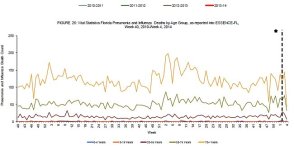
Florida Wk 3.jpg

http://www.floridahealth.gov/diseas...za/_documents/2013-14/2014-w03-flu-review.pdf
 
Re: Florida 2013-14 Flu Season Wks 43-04: 2 New Pediatric Deaths, 3 Total

Re: Florida 2013-14 Flu Season Wks 43-04: 2 New Pediatric Deaths, 3 Total

Wk 04, ending Jan 25

Two pediatric influenza-associated deaths were reported in week 4; one in an unvaccinated Orange County resident with underlying
health conditions and one in an unvaccinated Miami-Dade County resident with underlying health conditions.
Three pediatric influenza-associated deaths have been reported in the 2013-2014 season.

One influenza or ILI outbreaks (epidemiologically-linked cases of influenza in a single setting) was reported in week 4, in a Marion County correctional facility.

In week 4, the number of visits to ILINet sentinels for ILI decreased in all age groups. The percent of visits to EDs and UCCs for ILI are lower that previous years at this time.

http://www.floridahealth.gov/diseas...za/_documents/2013-14/2014-w04-flu-review.pdf
 
Re: Florida 2013-14 Flu Season Wks 43-05: 0 New Pediatric Deaths, 3 Total

Re: Florida 2013-14 Flu Season Wks 43-05: 0 New Pediatric Deaths, 3 Total

Wk 05, ending Feb 1

No pediatric influenza-associated deaths were reported in week 5. Three pediatric influenza-associated deaths have been reported in the 2013-2014 season.

227 preliminary estimated pneumonia and influenza deaths were reported.
Upper bound of 95% confidence interval for prediction: 263 deaths.
No excess deaths.

No influenza or ILI outbreaks (epidemiologically-linked cases of influenza in a single setting) were reported in week 5.

In week 5, 32 of 73 specimens submitted for influenza testing at BPHL tested PCR positive for influenza. Twenty-three were PCR positive for influenza A (2009 H1N1), three were PCR positive for influenza A unspecified, two were PCR positive for influenza A (H3) and four were PCR positive for influenza B. All of these are seasonal strains of influenza.

http://www.floridahealth.gov/diseas...za/_documents/2013-14/2014-w05-flu-review.pdf
 
Re: Florida 2013-14 Flu Season Wks 43-14: 0 New Pediatric Deaths, 4 Total

Re: Florida 2013-14 Flu Season Wks 43-14: 0 New Pediatric Deaths, 4 Total

Wk 14, ending Apr 5

? No pediatric influenza-associated deaths were reported in week 14. Four pediatric influenza-associated deaths have been reported in the 2013-2014 season. Note: The 4th death was reported in week 11.

? This season, FDOH has received reports of severe influenza illness, including hospitalizations, requiring intensive care unit (ICU) care among pregnant women.
? None of these women received the 2013-2014 influenza vaccine.
? Most Florida counties are reporting mild influenza activity. In week 14, 35 counties reported decreasing influenza activity; 27 counties indicated activity is at a plateau.
? Emergency department (ED) and urgent care center (UCC) influenza-like illness (ILI) visits have decreased in recent weeks and is as expected for this time of year; preliminary data suggest that the influenza season has peaked.
? While activity statewide is generally decreasing, those at high risk for infection, such as pregnant women, are among those presenting to EDs and UCCs for care.
? Pregnant women are among those at high risk for severe complications due to influenza infection. More information can be found here: http://www.floridahealth.gov/diseas...uments/2013/flu-fact-sheet-pregnant-women.pdf.
? In Florida, the most common influenza subtype detected at the Bureau of Public Health Laboratories (BPHL) in recent weeks has been influenza A (2009 H1N1).
? In week 14, 4 of 14 specimens submitted for influenza testing at BPHL were PCR positive for influenza. Two were PCR positive for influenza A (H3) and two were PCR positive for influenza A (2009 H1N1). All of these are seasonal strains of influenza.
? Nationally (including Florida), almost all circulating influenza is a good match for the vaccine.
? No influenza or ILI outbreaks (epidemiologically-linked cases of influenza in a single setting) were reported in week 14.
? The preliminary estimated number of Florida deaths due to pneumonia or influenza in week 13 is lower than the seasonal baseline, based on previous years? data. Estimated deaths due to pneumonia and influenza are identified using preliminary death certificate data.
? Because of local influenza activity in some areas of the state, Florida reported local influenza activity to CDC in week 14. This activity level represents the geographic spread of influenza in Florida.

http://www.floridahealth.gov/diseas...za/_documents/2013-14/2014-w14-Flu-Review.pdf
 
Back
Top