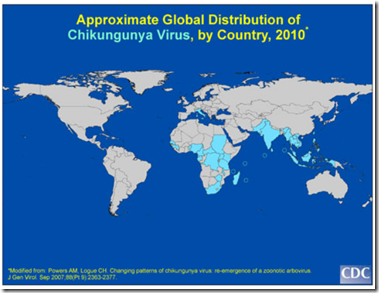
Re: Flaccid Paralysis observed in Tamil Nadu Chikungunya patients
hat tip Michael Coston -
Chikungunya & Reports Of Flaccid Paralysis In India
# 5329
An interesting (
although possibly misleading) report appears in today?s
Deccan Chronicle on Chikungunya (
CHKV) infections and reports of new
`polio-like? acute flaccid paralysis (
AFP) complications occurring in Tamil Nadu (
southern India) and
Andaman & Nicobar Islands (
bay of Bengal) during 2010.
First the story, which openly suggests that CHKV has
`gone rogue? (presumably meaning: mutated to a more virulent form) ? but in actuality provides very little evidence to support the notion.
Following that, I?ve some cites that indicate that these sorts of complications aren?t exactly new.
Rogue chikungunya attacks Chennai, docs for caution
February 21st, 2011
The government may have vehemently denied the presence of chikungunya in the state last year, but studies have found that the viral disease has begun to exhibit rogue symptoms. The ICMR's Regional Medical Resource Centre has analysed over 1,000 cases of the disease from Tamil Nadu and Andaman & Nicobar Islands, and found that patients with chikungunya suffered from polio-like symptoms of ?flaccid paralysis.?
<SNIP>
?However, the disease seems to have taken on an unusual turn in 2010. Patients suffered neurological symptoms of short-term paralytic attacks. Once the spasm passed, they found that their limbs were left weakened. They were not able to use their limp arms and legs,? explained Dr Elango.
(Continue . . . )
This report goes on to state that the ICMR was studying the virus strain looking for mutations or genetic changes that might explain these new symptoms.
Admittedly, declarations of feared or suspected
`viral mutations? are nothing new to the Indian press (see
here,
here, and
here) and so I tend to take these stories with a very large grain of salt.
Nevertheless, given the explosion in Chikungunya cases around the world since 2004, the emergence of a new, more virulent
`rogue? strain of CHKV capable of causing a
`polio-like? illness would be pretty big news.
And with viruses, mutations are always possible.
A hasty search turns up a number of references to flaccid paralysis as a symptom of Chikungunya, however, going back to at least 2006.
Epidemiol Infect. 2008 Sep;136(9):1277-80.
Four cases of acute flaccid paralysis associated with chikungunya virus infection.
Singh SS, Manimunda SP, Sugunan AP, Sahina, Vijayachari P.
GB Pant General Hospital, Port Blair, Andaman and Nicobar Islands, Port Blair-744101, India.
Abstract
The recent epidemic of chikungunya fever (2005-2006) in India has affected millions of people. The Andaman and Nicobar Islands, an archipelago situated in the Bay of Bengal 1200 km from peninsular India, also witnessed an outbreak of chikungunya fever starting in July 2006 which affected thousands of people.
Chikungunya fever classically manifests as high fever, myalgia, arthralgia and arthritis and in a certain percentage of cases with maculopapular rashes. However, deviation from the classical clinical features of chikungunya fever was reported in the earlier and recent epidemics.
During the recent epidemic in the Andaman and Nicobar Islands we came across ten cases of flaccid limb weakness following symptoms and signs suggestive of chikungunya fever. In four subjects we confirmed the diagnosis of chikungunya virus infection by serological method (IgM ELISA method). This is the case report of those four subjects.
In
Chikungunya Fever: An Epidemiological Review of a Re-Emerging Infectious Disease (
J. Erin Staples, Robert F. Breiman, and Ann M. Powers) which was published in the Journal
Clinical Infectious Diseases in September of 2009, we learn:
During early epidemics, rare but serious complications of the disease were noted, including myocarditis, meningoencephalitis, and mild hemorrhage [8, 39, 42, 43]. From recent epidemics, further neuroinvasive complications have been recognized, including Guillan-Barr? Syndrome, acute flaccid paralysis, and palsies [44?48].
(Citations below)
<cite>44. Chikungunya in paediatrics: epidemic of 2005?2006 in Saint-Denis, Reunion Island. <abbr>Arch Pediatr</abbr> 2008;15:253-62.</cite>
<cite>45. Guillain-Barr? syndrome complicating a chikungunya virus infection. <abbr>Neurology</abbr> 2007;69:2105-7.</cite>
<cite>46. Neurological complications in chikungunya fever. <abbr>J Assoc Physicians India</abbr> 2007;55:765-9.</cite>
<cite>47. Chikungunya virus induced sudden sensorineural hearing loss. <abbr>Int J Pediatr Otorhinolaryngol</abbr> 2008;72:257-9.</cite>
<cite></cite><cite>48. Four cases of acute flaccid paralysis associated with chikungunya virus infection. <abbr>Epidemiol Infect</abbr> 2008;136:1277-80.</cite>
Convincing evidence that flaccid paralysis has been ?
on rare occasions - associated with CHKV infection prior to the past year.
While
primarily associated with fever, rash, and arthralgias, the finding that
CHKV should produce occasional neurological symptoms (
including AFP) isn?t completely surprising.
Chikungunya is an alphavirus, after all; a genus that includes a number of mosquito borne encephalitis-producing viruses (e.g. Eastern Equine Encephalitis, Western Equine Encephalitis, Venezuelan Equine Encephalitis).
Acute Flaccid Paralysis (AFP) has also been observed on rare occasions in association with a number of
other encephalitic infections, including
West Nile Virus,
St. Louis Encephalitis,
Japanese Encephalitis, and
enterovirus 71.
The article that appears in today?s Deccan Chronicle provides us with precious few details.
We are not told how many cases of AFP have been detected recently among confirmed CHKV cases in Tamil Nadu, or whether the ICMR has actually found any molecular changes to the virus they?ve been looking for.
All of which leaves us with which to gauge the actual significance of today?s news report.
But changes to the virus or not, Chikungunya is a serious and growing concern around the world, and it even has the potential to spread to the Southern United States and parts of Europe.
Until more information is forthcoming on today?s story, for more on the Chikungunya virus and other arboviral threats, you may wish to revisit the following blogs: