• FluTrackers.com Inc. does not provide medical advice. Information on this web site is collected from various internet resources, and the FluTrackers board of directors makes no warranty to the safety, efficacy, correctness or completeness of the information posted on this site by any author or poster. The information collated here is for instructional and/or discussion purposes only and is NOT intended to diagnose or treat any disease, illness, or other medical condition. Every individual reader or poster should seek advice from their personal physician/healthcare practitioner before considering or using any interventions that are discussed on this website. By continuing to access this website you agree to consult your personal physican before using any interventions posted on this website, and you agree to hold harmless FluTrackers.com Inc., the board of directors, the members, and all authors and posters for any effects from use of any medication, supplement, vitamin or other substance, device, intervention, etc. mentioned in posts on this website, or other internet venues referenced in posts on this website.
  • We are not asking for any donations. Do not donate to any entity who says they are raising funds for us.

Finnish Food Safety Authority: H5N1 Detected In Additional Fur Farms (n=65)

Michael Coston

Editor, Senior Moderator
Finnish Food Safety Authority: H5N1 Detected In 10 Additional Fur (Foxes) Farms
AVvXsEg9QZEJJ32l06LonOLPrcHI7UQ-eTIXfiOxYYI98TPHSJezgO_PF_YIvdaj4_yMPmPjb6jBdex-2tZKNZW2n5T7Ho1sBnwMNMz2017jfEbnZnZidGupP9KbFT9Cjxf3lPVa6wzirs9-FXD6C4GrW-pWyiRgZK0NEvS2pqH1uOnEjlI-Fz5JDP8BtQ


#17,755

Last July Finland reported an outbreak of H5N1 in 20 fur farms (foxes, raccoons, mink), and after a slow initial response, on August 1st their food safety authority announced the decision to cull all of the mink housed at 3 H5N1 affected farms.

As for the tens of thousands of infected foxes and raccoons, they stated that `Decisions to cull other animals will be made on a case-by-case basis'.


A little more than a week later (Aug 8th), Finland's Institute for Health and Welfare (THL) released a strong statement urging the Food Authority to take more decisive actions, warning:

Although mink is considered to be the most problematic animal species in terms of avian influenza virus infections, there are also risks associated with bird flu epidemics in dense, large animal populations of foxes and other fur-bearing animals, that the virus becomes more adaptable to mammals.


A week later Ruokavirasto pledged to test all of the fur farms in the country (n > 400), but stated it would take months to complete. Two months ago (Sept 13th) the Food Safety Authority finally ordered All Animals From Bird Flu Infected Fur Farms Be Euthanized.

Last week, after 60 days of testing mink farms, only 3 additional farms were reported positive, and Ruokavirasto stated that they were moving on to test fox and raccoon farms.​


Today we learn from a press release, that in the first week of this new survey, that 10 farms tested positive. Since this was out of only 38 farms tested - that is a much higher percentage (26.3%) than anyone was expecting.

Bird flu was found in ten fox farms

November 10, 2023

In the mapping of fox and raccoon kennels, which started quietly, bird flu has been found in ten kennels. Infection centers are located in the five provinces where cases of bird flu have occurred in the past. So far, 38 fox and raccoon kennels have been examined in the survey. All of these have had foxes and a few also have raccoon dogs.

The mapping of the fox and raccoon kennels really started in week 45. More bird flu has already been found there than in the mink mapping carried out earlier, where bird flu was found in only three kennels. Possibly foxes are more sensitive than minks to getting infected with bird flu, or the bird protection of fox farms has not been as good as that of mink farms, or there have been more fox farms in areas where there have been many bird flu infections of wild birds.

The shelters found to be positive in the fox and raccoon survey are located in Ostrobothnia, Southern, Central and Northern Ostrobothnia and Satakunta. The locations of the shelters and animal species information will be published later on the Food Agency's website, as long as the regional administrative agency has first been in contact with those concerned.

In bird flu mapping, blood samples are taken from foxes and raccoons in fur farms. The samplers are mainly municipal veterinarians. The Regional Administrative Agency of Western and Central Finland is responsible for organizing the sampling and coordinating the mapping for the whole of Finland. The survey targets approx. 330 fur farms that have foxes or sable dogs or both. Before the survey began, bird flu had been found in 28 fur farms with foxes and/or raccoons. In total, bird flu has now been found in 42 fur farms.

In the Food Agency's laboratory, the blood samples are first tested for antibodies caused by the Influenza A virus using the ELISA method. Antibody-positive samples are confirmed by the HI method ( hemagglutination inhibition ). The method examines the binding of the antibodies in the sample to the HA protein of the influenza A virus, which is the same subtype as the virus isolated from fur farms. The test accurately identifies antibodies to the H5 virus.

The Food Agency will order animals to be euthanized from fur farms whose samples show antibodies to H5 bird flu.


The detection of H5N1 now in 42 fur farms in Finland is highly concerning, but it begs the question, how many other fur farms around the world are similarly infected?

There is often a good deal of resistance to testing - particularly when animals appear healthy - and in many parts of the world, the resources simply aren't available. Even Finland is struggling to test all of their farms.​


Long chains of infection can allow a virus to better adapt to a new host, as demonstrated by the classic serial passage experiment shown below.


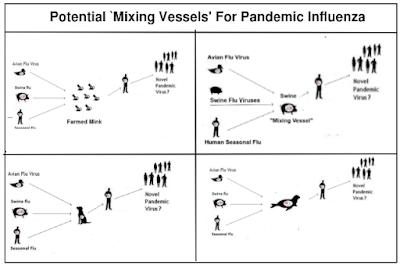
Although infected mink are are considered particularly problematic (see Mink farming poses risks for future viral pandemics by Thomas P. Peacock and Wendy S. Barclay), anytime you see a novel virus spreading (even asymptomatically) through a large population of animals, it is a cause for concern.

Fur farms aren't the only potential flash point for the emergence of a pandemic flu strain - but like live poultry markets - it is a venue over which we can exercise some control.​


Assuming of course, we have the foresight, and will, to do do.


https://afludiary.blogspot.com/2023/11/finnish-food-safety-authority-h5n1.html

 
Last edited:
Finnish Food Safety Authority: H5N1 Detected In 14 Additional Fur (Fox) Farms


AVvXsEjVHond6AHhvTz_V0N2s3W1RKeeio0UtBPY-6wNEAEARHWJf6CCx0Dhtw0LFw8V60fzLpYtF_VEDAlamSO7yzwFgsygXzuDlJxaWOg-jBA40z9sVZn_R4XyelYy4V0_N5YA9VIKraqovJAIMZS7sJ4-UVt-PWui8MvqJIY9899T3ywsAU5yVEKIQQ


#17,772


Last July Finland reported an outbreak of H5N1 in 20 fur farms (foxes, raccoons, mink), and after a slow initial response, the Finnish Food Safety Authority (Ruokavirasto) announced a plan to test all mink farms (starting in September), to be followed by testing all other fur farms (beginning in November).

Last summer, in PNAS: Mink Farming Poses Risks for Future Viral Pandemics, we looked at an excellent opinion piece penned by two well known virologists from the UK (Professor Wendy Barclay & Tom Peacock) on why fur farms - and mink farms in particular - are high risk venues for flu.​

Only 6 mink farms were identified as infected as of November 1st, but eleven days ago Ruokavirasto announced that in their first week of testing non-mink fur farms, 10 of 38 farms tested (26.3%) were positive for HPAI H5N1 antibodies.

This was an unexpected finding, and while the agency has not published any new press releases, they have since updated their list of affected fur farms twice, adding an additional 14 fur farms (see graphic below).


We don't currently know how many farms have been tested, but this is a remarkable increase. In their last update on November 10th, the Finnish Food Authority suggested:
Possibly foxes are more sensitive than minks to getting infected with bird flu, or the bird protection of fox farms has not been as good as that of mink farms, or there have been more fox farms in areas where there have been many bird flu infections of wild birds.

The Finnish Food Agency is using antibody testing rather than PCR testing, in order to more quickly identify farms that have been infected. This does not, however, reveal whether these animals are currently infected, only that they have (probably fairly recently) been infected.

Doing individual PCR tests on hundreds of thousands of farm animals is simply impractical, and so any foxes/mink kept on farms that test positive for H5N1 antibodies have been ordered to be euthanized.
FIFUR, the Finnish Fur Breeders’ Association, has gone on record vehemently opposing this type of testing, and the culling policy.

FIFUR opposes only H5N1 antibody testing of fur animals and euthanasia of healthy animals as a violation of the Animal Diseases Act

FIFUR and the certified fur breeders within its scope oppose the exclusive antibody testing of fur animals introduced by the Food Agency and the forced euthanasia of tens of thousands of healthy animals based on antibodies alone. FIFUR demands the authorities to return to the broader diagnostics required by law and to apply legal measures. According to FIFUR's view, antibody testing alone and the harsh coercive measures imposed on its basis are against the Animal Diseases Act and violate the basic legal property protection of entrepreneurs.

Although this particular policy may end up decided by the Finnish courts, the greater concern is that fur farms are ideal breeding grounds for new, and potentially dangerous, novel flu and COVID strains (see CDC: New IRAT Risk Assessment On Mink Variant of Avian H5N1).

But by putting thousands of highly susceptible animals into close quarters (often with poor biosecurity), we are giving H5N1 and SARS-CoV-2 (and other emerging viruses) ample opportunities to adapt to mammals and begin a world tour.​

A few past blogs include:
Over the past 3 years the amount of H5N1 in the environment has grown dramatically, making certain practices - like fur farming - far riskier than they used to be, and much harder to justify.

Like it or not, we must either adjust and adapt to this `new normal', or risk something much worse.

https://afludiary.blogspot.com/2023/11/finnish-food-safety-authority-h5n1_21.html
 
Finnish Food Safety Authority: H5N1 Detected In 4 More Fur Farms (n=60) - MMM Response to FIFUR Opposition


AVvXsEjimukh3s11NRudk2p1uKZjWF4NYG4hkOHtD7DfGwFrZ4UsTITYvZwHtgTs5vBbVf7aahq5gLPXY1bBYUqBHXjkbVqjdlxAJyB3uBGbwJfUpn1lEb23sfNGLCFSVNm34u82DHc2ocCMDR-PX2I3_ij3h7YA0zPon9v9H2OvxHy_tj9GV_oPjqecbA


#17,775

Overnight the Finnish Food Agency has added 4 more fur farms to their infected list (see below), bringing the total to 60, with 18 of those reported in the past two weeks (see FFSA:H5N1 Detected In 14 Additional Fur (Fox) Farms).


Unexpectedly, non-mink farms are testing positive at a much higher rate than mink farms.We don't currently know how many farms have been tested, but 90% of infected farms have been in foxes.

In their last update on November 10th, the Finnish Food Authority suggested:

Possibly foxes are more sensitive than minks to getting infected with bird flu, or the bird protection of fox farms has not been as good as that of mink farms, or there have been more fox farms in areas where there have been many bird flu infections of wild birds.

A little over two months ago, after nearly two months of debate, the Finnish Food Safety Authority Ordered All Animals From Bird Flu Infected Fur Farms Be Euthanized. This has led to the destruction of tens of thousands of animals.

The Finnish Food Agency is using antibody testing rather than PCR testing, in order to more quickly identify farms that have been infected. FIFUR, the Finnish Fur Breeders’ Association, has gone on record vehemently opposing this type of testing, and the culling policy.
In response, yesterday the Finnish Ministry of Agriculture and Forestry (MMM) released the following statement:

November 22, 2023

The Ministry of Agriculture and Forestry disputes the view of FIFUR of the Finnish Fur Breeders' Association (bulletin 17.11.2023) that the measures to eradicate bird flu in fur animals would be unreasonable and excessive.

"The measures are based on the powers laid down for the Food Agency in the Animal Diseases Act and the use of discretion left to the authority by the legislature in a way that is considered necessary to protect human health," states the ministry's response.

The ministry emphasizes that the termination of fur animals is always a hard blow to an individual fur breeder, but on the other hand, the future of the industry is best secured if the related risk to human health can be removed.


Fur farming is increasingly viewed as presenting a legitimate pandemic risk, since these animals have a long record of being susceptible to both novel flu viruses and COVID (see That Touch of Mink Flu (2023 Edition).


Last summer, in PNAS: Mink Farming Poses Risks for Future Viral Pandemics, we looked at an excellent opinion piece penned by two well known virologists from the UK (Professor Wendy Barclay & Tom Peacock) on why fur farms - and mink farms in particular - are high risk venues for flu.

But fur farming - like live poultry markets in Asia or the bush meat trade in Africa - are long held traditions, and despite their public health risks, getting people to move away form them has been a tough sell.​

While closing these types of operations won't prevent all future pandemics, it could go a long way in reducing their frequency.

Given their potential impact, the fewer we have endure, the better.

https://afludiary.blogspot.com/2023/11/finnish-food-safety-authority-h5n1_23.html
 
Finland: H5N1 Detected In 5 More Fur Farms (n=65)


#17,783

Last July Finland reported an outbreak of H5N1 in 20 fur farms (foxes, raccoons, mink), and after a slow initial response, the Finnish Food Safety Authority (Ruokavirasto) announced a plan to test all mink farms (starting in September), to be followed by testing all other fur farms (beginning in November).


Over the next 100 days (Aug 1st-Nov 9th) 12 additional farms were reported to be infected, and of these first 32, only 6 were mink farms. The rest were fox or raccoon farms.​

With hundreds of fur farms operating in Finland, testing is expected to extend into 2024. What wasn't expected was the high percentage of non-mink fur farms testing positive for antibodies to H5N1.

Since routine testing of non-mink farms began earlier this month, we've seen the total number of infected farms double.​

First with 10 Additional Fur (Foxes) Farmson November 10th, followed by two reports last week adding 14 Additional Fur (Fox) Farms on Tuesday, and 4 More Fur Farms (n=60) a couple of days later.

Today, the Finnish Food Safety Authority has added 5 more farms to their list (see below), bringing the total to 65. (Note: The only updates we've seen recently have been to the lists).


One metric we haven't seen updated (since Nov 10th) is the total number of farms tested to date. Two weeks ago, roughly 25% of non-mink fur farms tested positive.

While the initial outbreak was discovered last July following unusual mortality events on affected farms (see Eurosurveillance Report), routine antibody testing is turning up evidence of the virus on farms without obvious signs of infection.

This has raised the ire of fur farmers, who point out that antibody tests only indicate if animals had been exposed to the virus in the past, not whether they are currently infected.​

FIFUR, the Finnish Fur Breeders’ Association, has gone on record vehemently opposing this type of testing, and the culling policy (see press release FIFUR opposes only H5N1 antibody testing of fur animals and euthanasia of healthy animals as a violation of the Animal Diseases Act).

Last week the Finnish Ministry of Agriculture and Forestry (MMM) released a response (MMM: The Food Agency's actions at fur farms are necessary to protect people).​

Admittedly, PCR testing would tell us if an animal is currently infected, but that type of testing on hundreds of farms - each with tens of thousands of animals - is simply impractical.

Of course, even if a farm tests negative today (via PCR or antibody testing), there is no guarantee the virus won't turn up there next week or next month.​

While Ruokavirasto continues to update their H5N1 infected farms list, four months into this outbreak we still know frustratingly little about the spread of this virus in these farms.

How is it getting into these farms?

What biosecurity measures have failed or can be improved?

What percentage of tests are coming back positive?

Is it spreading from animal-to-animal or is there some other action at work?

And are there any other genetic changes (beyond what was reported last August) to the virus?

Without answers to these questions (and others), the the virus is likely to run roughshod over Finland's fur industry, and poses the same threat to fur farms in other countries as well.

Stay tuned.

https://afludiary.blogspot.com/2023/11/finland-h5n1-detected-in-5-more-fur.html
 
Finland: Food Safety Authority Statement On H5N1 In Fur Farms


AVvXsEgeVhisthH1yBBieSR3DojP2LfG4QLCzUOH4gyV4WXtUdTMiWzBmgUEnJ4NR1D6T6JI50bhCvf0_e-mhCThuw_CNheOkMPaeExP_BLC9ki4iFqviyZRvAGU8Tl2gooi3qhSIwnHkjHhMLU32oqppMAD7yn5Kqg2xoMYW5hOxMjguGa7qAIoj0RVYg

#17,791


According to the Finnish Food Safety Authority (Ruokavirasto), more than half of the fur farms in Finland have now been tested for avian H5N1, with 32 farms testing positive in the month of November. In all, 65 farms have tested positive since July.

This is the first statement we've seen since November 10th, although we've seen the infected farm list updated several times.​

First today's statement, after which I'll has a postscript.

The bird flu survey of foxes and raccoons has progressed rapidly

November 30, 2023

The avian flu survey for domesticated foxes and raccoons has progressed more than halfway. The Food Agency's laboratory has examined samples from 182 fur farms, of which bird flu has been found in 32 farms. The infected fur farms are located in the five provinces where bird flu infections have occurred before.

The bird flu survey of the fox and raccoon kennels really started in week 45, and more bird flu has been found in the survey than in the mink kennels. In the first carried out survey of mink farms, bird flu was found in only three farms out of more than a hundred examined. Possibly foxes are more sensitive than minks to getting infected with bird flu, or the bird protection in fox farms has not been as good as in mink farms.

In the survey, blood samples were taken from foxes and sable dogs in fur farms. The Regional Administrative Agency of Western and Central Finland has been responsible for organizing the sampling and coordinating the mapping for the whole of Finland. The samplers are mainly municipal control veterinarians, who have performed their work effectively. Samples have already been taken from 216 shelters and there are still around 80 shelters left. Sampling has been carried out in the nurseries in good agreement with the producers.

In the Food Agency's laboratory, the blood samples are first tested for antibodies caused by the Influenza A virus using the ELISA method. Antibody-positive samples are confirmed by the HI method ( hemagglutination inhibition ). The method examines the binding of the antibodies in the sample to the HA protein of the influenza A virus, which is the same subtype as the virus isolated from fur farms. The test accurately identifies antibodies to the H5 virus.

A total of 65 fur farms have been diagnosed with bird flu. So far, the Food Agency has ordered the culling of fur animals from 53 shelters. The total number of animals ordered to be killed is about 425,000, of which there are about 121,000 minks, about 287,000 foxes and about 17,000 raccoons. The preparation of termination decisions is in progress for 12 shelters. The basis for termination decisions is the protection of people's health.

While Finland initially concentrated their efforts on testing for H5N1 in mink - which are regarded as particularly susceptible to influenza A viruses - the surprise has been the high seropositivity among foxes and raccoons.

Finland's Institute for Health and Welfare (THL) warned of this possibility last August, writing:

Although mink is considered to be the most problematic animal species in terms of avian influenza virus infections, there are also risks associated with bird flu epidemics in dense, large animal populations of foxes and other fur-bearing animals, that the virus becomes more adaptable to mammals.

With the detection of H5N1 in 65 mixed species fur farms in Finland, it begs the question, how many other fur farms around the world are similarly infected?

Unfortunately, unless unusual mortality events are reported to local authorities, it is highly likely that no one is looking.


https://afludiary.blogspot.com/2023/11/finland-food-safety-authority-statement.html
 
Back
Top Bottom