

kent nickell
Well-known member
This article has probably been posted before but I just thought I'd emphasize some of their findings with the ferret model and some of the polymorphisms between a few of the viruses....
Four of five human isolates tested were highly lethal for both mice and ferrets and exhibited a substantially greater level of virulence in ferrets than other H5N1 viruses isolated from humans since 1997. Rapid disease progression and high lethality rates in ferrets distinguished the highly virulent 2004 H5N1 viruses from the 1997 H5N1 viruses. The highly virulent viruses replicated to high titers in the mouse and ferret respiratory tracts and spread to multiple organs, including the brain.
Four viruses isolated from humans, VN1203, VN1204, Thai16, and Kan353, caused severe lethargy in all infected ferrets that was accompanied by anorexia, rhinorrhea, dyspnea, diarrhea, and a mean maximal weight loss of 16 to 23% (Fig. 3 and Table 3). Furthermore, at least two-thirds of the animals died by day 9 p.i., indicating that these viruses are highly virulent for ferrets.
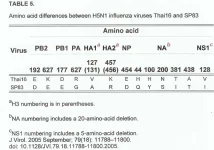
Thai16 and SP83 viruses, both isolated from humans in Thailand, are genetically similar but were strikingly different in their virulence for mice and ferrets (Tables 2 and 3). The deduced amino acid sequences of these viruses differ by 13 amino acids in seven genes, including 627 of PB2 (Table 5). Thai16 virus has a Lys at PB2 627, while SP83 has a Glu, which may contribute to the difference in virulence in mice. Because reduced virulence was not observed in ferrets infected with VN1204 virus, the PB2 627 Lys/Glu disparity alone is unlikely to account for the difference in virulence for ferrets between the Thai 16 and SP83 viruses. Therefore, other amino acid changes between these viruses likely confer the differences in the pathogenic phenotypes observed in both mice and ferrets.
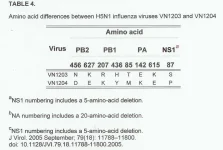
we have identified two H5N1 viruses isolated from humans (Thai16 and SP83) that cause substantially different diseases in both mice and ferrets but differ by only 13 amino acids, including the Lys/Glu difference at residue 627 of PB2 (Tables 4 and 5). Thai16 and SP83 viruses are candidates for reverse-genetics-based studies to identify molecular correlates for virulence using mice and ferrets as animal model systems.
These mammalian systems will be useful in identifying molecular correlates associated with virulence of HPAI viruses in mammals in order to predict the potential of newly emerging HPAI viruses to infect and cause severe disease in humans.
Avian Influenza (H5N1) Viruses Isolated from Humans in Asia in 2004 Exhibit Increased Virulence in Mammals
Taronna R. Maines,1 Xui Hua Lu,1 Steven M. Erb,1 Lindsay Edwards,1 Jeannette Guarner,2 Patricia W. Greer,2 Doan C. Nguyen,1 Kristy J. Szretter,1 Li-Mei Chen,1 Pranee Thawatsupha,3 Malinee Chittaganpitch,3 Sunthareeya Waicharoen,3 Diep T. Nguyen,4 Tung Nguyen,4 Hanh H. T. Nguyen, 5 Jae-Hong Kim,6 Long T. Hoang,5 Chun Kang,7 Lien S. Phuong,4 Wilina Lim,8 Sherif Zaki,2 Ruben O. Donis,1 Nancy J. Cox,1 Jacqueline M. Katz, 1 and Terrence M. Tumpey1*
Influenza Branch,1 Infectious Disease Pathology Activity, Division of Viral and Rickettsial Diseases, Centers for Disease Control and Prevention, Atlanta, Georgia 30333,2 Thai National Influenza Center, National Institute of Health, Ministry of Public Health, Bangkok, Thailand 11000, 3 National Center for Veterinary Diagnosis, Department of Animal Health, Ministry of Agriculture and Rural Development, Hanoi, Vietnam,4 National Institute of Hygiene and Epidemiology, Hanoi, Vietnam, 5 National Veterinary Research and Quarantine Service, Anyang 430-824, Korea,6 Laboratory of Respiratory Viruses, Department of Viruses, Korean National Institute of Health, Seoul, Korea,7 Hong Kong National Influenza Center, Government Virus Unit, Kowloon, Hong Kong Special Administrative Region, China8
*Corresponding author. Mailing address: Influenza Branch, Mail Stop G-16, DVRD, NCID, Centers for Disease Control and Prevention, 1600 Clifton Road, N.E., Atlanta, GA 30333. Phone: (404) 639-5444. Fax: (404) 639-2334. E-mail: tft9@cdc.gov.
Received April 9, 2005; Accepted June 2, 2005.
http://www.pubmedcentral.nih.gov/articlerender.fcgi?artid=1212624
whole paper: http://www.flutrackers.com/forum/showthread.php?t=14213
Four of five human isolates tested were highly lethal for both mice and ferrets and exhibited a substantially greater level of virulence in ferrets than other H5N1 viruses isolated from humans since 1997. Rapid disease progression and high lethality rates in ferrets distinguished the highly virulent 2004 H5N1 viruses from the 1997 H5N1 viruses. The highly virulent viruses replicated to high titers in the mouse and ferret respiratory tracts and spread to multiple organs, including the brain.
Four viruses isolated from humans, VN1203, VN1204, Thai16, and Kan353, caused severe lethargy in all infected ferrets that was accompanied by anorexia, rhinorrhea, dyspnea, diarrhea, and a mean maximal weight loss of 16 to 23% (Fig. 3 and Table 3). Furthermore, at least two-thirds of the animals died by day 9 p.i., indicating that these viruses are highly virulent for ferrets.
Thai16 and SP83 viruses, both isolated from humans in Thailand, are genetically similar but were strikingly different in their virulence for mice and ferrets (Tables 2 and 3). The deduced amino acid sequences of these viruses differ by 13 amino acids in seven genes, including 627 of PB2 (Table 5). Thai16 virus has a Lys at PB2 627, while SP83 has a Glu, which may contribute to the difference in virulence in mice. Because reduced virulence was not observed in ferrets infected with VN1204 virus, the PB2 627 Lys/Glu disparity alone is unlikely to account for the difference in virulence for ferrets between the Thai 16 and SP83 viruses. Therefore, other amino acid changes between these viruses likely confer the differences in the pathogenic phenotypes observed in both mice and ferrets.
we have identified two H5N1 viruses isolated from humans (Thai16 and SP83) that cause substantially different diseases in both mice and ferrets but differ by only 13 amino acids, including the Lys/Glu difference at residue 627 of PB2 (Tables 4 and 5). Thai16 and SP83 viruses are candidates for reverse-genetics-based studies to identify molecular correlates for virulence using mice and ferrets as animal model systems.
These mammalian systems will be useful in identifying molecular correlates associated with virulence of HPAI viruses in mammals in order to predict the potential of newly emerging HPAI viruses to infect and cause severe disease in humans.
Avian Influenza (H5N1) Viruses Isolated from Humans in Asia in 2004 Exhibit Increased Virulence in Mammals
Taronna R. Maines,1 Xui Hua Lu,1 Steven M. Erb,1 Lindsay Edwards,1 Jeannette Guarner,2 Patricia W. Greer,2 Doan C. Nguyen,1 Kristy J. Szretter,1 Li-Mei Chen,1 Pranee Thawatsupha,3 Malinee Chittaganpitch,3 Sunthareeya Waicharoen,3 Diep T. Nguyen,4 Tung Nguyen,4 Hanh H. T. Nguyen, 5 Jae-Hong Kim,6 Long T. Hoang,5 Chun Kang,7 Lien S. Phuong,4 Wilina Lim,8 Sherif Zaki,2 Ruben O. Donis,1 Nancy J. Cox,1 Jacqueline M. Katz, 1 and Terrence M. Tumpey1*
Influenza Branch,1 Infectious Disease Pathology Activity, Division of Viral and Rickettsial Diseases, Centers for Disease Control and Prevention, Atlanta, Georgia 30333,2 Thai National Influenza Center, National Institute of Health, Ministry of Public Health, Bangkok, Thailand 11000, 3 National Center for Veterinary Diagnosis, Department of Animal Health, Ministry of Agriculture and Rural Development, Hanoi, Vietnam,4 National Institute of Hygiene and Epidemiology, Hanoi, Vietnam, 5 National Veterinary Research and Quarantine Service, Anyang 430-824, Korea,6 Laboratory of Respiratory Viruses, Department of Viruses, Korean National Institute of Health, Seoul, Korea,7 Hong Kong National Influenza Center, Government Virus Unit, Kowloon, Hong Kong Special Administrative Region, China8
*Corresponding author. Mailing address: Influenza Branch, Mail Stop G-16, DVRD, NCID, Centers for Disease Control and Prevention, 1600 Clifton Road, N.E., Atlanta, GA 30333. Phone: (404) 639-5444. Fax: (404) 639-2334. E-mail: tft9@cdc.gov.
Received April 9, 2005; Accepted June 2, 2005.
http://www.pubmedcentral.nih.gov/articlerender.fcgi?artid=1212624
whole paper: http://www.flutrackers.com/forum/showthread.php?t=14213
Attachments
Last edited by a moderator:
