• FluTrackers.com Inc. does not provide medical advice. Information on this web site is collected from various internet resources, and the FluTrackers board of directors makes no warranty to the safety, efficacy, correctness or completeness of the information posted on this site by any author or poster. The information collated here is for instructional and/or discussion purposes only and is NOT intended to diagnose or treat any disease, illness, or other medical condition. Every individual reader or poster should seek advice from their personal physician/healthcare practitioner before considering or using any interventions that are discussed on this website. By continuing to access this website you agree to consult your personal physican before using any interventions posted on this website, and you agree to hold harmless FluTrackers.com Inc., the board of directors, the members, and all authors and posters for any effects from use of any medication, supplement, vitamin or other substance, device, intervention, etc. mentioned in posts on this website, or other internet venues referenced in posts on this website.
  • We are not asking for any donations. Do not donate to any entity who says they are raising funds for us.

Evidence of large scale Inapparent Infection in Cats

Ganseerpel

Advisory Board, Senior Moderator
An austrian research team did what should have been done before: Instaed of culling everything that could appear suspicious they put the animals in quarantine, waited and encountered a surprise....

CDC Volume 13, Number 2–February 2007

Research

Subclinical Infection with Avian Influenza A (H5N1) Virus in Cats

Michael Leschnik,* Joachim Weikel,† Karin Möstl,* Sandra Revilla-Fernández,† Eveline Wodak,† Zoltan Bagó,† Elisabeth Vanek,† Viviane Benetka,* Michael Hess,* and Johann G. Thalhammer*
*University of Veterinary Medicine, Vienna, Austria; and †Austrian Agency for Health and Food Safety Institute for Veterinary Disease Control, Mödling, Austria
Suggested citation for this article
Abstract
Avian influenza A virus subtype H5N1 was transmitted to domestic cats by close contact with infected birds. Virus-specific nucleic acids were detected in pharyngeal swabs from 3 of 40 randomly sampled cats from a group of 194 animals (day 8 after contact with an infected swan). All cats were transferred to a quarantine station and monitored for clinical signs, virus shedding, and antibody production until day 50. Despite unfamiliar handling, social distress, and the presence of other viral and nonviral pathogens that caused illness and poor health and compromised the immune systems, clinical signs of influenza did not develop in any of the cats. There was no evidence of horizontal transmission to other cats because antibodies against H5N1 virus developed in only 2 cats.

full text version
http://www.cdc.gov/eid/content/13/2/243.htm
 
Last edited:
Re: Evidence of large scale Inapparent Infection in Cats

I am reaching the edge of my envelope of competence with this question. If the study suggests that the only current way for cats to acquire H5N1 is by eating infected birds, what is the most likely method of B2C transmission? Is it the inhaling of virus while killing/eating, or is it the actual consumption of infected meat?

Consumption of infected meat seems to be the recurring theme for many of humans who are becoming infected, so would it appear that eating is the common method?

At that point, what part of the digestive process is responsible for transmitting the virus throughout the body? Is it the shedding of virus in the mouth itself during consumption? And if it involves the bloodstream, why are we not concerned about mosquitoes moving the virus as well as flies?

Thanks. Comments welcomed and encouraged.
Scott
 
Re: Evidence of large scale Inapparent Infection in Cats

moskitos have an antigen, which kills flu.
You also breath through the mouth, while eating.
Some fluids go through acidic stomach quickly.
Some parts of the food, small stones or bones or feathers might
leave hidden places for viruses to hide from stomach acid.

Infection of cat-intestine was assumed (but still somehow unclear?)
in the Kuijken-Rimmelzwaan experiments.
They also showed horizontal (respiratory) cat2cat

In the quarantine, the cats might behave differently than wild cats.
E.g. hunting, marking of territory, etc.
It could also go bird2cat2bird2... or mouse2cat2mouse2... or such
in the wild, but not in quarantine-stations
 
Re: Evidence of large scale Inapparent Infection in Cats

I am reaching the edge of my envelope of competence with this question. If the study suggests that the only current way for cats to acquire H5N1 is by eating infected birds, what is the most likely method of B2C transmission? Is it the inhaling of virus while killing/eating, or is it the actual consumption of infected meat?

Consumption of infected meat seems to be the recurring theme for many of humans who are becoming infected, so would it appear that eating is the common method?

At that point, what part of the digestive process is responsible for transmitting the virus throughout the body? Is it the shedding of virus in the mouth itself during consumption? And if it involves the bloodstream, why are we not concerned about mosquitoes moving the virus as well as flies?

Thanks. Comments welcomed and encouraged.
Scott
I don't know the whole answer, but here is some info from DEFRA :
http://www2.defra.gov.uk/research/pr...26&M=CFO&V=UEB

...infection of carnivores through oral ingestion of infected prey may be less pathogenic than infection of other hosts by other routes of transmission, such as inhalation or vector-borne transmission. High rates of seroconversion (with low morbidity or mortality) in carnivore and scavenger species have been recorded to a wide range of pathogens. Examples include rabbit haemorrhagic disease in foxes, where there is no evidence of pathogenicity, despite seroconversion (Philbey et al., 2005), and free-roaming (scavenging) domestic dog populations, in which seroconversion to Ebola virus (Allela et al., 2005), plague (Chomel et al., 1994: Leighton et al., 2001), Influenza A H5N1 (Butler, 2006) and anthrax (Cleaveland, unpublished data) have been recorded without evidence for widespread pathogenicity....

It makes sense that scavengers need to be adapted to handle pathogens from dead animals without being killed themselves. PMaybe the ones who do die somehow get a dose too large to handle, possibly by eating several carcasses instead of just one and moving on. Generalist/omnivorous species such as crows pigs also seem to have this ability.

As for humans, it must be true that significant numbers of people are eating infected chickens without getting ill. Now whether they are seroconverting is another issue. There must be some gray zone between full-blown illness and seroconversion that happens at lower exposure levels. The poultry worker exposure data are suggestive that there is some effect, but there aren't enough data to conclude much.

This link has a study of sialic acid recptors in cat intestines:
http://grippeaviaire.veille.inist.fr/IMG/pdf/grippeAvril.pdf
 
Last edited:
Re: Evidence of large scale Inapparent Infection in Cats

Another less obvious route would be through infected gums and scratches along the digestive tract. A bone scraping the throat or bleeding gums would be all that was necessary. Even a cut paw could be an entry.
 
Re: Evidence of large scale Inapparent Infection in Cats

There is empirical evidence that Infection can occur in a wide range of different tissues including the nasopharynx, the trachea the lung as well as in the digestive system and mesodermal tissue. As to the RT - It seems that ? under normal conditions - IGG contribute only lttle to protection of the upper respiratory tract (URT) but play a major role in the lung. In contrast IGA are highly protective in the URT but provide no protection in the LRT. (In humans, live i.n. vaccines stimulate the production<SUP> </SUP>of both nasal mucosal IgA and IgG Abs and plasma IgG, whereas<SUP> </SUP>inactivated vaccines given i.m. stimulate systemic IgG production,<SUP> </SUP>but not local mucosal IgA Ab).<?xml:namespace prefix = o ns = "urn:schemas-microsoft-com:office:office" /><o:p></o:p>
<o:p></o:p>
In the URT a 2,6 alpha SA independent binding mecanism is discussed as it has been demaonstrated, that human nasopharyngeal, adenoid and tonsillar tissues can be infected with H5N1 viruses in spite of an apparent lack of these receptors.<o:p></o:p>

Reference: <o:p></o:p>
Review of Aerosol Transmission of Influenza A Virus<o:p></o:p>
Raymond Tellier*? <o:p></o:p>
*Hospital for Sick Children, Toronto, Ontario, Canada; and ?University of Toronto, Toronto, Ontario, Canada<o:p></o:p>
<o:p></o:p>
The Journal of Immunology, 2004, 173: 1978-1986.<o:p></o:p>
Role of IgA versus IgG in the Control of Influenza Viral Infection in the Murine Respiratory Tract1 <o:p></o:p>
Kathryn B. Renegar<o:p></o:p>
<o:p></o:p>
Letter<o:p></o:p>
Tropism of avian infuenza A (H5N1) in the upper and lower respiratory<o:p></o:p>
tract<o:p></o:p>
1/10/07 Nature Publishing Group<o:p></o:p>
J M Nicholls1, M C W Chan2, W Y Chan2, H K Wong2, C Y Cheung2, D L W Kwong3, M P Wong1, W<o:p></o:p>
 
Re: Evidence of large scale Inapparent Infection in Cats

Competence? This is waaay over my head.

Yet I still have to ask why these poultry eating discussions for human infection are not distinguishing cooked poultry from the preparation and contact with uncooked poultry.

I've just prepared a chicken for dinner tonight. Frankly it's a royal pain making sure that every surface is properly cleaned, and I keep messing up with the order of cleaning things, re-contacting things, and then having to start all over again.

Those poor boys that ingested raw duck-blood pudding on a dare seem, IMO, to be indicative of what's happenind. I can't recall reading about a case that really links cooked, infected poultry with human AI where the eater was not also the preparer or in the near vicinity at the time. So it still seems more probable to me that the transmission is from a raw remnant making its way into a human, which is more analogous to the cats and other animals.

J.
 
Re: Evidence of large scale Inapparent Infection in Cats

Someone needs to tell the cats to cook those birds. LOL
 
Re: Evidence of large scale Inapparent Infection in Cats

Given all these new concerns, even if we change to mostly canned chicken meat (ugh!) workers in the chicken canning factories will have a very hazardous job.

About the cats...

Has the apparent cat fatality rate changed from last year? Does there appear to be a similar number of cats dieing in the area of an outbreak?

.
 
Re: Evidence of large scale Inapparent Infection in Cats

It appears that human mucosal cells in the gut have a sialic acid receptor:
http://cat.inist.fr/?aModele=afficheN&cpsidt=1585138

Titre du document / Document title
Pancreatic tumour marker anti-mucin antibody CAM 17.1 reacts with a sialyl blood group antigen, probably i, which is expressed throughout the human gastrointestinal tract
Auteur(s) / Author(s)
ECCLESTON D. W. (1) ; MILTON J. D. (2) ; HOFFMAN J. (1) ; BARA J. (3) ; RHODES J. M. (2) ;
Affiliation(s) du ou des auteurs / Author(s) Affiliation(s)
(1) Department of Histopathology, Walton Hospital, Liverpool, ROYAUME-UNI
(2) Department of Medicine, University of Medicine, University of Liverpool, Liverpool, ROYAUME-UNI
(3) IRSC, Villejuif, Paris, FRANCE
R?sum? / Abstract
CAM 17.1 is an antimucin monoclonal antibody which has recently been proven valuable as a reagent for serological diagnosis of pancreatic cancer. A series of studies have been performed to characterise its epitope. First it was screened immunohistochemically against a wide range of formalin-fixed normal and neoplastic human tissues and showed widespread binding to mucin throughout the gastro-intestinal tract, in both normal and malignant tissues. In pancreas, strong intracellular staining of acinar and ductal cells was found in normal tissue and in carcinoma cells in tumours. Normal stomach showed only weak staining (n = 6), but gastritis with metaplasia showed strong staining (n = 4). Staining of colonic mucosa from patients of known Lewis phenotype showed Le(a+b-) (7/8) and Le(a-b+) (4/6) samples to be positive, but not Le(a-b-) (0/3) samples. CAM 17.1 agglutinated all donor erythrocytes tested at 4?C regardless of blood group, whereas cord blood red cells were not agglutinated. Since I antigen is the only antigen known to be present on all adult red blood cells but absent from cord blood, this suggests probable involvement of this antigen in the binding site. The agglutination was abolished by sialidase treatment of the red cells and immunoblotting with slot-blotted mucin showed that binding was both acid and sialidase sensitive indicating the involvement of sialic acid in the binding site. These studies show that CAM 17.1 binds to a sialic-acid-containing determinant of mucin, probably sialyl-I, which epitope shows wide distribution throughout the gastro-intestinal tract.
=================
Now isn't it interesting that the mucosal receptor is targeted in oral polio vaccine (Sabin), a killed virus type vaccine. Hmmm. Supposing the scavengers eating dead birds are mainly being exposed to dead virus. It makes sense to me that it is more likely that, if the timing is right, the dead virus stimulates an immune response but not infection.

And because humans also have a gut receptor for sialic acid in mucin cells, then a killed oral vaccine like the Sabin vaccine might work. Tonsils and Adenoids have mucin cells, by the way.
 
Re: Evidence of large scale Inapparent Infection in Cats

Very good observation, WetDirt. :applause:

That would might explain why some cats die and others live after exposure.


If humans eat chickens with DEAD H5N1 cells, we should be immune?

Why are humans catching it when their chickens die & they eat them?

Freshness kills???? :confused:

.
 
Re: Evidence of large scale Inapparent Infection in Cats

Good observation, Wetdirt. Rememer, everyone, that in terms of development, the lungs form as an outpouch of the GI tract, and as a result are endodermally derived too. And so even though we think of them as being very different, they are actually very similar in many ways. This may give some insight too into why some viruses notably H5N1 are able to cause such massive infections of both the intestines and the lungs, causing sometimes diarrhea and other times pneumonia and other times both at the same time.
 
Re: Evidence of large scale Inapparent Infection in Cats

Now isn't it interesting that the mucosal receptor is targeted in oral polio vaccine (Sabin), a killed virus type vaccine. Hmmm. Supposing the scavengers eating dead birds are mainly being exposed to dead virus. It makes sense to me that it is more likely that, if the timing is right, the dead virus stimulates an immune response but not infection.
Sabin vaccine is -in contrast to Salk Vaccine- a trivalent attenuated live virus vaccine which replicates in the intestinal mucosa targeting a specific PV receptor (CD 155). CD155 is a "member" of the immunoglobulin superfamily and not comparable with SA receptors of AI.

The immunogenity of Sabin vaccine is due its composition of live replicating virus, whereas (dead virus) Salk vaccine is only effective when administered i.m.

Moreover, available data concerning effectiveness of live/killed vaccine such as Flu mist support the hypothesis that immunogenity of killed virus or viral particles on mucosal surfaces is not sufficient to elicit an effective immune response. Mucosa linked immunity seems to require rather a life virus capaple of replication.

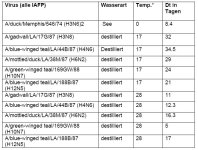
Supposing the scavengers eating dead birds are mainly being exposed to dead virus. It makes sense to me that it is more likely that, if the timing is right, the dead virus stimulates an immune response but not infection.
This is an interesting question! The references about virus viability are incomplete and in part contradictous. The most important parameters are temperature, salt concentration, and kind of medium.
Furthermore virus survival depends widely on the kind of subtype or strain.
In organic material such as body fluids, feces or manure the virus may maintain infectivity up to several months.
In 2001 infective virus was isolated from duck meat imported from China to Korea.
Stallknecht.jpg
source:Kristien Van Reeth Virologie-Labor
Veterin?rmedizinische Fakult?t Univ.Gent

AI viruses are rather robust so that the risk of ingestion of infectious matierial in cadavers is quite high
 
Re: Evidence of large scale Inapparent Infection in Cats

G?nseerpel said:
Moreover, available data concerning effectiveness of live/killed vaccine such as Flu mist support the hypothesis that immunogenity of killed virus or viral particles on mucosal surfaces is not sufficient to elicit an effective immune response. Mucosa linked immunity seems to require rather a life virus capaple of replication.

This still leaves the question of whether a vaccine targeting the intestinal mucosa might work, or be safer than one targeting the respiratory mucosa. It's not clear to me that the two locations will have the same immunogenicitiy.
 
Re: Evidence of large scale Inapparent Infection in Cats

I think the way of administration is a crucial point. Flumist seems to be a promising approach though present are not really convincing. Another issue which should be taken into account is adiuvants. In mucosal immunization, adiuvants are probably of particular importance.

The issue is not limited to AI questions: The current therapeutic options in dermal virusinfections like HPV (also dermal tumors) are poor and many parients could benefit from new therapeutic strategies.

(Sorry for this off topic.)
 
Back
Top