

Gert van der Hoek
In Memoriam - Editor, Senior Moderator
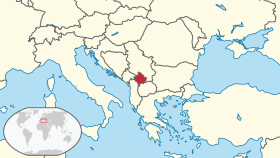
Location of Kosovo
EPISOUTH
Location: Kosovo
Event: CCHF
From 15th May 2010 to 13th August 2012, the National Institute of Public Health in Kosovo (NIPHK) reported 11 confirmed cases of Crimean-Congo Haemorrhagic Fever (CCHF), including 2 deaths (14 years and 16 years old).
About 1987 tick bites were reported during this period. Most of the cases are from endemic areas such as Mališevo municipality (8), Orahovac (2) and Suva Reka (1), cf. map 5.
Most of the cases occurred during the months of May and June 2010. 5 cases belong to group age over 50 years, 4 cases to the group age 10–19 years, and 2 to the age group 30-39 years.
A team form NIPHK and the regional Institute of Public Health (IPH) is investigating all suspect cases in the field, and taking preventive measures. In early spring foci areas have been disinfected at the municipality level.
Also, 24 hours reporting with feedback to all health levels in Kosovo is implemented at national level.
Comments: EPISOUTH
CCHF is a Nairovirus of the Bunyavirus family identified in 1956 in Congo and transmitted through tick bites.
In Kosovo, the first human cases were described in 1954 during an outbreak with 8 documented cases (cf; EpiSouth CCHF note).
During the past 15 years, cases have regularly been documented in Kosovo.
In 2009, 6 confirmed cases including 2 deaths were reported. This event does not constitute an alert for the country, but shows that CCHF is still circulating in the area.
Among other areas, CCHF is present in some EpiSouth countries such as Greece, Bulgaria, Turkey, Albania, and Kosovo. Evidence of CCHF circulation can also be found in most countries on the Black Sea coastline.
EPISOUTH
Location: Kosovo
Event: CCHF
From 15th May 2010 to 13th August 2012, the National Institute of Public Health in Kosovo (NIPHK) reported 11 confirmed cases of Crimean-Congo Haemorrhagic Fever (CCHF), including 2 deaths (14 years and 16 years old).
About 1987 tick bites were reported during this period. Most of the cases are from endemic areas such as Mališevo municipality (8), Orahovac (2) and Suva Reka (1), cf. map 5.
Most of the cases occurred during the months of May and June 2010. 5 cases belong to group age over 50 years, 4 cases to the group age 10–19 years, and 2 to the age group 30-39 years.
A team form NIPHK and the regional Institute of Public Health (IPH) is investigating all suspect cases in the field, and taking preventive measures. In early spring foci areas have been disinfected at the municipality level.
Also, 24 hours reporting with feedback to all health levels in Kosovo is implemented at national level.
Comments: EPISOUTH
CCHF is a Nairovirus of the Bunyavirus family identified in 1956 in Congo and transmitted through tick bites.
In Kosovo, the first human cases were described in 1954 during an outbreak with 8 documented cases (cf; EpiSouth CCHF note).
During the past 15 years, cases have regularly been documented in Kosovo.
In 2009, 6 confirmed cases including 2 deaths were reported. This event does not constitute an alert for the country, but shows that CCHF is still circulating in the area.
Among other areas, CCHF is present in some EpiSouth countries such as Greece, Bulgaria, Turkey, Albania, and Kosovo. Evidence of CCHF circulation can also be found in most countries on the Black Sea coastline.