

Giuseppe
Emeritus
Household transmissibility and other characteristics of seasonal oseltamivir-resistant influenza A(H1N1) viruses, Germany, 2007-8 (Euro Surveill., edited)
Eurosurveillance, Volume 15, Issue 6, 11 February 2010
Research articles
Household transmissibility and other characteristics of seasonal oseltamivir-resistant influenza A(H1N1) viruses, Germany, 2007-8
U Buchholz ( )<sup>1</sup>, S Brockmann<sup>1</sup><sup>,2</sup><sup>,3</sup>, S Duwe<sup>1</sup>, B Schweiger<sup>1</sup>, M an der Heiden<sup>1</sup>, B Reinhardt<sup>1</sup>, S Buda<sup>1</sup>
Citation style for this article: Buchholz U, Brockmann S, Duwe S, Schweiger B, an der Heiden M, Reinhardt B, Buda S. Household transmissibility and other characteristics of seasonal oseltamivir-resistant influenza A(H1N1) viruses, Germany, 2007-8. Euro Surveill. 2010;15(6) ii=19483. Available online: http://www.eurosurveillance.org/ViewArticle.aspx?ArticleId=19483
Date of submission: 12 November 2009
<hr>
During the influenza season 2007-8, the proportion of seasonal influenza A(H1N1) viruses resistant to the neuraminidase inhibitor oseltamivir increased worldwide. We conducted an investigation to compare patients infected with oseltamivir-resistant (ose-R) and oseltamivir- susceptible (ose-S) influenza A(H1N1) viruses regarding risk factors for resistance and the capability to transmit in the household setting. Within a cohort of 396 laboratory confirmed influenza patients from sentinel physicians we conducted a nested case-control study among patients infected with A(H1N1). Thirty patients in the cohort were infected with influenza B, none with influenza A(H3N2) and 366 with A(H1N1). Of the 366 A(H1N1) viruses 52 (14%) were ose-R. Demographic characteristics, oseltamivir exposure, travel history and outcome were not significantly different between ose-S and ose-R patients. Among 133 households in the nested case-control study, secondary household attack rates in households with ose-R cases and households with ose-S cases were similar (23 versus 26%; p-value=0.54). Ose-R household status and occurrence of secondary cases were associated with an odds ratio of 0.85 (95% confidence interval 0.38-1.88). We conclude that seasonal ose-R influenza A(H1N1) viruses have transmitted well in the household setting.
<hr>
Introduction
The neuraminidase inhibitors zanamivir and oseltamivir became available for the treatment and prophylaxis of influenza in 1999. Before the beginning of the influenza season 2007-8 in the northern hemisphere monitoring systems had identified resistance to oseltamivir in influenza viruses in less than 1%, and resistance to zanamivir had been detected even less often [1,2]. Higher rates of resistance to oseltamivir were only reported in children in Japan (16%, 18%), where weight-based dosage is lower than approved in Europe and may have led to increased resistance rates [3,4]. Studies in ferrets showed that resistant viruses were in general less virulent and less transmissible in comparison to susceptible viruses [5-8].
In November 2007, Norway reported an unusually high proportion of seasonal influenza A(H1N1) viruses resistant to the neuraminidase inhibitor oseltamivir (ose-R). Soon after, other countries in Europe and the US also detected ose-R viruses [9]. Sequence analysis of viruses identified a substitution of tyrosine instead of histidine at residue 274 (H274Y in the N2 numbering) which conferred reduced drug sensitivity (IC50) of the viral enzyme neuraminidase. Susceptibility to zanamivir was maintained. In Europe, the weighted average proportion of ose-R among influenza A(H1N1) viruses increased over time from near zero in week 40 (2007) to 56% in week 19 (2008) [9]. When the season 2007-8 had subsided, 22 (73%) of 30 countries who had tested for oseltamivir resistance, had detected ose-R in A(H1N1) viruses (median among countries: 10%; range: 0 - 67%) [10]. In addition, countries of the southern hemisphere reported the occurrence of ose-R influenza A(H1N1) viruses during their 2008 influenza season. In some of them the proportion of resistant viruses exceeded that found in European countries, for example in South Africa (100%; 225 of 225) [11], and Australia (80%; 47/59) [12]. During the influenza season 2008-9 close to 100% resistance was reported from European countries [13].
In March 2008, the European Centre for Disease Prevention and Control (ECDC) called a meeting with several European countries, to discuss the most salient questions around the new phenomenon. Following this, we launched an investigation (i) to compare the clinical characteristics and outcome of patients infected with ose-R and ose-S influenza A(H1N1) viruses, (ii) to investigate if - prior to the sample having been taken - patients with ose-R A(H1N1) viruses had been treated with oseltamivir more frequently than patients with ose-S A(H1N1) virus infections, (iii) to investigate if the occurrence of ose-R A(H1N1) virus infections was associated with exposure to an influenza-infected person in the household who was treated with oseltamivir, (iv) to examine if patients infected with ose-R A(H1N1) viruses were more likely to have had travelled abroad prior to infection more frequently compared with patients with ose-S A(H1N1) viruses, and (v) to explore the transmissibility of ose-R A(H1N1) viruses in comparison to ose-S A/H1N1 viruses in the household setting.
Methods
Cohort study
We used data from 396 laboratory confirmed influenza patients for whom samples (nose and/or throat swabs) were sent for laboratory investigation to the National Reference Centre for Influenza (NRCI) at the Robert Koch Institute (RKI, German national public health institute ), Berlin by sentinel physicians cooperating with the German network for influenza surveillance (Arbeitsgemeinschaft Influenza; www.influenza.rki.de/agi). These patients are referred to as ?sentinel cases?. Together with the samples, information is collected routinely on the date of illness onset, age, sex, location of the treating physician, presenting symptoms, influenza vaccination status, and willingness to be contacted by the RKI and telephone number in case of a positive reply.
Nested case-control study
To obtain information on pre-existing medical conditions, travel history, intake of oseltamivir prior to taking the sample, exposure to oseltamivir through a household contact, complications or outcome (otitis, pneumonia, hospitalisation, death, duration of sick leave and number of days confined to bed), household size and the occurrence of influenza-like illness (ILI) in the household on the same day or five days before or after onset of illness in the sentinel case, we attempted to contact (i) all sentinel cases with an ose-R A(H1N1) virus infection, and (ii) a subset of sentinel cases infected with ose-S A(H1N1) viruses. This subset consisted of patients who had previously agreed to be contacted and had provided their telephone number. Interviewers conducted a questionnaire with the respective patients or, in the case of minors, their guardians. Interviewees were blinded to the susceptibility status of the virus of the sentinel case. Households were contacted between one and five months after occurrence of the laboratory confirmed household case.
Data were entered into a Microsoft Access database (Microsoft Corp., Redmond, WA, USA). Analysis was performed using STATA version 10.1 (STATA Corp., College Station, TX, USA). For categorical variables we calculated univariate odds ratios and p-values using Fisher?s exact test. Numerical variables were analysed using a ranksum test.
For the analysis of the likelihood to transmit the virus within the household we conducted a multilevel analysis with levels person and household. In this context we defined the following terms:
Household transmission period (HTP): period from five days before until five days after the illness onset in sentinel cases, in total 11 days.
Household transmission: occurrence of at least one secondary case within the HTP after a primary case of ILI or laboratory-confirmed influenza (Figure 1).
Influenza-like illness (ILI) in a household contact: illness in a household contact of the sentinel case during the HTP with (i) subjective feeling of having fever; and/or (ii) cough and (myalgia or headache).
Primary case: first case in the household during the HTP with either ILI or laboratory-confirmed influenza.
Secondary case: occurrence of at least one other case following the primary case during the HTP.
Figure 1. Transmission of seasonal influenza A(H1N1) viruses in two
exemplary households (A and B), study on transmission of oseltamivir-resistant seasonal influenza A(H1N1) viruses in household settings, Germany 2008

Different from the sentinel cases, additional household cases were identified through interviews only and were not laboratory tested for influenza. We assumed that (i) within the HTP resistance status did not change, i.e. we applied the resistance status of the sentinel case also to other household contacts if they became cases, and that (ii) within the HTP secondary cases occurred only from infection within the household and not from the community.
On household level we used as explanatory variables household size and age and sex of the primary case. Moreover, treatment of this patient with oseltamivir, whether the influenza virus causing infection was ose-R, and date of illness onset were used as additional explanatory variables.
Laboratory testing
Susceptibility testing to oseltamivir was conducted at the NRCI using either a genotypic test for the H274Y-mutation, and/or the phenotypic neuraminidase susceptibility analysis, as described previously [14].
Results
Cohort study
Of the 396 patients with laboratory confirmed influenza infection, 366 (92%) were infected with seasonal influenza A(H1N1), none with A(H3N2) and 30 (8%) with influenza B. None of the influenza B viruses were ose-R. Further analysis was restricted to 366 sentinel cases with influenza A(H1N1). Of these, age was known for 358 (98%) patients, ranging from one to 78 years and patients were categorised in the following age groups: 0?4 years (n= 59; 17%), 5?14 years (n= 152; 42%), 15?34 years (n=78; 22%), 35 years or older (n= 69; 19%). Sex was known for 363 (99%) patients, 192 (47%) were male, 171 (53%) female. Onset of symptoms was between 6 December 2007 and 19 March 2008; 87% of cases occurred in January and February. Patient samples came from all 16 German states except one (Mecklenburg-Western Pomerania).
Overall, 52 (14%) patients were infected with an ose-R virus. The proportion of patients with ose-R virus infections rose over time (p-value = 0.02) and reached 28% in March 2008 (Figure 2).
Figure 2. Proportion of seasonal influenza A(H1N1) viruses resistant to oseltamivir among patient samples taken by sentinel physicians, Germany, influenza season 2007-8

There were no significant differences in age or sex between patients with and without ose-R virus infections, even though the proportion of patients infected with ose-R viruses increased slightly with age (Table 1). Also regarding symptoms and vaccination status there was no statistically significant difference (Table 2).
Table 1. Patients with oseltamivir susceptible and oseltamivir resistant seasonal influenza A(H1N1) viruses by age group, cohort of patients attended by sentinel physicians (sentinel cases), Germany, influenza season 2007-8 (n=358)

Table 2. Age, sex, vaccination status and symptoms of patients with seasonal influenza A(H1N1) viruses by sensitivity to oseltamivir, cohort of patients attended by sentinel physicians (sentinel cases), Germany, influenza season 2007-8 (n=343)

Nested case-control study
Of 52 ose-R patients, 38 (73%) could be contacted for a telephone interview either because they had agreed to be contacted (n=22) or were asked by their physician to get in contact with us (n=16). Of 105 ose-S patients who were willing to be contacted by telephone we reached 95 (90%). No statistically significant difference regarding age or sex was found between patients who had agreed to be contacted by our institute and those who did not. Therefore, we included 133 patients (38 ose-R, 95 ose-S) in the calculations for the nested case-control study.
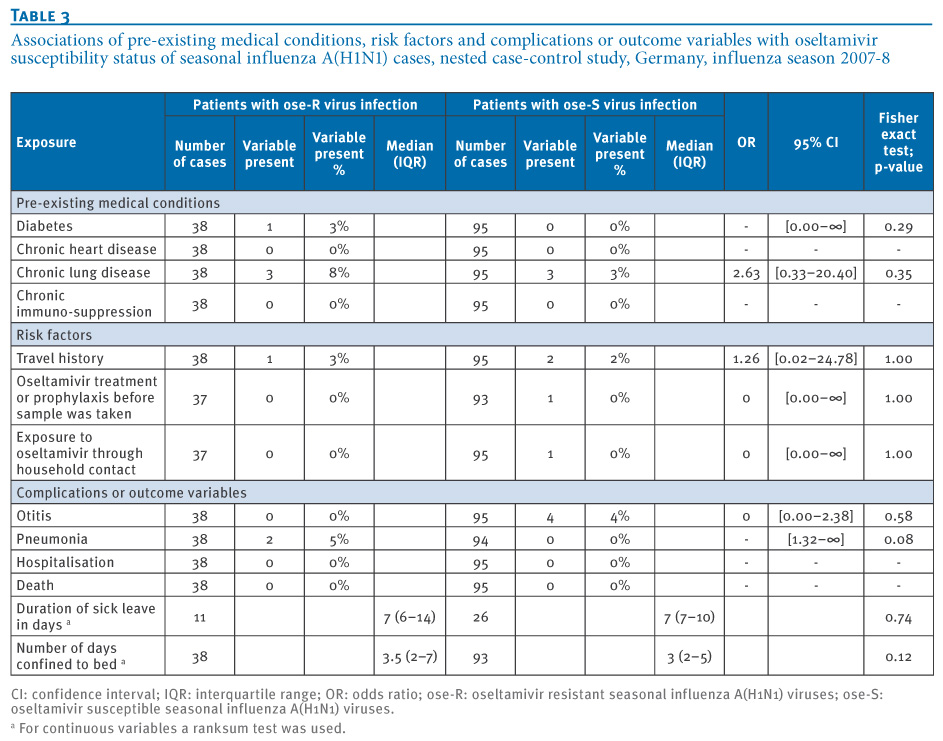
Odds ratios and p-values for pre-existing medical conditions, travel history, exposure to oseltamivir (patient him/herself or through household contact), complications and outcome are displayed in Table 3. Overall, 39 (34%) of 114 were treated with oseltamivir. No patient with ose-R influenza and only one patient with ose-S influenza had taken oseltamivir before the respiratory sample was taken. Similarly, no patient with an ose-R infection and one patient with an ose-S infection was exposed to a household contact who had taken oseltamivir. Two cases of pneumonia occurred among patients with ose-R influenza, none among infected with ose-S viruses. The number of days that patients were bedridden was higher in patients with an ose-R virus infection (mean 4.6 days versus 3.4 days; p-value = 0.12). When this variable was stratified by age and sex there was no difference among the groups except for males less than five years old, where the median for patients with ose-R viruses was five (interquartile range, IQR: 1.5?7; n=4) and the median for patients with ose-S viruses 0.5 days (IQR: 0?2; n=6).
Table 3. Associations of pre-existing medical conditions, risk factors and complications or outcome variables with oseltamivir susceptibility status of seasonal influenza A(H1N1) cases, nested case-control study, Germany, influenza season 2007-8

Household transmission
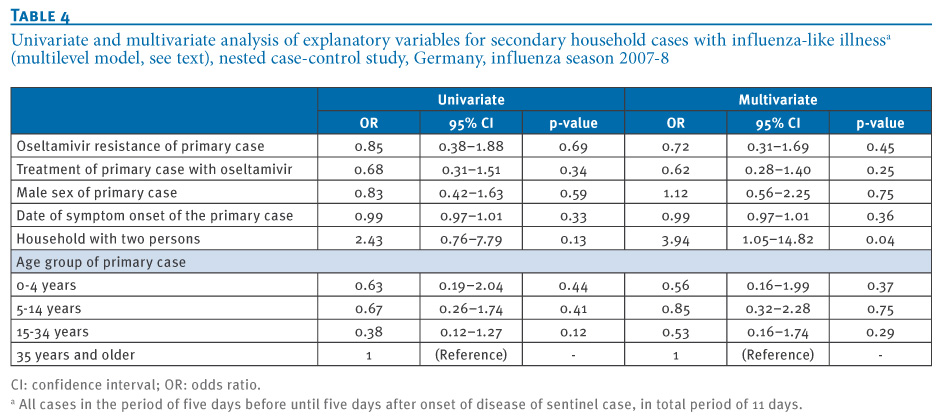
Information on household size was available for 132 (99%) of 133 households. The median number of persons per household was four (IQR: 3? 4; n=132). The number of household members in ose-S and ose-R households did not differ significantly (p-value = 0.2). Overall, the secondary attack rate in households was 25.4% (89/350); in households with ose-S patients (ose-S household) it was 26.2% (71/271) compared with 22.8% (18/79) in ose-R households (p-value = 0.54) (Figure 3). In univariate analysis ose-R of the household was not significantly associated with household transmission (Table 4), neither were date of infection, treatment of the primary case with oseltamivir, living in a two-person household or male sex of the primary case. Furthermore, there was also no trend (in terms of increasing or decreasing odds ratios) associated with increasing age of the primary case. In multivariate analysis none of the above variables except living in a two-person household were significantly associated with increased household transmission. The variance of the random effect for household was estimated as 0.86 (0.27?2.78), and this model was significantly better fitting the data than a usual logistic regression model that does not account for the household structure (p-value < 0.01).
Figure 3. Frequency distribution of secondary household attack rates by oseltamivir susceptibility status of the households, nested case-control study, Germany, influenza season 2007-8 (n=128 households)

Table 4. Univariate and multivariate analysis of explanatory variables for secondary household cases with influenza-like illness (multilevel model, see text), nested case-control study, Germany, influenza season 2007-8

Discussion
Our study took place during the influenza season 2007-8 and focuses on the seasonal influenza A(H1N1) virus circulating at the time, i.e. before the appearance of the 2009 pandemic influenza A(H1N1) virus. Nevertheless, the conclusions that can be drawn from our study are of importance also in the context of the 2009 pandemic influenza. Using household based data we demonstrate formally and convincingly that the ose-R seasonal influenza A(H1N1) virus of that time was capable of being transmitted to the same extent as the ose-S virus. The 2009 pandemic virus is also a subtype A(H1N1) virus. It is therefore possible at any time that the pandemic virus may become resistant to oseltamivir while maintaining transmissibility and pathogenicity similar to the seasonal A(H1N1) virus in the influenza seasons 2007-8 and 2008-9.
The occurrence of secondary cases in households of patients with an ose-R infection in our study can be interpreted as evidence of transmission of ose-R virus in the household setting. In addition, as secondary household attack rates and the odds for a secondary case were similar in ose-R and ose-S households there is evidence that ose-R and ose-S viruses do not differ considerably in their capacity to transmit within the household setting. Analysis of demographic characteristics and other factors related to the primary case or household showed that treatment of the primary case with oseltamivir did not inhibit transmission significantly. As the proportion of ose-R viruses increased over time, it was interesting to know if date of infection was associated with an increased transmission probability. However, we did not find any time trend in this regard. Although the power of our study was too low to show any difference (if it exists), the point estimates and p-values of investigated factors did not indicate that they are of relevance. Nevertheless, if transmission is as likely for ose-R viruses as it is for ose-S viruses it remains unclear why the proportion of ose-R A(H1N1) viruses has increased over the course of the 2007-8 season not only in Germany, but also in other countries in Europe [15]. As we have measured transmission in households only it is possible that differences in transmission in the community account for the increasing dominance of resistant viruses.
Although van der Vries et al. have described a fatal case of ose-R A(H1N1) infection in a man with chronic lymphocytic leukemia [16], systematic comparisons of the outcome of ose-S and ose-R infections in European countries and the United States (US) have not suggested a difference in clinical outcome [17-19]. Similarly we also found no different pathogenicity of ose-R viruses compared with ose-S viruses, when measured by complications (otitis, pneumonia) or outcome.
Oseltamivir resistance was also not associated with exposure to oseltamivir, neither through treatment or prophylaxis before sampling of the sentinel case nor through exposure from any of his/her household contacts. Thus, our data do not indicate that drug pressure has led to the emergence of ose-R viruses in individual patients. This finding is consistent with patient-level data from the US [18] and ecological state or nation-level data from the US and Europe, respectively, where increased ose-R rates in influenza A(H1N1) viruses were not associated with increased levels of prescriptions of oseltamivir [18,20].
Lastly, in our data there was no sign that travel history was associated with the emergence of oseltamivir resistance. As most sequenced European ose-R A(H1N1) viruses are closely related and belong to a separate group, distinct from that of ose-S viruses, it is likely that they originate from a single variant [9] which at some point before the start of the season had been imported, from an unknown location, and was transmitted in the community afterwards. We would therefore expect to find no association with foreign travel.
Our study has some limitations. Additional household cases were not laboratory confirmed but were identified through a symptom-based unspecific case definition only. This may have led to over- or underestimation of the true number of additional household infections. However, it is unlikely that information bias has occurred because this limitation applies equally to ose-S and ose-R households. The time interval between disease of the sentinel case and interview was variable and sometimes long. This may have reduced the ability of interviewees to remember details asked in the questionnaire. Again, this did not happen differentially in one or another group and should have therefore not resulted in distorted effect measures.
In conclusion, analysis of our data from the influenza season 2007-8 suggests that there is no indication of an association of oseltamivir exposure and/or use and the occurrence of ose-R seasonal influenza A(H1N1) viruses. Ose-R viruses seem to be as pathogenic as ose-S viruses. We have found evidence of and have quantified transmission of ose-R A(H1N1) viruses in the household setting and its degree is comparable to that in ose-S viruses. This information is important to understand the epidemiology of ose-R viruses, but more work needs to be done to fully comprehend the reasons for the increase of the prevalence of ose-R among A(H1N1) viruses over the two influenza seasons 2007-8 and 2008-9.
Acknowledgements
We thank Franziska Schwarz for her administrative support; Manuela Friedrich for her excellent technical assistance; Melanie Helmig and Stefanie Fehrendt for conducting telephone interviews; the sentinel physicians for taking patient samples for virological testing.
<hr>
References
------
Eurosurveillance, Volume 15, Issue 6, 11 February 2010
Research articles
Household transmissibility and other characteristics of seasonal oseltamivir-resistant influenza A(H1N1) viruses, Germany, 2007-8
U Buchholz (
- Robert Koch Institute, Berlin, Germany
- State Health Office (LGA) Baden-W?rttemberg, Stuttgart, Germany
- European Programme for Intervention Epidemiology Training (EPIET), European Centre for Disease Prevention and Control, Stockholm, Sweden
Citation style for this article: Buchholz U, Brockmann S, Duwe S, Schweiger B, an der Heiden M, Reinhardt B, Buda S. Household transmissibility and other characteristics of seasonal oseltamivir-resistant influenza A(H1N1) viruses, Germany, 2007-8. Euro Surveill. 2010;15(6)
ii=19483. Available online: http://www.eurosurveillance.org/ViewArticle.aspx?ArticleId=19483 Date of submission: 12 November 2009
<hr>
During the influenza season 2007-8, the proportion of seasonal influenza A(H1N1) viruses resistant to the neuraminidase inhibitor oseltamivir increased worldwide. We conducted an investigation to compare patients infected with oseltamivir-resistant (ose-R) and oseltamivir- susceptible (ose-S) influenza A(H1N1) viruses regarding risk factors for resistance and the capability to transmit in the household setting. Within a cohort of 396 laboratory confirmed influenza patients from sentinel physicians we conducted a nested case-control study among patients infected with A(H1N1). Thirty patients in the cohort were infected with influenza B, none with influenza A(H3N2) and 366 with A(H1N1). Of the 366 A(H1N1) viruses 52 (14%) were ose-R. Demographic characteristics, oseltamivir exposure, travel history and outcome were not significantly different between ose-S and ose-R patients. Among 133 households in the nested case-control study, secondary household attack rates in households with ose-R cases and households with ose-S cases were similar (23 versus 26%; p-value=0.54). Ose-R household status and occurrence of secondary cases were associated with an odds ratio of 0.85 (95% confidence interval 0.38-1.88). We conclude that seasonal ose-R influenza A(H1N1) viruses have transmitted well in the household setting.
<hr>
Introduction
The neuraminidase inhibitors zanamivir and oseltamivir became available for the treatment and prophylaxis of influenza in 1999. Before the beginning of the influenza season 2007-8 in the northern hemisphere monitoring systems had identified resistance to oseltamivir in influenza viruses in less than 1%, and resistance to zanamivir had been detected even less often [1,2]. Higher rates of resistance to oseltamivir were only reported in children in Japan (16%, 18%), where weight-based dosage is lower than approved in Europe and may have led to increased resistance rates [3,4]. Studies in ferrets showed that resistant viruses were in general less virulent and less transmissible in comparison to susceptible viruses [5-8].
In November 2007, Norway reported an unusually high proportion of seasonal influenza A(H1N1) viruses resistant to the neuraminidase inhibitor oseltamivir (ose-R). Soon after, other countries in Europe and the US also detected ose-R viruses [9]. Sequence analysis of viruses identified a substitution of tyrosine instead of histidine at residue 274 (H274Y in the N2 numbering) which conferred reduced drug sensitivity (IC50) of the viral enzyme neuraminidase. Susceptibility to zanamivir was maintained. In Europe, the weighted average proportion of ose-R among influenza A(H1N1) viruses increased over time from near zero in week 40 (2007) to 56% in week 19 (2008) [9]. When the season 2007-8 had subsided, 22 (73%) of 30 countries who had tested for oseltamivir resistance, had detected ose-R in A(H1N1) viruses (median among countries: 10%; range: 0 - 67%) [10]. In addition, countries of the southern hemisphere reported the occurrence of ose-R influenza A(H1N1) viruses during their 2008 influenza season. In some of them the proportion of resistant viruses exceeded that found in European countries, for example in South Africa (100%; 225 of 225) [11], and Australia (80%; 47/59) [12]. During the influenza season 2008-9 close to 100% resistance was reported from European countries [13].
In March 2008, the European Centre for Disease Prevention and Control (ECDC) called a meeting with several European countries, to discuss the most salient questions around the new phenomenon. Following this, we launched an investigation (i) to compare the clinical characteristics and outcome of patients infected with ose-R and ose-S influenza A(H1N1) viruses, (ii) to investigate if - prior to the sample having been taken - patients with ose-R A(H1N1) viruses had been treated with oseltamivir more frequently than patients with ose-S A(H1N1) virus infections, (iii) to investigate if the occurrence of ose-R A(H1N1) virus infections was associated with exposure to an influenza-infected person in the household who was treated with oseltamivir, (iv) to examine if patients infected with ose-R A(H1N1) viruses were more likely to have had travelled abroad prior to infection more frequently compared with patients with ose-S A(H1N1) viruses, and (v) to explore the transmissibility of ose-R A(H1N1) viruses in comparison to ose-S A/H1N1 viruses in the household setting.
Methods
Cohort study
We used data from 396 laboratory confirmed influenza patients for whom samples (nose and/or throat swabs) were sent for laboratory investigation to the National Reference Centre for Influenza (NRCI) at the Robert Koch Institute (RKI, German national public health institute ), Berlin by sentinel physicians cooperating with the German network for influenza surveillance (Arbeitsgemeinschaft Influenza; www.influenza.rki.de/agi). These patients are referred to as ?sentinel cases?. Together with the samples, information is collected routinely on the date of illness onset, age, sex, location of the treating physician, presenting symptoms, influenza vaccination status, and willingness to be contacted by the RKI and telephone number in case of a positive reply.
Nested case-control study
To obtain information on pre-existing medical conditions, travel history, intake of oseltamivir prior to taking the sample, exposure to oseltamivir through a household contact, complications or outcome (otitis, pneumonia, hospitalisation, death, duration of sick leave and number of days confined to bed), household size and the occurrence of influenza-like illness (ILI) in the household on the same day or five days before or after onset of illness in the sentinel case, we attempted to contact (i) all sentinel cases with an ose-R A(H1N1) virus infection, and (ii) a subset of sentinel cases infected with ose-S A(H1N1) viruses. This subset consisted of patients who had previously agreed to be contacted and had provided their telephone number. Interviewers conducted a questionnaire with the respective patients or, in the case of minors, their guardians. Interviewees were blinded to the susceptibility status of the virus of the sentinel case. Households were contacted between one and five months after occurrence of the laboratory confirmed household case.
Data were entered into a Microsoft Access database (Microsoft Corp., Redmond, WA, USA). Analysis was performed using STATA version 10.1 (STATA Corp., College Station, TX, USA). For categorical variables we calculated univariate odds ratios and p-values using Fisher?s exact test. Numerical variables were analysed using a ranksum test.
For the analysis of the likelihood to transmit the virus within the household we conducted a multilevel analysis with levels person and household. In this context we defined the following terms:
Household transmission period (HTP): period from five days before until five days after the illness onset in sentinel cases, in total 11 days.
Household transmission: occurrence of at least one secondary case within the HTP after a primary case of ILI or laboratory-confirmed influenza (Figure 1).
Influenza-like illness (ILI) in a household contact: illness in a household contact of the sentinel case during the HTP with (i) subjective feeling of having fever; and/or (ii) cough and (myalgia or headache).
Primary case: first case in the household during the HTP with either ILI or laboratory-confirmed influenza.
Secondary case: occurrence of at least one other case following the primary case during the HTP.
Figure 1. Transmission of seasonal influenza A(H1N1) viruses in two
exemplary households (A and B), study on transmission of oseltamivir-resistant seasonal influenza A(H1N1) viruses in household settings, Germany 2008

Different from the sentinel cases, additional household cases were identified through interviews only and were not laboratory tested for influenza. We assumed that (i) within the HTP resistance status did not change, i.e. we applied the resistance status of the sentinel case also to other household contacts if they became cases, and that (ii) within the HTP secondary cases occurred only from infection within the household and not from the community.
On household level we used as explanatory variables household size and age and sex of the primary case. Moreover, treatment of this patient with oseltamivir, whether the influenza virus causing infection was ose-R, and date of illness onset were used as additional explanatory variables.
Laboratory testing
Susceptibility testing to oseltamivir was conducted at the NRCI using either a genotypic test for the H274Y-mutation, and/or the phenotypic neuraminidase susceptibility analysis, as described previously [14].
Results
Cohort study
Of the 396 patients with laboratory confirmed influenza infection, 366 (92%) were infected with seasonal influenza A(H1N1), none with A(H3N2) and 30 (8%) with influenza B. None of the influenza B viruses were ose-R. Further analysis was restricted to 366 sentinel cases with influenza A(H1N1). Of these, age was known for 358 (98%) patients, ranging from one to 78 years and patients were categorised in the following age groups: 0?4 years (n= 59; 17%), 5?14 years (n= 152; 42%), 15?34 years (n=78; 22%), 35 years or older (n= 69; 19%). Sex was known for 363 (99%) patients, 192 (47%) were male, 171 (53%) female. Onset of symptoms was between 6 December 2007 and 19 March 2008; 87% of cases occurred in January and February. Patient samples came from all 16 German states except one (Mecklenburg-Western Pomerania).
Overall, 52 (14%) patients were infected with an ose-R virus. The proportion of patients with ose-R virus infections rose over time (p-value = 0.02) and reached 28% in March 2008 (Figure 2).
Figure 2. Proportion of seasonal influenza A(H1N1) viruses resistant to oseltamivir among patient samples taken by sentinel physicians, Germany, influenza season 2007-8

There were no significant differences in age or sex between patients with and without ose-R virus infections, even though the proportion of patients infected with ose-R viruses increased slightly with age (Table 1). Also regarding symptoms and vaccination status there was no statistically significant difference (Table 2).
Table 1. Patients with oseltamivir susceptible and oseltamivir resistant seasonal influenza A(H1N1) viruses by age group, cohort of patients attended by sentinel physicians (sentinel cases), Germany, influenza season 2007-8 (n=358)

Table 2. Age, sex, vaccination status and symptoms of patients with seasonal influenza A(H1N1) viruses by sensitivity to oseltamivir, cohort of patients attended by sentinel physicians (sentinel cases), Germany, influenza season 2007-8 (n=343)

Nested case-control study
Of 52 ose-R patients, 38 (73%) could be contacted for a telephone interview either because they had agreed to be contacted (n=22) or were asked by their physician to get in contact with us (n=16). Of 105 ose-S patients who were willing to be contacted by telephone we reached 95 (90%). No statistically significant difference regarding age or sex was found between patients who had agreed to be contacted by our institute and those who did not. Therefore, we included 133 patients (38 ose-R, 95 ose-S) in the calculations for the nested case-control study.
Odds ratios and p-values for pre-existing medical conditions, travel history, exposure to oseltamivir (patient him/herself or through household contact), complications and outcome are displayed in Table 3. Overall, 39 (34%) of 114 were treated with oseltamivir. No patient with ose-R influenza and only one patient with ose-S influenza had taken oseltamivir before the respiratory sample was taken. Similarly, no patient with an ose-R infection and one patient with an ose-S infection was exposed to a household contact who had taken oseltamivir. Two cases of pneumonia occurred among patients with ose-R influenza, none among infected with ose-S viruses. The number of days that patients were bedridden was higher in patients with an ose-R virus infection (mean 4.6 days versus 3.4 days; p-value = 0.12). When this variable was stratified by age and sex there was no difference among the groups except for males less than five years old, where the median for patients with ose-R viruses was five (interquartile range, IQR: 1.5?7; n=4) and the median for patients with ose-S viruses 0.5 days (IQR: 0?2; n=6).
Table 3. Associations of pre-existing medical conditions, risk factors and complications or outcome variables with oseltamivir susceptibility status of seasonal influenza A(H1N1) cases, nested case-control study, Germany, influenza season 2007-8
Household transmission
Information on household size was available for 132 (99%) of 133 households. The median number of persons per household was four (IQR: 3? 4; n=132). The number of household members in ose-S and ose-R households did not differ significantly (p-value = 0.2). Overall, the secondary attack rate in households was 25.4% (89/350); in households with ose-S patients (ose-S household) it was 26.2% (71/271) compared with 22.8% (18/79) in ose-R households (p-value = 0.54) (Figure 3). In univariate analysis ose-R of the household was not significantly associated with household transmission (Table 4), neither were date of infection, treatment of the primary case with oseltamivir, living in a two-person household or male sex of the primary case. Furthermore, there was also no trend (in terms of increasing or decreasing odds ratios) associated with increasing age of the primary case. In multivariate analysis none of the above variables except living in a two-person household were significantly associated with increased household transmission. The variance of the random effect for household was estimated as 0.86 (0.27?2.78), and this model was significantly better fitting the data than a usual logistic regression model that does not account for the household structure (p-value < 0.01).
Figure 3. Frequency distribution of secondary household attack rates by oseltamivir susceptibility status of the households, nested case-control study, Germany, influenza season 2007-8 (n=128 households)
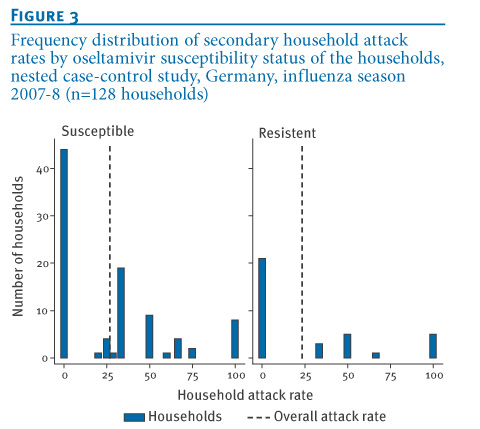
Table 4. Univariate and multivariate analysis of explanatory variables for secondary household cases with influenza-like illness (multilevel model, see text), nested case-control study, Germany, influenza season 2007-8
Discussion
Our study took place during the influenza season 2007-8 and focuses on the seasonal influenza A(H1N1) virus circulating at the time, i.e. before the appearance of the 2009 pandemic influenza A(H1N1) virus. Nevertheless, the conclusions that can be drawn from our study are of importance also in the context of the 2009 pandemic influenza. Using household based data we demonstrate formally and convincingly that the ose-R seasonal influenza A(H1N1) virus of that time was capable of being transmitted to the same extent as the ose-S virus. The 2009 pandemic virus is also a subtype A(H1N1) virus. It is therefore possible at any time that the pandemic virus may become resistant to oseltamivir while maintaining transmissibility and pathogenicity similar to the seasonal A(H1N1) virus in the influenza seasons 2007-8 and 2008-9.
The occurrence of secondary cases in households of patients with an ose-R infection in our study can be interpreted as evidence of transmission of ose-R virus in the household setting. In addition, as secondary household attack rates and the odds for a secondary case were similar in ose-R and ose-S households there is evidence that ose-R and ose-S viruses do not differ considerably in their capacity to transmit within the household setting. Analysis of demographic characteristics and other factors related to the primary case or household showed that treatment of the primary case with oseltamivir did not inhibit transmission significantly. As the proportion of ose-R viruses increased over time, it was interesting to know if date of infection was associated with an increased transmission probability. However, we did not find any time trend in this regard. Although the power of our study was too low to show any difference (if it exists), the point estimates and p-values of investigated factors did not indicate that they are of relevance. Nevertheless, if transmission is as likely for ose-R viruses as it is for ose-S viruses it remains unclear why the proportion of ose-R A(H1N1) viruses has increased over the course of the 2007-8 season not only in Germany, but also in other countries in Europe [15]. As we have measured transmission in households only it is possible that differences in transmission in the community account for the increasing dominance of resistant viruses.
Although van der Vries et al. have described a fatal case of ose-R A(H1N1) infection in a man with chronic lymphocytic leukemia [16], systematic comparisons of the outcome of ose-S and ose-R infections in European countries and the United States (US) have not suggested a difference in clinical outcome [17-19]. Similarly we also found no different pathogenicity of ose-R viruses compared with ose-S viruses, when measured by complications (otitis, pneumonia) or outcome.
Oseltamivir resistance was also not associated with exposure to oseltamivir, neither through treatment or prophylaxis before sampling of the sentinel case nor through exposure from any of his/her household contacts. Thus, our data do not indicate that drug pressure has led to the emergence of ose-R viruses in individual patients. This finding is consistent with patient-level data from the US [18] and ecological state or nation-level data from the US and Europe, respectively, where increased ose-R rates in influenza A(H1N1) viruses were not associated with increased levels of prescriptions of oseltamivir [18,20].
Lastly, in our data there was no sign that travel history was associated with the emergence of oseltamivir resistance. As most sequenced European ose-R A(H1N1) viruses are closely related and belong to a separate group, distinct from that of ose-S viruses, it is likely that they originate from a single variant [9] which at some point before the start of the season had been imported, from an unknown location, and was transmitted in the community afterwards. We would therefore expect to find no association with foreign travel.
Our study has some limitations. Additional household cases were not laboratory confirmed but were identified through a symptom-based unspecific case definition only. This may have led to over- or underestimation of the true number of additional household infections. However, it is unlikely that information bias has occurred because this limitation applies equally to ose-S and ose-R households. The time interval between disease of the sentinel case and interview was variable and sometimes long. This may have reduced the ability of interviewees to remember details asked in the questionnaire. Again, this did not happen differentially in one or another group and should have therefore not resulted in distorted effect measures.
In conclusion, analysis of our data from the influenza season 2007-8 suggests that there is no indication of an association of oseltamivir exposure and/or use and the occurrence of ose-R seasonal influenza A(H1N1) viruses. Ose-R viruses seem to be as pathogenic as ose-S viruses. We have found evidence of and have quantified transmission of ose-R A(H1N1) viruses in the household setting and its degree is comparable to that in ose-S viruses. This information is important to understand the epidemiology of ose-R viruses, but more work needs to be done to fully comprehend the reasons for the increase of the prevalence of ose-R among A(H1N1) viruses over the two influenza seasons 2007-8 and 2008-9.
Acknowledgements
We thank Franziska Schwarz for her administrative support; Manuela Friedrich for her excellent technical assistance; Melanie Helmig and Stefanie Fehrendt for conducting telephone interviews; the sentinel physicians for taking patient samples for virological testing.
<hr>
References
- Monto AS, McKimm-Breschkin JL, Macken C, Hampson AW, Hay A, Klimov A, et al. Detection of influenza viruses resistant to neuraminidase inhibitors in global surveillance during the first 3 years of their use. Antimicrob Agents Chemother. 2006;50(7):2395-402.
- Sheu TG, Deyde VM, Okomo-Adhiambo M, Garten RJ, Xu X, Bright RA, et al. Surveillance for neuraminidase inhibitor resistance among human influenza A and B viruses circulating worldwide from 2004 to 2008. Antimicrob Agents Chemother. 2008;52(9):3284-92.
- Ward P, Small I, Smith J, Suter P, Dutkowski R. Oseltamivir (Tamiflu) and its potential for use in the event of an influenza pandemic. J Antimicrob Chemother. 2005;55 Suppl 1:i5-i21.
- Kiso M, Mitamura K, Sakai-Tagawa Y, et al. Resistant influenza A viruses in children treated with oseltamivir: descriptive study. Lancet. 2004;364(9436):759-65.
- Carr J, Ives J, Kelly L, Lambkin R, Oxford J, Mendel, et al. Influenza virus carrying neuraminidase with reduced sensitivity to oseltamivir carboxylate has altered properties in vitro and is compromised for infectivity and replicative ability in vivo. Antiviral Res. 2002;54(2):79-88.
- Herlocher ML, Carr J, Ives J, Elias S, Truscon R, Roberts N, et al. Influenza virus carrying an R292K mutation in the neuraminidase gene is not transmitted in ferrets. Antiviral Res. 2002;54(2):99-111.
- Ives JA, Carr JA, Mendel DB, et al. The H274Y mutation in the influenza A/H1N1 neuraminidase active site following oseltamivir phosphate treatment leave virus severely compromised both in vitro and in vivo. Antiviral Res. 2002;55(2):307-17.
- Carr J, Roberts N, Herlocher L. (2002). Further study of the transmission in ferrets of influenza A/H1N1 virus carrying a H274Y neuraminidase mutation for Tamiflu?, oseltamivir phosphate; Roche Research Report 1008171
- Meijer A, Lackenby A, Hungnes O, Lina B, van der Werf S, Schweiger B. Oseltamivir-resistant influenza A (H1N1) virus, Europe, 2007?08 season. Emerg Infect Dis. 2009;15(4):552-60.
- EISS. European Influenza Surveillance Scheme. EISS update from August 27, 2008.[Accessed on: Nov 24, 2008]. Later updates available from: http://webportal.ecdcdmz.europa.eu/en/activities/surveillance/EISN/Pages/home.aspx
- Besselaar TG, Naidoo D, Buys A, Gregory V, McAnerney J, Manamela JM, et al. Widespread oseltamivir resistance in influenza A viruses (H1N1), South Africa. Emerg Infect Dis. 2008;14(11):1809-10.
- World Health Organization (WHO). [Internet]. Geneva; 2008. Influenza A/H1N1 virus resistance to oseltamivir - 2008 influenza season, southern hemisphere. [Accessed on: Dec 01, 2008]. Available from: www.who.int/csr/disease/influenza/H1N1200801013.pdf..
- European Centre for Disease Prevention and Control (ECDC). [Internet]. Stockholm; 2009. Monitoring of influenza antiviral resistance in EU during the 2008-09 season. [Accessed on: Feb 20, 2009]. Available from: http://ecdc.europa.eu/en/Health_topics/influenza/antivirals.aspx.
- Duwe S, Schweiger B. A new and rapid genotypic assay for the detection of neuraminidase inhibitor resistant influenza A viruses of subtype H1N1, H3N2, and H5N1. Journal of virological methods. 2008;153(2):134-41.
- EISS. European Influenza Surveillance Scheme. EISS updates. [Accessed on: Dec 01, 2008]. Later updates available from: http://webportal.ecdcdmz.europa.eu/en/activities/surveillance/EISN/Pages/home.aspx
- van der Vries E, van den Berg B, Schutten M. Fatal oseltamivir-resistant influenza virus infection. N Engl J Med. 2008;359(10):1074-6.
- Ciancio BC, Meerhoff TJ, Kramarz P, et al. Oseltamivir-resistant influenza A(H1N1) viruses detected in Europe during season 2007-8 had epidemiologic and clinical characteristics similar to co-circulating susceptible A(H1N1) viruses. Euro Surveill. 2009;14(46). pii= 19412. Available from: http://www.eurosurveillance.org/ViewArticle.aspx?ArticleId=19412
- Dharan NJ, Gubareva LV, Meyer JJ, Okomo-Adhiambo M, McClinton RC, Marshall SA et al. Infections with oseltamivir-resistant influenza A(H1N1) virus in the United States. JAMA. 2009;301(10):1034-41.
- Hauge S, Dudman S, Borgen K, Lackenby A, Hungnes O. Oseltamivir-resistant influenza viruses A(H1N1), Norway, 2007-08. Emerg Infect Dis. 2009;15(2):155-62.
- Kramarz P, Monnet D, Nicoll A, Yilmaz C, Ciancio B. Use of oseltamivir in 12 European countries between 2002 and 2007 - lack of association with the appearance of oseltamivir-resistant influenza A(H1N1) viruses. Euro Surveill. Feb 5 2009;14(5). pii=19112. Available from: http://www.eurosurveillance.org/ViewArticle.aspx?ArticleId=19112
------