• FluTrackers.com Inc. does not provide medical advice. Information on this web site is collected from various internet resources, and the FluTrackers board of directors makes no warranty to the safety, efficacy, correctness or completeness of the information posted on this site by any author or poster. The information collated here is for instructional and/or discussion purposes only and is NOT intended to diagnose or treat any disease, illness, or other medical condition. Every individual reader or poster should seek advice from their personal physician/healthcare practitioner before considering or using any interventions that are discussed on this website. By continuing to access this website you agree to consult your personal physican before using any interventions posted on this website, and you agree to hold harmless FluTrackers.com Inc., the board of directors, the members, and all authors and posters for any effects from use of any medication, supplement, vitamin or other substance, device, intervention, etc. mentioned in posts on this website, or other internet venues referenced in posts on this website.
  • We are not asking for any donations. Do not donate to any entity who says they are raising funds for us.

Equatorial Guinea: Marburg Virus Disease outbreak confirmed - February 10, 2023+ - approximately 40 confirmed/probable cases (35 fatal) - Outbreak en

WHO Director-General's opening remarks at the media briefing – 29 March 2023

29 March 2023
...
First, to the outbreaks of Marburg virus disease in Equatorial Guinea and Tanzania.

In Equatorial Guinea, WHO is on the ground with partners, supporting the Ministry of Health to respond to the outbreak.

We have deployed teams to assist with case finding, clinical care, logistics, and community engagement.

We have also helped to establish treatment units in the affected areas.

The number of officially reported cases remains at nine, with seven deaths, in three provinces.

However, these three provinces are 150 kilometres apart, suggesting wider transmission of the virus.

WHO is aware of additional cases, and we have asked the government to report these cases officially to WHO.
...
https://www.who.int/news-room/speec...emarks-at-the-media-briefing---29--march-2023


GENEVA, March 29 (Reuters) - Equatorial Guinea has confirmed 13 cases of Marburg disease since the beginning of the epidemic, its health officials said on Wednesday after the head of the World Health Organization (WHO) urged the Central African country's government to report new cases officially.

Marburg virus disease is a viral haemorrhagic fever that can have a fatality rate of up to 88%, according to the WHO.

more...

https://www.reuters.com/world/afric...uinea-urges-govt-report-them-2023-03-29/?s=08
 
WEEKLY BULLETIN ON OUTBREAKS
AND OTHER EMERGENCIES

Week 13: 20 - 26 March 2023
Data as reported by: 17:00; 26 March 2023

...

Equatorial Guinea

Marburg Virus Disease


35 Cases
27 Deaths
77.1 % CFR


EVENT DESCRIPTION

Eight new confirmed Marburg Virus Disease (MVD) cases have
been reported in Equatorial Guinea, making a total of nine
confirmed cases since 13 February 2023 when the outbreak
was officially declared in the country.

The first case was reported from Kié-Ntem province and
was tested at the Institute Pasteur of Dakar in Senegal on 12
February. Of the nine confirmed cases, three were reported
from the province of Kié-Ntem, four from Littoral, and two from
Centro-Sur provinces.

Since 10 March, Equatorial Guinea has developed capacity
to diagnose haemorrhagic fever diseases (including Marburg
disease) through a field laboratory established at the Regional
Hospital of Ebibeyin with the technical and logistic support from
partners.

On 13 March, samples from two additional individuals from KiéNtem
province tested positive for MVD by reverse transcriptasepolymerase
chain reaction (RT-PCR) at the mobile laboratory.

On 15 March, another sample tested positive for MVD for case
residing in Littoral province in the western part of the country
and is epidemiologically linked to a confirmed case from KiéNtem.
On 18 and 20 March, three additional laboratory confirmed
positive cases were reported from Littoral province. On 20
March two more laboratory confirmed cases were reported from
Centro Sur province.

Overall, from 13 February-21 March, a cumulative number of
nine confirmed, 20 probable cases and six suspected cases
have been recorded in Equatorial Guinea from three affected
provinces: Centro-Sud, Littoral and Kie-Ntem.

The areas reporting cases are about 150 kilometres apart,
suggesting wider transmission of the disease. Among the nine
laboratory confirmed cases, seven have died, and all probable
cases are dead. This gives a case fatality ratio (CFR) of 77.1%
for all 35 epidemiologically linked cases reported so far. As of
21 March, a total of 459 contacts have been listed and followed
up and 29 alerts have been notified.

PUBLIC HEALTH ACTIONS

The government is taking the lead in the response and
various partners are providing technical support to the
government to contain this outbreak.

The Ministry of Health continues to investigate the source of
the outbreak.

International health experts have been deployed to conduct
active investigation and case finding which includes experts
in epidemiology, clinical management, risk communication
and community engagement, health logistics, infection
prevention and control and emergency coordination.

Active case search, contact tracing, isolation and supportive
care are ongoing to prevent transmission and save lives.
With support from partners, a field laboratory has been
established in Ebibeyin town in Kie-Ntem province to facilitate
testing of samples. The laboratory has been operating since
10 March.

A VHF treatment unit with capacity for eight beds has been
established and is now operational in Nsok-Nsomo district.
Plans are underway to set up an additional eight-bed
capacity isolation centre in the same location.

Another 12-bed capacity treatment unit has been set up
at Ebebiyin hospital, along with an Emergency Operations
Centre.

SITUATION INTERPRETATION

The trend of the ongoing MVD outbreak in Equatorial Guinea
is worrying with the increased number of new confirmed
cases reported. After a silent period of few weeks following the
confirmation of the first case at the Pasteur Institute of Dakar
in Senegal on 12 February, the recent report of new confirmed
cases calls for intensification of the ongoing response activities to
contain this outbreak as quickly as possible. The wide geographic
distribution of cases suggests the potential for undetected
community spread of the virus especially since cases have been
reported from very distant areas. The two neighbouring countries
(Cameroon and Gabon) should scale up readiness activities to
be able to detect potential cases as early as possible.


...
https://apps.who.int/iris/bitstream/handle/10665/366672/OEW13_2026032023.pdf?sequence=1&isAllowed=y
 
Translation Google

Guinean Health
@GuineaSalud

#FHM update closing April 2: No cases reported in the last 48h, accumulated positives 10 hospitalized 2 confirmed and 8 suspected. 1 deceased, 10 accumulated 604 people in contact tracing. + info: http:// bit.ly/3m9XETc
FsyVpPEXwAAnyq3


6:32 AM · Apr 3, 2023
·
 
Translation Google

10 deaths, 14 confirmed cases and Bata leads the list of regions with the most cases and deaths

The record of the age group most affected by the Marburg virus are adults aged 30-44.

By Alisol Buiyaban Bichua April 5, 2023in Science and Health

The new report on the update of the epidemiological data of the Marburg virus in Equatorial Guinea (April 4) issued by the Ministry of Health and Social Welfare comes to light: 14 confirmed of which 9 hospitalized, 10 dead and 7 people suspected of have been infected with the virus.

Of the 14 confirmed and accumulated cases, women have the highest percentage (8 women) compared to men (5 cases), being the group of citizens between the ages of 30 and 44 the ones with the most registered cases. . Toilets have also been affected by the epidemic; since the start of the pandemic, 2 of them have died and 4 positive cases belong to citizens of this group.

The first positive case of the epidemic was confirmed in Ebibeyin district, Kie-Ntem province. With the new update, the district of Bata located in the province of Litoral, the last to be added to the registry of affected areas, takes the lead: 8 confirmed cases and 5 of the 10 deaths.

Health continues to deploy all the necessary artillery to control the outbreak of the disease in the country. Health currently has 535 contacts under follow-up, and the number of accumulated cases amounts to 1,159.

https://ahoraeg.com/ciencia-y-salud/...sos-y-muertos/

------------------------------------

Guinean Health@GuineaSalud

📊Update #FHM closing April 4:
No new or deceased cases are reported, 14 accumulated positives and 10 deaths since the start of the epidemic.
📉 9 hospitalized, 2 confirmed and 7 suspects.
535 contacts in follow-up.

+ℹinfo:👉 http://bit.ly/3zyRzCV


3:02 AM · Apr 5, 2023
 
Marburg Outbreaks

Equatorial Guinea Outbreak Update

On February 13, 2023, government officials in Equatorial Guinea declared a Marburg outbreak. Ministry of Health staff initially reported one confirmed case and additional suspect cases in Ebebiyin, Kie-Ntem Province, in the northeast corner of the country. Information on the additional suspect cases is currently limited.

CDC is providing assistance as requested and sent a team of scientists with expertise in epidemiology and laboratory testing to support local health officials in outbreak response activities. The team is assisting with case investigation, contact tracing, and laboratory training.

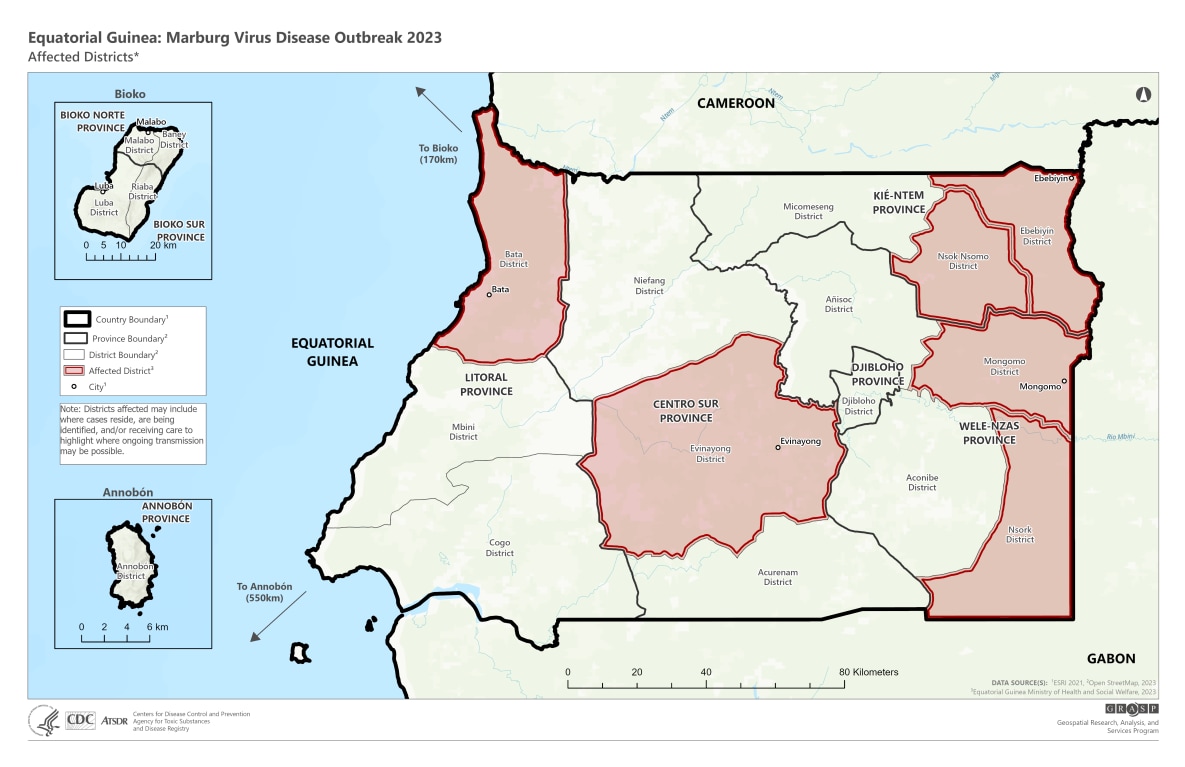
Note: Districts affected may include where cases reside, are being identified, and/or receiving care to highlight where ongoing transmission may be possible.


gnq-overview-large.png


...
Last Reviewed: April 6, 2023

https://www.cdc.gov/vhf/marburg/outbreaks/chronology.html
 
Translation Google


Equatorial Guinea: 11 dead due to Marburg virus, according to a new report

Published on :04/11/2023 - 19:34
Modified :04/11/2023 - 19:32

Malabo (Equatorial Guinea) (AFP) – The new provisional toll of the Marburg virus disease epidemic, which has been raging for almost three months in Equatorial Guinea, stands at 11 confirmed dead, according to a new report from the Ministry of Health on Tuesday.

The last death recorded by the authorities due to the epidemic of this virus, a cousin of Ebola and almost as deadly as it, dates back to April 3.

The ministry also mentions 15 positive cases, none of which are hospitalized, and 385 "followed" contact cases against 604 last week, the ministry said in a document dated Monday and posted on Twitter on Tuesday.

The recorded cases of this haemorrhagic fever overflowed from the province of Kié-Ntem (East) where it had caused the first known deaths on January 7, to reach Bata, the economic capital of this small country in Central Africa, where nine cases have been confirmed, authorities said.

Two weeks ago, the World Health Organization (WHO) called on Equatorial Guinea to report cases of the Marburg virus to it, fearing a potential "large-scale epidemic" that could affect neighboring Gabon and Cameroon in particular.

The WHO had announced the deployment of “additional experts” and specified that it was also helping “Gabon and Cameroon to strengthen preparedness and response to the epidemic”.
...

https://www.france24.com/fr/info-en...es-au-virus-de-marburg-selon-un-nouveau-bilan

-----------------------------------------------------------

Guinean Health@GuineaSalud

📊#FHM update closing April 10: 1 confirmed, 15 accumulated, 1 deceased case, 11 since the beginning of the epidemic. 2 recovered discharged are reported, 📉3 accumulated. As of today 0 hospitalized case. 385 contacts in follow-up. + ℹinfo:👉 http://bit.ly/3MygtKL

4:26 AM · Apr 11, 2023
 
Marburg virus disease - Equatorial Guinea

15 April 2023

Situation at a glance

Since the last Disease Outbreak News on this event was published on 22 March 2023 (with data as of 21 March 2023), six additional laboratory-confirmed cases of Marburg virus disease (MVD) have been reported in Equatorial Guinea. This brings the total to 15 laboratory-confirmed and 23 probable cases since the declaration of the outbreak on 13 February 2023. Among the laboratory confirmed there are 11 deaths (Case Fatality Ratio 78.6%; for one confirmed case the outcome is unknown), and all probable cases are dead. The most affected district is Bata in Litoral province, with nine laboratory-confirmed MVD cases reported.

WHO is supporting the Ministry of Health by strengthening different response pillars, including but not limited to surveillance, including at points of entry; laboratory; case management; infection prevention and control; risk communication and community engagement.

MVD is a disease with high mortality that causes haemorrhagic fever, and is among the diseases that require assessment under the International Health Regulations.

On 30 March 2023, WHO assessed the public health risk posed by this outbreak as very high at the national level, high at sub-regional level, moderate at the regional level and low at the global level.

WHO advises against restrictions to international travel and/or trade in Equatorial Guinea.

Description of the situation


On 13 February 2023, the Ministry of Health and Social Welfare of Equatorial Guinea declared an outbreak of Marburg virus disease (MVD) after suspected viral hemorrhagic fever deaths were reported between 7 January and 7 February 2023, and a case tested positive on 12 February for Marburg virus by real-time polymerase chain reaction (RT-PCR) at the Institute Pasteur in Dakar, Senegal.

Since the last Disease Outbreak News on this event (22 March 2023) and as of 11 April 2023, six additional laboratory-confirmed cases of MVD were reported in Equatorial Guinea, bringing the total of cases in the outbreak to 15 laboratory-confirmed. Additionally, 23 probable cases have been reported since the start of the outbreak. Eleven deaths were recorded among laboratory-confirmed cases (Case Fatality Ratio (CFR) among confirmed cases 78.6%), and all probable cases are dead; for one confirmed case the outcome is unknown. Four laboratory-confirmed cases (26.6%) were reported among healthcare workers, of whom two died. Among the confirmed cases, three have recovered.

Figure 1. MVD cases by week of onset* and case classification, Equatorial Guinea, as of 11 April 2023.

Among MVD laboratory-confirmed cases with age and sex information (n = 13), the majority occurred among females (9/14; 64.3%), while the most affected age group is 40-49 years (6/14; 42.8%), followed by the age groups 10-19 and 30-39 (three cases each).

Five districts (Bata, Ebebiyin, Evinayong, Nsok Nsomo and Nsork) in four provinces (Centro Sur, Kie Ntem, Litoral and Wele-Nzas) have been affected by the outbreak (Figure 2), with Bata district reporting the majority of confirmed cases (n = 9) and deaths (n = 6), and Ebebiyin district, where the outbreak was first detected, reporting the majority of probable cases,(n = 11) (Table 1).

In the last 21 days (from 22 March 2023 to 11 April 2023), five confirmed cases were reported from Bata (n = 4) and Nsork (n = 1) districts (Figure 3). Among the four cases reported from Bata district, three cases have an epidemiological link either through a family cluster or through health care setting. The fourth and most recent case was reported on 7 April; an investigation of this case is ongoing to establish transmission chains and ensure appropriate identification of all contacts.

Since the last Disease Outbreak News on this event, one new district, Nsork in Wele-Nzas province, has been affected by the outbreak, reporting one confirmed case, linked to a known case from another district that previously reported confirmed cases.

Since the start of the outbreak and as of 10 April 2023, a total of 1322 contacts have been listed, with an average follow-up rate around 80-90%.


Table 1. Number of MVD cases and deaths, by district and case classification, Equatorial Guinea, as of 11 April 2023.

Figure 2. Map of districts reporting MVD confirmed and probable cases as of 11 April, Equatorial Guinea.

Figure 3. Map of districts reporting MVD confirmed cases in the last 21 days (from 21 March 2023 to 11 April 2023), Equatorial Guinea.

Epidemiology of Marburg virus disease

Marburg virus spreads between people via direct contact through broken skin or mucous membranes with the blood, secretions, organs or other bodily fluids of infected people, and with surfaces and materials such as bedding, clothing contaminated with these fluids. Healthcare workers have previously been infected while treating patients with suspected or confirmed MVD. Burial ceremonies that involve direct contact with the body of the deceased can also contribute to the transmission of Marburg virus. The incubation period varies from two to 21 days. Illness caused by Marburg virus begins abruptly, with high fever, severe headache, and severe malaise. Severe haemorrhagic manifestations may appear between five and seven days from symptom onset, although not all cases have haemorrhagic signs, and fatal cases usually have some form of bleeding, often from multiple areas. Although no vaccines or antiviral treatments are approved to treat the virus, Remdesivir is being used on compassionate care bases. Supportive care – rehydration with oral or intravenous fluids – and treatment of specific symptoms improve survival. A range of potential treatments are being evaluated, including blood products, immune therapies, and drug therapies. This is the first time that Equatorial Guinea has reported an outbreak of MVD. Another MVD outbreak is currently taking place in Tanzania with a total of eight confirmed cases and five deaths as of 4 April 2023. Other MVD outbreaks have been previously reported in Ghana (2022), Guinea (2021), Uganda (2017, 2014, 2012, 2007), Angola (2004-2005), the Democratic Republic of the Congo (1998 and 2000), Kenya (1990, 1987, 1980) and South Africa (1975).

Public health response


Coordination
  • The Government has activated a regional public health emergency operation center (PHEOC) in Bata under the leadership of the Minister of Health and the Minister Delegate.
  • A national operational response plan has been developed by the MoH.
  • Regular meetings are held by the MoH to coordinate response activities at national, regional and district level.
Surveillance
  • WHO supported the Ministry of Health in setting up an alert and dispatch center for MVD alert management across the region.
  • WHO is supporting the Ministry of Health in training for surveillance activities, including case investigation, contact tracing, active case search in health facilities and the community, and in supervising field teams.
  • WHO is supporting the Ministry of Health in epidemiological data collection and management system, and developed and disseminated a reviewed case definition, validated by the Ministry of Health.
Laboratory
  • With the support of the US Centers for Disease Control and Prevention (CDC), and WHO, a laboratory with RT-PCR capacities has been set up in Bata for MVD diagnostic.
  • WHO is supporting the implementation of a specimen transportation system, and discussions are on-going to support the establishment of sequencing capacities in the country.
  • Additional national staff are being trained on Marburg virus diagnostics by the WHO.
Clinical care
  • WHO supported the Ministry of Health in the establishment an operational treatment and isolation centre in Bata, and is planning to open additional treatment facilities in other districts.
  • Assessments visits were carried out at identified treatment and isolation centers to identify and address gaps.
  • WHO is supporting awareness campaigns of clinical staff to help surveillance and reporting.
Infection Prevention and Control (IPC)
  • An IPC task force has been initiated, and a national IPC strategy is currently in draft form.
  • An IPC Scorecard for assessment of health facility IPC practices for readiness and response to Marburg has been implemented.
  • Trainings for health workers on IPC are in progress, including decontamination and safe and dignified burial teams (SBD).
  • Safe and dignified burials teams have been established in Bata and Ebibeyin.
Risk Communication and Community Engagement (RCCE)
  • WHO is coordinating with other key partners for joint support on RCCE activities (UNICEF, IFRC among others).
  • WHO is supporting public awareness and capacity building for RCCE national experts, social mobilisers and community leaders (such as Civil Society Organizations, religious leaders, and women groups).
  • The recruitment of national RCCE consultants and deployment of an international expert have been conducted.
  • An RCCE national plan is under development and a rapid social behavioural survey is being prepared for implementation.
  • The Message Bank for Marburg has been developed and disseminated. The message bank is available in Spanish and English, with ongoing translation in Swahili, French and Portuguese.
  • A list of frequently asked questions and answers on Marburg virus disease, which will be accessible to the public, is under development.
  • WHO is providing technical support to the development of tools and education and communication (IEC) materials for preparedness in Gabon and Cameroon.
Border health and points of entry
  • A needs and capacity assessment has been conducted to strengthen response capacities at points of entry through, for example, the development of contingency plans and standard operating procedures, the training of point-of-entry staff on the identification of signs and symptoms of MVD and the management of potential cases, implementation of risk communication and community engagement activities and the provision of handwashing and transportation capabilities.
  • WHO is working with the US Centers for Disease Control and Prevention (CDC) and the International Organization for Migration (IOM) on an upcoming webinar to raise awareness on the necessary border health readiness and response activities in the context of MVD outbreaks for affected and neighboring countries.
Operational support and logistics (OSL)
  • ​WHO has established support for fleet management including two ambulances on standby 24/7 at the Bata treatment centr​e, and over 20 vehicles. WHO has provided essential medicines and supplies.
Readiness and preparedness in neighboring countries
  • WHO has conducted a second readiness assessment across all pillars for the two surrounding countries, Cameroon and Gabon, and based on their gaps, activities to address them will be recommended including the deployment of experts to support the implementation of some of the readiness activities.
  • The WHO is working with Cameroon, Equatorial Guinea and Gabon to coordinate a high-level cross-border meeting.
WHO risk assessment


Equatorial Guinea is facing an outbreak of MVD for the first time and the country's capacity to manage the outbreak needs to be strengthened. In addition to the nine confirmed cases reported in the Disease Outbreak News of 22 March, six more individuals have tested positive for MVD, with an additional affected province. While many cases are linked within a social network or by geographic proximity, the presence of cases and/or clusters across multiple districts without clear epidemiologic links may indicate undetected transmission of the virus. The presence of confirmed cases in Bata increases the risk of disease spread, as it is the most populated city and economic hub of Equatorial Guinea, with an international airport and port. Bata has also reported the highest number of confirmed cases and confirmed deaths. The last case was also reported from Bata and investigation is ongoing to establish transmission chains. The country surveillance system remains suboptimal with few alerts reported and investigated. Several epidemiological links and transmission chains have not been detected, thus there might be contacts not identified.

Implemented infection prevention and control measures are insufficient as demonstrated by MVD cases reported among healthcare workers. The diagnostic capacity for Marburg virus in the country is limited in terms of the number of samples that can be analyzed per day (a maximum of around 50 a day). The community's perception of risk is estimated to be very low. There are frequent population movements between the different districts of the mainland region, as well as with the island region, despite the quarantine measures implemented in several of the affected areas. Frequent population movements and very porous land borders are also reported in the districts bordering Cameroon and Gabon, with surveillance at land entry points being suboptimal, and countless uncontrolled paths or trails along the border with Cameroon and Gabon. Also, surveillance at the entry points of the international Bata airport or international seaport, is not optimal.

Considering the above-described situation, on 30 March 2023, WHO assessed the risk posed by this outbreak as very high at the national level, high at sub-regional level, moderate at the regional level and low at the global level.


WHO advice


Marburg virus disease outbreak control relies on using a range of interventions, such as prompt isolation and case management; surveillance including active case search, case investigation and contact tracing; an optimal laboratory service; infection prevention and control, including prompt safe and dignified burial; and social mobilization. Community engagement is key to successfully controlling Marburg disease outbreaks. Raising awareness of risk factors for infection with Marburg virus and the protective measures that individuals can take is an effective way to reduce human transmission. Health and care workers caring for patients with confirmed or suspected MVD should apply IPC measures including standard and transmission-based precautions to avoid contact with the patient’s blood and body fluids and with contaminated surfaces and objects. Health facilities should ensure environmental controls, such as adequate water, sanitation and hygiene, as well as that safe infectious waste management protocols are in place to enable health workers to practice IPC measures. WHO recommends that male survivors of MVD practice safer sex for 12 months from onset of symptoms, or until their semen twice tests negative for the Marburg virus. Contact with body fluids should be avoided and washing with soap and water is recommended. WHO does not recommend isolation of male or female convalescent patients whose blood has tested negative for the Marburg virus.

Based on the available information and current risk assessment, WHO advises to strengthen surveillance at points of entry in the affected areas in Equatorial Guinea for the identification of cases, including through exit screening; to map cross-border population mobility to identify populations in vulnerable situations and target public health interventions; and to provide public health information and advice in all relevant languages at points of entry and in adjacent communities near land borders. In addition, suspect, probable and confirmed cases and their contacts should not undertake travel, including international.

WHO advises against any other international travel and/or trade measures in Equatorial Guinea.


States Parties adopting international travel- and trade-related measures potentially more restrictive than those advised by WHO, are invited to report them to WHO, pursuant to Article 43 of the International Health Regulations (2005).


...
https://www.who.int/emergencies/dise...em/2023-DON459
 
WHO Director-General's opening remarks at media briefing – 18 April 2023

18 April 2023

...

Marburg.

Now to Marburg, Marburg Virus Disease in Equatorial Guinea where in the last week, two healthcare workers that had contracted the virus were discharged from a WHO supported treatment center.

There has now been a total of 16 laboratory-confirmed MVD cases. Among these cases, 11 people have died.

23 probable cases of MVD have also been reported since the outbreak was declared on 13 February.


The most affected district is Bata in Litoral province, where nine cases have been reported.

Today a new case was reported in a health worker from Bata who was being monitored due to exposure from a previous case.

The case was detected on the day of disease onset and they were given antiviral therapy via government protocol, which is being supported by WHO.

WHO calls on all partners to remain vigilant as there may be undetected chains of transmission in the country.

With partners, WHO is supporting the Ministry of Health to strengthen surveillance, in affected areas, and increase laboratory capacity.

We’re also working together to improve case management; infection prevention and control, protect health and care workers, conduct safe and dignified burials, as well as engaging with the community around risk and staying safe.

WHO is working with neighbouring countries to help prepare for any importation.

This is a critical moment in the outbreak response in Equatorial Guinea, and it will take an all of government and all of society effort to stop this outbreak.

===

https://www.who.int/director-general...-18-april-2023
 
Translation Google

The Government calls for prudence in the handling of data related to the Marburg virus

April 18, 2023
News Government

This is expressed in a note released by the Office of Diplomatic Information and Communication, the full content of which is attached to this news item.

General Directorate of Written Press, Government Institutional Web Page (DGPEPWIG)
Information and Press Office of Equatorial Guinea

PRESS RELEASE 170423 MARBURG

Translation Google


Office of Information and Diplomatic Communication

The government calls for "informative prudence" in the management of data related to the Marburg

The Equatorial Guinean government urges "informative prudence, moderation, ethics and professionalism" by the media and information agencies in the dissemination of data related to the epidemiological outbreak of hemorrhagic fever of Marburg (FHM) in the country.

This is how Simeón Oyono Esono Angué and Mitoha Ondo, or Ayekaba, both have agreed Ministers of Foreign Affairs, International Cooperation and Diaspora and of Health and Social welfare, in the course of a meeting held this morning with all the diplomatic corps and representatives of international organizations, accredited in Equatorial Guinea.

During the meeting held at the headquarters of the Ministry of Foreign Affairs in Malabo ll, oyono Esono Angué expressed the concern of the Executive for what he considers as "reports that are being published with biased, faulty and lacking data of reliability and do not agree with the real information handled by the Government, such as main person responsible for the health of all Equatoguineans,,.

"We know that all these manipulations of information have only one purpose, which is to distort and damage the good reputation of Equatorial Guinea. it is not forbidden publish information about the outbreak. Do it with real data, because you can't even people's health should not be argued or politicized, he said.

Mitoha Ondo'o Ayekaba, who placed the epidemiological information "to this day, 15 laboratory confirmed cases, of which [there are] 11 deceased, 3 recovered and L unidentified, with no cases recorded since April 7 and deaths since April 6,. He recommended consulting "the official platforms" of his department when searching "systematic and reliable updates on the evolution of the epidemic in the a disease with a high impact on international public health,."Surveillance actions are carried out in the city of Bata, where 11 days remain and Nsork, with 4; saving the districts of Ebibeying, Mongomo and Evinayong. The data currently point to a situation of control. If [so], in the next days, we can be declaring the end of the epidemic,,,he said.

Malabo, April 17 2023

...

https://www.guineaecuatorialpress.co...virus_marburgo

------------------------------------------------

Appearance of the Ministry of Health before the Plenary Session of the Senate on the Marburg virus

April 18, 2023
News Government

The departmental delegation of Health and Social Welfare has appeared this Tuesday before the Senate Plenary to provide information on the incidence of the Marburg virus and its consequences, as well as the steps taken by the Ministry of Health to contain the disease in the Republic from Equatorial Guinea.
The senators have requested the appearance of the delegation of the Ministry of Health and Social Welfare to have information on the incidence of the Marburg disease, its consequences, as well as the cases detected in the country, in addition to other issues related to the management of the department of Health led by Minister Mitoha Ondo'o Ayecaba, represented in the chamber by Delegate Minister Justino Obama Nve, accompanied by Dr. Vicente Urbano, Head of the Epidemiology and Foreign Health Service and Juan Asumu Esono, Chief Medical Officer of the Health District, who have explained the cause of the Marburg virus disease, the symptoms and the health strategies to stop the chain of transmission.

Before the Plenary Session of the Senate, Obama Nve has informed that, of the 1,418 cases processed in the laboratory, 16 cases have been confirmed positive; and among them there are eleven deaths, three recovered. Of the recovered patients, two are health workers and the third is a ten-year-old girl.

Obama Nve has also explained that the behavior of the virus is different. In towns, its propagation is less due to the spatial characteristics of the houses, while in cities the propagation is faster due to overcrowding.

The senators have asked why the virus is not registered in border countries such as Gabon and Cameroon, with which we have fluid circulation, and how an epidemic can be declared with a few isolated cases. They have also been interested in knowing if the transmitter of the Marburg is an animal or a human being and the treatment that is given to the sick.

Obama Nve has said that since February 12, when Equatorial Guinea issued a health alert about the virus outbreak, what Gabon and Cameroon did is join this health alert, and they opened a line of investigation establishing surveillance teams, although up to now no cases have been reported in these neighboring countries. He has also pointed out that the transmitters of the disease are the monkey and the bat.

Speaking of those recovered, the minister said that Marburg is a lethal disease, that if it is treated on time the possibility of life is high, but with the appearance of symptoms the situation is complicated, since the lack of effective treatment for the cure, the drug Rendecivir is used, as was done in the case of Covid 19.

On the other hand, he stressed that Guinea is a small country, the challenge we now have is to raise awareness among the population so that they pay attention to the scientific approach to the virus.

The senators have suggested to the Ministry of Health that before considering any information or case related to public health, the information should be verified to obtain compelling data that confirms the reality of the facts. In this sense, they recommend that the ministry address the issue with fairly solid arguments to avoid speculation, and likewise end the confinements in the affected areas, since Ebibeyin, as the focus of the disease, has been released from surveillance since 9 this this month of April.

Text and photos: Press Office of the Senate Press
and Information Office of Equatorial Guinea
...
https://www.guineaecuatorialpress.co...virus_marburgo
 
Translation Google

Guinea Salud@GuineaSalud

📊#FHM update with closure 04/18.
1 new case {+} is reported, health care linked to the care of the last confirmed case in #Bata on 04/06.
16 cases have accumulated since the beginning of the epidemic, no new deaths have been reported, 11 accumulated.
+ℹinfo:👉 http://bit.ly/3MTooTb

12:49 PM · Apr 20, 2023
 
Translation Google


Evaluation of the information provided to the Senate on the Marburg virus and COVID 19

April 20, 2023
News Government

The senators have evaluated this Thursday the information provided by the delegation of the Ministry of Health and Social Welfare on the current situation of the Marburg virus and Covid 19 in Equatorial Guinea, in their recent appearance before the Plenary Session of the Senate.

The plenary session, chaired by the Second Vice President of this high legislative body, Agustín Nze Nfumu, after receiving information on the current situation of the Marburg virus and Covid 19, provided by the delegation of the Minister of Health and Social Welfare in his recent appearance before the Plenary Session of the Senate, and as representatives of the people who are called to defend the interests of the citizens who once placed their trust in them, have dedicated this day to thoroughly evaluating said information and making pertinent recommendations to the government to enrich its actions , by emphasizing that parliamentarians and the executive power work in parallel for social welfare.

The senators have described the information provided on the Marburg virus disease as valuable, which has allowed parliamentarians to clear up doubts, while they have valued the material, human and financial efforts deployed by the government to control it, in addition to remind the Executive that, in order to declare any state of alarm, it is pertinent to carry out an exhaustive and firm preliminary investigation, prioritizing the tranquility and well-being of the population, taking into account the high contagious incidence and real lethality of Marburg.

On the other hand, the parliamentarians have responsibly and firmly accepted the information related to the disease after listening to the scientific explanations of the delegation of the Ministry of Health. In this sense, they intend to help the government with awareness campaigns, so that citizens are well aware of the symptoms and the action measures that must be carried out to combat the virus in question.
...
Text and photos: Press Office of the Senate Press
and Information Office of Equatorial Guinea

...
https://www.guineaecuatorialpress.c...nado_sobre_el_virus_de_marburgo_y_la_covid_19
 
Toll In Equatorial Guinea Marburg Outbreak Rises To 12

By AFP - Agence France Presse
April 24, 2023

The death toll in Equatorial Guinea from an outbreak of Marburg virus, a cousin of Ebola haemorrhagic fever, has risen to 12, the health ministry said on Monday.

The figures are a provisional toll based on lab-confirmed tests as of April 21, it said in an update, adding that 116 people were currently being monitored as contact risks.

The first known deaths were documented on January 7 in the eastern province of Kie-Ntem before the outbreak spread to Bata, the West African nation's economic capital.

The latest known fatality occurred on April 11, the ministry said.
...

https://www.barrons.com/news/toll-in-equatorial-guinea-marburg-outbreak-rises-to-12-3cc65839

------------------------------------

Translation Google

Guinea Salud@GuineaSalud

📊#FHM update with closure 04/21.
1 new case {+} is reported, and deceased at the same time, first-order relative of the confirmed case of 04/6 in Bata.
There have been 17 cases and 12 deaths since the beginning of the epidemic.
116 contacts in follow-up.
+ℹinfo:👉 http://bit.ly/3osQytQ

FuZwNhOWcAElE7g


7:29 AM · Apr 23, 2023
 
Translation Google

African Red Cross societies seek strategies to curb the Marburg virus

The national president of the Red Cross of Equatorial Guinea, Basilio Ndong Beyeng, has returned to the country after spending more than four days in Cameroonian lands, Yaounde.

By Constantina Nchama April 25, 2023in Health

In the early hours of April 24, Basilio Ndong Beyeng returned to the country, after taking part in the coordination and collaboration work of the national Red Cross societies of Cameroon, Equatorial Guinea, Gabon and Sao Tome, to respond to and prepare the fight against the Marburg virus. These tasks have been developed between the 19th and 21st of this month.

Basilio Ndong Beyeng, Veronique Tsakoura, president of the Gabonese Red Cross, and Cecile Akame Nfoumou, president of the Cameroonian Red Cross, in collaboration with the head of the International Federation of the Red Cross, Adesh Tripathee, have been the personalities that have carried out these works .

National Red Cross societies have met to seek strategies to stop the virus. The international federation is expected to send more technicians to support the team that is carrying out work in the red zones of Equatorial Guinea.

https://ahoraeg.com/ciencia-y-salud...an-estrategias-para-frenar-el-virus-marburgo/
 
WEEKLY BULLETIN ON OUTBREAKS
AND OTHER EMERGENCIES

Week 17: 17-23 April 2023
Data as reported by: 17:00; 23 April 2023

...

Equatorial Guinea
Marburg Virus Disease


17 Cases
12 Deaths


EVENT DESCRIPTION

Two new confirmed cases of Marburg Virus Disease
(MVD) were reported on 18 and 20 April 2023, both from
Bata district which is now the epicenter of the outbreak.
The last confirmed death was reported on 21 April 2023.
The case reported on 18 April is a 29-year-old male
who is a known contact and was under active follow-up.
He is a healthcare worker who attended to a case on 6
April 2023. The symptom onset was around 16 April. On
17 April, he was transported to the Marburg treatment
center at Mondong in Bata, and samples were collected
upon admission which tested positive the same day. As
the patient was identified and admitted to the treatment
center in the early stages of the illness, there are few
community contacts.

The most recent case, reported on 20 April 2023, is a
two year-old girl, who is a sister of the confirmed case who
died on 6 April in Bata. The patient was transferred to the
treatment center in Mondong where, despite intensive
care interventions, she died early in the morning on 21
April 2023.

As of 23 April 2023, a total of 17 confirmed cases of
MVD; including 12 deaths, three survivors, one case
with unknown status and one case currently admitted,
have been reported in Equatorial Guinea for the ongoing
outbreak. In addition, 23 probable cases have been
reported.

The number of affected districts remains five (Bata,
Ebebiyin, Evinayong, Nsok Nsomo and Nsork) and the
number of affected provinces is still four (Centro Sur,
Kie Ntem, Litoral and Wele-Nzas). Bata is leading in
number of confirmed cases and deaths with 11 cases
(65%) and seven deaths (58.3%) reported respectively.
Other districts reporting confirmed cases and deaths
are Ebebiyin (two cases and two deaths, Evinayong
(two cases and two deaths), Nsork (one case and one
death). For one confirmed case, the district and outcome
is unknown.

Among the confirmed cases, nine are female, seven are
male and one is unknown. The most affected age group
remains 30-44 years with six cases reported, followed by
the 0-14 years old age group with four cases and 45-64
years old group with three cases. There have been five
confirmed cases among healthcare workers, of which two
have died.

A total of 1 427 contacts have been listed since the
beginning of the outbreak through 18 April 2023, and a
total of 116 are under active follow up as of 21 April, all in
Bata district.

PUBLIC HEALTH ACTIONS

The regional coordination meeting with all partners
involved in the outbreak response is organized on
daily basis.

The alert cell is operating for MVD alert management.
District epi teams are supporting training and
supervision of investigators and contact tracing
teams.

Case management for suspected and confirmed
cases is ongoing and Installation of two Biosecure
Emergency Care Unit for Outbreaks for patient care
has been completed. Evaluations and improvement
plans on Infection prevention and control was
completed at priority health care facilities and MOH/
WHO/US CDC teams started to provide supportive
supervision and mentorship.

Ongoing monitoring/reinforcement for screening,
isolation, and referral in the three main hospitals
Decontamination support to health facilities are
ongoing and teams in the priority hospitals have been
trained for them to work independently when there is
indication in their facilities.

Intensification of community engagement with Muslim
and Catholics leaders, and with schools’ delegates
is underway as well as continued intensive public
awareness and sensitization session conducted
towards Senators and parliamentarians in Malabo.


SITUATION INTERPRETATION

Among the last two new cases reported, one is health care worker who was a contact under follow up, this prompted the timely isolation and limited the number of contacts. The report of a new case among healthcare workers demonstrates the need to strengthen infection prevention and control measures within health care facilities. Overall, the number of alerts generated remains relatively low compared to the current epidemiological situation, this could reflect low risk perception of the disease in the community, the risk communication and community engagement component of the outbreak response remains paramount and need to be reinforced.

https://apps.who.int/iris/bitstream/handle/10665/367270/OEW17-1723042023.pdf
 
Translation Google

Posted 3 hours ago

The Director General of the WHO will arrive in Equatorial Guinea soon

His visit will help the Government to present the strategy adopted in the fight against the Marburg virus.

By Feliciano Obiang
Royal EG MagazineHealth

The Government of Equatorial Guinea, through the Vice President of the Republic Teodoro Nguema Obiang Mangue, has announced that the Director General of the World Health Organization (WHO) Tedros Adhanom will soon arrive in the country. For this reason, Nguema Obiang Mangué has had a telephone conversation with him to coordinate his arrival in Equatorial Guinea.

Your visit to Equatoguinean soil will allow the Government to present the health strategy it adopted in the fight against the Marburg virus, a strategy that has allowed the danger of this virus in the country to be considered minimal today, accumulating only 17 positive cases and 12 deaths, according to the data handled by the Ministry of Health and Social Welfare.

In addition, the first African to lead the WHO will also be able to see first-hand all the details related to the virus that threatens the country's public health, taking into account that some international media have sometimes manipulated the information related to the data on this fever. hemorrhagic disease in the country, going so far as to publish erroneous data that is not handled in Equatorial Guinea.

https://realequatorialguinea.com/sal...-proximamente/
 
Translation Google

HE Nguema Obiang Mangue congratulates Health

April 30, 2023
vice presidency

HE Nguema Obiang Mangue congratulates the Health Emergency Committee for the results achieved in the fight against the Marburg virus in the country.

It has done so, this Saturday, in a work session that it has held with the ministries involved in the Health Emergency Committee as well as the World Health Organization.

According to the Equatoguinean health system, since the start of the Marburg outbreak three months ago, 17 cases have been confirmed; of which, 12 deceased, one unknown and 4 recovered.

As a result of these statistical data, Health certifies that the outbreak is under control and that they currently have no confirmed cases hospitalized.

For this reason, the President of the Health Emergencies Committee has congratulated, on the one hand, the departments involved and, on the other, has thanked the help of international organizations and countries such as Spain and the US for their economic contribution.

Since the appearance of the pandemic more than 90 days ago, the Equatorial Guinean Government has deployed efforts in four epidemiological events, distributed in four provinces of the continental region, with the aim of containing the Marburg virus in the country. Efforts that Nguema Obiang Mangue applauded when he condemned the manipulation of information on confirmed cases in Equatorial Guinea.

Despite these positive results, Nguema Obiang Mangue has insisted on Health not to lower its guard and has agreed with the health workers to continue reinforcing the pillars of surveillance, laboratory and communication, among others, with the idea that the end of Marburgo can be declared. nationally on May 11 and by the WHO on June 1 in Equatorial Guinea.

Text: Press and Image Office of the Vice Presidency of the Republic
...

https://guineaecuatorialpress.com/noticias/se_nguema_obiang_mangue_felicita_a_sanidad​
 
Translation Google

Guinea Salud@GuineaSalud

📊 Epidemiological Update of #FHM closing 1/05: No new cases, no deaths, no confirmed hospitalizations reported.
Since the beginning of the epidemic, 17 cases, 12 deaths, 4 recovered and 1 unknown. Thread: 👇
...
📉 Since last 04/20, no cases have been registered, only surveillance in the DS of Bata, which is 10 days away from completing the 1st Surveillance cycle.
For +ℹ️info:👉 http://bit.ly/3LMvyHN


7:03 AM · May 2, 2023​​
 
Marburg virus disease - Equatorial Guinea and the United Republic of Tanzania

8 May 2023


Situation at a glance

Equatorial Guinea and the United Republic of Tanzania have been responding to separate outbreaks of Marburg virus disease (MVD) since early February and late March 2023, respectively.

In Equatorial Guinea, from 13 February to 1 May 2023, 17 laboratory-confirmed MVD cases and 23 probable cases have been reported. The last confirmed case was reported on 20 April. Among the laboratory-confirmed cases, there are 12 deaths (Case Fatality Ratio (CFR) 75%).For one confirmed case, the outcome is unknown. Among the confirmed cases, four have recovered. All of the probable cases are dead. The most affected district is Bata in Litoral province, with 11 laboratory-confirmed MVD cases reported.

In the United Republic of Tanzania, between 16 March to 30 April 2023, a cumulative total of nine cases including eight laboratory-confirmed cases and one probable case have been reported. The last confirmed case was reported on 11 April 2023. A total of six deaths (CFR 66.7%) have been reported, including one probable case and five among the confirmed cases. Among the confirmed cases, three have recovered. All cases have been reported from Bukoba district, Kagera region.

Health authorities in both countries have shown strong political commitment. In recent weeks they have further strengthened critical response functions, such as disease surveillance, including at points of entry; laboratory activities; clinical case management; infection prevention and control; risk communication and community engagement; and operations support and logistics with support of WHO and partners.

WHO continues to monitor the situation in these two countries closely and to support the responses.

Description of the situation

Equatorial Guinea:

Since the declaration of the outbreak on 13 February 2023, a total of 17 laboratory-confirmed cases of MVD and 23 probable cases have been reported as of 1 May (Figure 1). Among laboratory-confirmed cases, 12 deaths were recorded (CFR 75%). For one confirmed case, the outcome of the illness is unknown. All probable cases are dead. Five districts (Bata, Ebebiyin, Evinayong, Nsok Nsomo and Nsork) in four of the country’s eight provinces (Centro Sur, Kié-Ntem, Litoral and Wele-Nzas) have reported confirmed or probable cases (Figure 2). The most affected district is Bata in Litoral province, with 11 laboratory-confirmed MVD cases reported.
Among the confirmed cases, four have recovered and five have been reported among healthcare workers, of whom two died.

Among the reported cases, many are linked within a social network/gathering or by geographic proximity, however, the earlier presence of cases and/or clusters across multiple districts without clear epidemiologic links may indicate undetected virus transmission.

There are currently no confirmed cases in the Marburg treatment centre following the most recent discharge of a patient on 26 April 2023. This brings the total of survivors to four since the outbreak was declared.

Figure 1. MVD cases by week of symptom onset* and case classification, Equatorial Guinea, between 13 February to 1 May 2023.


Among MVD laboratory-confirmed cases with age and sex information (n = 16), the majority occurred among females (10/16; 62.5%), while the most affected age group is 40-49 years (6/16; 37.5%), followed by the age groups 30-39 years (3/16; 18.8%), 10-19 years (2/16; 12.5%), and 0-9 years (2/16; 12.5%).

In the last 21 days (from 11 April to 1 May 2023), two confirmed cases were reported from Bata district (Figure 3). These cases had a known epidemiological link to a confirmed case, through a family cluster or through a healthcare setting.

Figure 2. Map of Equatorial Guinea districts reporting confirmed and probable MVD cases or affected district reporting contacts with cases, between 13 February to 1 May 2023 .

Figure 3. Map of district reporting MVD confirmed cases in the last 21 days (11 April - 1 May 2023), Equatorial Guinea.


The United Republic of Tanzania:

Since the declaration of the MVD outbreak on 21 March 2023, a total of nine cases (eight laboratory-confirmed and one probable case) have been reported as of 30 April 2023 (Figure 4). Among the total cases, six deaths were recorded (CFR 66.7%). Among the confirmed cases, three have recovered, and two have been reported among healthcare workers, one of whom died .

In the last 21 days, from 10 to 30 April, one confirmed case was reported on 11 April. This case was the mother of a previously reported MVD case, a child of 18 months old, who died on the same day. The mother was quarantined as soon as MVD was detected in the child in March. No further contacts linked to this case have been reported. There are currently no confirmed cases in the treatment centre in Bukoba following the discharge of the confirmed patient on 21 April 2023. This brings the total of survivors to three since the outbreak was declared.

Figure 4: Distribution of MVD cases (confirmed and probable) by date of symptom onset in the United Republic of Tanzania, as of 30 April 2023.


Figure 5: Map of district reporting MVD confirmed and probable cases in the United Republic of Tanzania, as of 30 April 2023.


All cases are reported from Bukoba district in Kagera Region.

Cases ranged in age from 1 to 59 years old (median 35-year-old), with males being the most affected (n= 6; 66.7%).

Epidemiology of Marburg virus disease


Marburg virus spreads between people via direct contact through broken skin or mucous membranes with the blood, secretions, organs, or other bodily fluids of infected people and with surfaces and materials such as bedding, and clothing contaminated with these fluids. Healthcare workers have previously been infected while treating patients with suspected or confirmed MVD. Burial ceremonies involving direct contact with the deceased's body can also contribute to the transmission of the Marburg virus.

The incubation period varies from 2 to 21 days. Illness caused by the Marburg virus begins abruptly, with high fever, severe headache, and severe malaise. Severe haemorrhagic manifestations may appear between five and seven days from symptom onset. However, not all cases have haemorrhagic signs, and fatal cases usually have some form of bleeding, often from multiple areas.

Although no vaccines or antiviral treatments are approved to prevent or treat the virus, Remdesivir is being used on a modified, monitored emergency-use basis in Equatorial Guinea. Early supportive care – rehydration with oral or intravenous fluids – and treatment of specific symptoms and co-infections can improve survival. A range of potential treatments are being evaluated, including blood products, immune therapies, and drug therapies.

This is the first reported outbreak of MVD in both Equatorial Guinea and the United Republic of Tanzania. Other MVD outbreaks have been previously reported in Ghana (2022), Guinea (2021), Uganda (2017, 2014, 2012, 2007), Angola (2004-2005), the Democratic Republic of the Congo (2000 and1998), Kenya (1990, 1987, 1980) and South Africa (1975).


Public health response


In Equatorial Guinea:

Coordination
• The Government activated a regional public health emergency operation center in Bata under the leadership of the Minister of Health and the Minister Delegate.
• The MoH developed a national operational response plan and is currently organising regular meetings to coordinate response activities at the national, regional, and district levels.
• Partners from the Global Outbreak Alert and Response Network (GOARN) were mobilized to assist response activities. Several experts have been deployed through WHO to support case management, laboratory, epidemiology, and surveillance functions.
• The UN system, including WHO, continues to advocate for the Prevention of Sexual Exploitation and Abuse as it awaits government agreement to undertake community-based activities.

Partner Support
• Several partners are supporting the government-led response through the provision of technical, financial and operational support. These include WHO, the US Centers for Disease Control and Prevention (US-CDC), the Cuban Medical Brigade, the Africa Centre for Disease Control and Prevention (Africa CDC), the International Federation of the Red Cross and Red Crescent Societies (IFRC), and the United Nations Children’s Fund (UNICEF).

Surveillance
• The alert and dispatch center for MVD alert management across the region developed by the MoH, with support from WHO, is operational. However, the daily level of alerts reported remains low.
• WHO is supporting the MoH in training and supportive supervision of surveillance activities, including case investigation and contact tracing and coordinating with healthcare facilities for active surveillance.
• WHO is coordinating with the US-CDC and the Cuban Medical Brigade on human resources and activity distribution.

Laboratory
With the support of the US-CDC, and WHO, a laboratory with RT-PCR capacities is set up in Bata for MVD diagnostic and national staff continue to be trained.
• WHO is supporting the strengthening of sample collection and sample transportation system, to ensure quality and timely testing of samples.
• WHO continues to work with the MoH and support partner coordination efforts towards establishing Marburg testing and sequencing capacity in Malabo.

Clinical care
• WHO continues to support the MoH in the operations of the Mondong Treatment Center in Bata. In addition to the 18 individual beds, two cubes[SUP]1[/SUP] were installed for improved patient care and a well-stocked pharmacy was put in place.
• WHO continues to support MoH in the coordination of a referral system, including three ambulances that can retrieve suspected and confirmed patients from any district in the region and bring them to the Mondong treatment center.
• WHO is supporting the MoH in the establishment of a survivor clinic that provides medical and psychological care and testing to survivors.
• WHO provides continual training of local clinical and hygienist staff and provides clinical mentorship at the treatment centre.

Infection Prevention and Control (IPC)
• WHO continues to support the MoH regional task force for coordination of IPC activities and a national strategy for the IPC response.
• WHO continues to support the MoH in providing supervision and mentorship to complete evaluations and improvement plans at priority healthcare facilities and training of health workers.
• WHO continues to work with partners to advocate for improved Water, Sanitation and Hygiene (WASH) in health facilities, in particular water supply and waste management.
• WHO continues to support the decontamination of healthcare facilities, including training of teams in priority hospitals.
• WHO has recruited and trained five national IPC focal points in Bata, Ebibeyin, Mongomo, Evinayong and Malabo.
• Safe and dignified burials teams have been established in Bata and Ebibeyin. Training of these teams on taking oral swabs of the deceased is on-going and needs to be scaled up.

Risk Communication and Community Engagement (RCCE)
• WHO is coordinating with other key partners to ensure timely, relevant and actionable RCCE messaging, and activities reach affected and at-risk populations. (UNICEF, IFRC, Africa CDC, among others).
• WHO is supporting public awareness and capacity building for RCCE national experts, social mobilisers and community leaders (such as civil society organizations, religious leaders, and women groups).
• Intensive public awareness and sensitization sessions have been conducted to sensitize decision makers in Malabo and affected communities in Mongomo District.
• Community engagement with religious leaders, and with school delegates have been intensified.
• An RCCE national plan for (April-June 2023) has been developed with partners. Implementation is ongoing in all affected districts responding to the outbreak. Preparedness and readiness activities are ongoing in Malabo.
• Media networks in Bata have been engaged to understand and amplify protective messages to communities in the local languages, and in French and Spanish.

Border health and points of entry
• WHO is supporting health authorities in convening key travel and transport partners to strengthen capacities and preventive measures at points of entry.
• On 26 April 2023, WHO organized a webinar with the support of the US-CDC and the International Organization for Migration (IOM) to raise awareness on the necessary border health readiness and response activities in the context of MVD outbreaks for affected and neighboring countries.

Operational support and logistics (OSL)
• WHO has provided operational and logistics support and maintenance of the Marburg treatment centre, including structural rehabilitation, provision of electricity and water, and supply chain management.
• WHO has established support for fleet management, including three ambulances on standby 24/7 at the Bata treatment centre, and approximately 20 vehicles. WHO has provided essential medicines and supplies to all pillars. Procurement is ongoing.
• WHO has established a central warehouse for essential items in Bata, which supports distribution to other areas.

Readiness and preparedness in neighboring countries
• WHO developed a readiness checklist to assist neighbouring countries in assessing their level of readiness, and identifying potential gaps and concrete actions to be taken in case of any potential outbreak of filovirus including MVD. The checklist consists of several key components and an average score is calculated to provide readiness scores to each of the identified countries. A second round of readiness assessment across all pillars was conducted for Cameroon and Gabon. As of 3 May 2023, the sub-region's overall readiness capacity was evaluated at 66%.
• Based on the gaps identified during the assessments, a gap analysis was conducted and shared with Cameroon and Gabon to inform priority readiness activities. The identified gaps would be addressed through the optimization of operational capacities and capabilities using various strategies, including trainings, table-top exercises, and simulation exercises. Additionally, the deployment of experts would be employed to support the implementation of the readiness activities.


In the United Republic of Tanzania:

Coordination
• The Ministry of Health holds daily response meetings to discuss the ongoing response activities. These meetings are attended by heads of pillars and partners
• Resource mobilization activities by the Ministry of Health, in collaboration and support from WHO and UNICEF, are ongoing
• The MoH continue capacity building efforts for the regional response team .
• Prevention of sexual misconduct activities are ongoing at the country level. This include briefing of all Emergency Prepared and Response (EPR) new comers, signature and display of code of conduct at any WHO event, refresher for all WHO personnel, printing of awareness materials, for both partners, and community.
• WHO also supports the Inter-agency protection of sexual exploitation, abuse, and harassment (PSEAH) network in facilitating community awareness sessions and ensuring that the reporting mechanism is well known to all community members. In addition, WHO ,in coordination with the Inter-agency PSEAH network conducted the PSEAH Rapid risk assessment along with risk mitigation measures.


Surveillance
• Contact tracing activities ongoing: As of 30 April, a cumulative of 212 contacts have completed 21 days follow up.
• Active case search and alert management is ongoing. The daily level of alerts reported remains low. As of 30 April, a total of 176 alerts have been reported since the start of the outbreak.

Laboratory
• Capacity building activities are ongoing to train the regional laboratory officers on Marburg specimen management and analysis.

Case management and IPC
• No new hospitalizations have taken place since the last case was discharged on 21 April. However, suspect cases identified continue to be isolated and receive treatment while awaiting for MVD testing.
• Supervision and orientation on proper donning and doffing of personal protective equipment (PPE) is ongoing

RCCE
• Activities include public awareness through radio, mass sensitization and information dissemination on MVD to Community Health Workers and community leaders in Bukoba district
• The MoH continues to provide information on MVD through social media platforms.
• Ongoing tracking of rumors and misinformation is being performed using established community-based platforms.
• Information Education and Communication material continues to be reviewed and disseminated, as well as off-line social listening findings (Africa Infodemic Response Alliance, Afya call center, community polling survey)

Border health and points of entry
• Activities to enhance screening at points of entry (PoE) are ongoing, including for domestic travellers to identify any suspected or probable cases of MVD. As of 30 April, over 250 000 people have been screened.
• Relevant PoE have been assessed and capacities enhanced through the provision of health education materials, hand washing equipment, and medical supplies and infrastructure for screening and isolation.

Operational support and logistics (OSL)
• With support from WHO, medical supplies including thermo-scanners, spray pumps, surgical masks, face shields, burial bags, and other PPEs have been provided.
• Following a joint assessment with UNHCR, WHO is currently supporting a proposal of eight beds isolation unit for UN staff in the UNHCR compound in Kigoma region.

Readiness and preparedness in neighboring countries
• First round of WHO readiness assessment was conducted for Burundi, the Democratic Republic of Congo, Kenya, Rwanda, and Uganda. As of 3 May 2023, the overall readiness capacity for this sub-region was evaluated at 70%.
• Based on the gaps identified during the assessments, a gap analysis was conducted and shared with the mentioned five countries to inform priority readiness activities. The identified gaps would be addressed through the optimization of operational capacities and capabilities using various strategies, including trainings, table-top exercises, and simulation exercises. Additionally, the deployment of experts would be employed to support the implementation of the readiness activities.


WHO risk assessment

Both countries have reported MVD outbreaks for the first time.

In Equatorial Guinea, while many cases are linked within a social network/gatherings or by geographic proximity, the earlier presence of cases and/or clusters across multiple districts without clear epidemiologic links may indicate undetected virus transmission. The last cases occurred in Bata, the most populated city and economic hub of Equatorial Guinea, with an airport and seaport, posing challenges for the response. The country surveillance system remains suboptimal, with few alerts reported. Additionally, there are population movements between the different districts of the mainland and island regions. Frequent population movements and porous land borders are also reported in the districts bordering Cameroon and Gabon, with suboptimal surveillance at land entry points and countless uncontrolled paths or trails along the border with Cameroon and Gabon.

In the United Republic of Tanzania, the affected region, Kagera, borders three countries (Uganda to the north, and Rwanda and Burundi to the west) and Lake Victoria, and cross-border population movements may increase the risk of disease spread. Following the recent Ebola virus outbreaks in the Democratic Republic of the Congo from 23 April - 3 July 2022 and from 21 August - 27 September 2022, and Sudan ebolavirus outbreak in Uganda from 20 September 2022 to 11 January 2023, neighbouring countries in the subregion, including the United Republic of Tanzania, have been building preparedness capacities against filovirus diseases. However, an epidemiological investigation, which is still being carried out, has not revealed the source of the outbreak which may pose an additional risk to the population in the affected district.

In March 2023, WHO assessed the public health risk posed by the MVD outbreaks in Equatorial Guinea and the United Republic of Tanzania as very high at the national level, high at the sub-regional level, moderate at the regional level, and low at the global level. WHO continues to monitor the situation in these two countries closely.


WHO advice


MVD outbreak control relies on using a range of interventions, such as early isolation and optimized supportive care; surveillance including active case search, case investigation and contact tracing; an optimal laboratory service; infection prevention and control; safe and dignified burial; and social mobilization. Risk Communication and Community engagement is key to successfully controlling MVD outbreaks. Raising awareness of risk factors for infection with Marburg virus and the protective measures that individuals can take is an effective way to reduce human transmission.

Health workers caring for patients with confirmed or suspected MVD should apply IPC measures including, standard and transmission-based precautions and wearing personal protective equipment and performing hand hygiene to avoid contact with the patient’s blood and body fluids and with contaminated surfaces and objects. Health facilities should ensure environmental controls, such as adequate water, sanitation and hygiene, as well as that safe infectious waste management protocols are in place to enable health workers to practice IPC measures. In addition, healthcare facilities should conduct appropriate screening, isolation and referral of suspected cases. WHO recommends that male survivors of MVD practice safer sex for 12 months from onset of symptoms, or until their semen twice tests negative for the Marburg virus. WHO does not recommend isolation of male or female convalescent patients whose blood has tested negative for the Marburg virus.

Based on the available information and current risk assessment, WHO advises to strengthen surveillance in the country through alert management, case investigation, contact listing, tracing and follow up and active case search. In addition, WHO advises to strengthen surveillance at points of entry in the affected areas in Equatorial Guinea and the United Republic of Tanzania for the identification of cases, including through exit screening; to map cross-border population mobility to identify populations in vulnerable situations and target public health interventions; and to provide public health information and advice in all relevant languages in affected districts, at points of entry and in adjacent communities near land borders. Furthermore, suspect, probable and confirmed cases and their contacts should not undertake travel, including international. Based on available information, WHO advises against any other international travel and/or trade measures in Equatorial Guinea and the United Republic of Tanzania. States Parties adopting international travel- and trade-related measures potentially more restrictive than those advised by WHO, are invited to report them to WHO, pursuant to Article 43 of the International Health Regulations (2005).

Before initiating discussion on the 42-day countdown to declare the end of an outbreak, it is recommended that all listed contacts of confirmed or probable cases have completed their 21-day follow-up period with no symptoms. If not, there is still a possibility that a contact becomes a case.


Once all contacts have completed their 21-day period, the date of last possible exposure to a MVD probable or confirmed case can be set, based on two possible scenarios:

• The person was a confirmed positive case. He/she recovered and later tested negative by polymerase chain reaction (PCR) on two blood samples collected at an interval of at least 48 hours. The 42-day count starts on the day after the day on which the second negative PCR sample was collected.
• The person was a confirmed or probable MVD case. He/she died and a burial was organized. The 42-day count begins the day after the burial.​


...

https://www.who.int/emergencies/disease-outbreak-news/item/2023-DON467

 
Translation Google

May 15, 2023

The Vice President announces the end of Covid and Marburg in Equatorial Guinea

Through a series of tweets, from his own personal social network, HE Nguema Obiang Mangue has announced these two fantastic pieces of news: the end of the COVID 19 pandemic and the end of the Marburg virus. He has also announced a tribute to those who participated in this health fight and to the deceased.

-“As President of the Political Committee on Health Emergencies, I am pleased to announce the #end of #COVID19 in #EquatorialGuinea. This excellent news is the result of the results and efforts of all of us. After the decree, the use of the mask will be voluntary!", the Vice President of the Nation wrote in the first place, to continue adding that "after not having registered infections by Marburg during the 21 days stipulated by the WHO, and after the magnificent work and results obtained in the fight and containment of this virus; Today I have declared the #end of the [HASHTAG="t419"]marburg[/HASHTAG] virus in #EquatorialGuinea!”

The member of the Government has also taken the opportunity to send different recognitions: “ The containment of the Covid-19 and the Marburg have been crucial to avoid greater losses and havoc in our country; For this reason, I have planned a #tribute in favor of those who participated in the fight and control of both viruses, as well as honoring those who died from these calamities.

Similarly, the Vice President thanked the Head of State and other nations and institutions: “ I warmly thank HE Obiang Nguema Mbasogo, for his high moral and financial involvement in the fight against #COVID19 and #Marburg. I also extend my gratitude to China, WHO, Cuba, USA, CDC Africa, Russia, Israel and all who supported us in both fights. THANK YOU!".

Information and photos of the Press and Image Office of the Vice Presidency
Press Department of the PDGE

https://www.pdge-guineaecuatorial.c...el-covid-y-del-marburgo-en-guinea-ecuatorial/


--------------------------------------------------------

teddy nguema@teonguema

Translated from Spanish by Google

After no infections have been registered by Marburg during the 21 days stipulated by the WHO, and after the magnificent work and results obtained in the fight and containment of this virus; I have declared the #fin of the virus #Marburgo in #GuineaEcuatorial today!

1:29 PM · May 15, 2023

The containment of the Covid-19 and the Marburgo have been crucial to avoid greater losses and havoc in our country; For this reason, I have planned a #tribute in favor of those who participated in the fight and control of both viruses, as well as paying tribute to those who died from these calamities


1:27 PM · May 15, 2023

I warmly thank HE Obiang Nguema Mbasogo, for his high moral and financial involvement in the fight against # COVID19 and [HASHTAG="t419"]marburg[/HASHTAG] . I also extend my gratitude to China,WHO,Cuba,USA,CDC Africa,Russia,Israel and all who supported us in both struggles. THANK YOU!

1:26 PM · May 15, 2023

As Chairman of the Political Committee on Health Emergencies, I am pleased to announce the #end of #COVID19 in #EquatorialGuinea . This excellent news is the result of the results and efforts of all of us. After the decree, the use of the mask will be voluntary!​​

1:26 PM · May 15, 2023
 
Back
Top