Giuseppe
Emeritus
[Source: European Centre for Disease Prevention and Control (ECDC), full page: (LINK). Edited.]
-------
Epidemiological update of 26 April on avian influenza A(H7N9) virus
26 Apr 2013
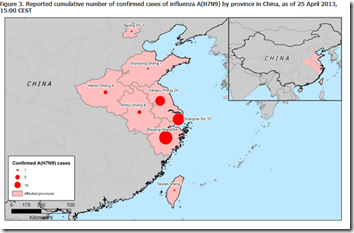
Since 31 March 2013, one hundred and eleven (111) cases of human infection with avian influenza A(H7N9) virus have been reported from seven provinces in eastern China and one (1) from Taiwan. Onset of disease has been between 19 February and 18 April 2013 in: Zhejiang (44), Shanghai (33), Jiangsu (24), Henan (4), Anhui (4), Beijing (1), Shandong (1) and on 24 April 2013 in Taiwan (1). The date of disease onset is currently unknown for fourteen patients.
The Chinese health authorities are responding to this public health event by enhanced surveillance, epidemiological and laboratory investigation and contact tracing.
The animal health sector has intensified investigations into the possible sources and reservoirs of the virus.
The authorities reported to the World Organisation for Animal Health (OIE) that avian influenza A(H7N9) was detected in samples from pigeons, chickens and ducks, and in environmental samples from live bird markets ('wet markets') in Shanghai, Jiangsu, Anhui and Zhejiang provinces. Authorities have closed markets and culled poultry in affected areas.
The source and mode of transmission have not been confirmed.
The outbreak is caused by a reassortant avian influenza virus with low pathogenicity for birds, hence it does not cause the signal 'die-offs' in poultry associated with highly pathogenic strains of avian influenza viruses.
Genetic analyses of the isolates have shown changes which suggest that the H7N9 virus may have greater ability to infect mammalian species, including humans, than most other avian influenza viruses. Pathogenicity for humans appears to be high and higher age appears to be a risk factor for disease.
The most likely scenario is that the influenza A(H7N9) virus is spreading undetected in poultry populations and occasionally infecting humans who have close contact with poultry or poultry products but this will have to be validated as further data become available.
At the present time there is no evidence of sustained human-to-human transmission.
Close to 2 000 close contacts of confirmed cases are reported to have been followed up.
There is one family cluster with two confirmed cases for which human-to-human transmission cannot be ruled out but where common exposure is the most likely explanation. In addition, the virus has been detected in one asymptomatic carrier in Beijing.
An increasing incidence of sporadic cases and expansion of geographic spread in China and possibly neighbouring countries are expected over the coming weeks. Individual imported human cases to Europe cannot be ruled out and countries need to prepare for detecting and diagnosing such cases.
Critical developments that would change this assessment would be evidence of sustained human-to-human transmission and detection of avian influenza A(H7N9) in bird populations in Europe.
ECDC has published the Supporting diagnostic preparedness for detection of avian influenza A(H7N9) viruses in Europe guidance for laboratories on 24 April 2013.
ECDC is preparing an EU case definition for A(H7N9).
ECDC is closely monitoring developments and is continuously re-assessing the situation in collaboration with WHO, US CDC, China CDC and other partners.
This epidemiological update does not change the conclusions and recommendations of the updated risk assessment published on April 12.
(?)
Related links:
-26 Apr 2013
Since 31 March 2013, one hundred and eleven (111) cases of human infection with avian influenza A(H7N9) virus have been reported from seven provinces in eastern China and one (1) from Taiwan. Onset of disease has been between 19 February and 18 April 2013 in: Zhejiang (44), Shanghai (33), Jiangsu (24), Henan (4), Anhui (4), Beijing (1), Shandong (1) and on 24 April 2013 in Taiwan (1). The date of disease onset is currently unknown for fourteen patients.
The Chinese health authorities are responding to this public health event by enhanced surveillance, epidemiological and laboratory investigation and contact tracing.
The animal health sector has intensified investigations into the possible sources and reservoirs of the virus.
The authorities reported to the World Organisation for Animal Health (OIE) that avian influenza A(H7N9) was detected in samples from pigeons, chickens and ducks, and in environmental samples from live bird markets ('wet markets') in Shanghai, Jiangsu, Anhui and Zhejiang provinces. Authorities have closed markets and culled poultry in affected areas.
The source and mode of transmission have not been confirmed.
The outbreak is caused by a reassortant avian influenza virus with low pathogenicity for birds, hence it does not cause the signal 'die-offs' in poultry associated with highly pathogenic strains of avian influenza viruses.
Genetic analyses of the isolates have shown changes which suggest that the H7N9 virus may have greater ability to infect mammalian species, including humans, than most other avian influenza viruses. Pathogenicity for humans appears to be high and higher age appears to be a risk factor for disease.
The most likely scenario is that the influenza A(H7N9) virus is spreading undetected in poultry populations and occasionally infecting humans who have close contact with poultry or poultry products but this will have to be validated as further data become available.
At the present time there is no evidence of sustained human-to-human transmission.
Close to 2 000 close contacts of confirmed cases are reported to have been followed up.
There is one family cluster with two confirmed cases for which human-to-human transmission cannot be ruled out but where common exposure is the most likely explanation. In addition, the virus has been detected in one asymptomatic carrier in Beijing.
An increasing incidence of sporadic cases and expansion of geographic spread in China and possibly neighbouring countries are expected over the coming weeks. Individual imported human cases to Europe cannot be ruled out and countries need to prepare for detecting and diagnosing such cases.
Critical developments that would change this assessment would be evidence of sustained human-to-human transmission and detection of avian influenza A(H7N9) in bird populations in Europe.
ECDC has published the Supporting diagnostic preparedness for detection of avian influenza A(H7N9) viruses in Europe guidance for laboratories on 24 April 2013.
ECDC is preparing an EU case definition for A(H7N9).
ECDC is closely monitoring developments and is continuously re-assessing the situation in collaboration with WHO, US CDC, China CDC and other partners.
This epidemiological update does not change the conclusions and recommendations of the updated risk assessment published on April 12.
(?)
Related links:
- ECDC Rapid Risk Assessment on avian influenza A(H7N9) virus in China, 12 April 2013
- Diagnostic preparedness in Europe for detection of influenza A(H7N9) viruses
- Epidemiological update 18 April 2013: avian influenza A(H7N9) virus in China
- More on avian influenza on ECDC website
- WHO: question and answers on human infection with influenza A(H7N9) virus, China (updated 5 April 2013)
- Chinese Center for Disease Control and Prevention: question and answers about human infection with A(H7N9) avian influenza virus (published 31 March 2013)
- Updates on avian influenza A(H7N9) by Chinese Center for Disease Control and Prevention
-------