TrevonFuller
New member
We have a new article in Epidemiology and Infection on AIV in wild and domestic birds in Central and West Africa: http://journals.cambridge.org/repo_A945QIK8. Prevalence was substantial in Central Africa including Cameroon, Central African Republic, and Gabon. Avian influenza surveillance in Central and West Africa,
2010?2014
Summary
Avian influenza virus (AIV) is an important zoonotic pathogen, resulting in global human
morbidity and mortality and substantial economic losses to the poultry industry. Poultry and
wild birds have transmitted AIV to humans, most frequently subtypes H5 and H7, but also
different strains and subtypes of H6, H9, and H10. Determining which birds are AIV reservoirs
can help identify human populations that have a high risk of infection with these viruses due to
occupational or recreational exposure to the reservoir species. To assess the prevalence of AIV in
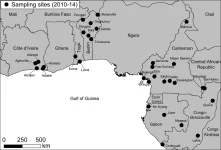
tropical birds, from 2010 to 2014, we sampled 40 099 birds at 32 sites in Central Africa (Cameroon,
Central African Republic, Congo-Brazzaville, Gabon) and West Africa (Benin, C?te d?Ivoire,
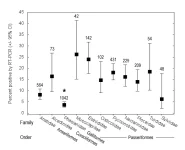
Togo). In Central Africa, detection rates by real-time RT?PCR were 16?6% in songbirds (eight
passerine families, n = 1257), 16?4% in kingfishers (family Alcedinidae, n = 73), 8?2% in ducks
(family Anatidae, n = 564), and 3?65% in chickens (family Phasianidae, n = 1042). Public health
authorities should educate human cohorts that have high exposure to these bird populations about
AIV and assess their adherence to biosecurity practices, including Cameroonian farmers who raise
small backyard flocks.
2010?2014
Summary
Avian influenza virus (AIV) is an important zoonotic pathogen, resulting in global human
morbidity and mortality and substantial economic losses to the poultry industry. Poultry and
wild birds have transmitted AIV to humans, most frequently subtypes H5 and H7, but also
different strains and subtypes of H6, H9, and H10. Determining which birds are AIV reservoirs
can help identify human populations that have a high risk of infection with these viruses due to
occupational or recreational exposure to the reservoir species. To assess the prevalence of AIV in
tropical birds, from 2010 to 2014, we sampled 40 099 birds at 32 sites in Central Africa (Cameroon,
Central African Republic, Congo-Brazzaville, Gabon) and West Africa (Benin, C?te d?Ivoire,
Togo). In Central Africa, detection rates by real-time RT?PCR were 16?6% in songbirds (eight
passerine families, n = 1257), 16?4% in kingfishers (family Alcedinidae, n = 73), 8?2% in ducks
(family Anatidae, n = 564), and 3?65% in chickens (family Phasianidae, n = 1042). Public health
authorities should educate human cohorts that have high exposure to these bird populations about
AIV and assess their adherence to biosecurity practices, including Cameroonian farmers who raise
small backyard flocks.