• FluTrackers.com Inc. does not provide medical advice. Information on this web site is collected from various internet resources, and the FluTrackers board of directors makes no warranty to the safety, efficacy, correctness or completeness of the information posted on this site by any author or poster. The information collated here is for instructional and/or discussion purposes only and is NOT intended to diagnose or treat any disease, illness, or other medical condition. Every individual reader or poster should seek advice from their personal physician/healthcare practitioner before considering or using any interventions that are discussed on this website. By continuing to access this website you agree to consult your personal physican before using any interventions posted on this website, and you agree to hold harmless FluTrackers.com Inc., the board of directors, the members, and all authors and posters for any effects from use of any medication, supplement, vitamin or other substance, device, intervention, etc. mentioned in posts on this website, or other internet venues referenced in posts on this website.
  • We are not asking for any donations. Do not donate to any entity who says they are raising funds for us.

Epidemic Hazard - North America -Early flu season

Harriet

Registered User
Epidemic Hazard - North-America
Event summary

GLIDE Number EH-20060921-7670-USA
Event type Epidemic Hazard Date / time [UTC] 21/09/2006 - 03:51:53 (Military Time, UTC)
Country USA Area -
County / State North Carolina City Charlotte
Cause of event Unknow Log date 21/09/2006 - 03:51:53 (Military Time, UTC)
Damage level Not or Not data Time left -
Latitude: N 35? 8.801 Longitude: W 80? 57.625
Number of deaths: Not or Not data Number of injured persons: Not or Not data
Evacuated: - Infected -
-

--------------------------------------------------------------------------------

DESCRIPTION
The state's first cases of influenza have been confirmed by the Alabama Department of Public Health. Eleven cases of early season influenza A have been identified in the Ozark area, while one laboratory-confirmed case of influenza B has been reported in Mobile County. The latter remains under investigation by public health officials. According to the Centers for Disease Control and Prevention, influenza B viruses can cause morbidity and mortality among humans but are generally associated with less severe epidemics than influenza A viruses. Although influenza type-B viruses can cause human epidemics, they have not caused pandemics. Alabama public health officials are encouraging people to contact their health-care providers to determine when and where immunizations will be available.


http://visz.rsoe.hu/alertmap/woalert_read.php?id=7670&cat=dis&lang=eng

National Association of Radio-Distress Signalling and Infocommunications,
Havaria Emergency and Disaster Information Services
Budapest Hungary
 
Re: Epidemic Hazard - North-America

Re: Epidemic Hazard - North-America

Ozark, Mobile report early outbreak of flu
Thursday, September 21, 2006
DAVE PARKS
News staff writer

An unusual outbreak of influenza has hit south Alabama, threatening to trigger an early flu season, the state Department of Public Health reported Wednesday.

Chris Sellers, a public health epidemiologist, said 11 cases of Type A influenza have been confirmed in Ozark and a single case of Type B influenza has been confirmed in Mobile. The earliest of the cases occurred in late August.

The outbreak in Ozark continues, Sellers said, while the Mobile case appears to be isolated and is still under investigation.

These appear to be the first cases of flu in the United States this season, Sellers said. However, the Centers for Disease Control and Prevention in Atlanta is checking to see if any other states have reported outbreaks in recent days. Normally, the flu season runs from October to May. The flu season didn't start last year until February.

"Late August is a little early," Sellers said. "It is unusual."

The big question, he said, is whether the flu will spread and signal the start of the 2006-07 season.

"We're not certain at this point that this is going to take off and be the season," he said. Flu can occur any time of year, but the season normally starts in cold weather, when people are indoors more.

The early cases were detected through the state's influenza surveillance system, which is operating year-round for the first time this year as part of a pandemic-preparedness plan, Sellers said.

Doctors in Ozark, a city of about 15,000 in Dale County near Fort Rucker Army Base, noticed a pattern of illness and used a quick influenza test to confirm the outbreak, he said.

Samples are now being sent to the CDC to determine the exact variant of the virus and see if it is included in this year's flu shot. Early results indicate that the Ozark outbreak is being caused by the subtype H1N1, normally a mild strain of flu that is included in this year's shot. However, further analysis is needed to determine whether the shot will provide protection, Sellers said.

Flu shots normally aren't given until October, so supplies are just now becoming available. Sellers said people should check with private providers. Most flu shot clinics in the Birmingham area aren't scheduled until after Oct. 2, and then several are planned for drug stores and supermarkets, according to the Web site findaflushot.com.

The worst-case scenario would be a pandemic. These worldwide outbreaks of lethal, new flu viruses often start early and come in waves, Sellers said. A mutation of the H1N1 virus caused the catastrophic 1918 flu pandemic.

E-mail: dparks@bhamnews.com

? 2006 The Birmingham News
? 2006 al.com All Rights Reserved.

http://www.al.com/news/birminghamnews/index.ssf?/base/news/115883062031120.xml&coll=2
 
Re: Regular Flu - Epidemic Hazard - North-America

Re: Regular Flu - Epidemic Hazard - North-America

Flu shots normally aren't given until October, so supplies are just now becoming available.

This outbreak is coming very early. Thanks for the update.

From Wikipedia, the free encyclopedia


H1N1 is a subtype of the species Influenza A virus. H1N1 has mutated into various strains including the Spanish Flu strain (now extinct in the wild), rare and mild human flu strains, endemic pig strains, and various strains found in birds.

A variant of H1N1 was responsible for the Spanish flu pandemic that killed some 50 million to 100 million people worldwide over about a year in 1918 and 1919 [1]. A different variant exists in pig populations. Controversy arose in October, 2005, after the H1N1 genome was published in the journal, Science. Many fear that this information could be used for bioterrorism.

"When he compared the 1918 virus with today's human flu viruses, Dr. Taubenberger noticed that it had alterations in just 25 to 30 of the virus's 4,400 amino acids. Those few changes turned a bird virus into a killer that could spread from person to person." [2]

Much less pathogenic H1N1 strains still exist in the wild today, causing roughly half of all flu infections in 2006

http://en.wikipedia.org/wiki/H1N1
 
Last edited:
Re: Regular Flu - Epidemic Hazard - North-America

Re: Regular Flu - Epidemic Hazard - North-America

so just a wild guess here...but take H1N1...mix in a dash of H5N1...and are we back to the Spanish Flu?
 
Re: Regular Flu - Epidemic Hazard - North-America

Re: Regular Flu - Epidemic Hazard - North-America

So is anyone watching the seasonal flu season where AI has already been detected?
 
Re: Regular Flu - Epidemic Hazard - North-America

Re: Regular Flu - Epidemic Hazard - North-America

Early Flu Season
Flu season hits in Dale County


Updated: 6:33 PM Sep 13, 2006
Erica Proffer

Thirty-five to 40 cases of the flu have been reported in Dale County.

This comes months before the normal flu season, and months before vaccinations arrive.

Normally, the virus comes in the cooler months and doctors say it's mostly found in children.

The normal flu season begins in November, but doctors are saying it has already struck in some areas.

?In fact, the first flu cases came in late August,? said Emergency Medical Doctor, Dr. Carl Barlow. ?Since then, we've probably had 35-40 cases of the flu that we've diagnosed with the flu test, and have been positive. A lot of them have been in children."

Doctors say there are some ways to help reduce the spread of the virus.

One way is to sneeze or cough into your elbow instead of your hand, because it makes less contact throughout the day.

Doctors also say one of the main ways to reduce the spread of the flu is by washing your hands, but it's important how you wash them. They suggest using a lot of friction and be sure you clean both sides of the hands, and underneath your fingernails. It's not necessary to rinse in scalding hot water. Then, dry with a paper towel that's already down. Use that paper towel to cut off the water.

Doctors say these few steps will go a long way in helping reduce the spread of the flu.

Since many of the flu cases have been found in children, Ozark School officials have sent their annual health precautions letter a little early, to help combat the spread.

In that letter, officials encourage parents to review with children the basics of good hygiene and health care.

Superintendent, Dr. Dan Payant of Ozark City Schools says, ?We want to remind parents to not send their children to school if they're experiencing those types of symptoms: coughing, sore throat, fever. Keep them at home till they get healthy."

Both doctors and school leaders say if you have symptoms of the flu, the most important thing is to stay home.

The flu cases in Ozark are being double checked by state health leaders to make sure it is in fact the influenza virus.

No flu vaccinations are available at this time. Doctors expect them to arrive closer to October.


Find this article at:
http://www.wtvynews4.com/news/headlines/3913151.html

.
 
Re: Regular Flu - Epidemic Hazard - North-America

Re: Regular Flu - Epidemic Hazard - North-America

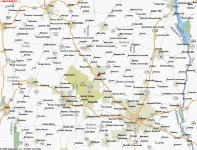
Map of Ozark, AL and surrounding area including Fort Rucker mentioned in article(a). I always look for bodies of water :whistle:


oczark al map.gif
 
Re: Regular Flu - Epidemic Hazard - North-America

Re: Regular Flu - Epidemic Hazard - North-America

Add Texas, unofficially so far..
I am a eligibility worker for foodstamps and medicaid and have seen a LOT of people coming into our offices this past week with coughs and other symptoms that sound a lot like the flu. My clients have said that there are a lot of people they know who are sick in their neighborhoods as well. I hope that this is just an early flu season as well, but it has never been THIS early in the 10 years i have lived in this community. I am located in Corpus Christi, Texas, down in the southern part of the state on the gulf coast on one of the major migratory pathways that birds from the north, and northwest, including those from as far away as alaska travel through each year. I really hope it is just early flu!
 
Re: Epidemic Hazard - North America -Early flu season

Flu case among first in nation
Thursday, September 21, 2006
By PENELOPE McCLENNY
Staff Reporter

A 2-year-old Mobile County child was hospitalized in August for a case of influenza that is among the first reported in the country this season, an Alabama Department of Public Health official said Wednesday.

Laboratory tests confirmed that the victim, whose name was not released, tested positive for Influenza B, a less virulent type of flu often seen in children.

While state flu coordinator Chris Sellers said the Mobile case is notable because it was unusual to see the flu this early in the season, his department is more closely watching nearly a dozen recently reported cases of Influenza A in the southeast Alabama city of Ozark.

"The Mobile case, so far it's a singular case," Sellers said. "Ozark is a little bit more concerning to us right now than the Mobile case. Every day we're seeing a handful of people. That's truly unusual."

The Mobile and Ozark cases combined give Alabama an infamous distinction thus far in the season, Seller said.

"The only flus we know of in the nation are Ozark and Mobile," he said.

Eleven of the Ozark cases have been confirmed as H1N1, the same strain behind the 1918 virus that killed as many as 50 million people worldwide, according to the Atlanta-based Centers for Disease Control and Prevention. While H1N1 is more virulent and contagious than influenza B, humans have built up immunity to that strain, said Patti Thames, director of Infection Control at Thomas Hospital, and it does not pose the same threat as it did in the early 1900s.

H1N1, which is not the same strain as the avian flu public health officials are watching worldwide, was included in vaccines during last year's season, according to the CDC. Local health officials also say it will be included in this year's supplies as well.

"I'm hoping that that's going to be our strain this year, and that's what's in our vaccine," said Melissa Tucker, director of epidemiology at the Mobile County Health Department.

The Mobile Influenza B cases is likely "an absolute coincidence at this point," Seller said. Health officials will monitor the child's family, physicians and any other people who came into contact with the victim to see if the illness emerges elsewhere, but they don't consider the case a cause for alarm.

These early cases do serve as a reminder for those who are eligible to begin making plans to receive their flu vaccine, Sellers said. Some private, local physicians have already begun receiving their supplies, said Dr. Bernard Eichold, Mobile County health officer. The Health Department expects to receive its vaccines by Oct. 15, Eichold said.


? 2006 The Mobile Register
? 2006 al.com All Rights Reserved.
 
Back
Top Bottom