

Michael Coston
Editor, Senior Moderator
Emergency Preparedness: A Medicine For The Melancholy

#18,596
During 2024 the United States saw 27 Billion-dollar weather disasters, resulting in the deaths of at least 568 people, and economic losses of over $180 billion dollars. While not the worst year on record, it was bad enough.
Last fall - along with several million other Floridians - I found myself under the gun for the second time in two weeks from an approaching hurricane. While I was able to ride out Helene in my home, Milton was another story (see With Milton, Evacuation Is The Better Part Of Valor).
Thanks to having a Disaster Buddy, I had a pre-arranged safe place to go. And while my home took some damage, the floodwaters - which inundated homes only a few hundred feet from mine - spared my humble abode. It would take more than a week for my power, water, and Internet to be fully restored (see Signs of Life), but I count myself very lucky.
Since this was my 3rd evacuation in the past 7 years, I was reasonably well prepared. But every crisis is a learning experience, and since then I've improved my emergency preparations (see Post-Milton Improvements To My Power Preps).
Already in 2025, Southern California has endured the costliest wildfire in history, while the Southern States (Texas, Louisiana, Alabama, Georgia and Florida) experienced rare blizzard conditions. Although nowhere is completely safe, FEMA's National Risk Index For Natural Disasters (see map below) shows the historically highest risk areas in the country.
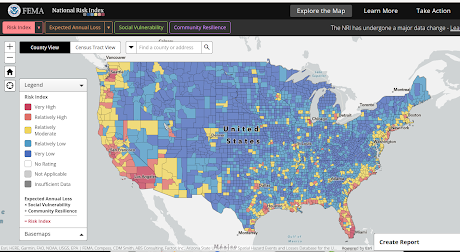
Not surprisingly, Southern California and much of Florida are among the highest risk regions in the nation.
No one can predict what the next 11 months will bring, but the spring severe weather season is likely only weeks from ramping up, hurricane season starts again in 5 months, and earthquakes, wildfires, and floods can happen at any time.
While most disasters are local or regional, some can be national or international in scope.
While we might go years before that happens again, the aggressive spread and spillover of avian flu is a genuine concern, and - like with COVID - there could be little or no warning should it happen.
Three months ago, in A Personal Pre-Pandemic Plan, I provided links to a number of useful documents - many buried in the CDC Archives - on preparing for a pandemic. I'd suggest downloading them now, while they remain easily accessible.
Other preparations that would be useful in any emergency/disaster situation include:
While being better prepared doesn't guarantee you and your loved ones will come through a major disaster unscathed - it is relatively cheap insurance - and it can substantially improve your chances.
And for me at least, I sleep a lot better knowing I am reasonably well prepared for . . . whatever may come.
https://afludiary.blogspot.com/2025/02/emergency-preparedness-medicine-for.html
#18,596
During 2024 the United States saw 27 Billion-dollar weather disasters, resulting in the deaths of at least 568 people, and economic losses of over $180 billion dollars. While not the worst year on record, it was bad enough.
Last fall - along with several million other Floridians - I found myself under the gun for the second time in two weeks from an approaching hurricane. While I was able to ride out Helene in my home, Milton was another story (see With Milton, Evacuation Is The Better Part Of Valor).
Thanks to having a Disaster Buddy, I had a pre-arranged safe place to go. And while my home took some damage, the floodwaters - which inundated homes only a few hundred feet from mine - spared my humble abode. It would take more than a week for my power, water, and Internet to be fully restored (see Signs of Life), but I count myself very lucky.
Since this was my 3rd evacuation in the past 7 years, I was reasonably well prepared. But every crisis is a learning experience, and since then I've improved my emergency preparations (see Post-Milton Improvements To My Power Preps).
Already in 2025, Southern California has endured the costliest wildfire in history, while the Southern States (Texas, Louisiana, Alabama, Georgia and Florida) experienced rare blizzard conditions. Although nowhere is completely safe, FEMA's National Risk Index For Natural Disasters (see map below) shows the historically highest risk areas in the country.
Not surprisingly, Southern California and much of Florida are among the highest risk regions in the nation.
No one can predict what the next 11 months will bring, but the spring severe weather season is likely only weeks from ramping up, hurricane season starts again in 5 months, and earthquakes, wildfires, and floods can happen at any time.
While most disasters are local or regional, some can be national or international in scope.
- In December of 2018, in NIAC: Surviving A Catastrophic Power Outage, we looked at a NIAC (National Infrastructure Advisory Council) 94-page report that examined the United State's current ability to respond to and recover from a widespread catastrophic power outage.
- Eight years ago, in DHS: NIAC Cyber Threat Report - August 2017, we looked at a 45-page report addressing urgent cyber threats to our critical infrastructure that called for `bold, decisive actions'.
- Last September, in #NatlPrep: Preparing For Extreme Space Weather, we revisited the potential for grid damage from a Coronal Mass Ejection from the sun.
While we might go years before that happens again, the aggressive spread and spillover of avian flu is a genuine concern, and - like with COVID - there could be little or no warning should it happen.
Three months ago, in A Personal Pre-Pandemic Plan, I provided links to a number of useful documents - many buried in the CDC Archives - on preparing for a pandemic. I'd suggest downloading them now, while they remain easily accessible.
- Get Your Household Ready For Pandemic Flu {PDF - 16 pages]
- Get Ready for Pandemic Flu: Educational Settings [PDF – 16 pages]
- Get Ready for Pandemic Flu: Workplace Settings [PDF – 16 pages]
Other preparations that would be useful in any emergency/disaster situation include:
- Having enough food and water stockpiled for 10 to 14 days
- Having a family communications plan
- Having extra prescription medications in case of supply chain problems
- Consider having a Living Will and Health Care Proxy
- Take advantage of existing Flu/COVID vaccines
- Making sure you are current on other vaccines liked Tetanus, Pneumonia, etc.
- Consider acquiring emergency heating, lighting, cooking, and entertainment supplies (see The Gift of Preparedness 2024)
While being better prepared doesn't guarantee you and your loved ones will come through a major disaster unscathed - it is relatively cheap insurance - and it can substantially improve your chances.
And for me at least, I sleep a lot better knowing I am reasonably well prepared for . . . whatever may come.
https://afludiary.blogspot.com/2025/02/emergency-preparedness-medicine-for.html