

Michael Coston
Editor, Senior Moderator
Emerg. Microbes & Infect.: Novel Coronaviruses In Least Horseshoe Bats In Southwestern China
#12,353
While bats have been long been known to carry rabies, its only been in the past couple of decades have other bat-hosted viruses really gained our attention.
The list of potentially zoonotic viruses that bats carry grows every year. Just over a year ago, in Study: Hotspots For Bat To Human Disease Transmission, we looked at a study that attempted to quantify the risks of zoonotic transmission of a wide variety of bat viruses to humans.
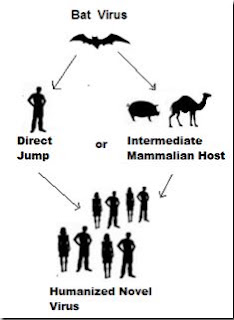
In March of 2016 a paper (PNASSARS-like WIV1-CoV poised for human emergence) from researchers at UNC Chapel Hill highlighted a coronavirus isolated from Chinese horseshoe bats, that already seems to have much of the `right stuff' needed to infect, and replicate, in humans.
Today we've another paper - again on Coronaviruses isolated from horseshoe bats in China - that finds that the least horseshoe bat (R.pusillus) is (quote):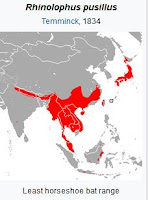
Below you'll find the abstract and an excerpt from the discussion of a much longer (and at times pretty technical) open access study.
None of this is meant to demonize bats, as they are an important part of our environment (they even eat mosquitoes). Still, the CDC offers some sage advice when it comes to avoid coming in contact with bats. And for some other bat-related posts you may wish to revisit:
#12,353
While bats have been long been known to carry rabies, its only been in the past couple of decades have other bat-hosted viruses really gained our attention.
- Among the first, were the Hendra and Nipah viruses, which were first recognized in the 1990s (see Update: Hendra In Queensland, Nipah In Bangladesh).
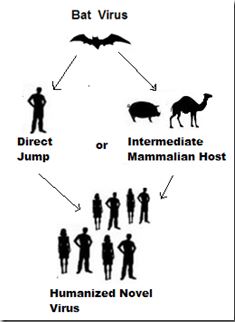
- In 2003 the SARS-Cov (coronavirus) epidemic emerged - and while it was originally linked to civets, later recent research suggested civets were (at best) intermediate hosts. SARS-like viruses have been found in bats around the world (see EID Journal: Novel Bat Coronaviruses, Brazil and Mexico).
- In addition to Ebola and Marburg, bats are also suspected to be part of the ecology of MERS-CoV (camels, like civets, may be secondary hosts).
- And in the past four years, bats have even been found to harbor several unique influenza viruses (see CDC: Bat Flu Q&A).
When Steven Soderbergh made his pandemic thriller `Contagion’ a few years ago, technical adviser Professor Ian Lipkin created fictional MEV-1 virus based on a mutated Nipah virus (see The Scientific Plausibility of `Contagion’) simply because of the potential of someday seeing a bat-borne pandemic virus.
.The list of potentially zoonotic viruses that bats carry grows every year. Just over a year ago, in Study: Hotspots For Bat To Human Disease Transmission, we looked at a study that attempted to quantify the risks of zoonotic transmission of a wide variety of bat viruses to humans.
In March of 2016 a paper (PNASSARS-like WIV1-CoV poised for human emergence) from researchers at UNC Chapel Hill highlighted a coronavirus isolated from Chinese horseshoe bats, that already seems to have much of the `right stuff' needed to infect, and replicate, in humans.
Today we've another paper - again on Coronaviruses isolated from horseshoe bats in China - that finds that the least horseshoe bat (R.pusillus) is (quote):
. . . . a prominent natural reservoir or mixer of genetically diverse Alphacoronavirus and Betacoronavirus species and plays a pivotal role in the evolution and dissemination of these viruses.
Other bat species in the region tested negative for these viruses. The range of the R. pusillus is shown below. 
Below you'll find the abstract and an excerpt from the discussion of a much longer (and at times pretty technical) open access study.
Discovery and genetic analysis of novel coronaviruses in least horseshoe bats in southwestern China
Open
Lihua Wang1,2, Shihong Fu1,2, Yuxi Cao1,2, Hailin Zhang3, Yun Feng3, Weihong Yang3, Kai Nie1,2, Xuejun Ma1,2 and Guodong Liang1,2
Received 23 August 2016; Revised 21 December 2016; Accepted 27 December 2016
ABSTRACT
To investigate bat coronaviruses (CoVs), we collected 132 rectal swabs and urine samples from five bat species in three countries in southwestern China. Seven CoVs belonging to distinct groups of severe acute respiratory syndrome (SARS)-like CoVs and α-CoVs were detected in samples from least horseshoe bats.
Open
Lihua Wang1,2, Shihong Fu1,2, Yuxi Cao1,2, Hailin Zhang3, Yun Feng3, Weihong Yang3, Kai Nie1,2, Xuejun Ma1,2 and Guodong Liang1,2
Received 23 August 2016; Revised 21 December 2016; Accepted 27 December 2016
ABSTRACT
To investigate bat coronaviruses (CoVs), we collected 132 rectal swabs and urine samples from five bat species in three countries in southwestern China. Seven CoVs belonging to distinct groups of severe acute respiratory syndrome (SARS)-like CoVs and α-CoVs were detected in samples from least horseshoe bats.
Samples from other bat species were negative for these viruses, indicating that the least horseshoe bat represents one of the natural reservoirs and mixers for strains of CoVs and has a pivotal role in the evolution and dissemination of these viruses. The genetic and evolutionary characteristics of these strains were described.
Whole-genome sequencing of a new isolate (F46) from a rectal swab from a least horseshoe bat showed that it contained 29 699 nucleotides, excluding the poly (A) tail, with 13 open reading frames (ORFs). Phylogenetic and recombination analyses of F46 provided evidence of natural recombination between bat SARS-like CoVs (Rs3367 and LYRa11) or SARS-CoV (BJ01), suggesting that F46 could be a new recombinant virus from SARS-like CoVs or SARS-CoVs.
(SNIP)
(SNIP)
In conclusion, horseshoe bats carry genetically diverse SARS-like CoVs. Owing to the high likelihood of recombination among bat CoVs, additional bat SARS-like CoVs are likely to be identified in the future. To better predict and prevent the next emergence of disease caused by CoVs of bat origin, it is necessary to maintain long-term surveillance of bat CoVs.
Bats are the most abundant and geographically dispersed vertebrates on earth. Their ability to carry and vector dangerous diseases without ill-effect (i.e. Rabies, Nipah, Hendra, etc.) is increasingly viewed as a potential public health threat.None of this is meant to demonize bats, as they are an important part of our environment (they even eat mosquitoes). Still, the CDC offers some sage advice when it comes to avoid coming in contact with bats. And for some other bat-related posts you may wish to revisit: