Re: Emerg Infect Dis. Influenza Virus A (H1N1) in Giant Anteaters (Myrmecophaga tridactyla)
Discovery Institute's biggest fear? »
Human seasonal H1N1 flu in Giant Anteaters
Category: Infectious disease • Swine flu • Zoonoses
Posted on: May 30, 2009 6:24 AM, by revere
The natural reservoir for most influenza viruses is birds, especially aquatic birds, but some versions of the virus have also become adapted to the host cells of other species, among them sea mammals, horses, dogs and of course pigs and humans (among others). How long is the list? We really don't know, as there has been little systematic inquiry into influenza hosts in the natural world. While human influenza is seasonal in the northern and southern hemispheres, where it goes in the "off season" is a matter of debate. Most flu experts think it remains at low levels in the community, spiking to outbreak levels during "flu season" for reasons that are yet to be agreed upon. Another possibility is that it remains in some unidentified non-human reservoir. And there is surprisingly little information about influenza in tropical climes (see this interesting piece by Declan Butler in Nature).
A paper just published in Emerging Infectious Diseases is a stark example that the virus could exist almost anywhere. The paper describes an outbreak with a human seasonal H1N1 virus in a colony of Myrmecophaga tridactyla, more popularly known as The Giant Anteater:
A colony of 11 adult anteaters (7 males, 4 females) and 1 neonate was housed at the Nashville Zoo at Grassmere, Nashville, Tennessee, USA. The colony experienced an outbreak of respiratory disease beginning in February 2007. The anteaters were housed separately in stalls in the same building with shared ventilation, with the exception of the nursing neonate who was housed with his dam. There was no contact with animals outside the colony. The primary caretaker of the colony had no contact with other animals housed at the zoo. No other species experienced respiratory disease at the zoo during the outbreak. Only the primary caretaker had sustained direct contact with any members of the colony.
The index case occurred on February 8 in 1 animal that was being treated twice a day for a superficial wound. The respiratory disease was characterized clinically by severe nasal discharge and congestion, inappetence, and lethargy. Within several days, all adult animals in the colony were affected. Only the neonate appeared to remain unaffected. The caretakers overseeing the colony, with the exception of the attending veterinarian, were also ill with respiratory disease, including the primary caretaker. The onset of the caretakers’ illness coincided with the illness in the anteaters. No diagnostic testing was conducted for the caretakers during the outbreak. (Nofs S, Abd-Eldaim M, Thomas KV, Toplon D, Rouse D, Kennedy M. Influenza virus A (H1N1) in giant anteaters (Myrmecophaga tridactyla). Emerg Infect Dis. 2009 Jul; [Epub ahead of print])
Here's a picture of a Giant Anteater:
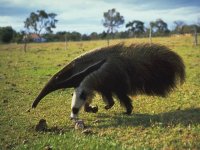
Source
Seasonal influenza A/H1N1 was cultured from the nasal discharge from 3 of these large animals (they can be 6 to 8 feet long and weigh 65 to 140 pounds). The viral subtype and strain was closest to a contemporaneously circulating human virus in the region. Examination of convalescent and historical sera for the 3 animals showed that post infection conversion occurred in 2 but 1 already had antibodies before the 2007 outbreak. The animal with evidence of prior infection had been imported into the colony as a juvenile in 2003 and was noted at that time to have had a respiratory infection. This could have been an influenza infection or the animal's seroconversion could have happened at another time. In any event, the authors concluded:
The differences between the anteater isolate and circulating human strains did not occur at sites known to be antigenically or functionally important; thus, these minor changes do not appear to alter the antigenicity or the function of the encoded proteins (E. Gorvokova, pers. comm.). We concluded that based on the genetic sequence of the virus isolated from the anteaters and on the fact that the colony was not exposed to animals other than the human caretakers the caretakers were the most likely source of the virus affecting the anteater colony. Further genetic sequencing will be required to determine if this interspecies transmission arose as a result of mutations of the virus, including reassortment. [cites omitted]
Mutation and reassortment are one mechanism whereby a virus might cross a species boundary, but it doesn't appear to be necessary. Horse flu has crossed to dogs and bird flu to humans without reassortment or obvious mutation to allow this (although admittedly our knowledge of what is required is still meager). Once the species boundary is crossed, however, there is the potential for the virus to become adapted to the new host and change in unpredictable ways.
Giant Anteaters are unusual mammals. Their natural habitat is in neotropical regions of Central and South America. Their diet consists entirely of insects (grubs, ants and termites), as many as 30,000 per day.
They have one of the lowest body temperatures of any terrestrial mammal (32.7 degrees C., more than 4.3 degrees C. or 8 degrees F. lower than human body temperature) as well as numerous other features very unlike other mammals (
they are one of only two mammals without teeth, for example).
Yet Giant Anteaters seem to become easily infected with human adapted influenza virus. What other animals, tropical or otherwise, might harbor this virus?
http://scienceblogs.com/effectmeasure/2009/05/human_seasonal_h1n1_flu_in_gia.php


