

Michael Coston
Editor, Senior Moderator
EID Journal: HPAI A(H5N1) Clade 2.3.4.4b Virus in Domestic Cat, France, 2022
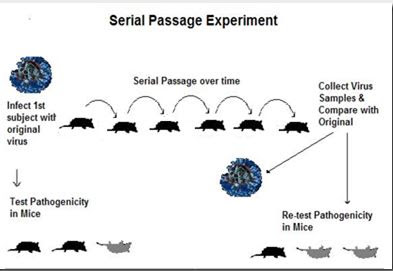
Host Adaptation via serial passage of a virus
#17,514
Influenza A viruses, being negative-sense single-stranded segmented RNA viruses, are prolific but notoriously sloppy replicators. They make millions of copies of themselves while they infect a host, but in the process, often make small transcription errors.
Most of these `errors' do little to help the virus, and many are detrimental to its survival.
Those that accidentally favor replication in the host can produce more progeny, and if `fit enough', can drown out the earlier `wild type’ virus in the host. This process is called host adaptation, and while it can be easily accomplished in the laboratory via a classic serial passage study (see graphic above), it occurs in nature all the time.
Hence our concerns over mammal-to-mammal transmission of avian viruses. The longer the chains of infection, the more likely the virus is to adapt to its new found host.
Yesterday, in A Brief History Of Avian Influenza In Cats, I mentioned a report from early January (see WOAH: France Reports Cat Infected With Avian H5N1), on the discovery of an H5N1 infected cat at a poultry farm in western France.
The cat was euthanized on December 23rd, but few other details were offered.
Since then we've seen sporadic feline infections with H5N1 in the United States (see here, and here) and Canada (see here), and for the past 7 days we've been following a much larger outbreak in Poland.
How large is hard to estimate, but 9 of 11 cats tested (from 3 different cities) were positive for avian H5. We are awaiting further details, including laboratory analyses.
Today we have a Research Letter published this week in the CDC's EID Journal on last December's feline infection in France. From it we learn that the animal suffered both respiratory and neurological symptoms, and the virus carried two potentially significant amino acid changes (E627K in PB2 and E26G in NS2), likely the result of host adaptation.
Some excerpts (reformatted for readability) from the report follow, after which I'll have a bit more.
Volume 29, Number 8—August 2023
Research Letter
Highly Pathogenic Avian Influenza A(H5N1) Clade 2.3.4.4b Virus in Domestic Cat, France, 2022
François-Xavier Briand , Florent Souchaud, Isabelle Pierre, Véronique Beven, Edouard Hirchaud, Fabrice Hérault, René Planel, Angélina Rigaudeau, Sibylle Bernard-Stoecklin, Sylvie Van der Werf, Bruno Lina, Guillaume Gerbier, Nicolas Eterradossi, Audrey Schmitz, Eric Niqueux, and Béatrice Grasland
Abstract
We detected highly pathogenic avian influenza A(H5N1) clade 2.3.4.4b virus in a domestic cat that lived near a duck farm infected by a closely related virus in France during December 2022. Enhanced surveillance of symptomatic domestic carnivores in contact with infected birds is recommended to prevent further spread to mammals and humans.
On December 27, 2022, the avian influenza National Reference Laboratory of the Agency for Food, Environmental and Occupational Health & Safety in France confirmed a case of highly pathogenic avian influenza (HPAI) A(H5N1) clade 2.3.4.4b virus in a domestic cat. The cat lived with a human family next to a breeding duck farm, which had notified the animal health services of possible HPAI on December 9, 2022, after observing a 20% drop in egg production. After HPAI H5N1 clade 2.3.4.4b virus was confirmed at the farm, 8,375 ducks were culled on December 14.
On December 20, the cat displayed disturbances in general condition, including apathy and mild hyperthermia, and was seen by a veterinary surgeon. The cat's condition worsened; pronounced neurologic and respiratory (dyspnea) symptoms appeared, resulting in compassionate euthanasia on December 24. Veterinarians collected sinonasal, tracheal, and anal swab samples after death, and a screening laboratory performed real-time reverse transcription PCR (RT-PCR) targeting the matrix protein and hemagglutinin (H5) genes. The laboratory sent H5-positive tracheal and sinonasal swab samples to the National Reference Laboratory, which confirmed HPAI H5N1 virus by using specific real-time RT-PCR for H5 clade 2.3.4.4b and neuraminidase (N1) genes (Table).
We compared the complete sequence of the HPAI H5N1 virus found in the cat (A/cat/France/22P026544/2022) with other HPAI H5N1 virus sequences circulating in France in the same area, including the virus found in the neighboring duck farm (A/duck/France/22P025647/2022). Phylogenetic analyses of HPAI H5N1 genomes indicated that the virus from the cat belonged to the A/duck/Saratov/29-02/2021–like genotype, which has been the predominant virus genotype circulating in France and Europe since September 2022. The cat virus sequence was directly related to virus sequences identified in the same area in December 2022 (Figure).
Furthermore, the virus isolated from the neighboring duck farm (Figure) had only 2 nt differences (out of 13,507 total nts) compared with the cat virus, resulting in an E627K mutation in polymerase basic protein 2 and E26G mutation in nonstructural protein 2 in the cat virus. The E627K mutation has been described as a major marker of influenza virus adaptation to mammalian hosts (1). The E26G mutation has a possible role in virus adaptation to temperature changes (2).
Since September 2021, a total of 90 sequences of HPAI H5N1 clade 2.3.4.4b viruses detected in mammals have been available in the GISAID EpiFlu database (https://www.gisaid.org), 20 of which have the E627K mutation, most probably indicating a rapid selection of this mutation in mammalian hosts (3). This virulence marker is in addition to those already observed in circulating HPAI H5N1 viruses detected in birds in Europe, such as the PB1-F2 N66S mutation (4).
Since winter 2021–22, the number of reported cases of HPAI H5N1 clade 2.3.4.4b infections in mammals has increased (5,6), likely caused by several factors.
Given that HPAI H5N1 circulates at high levels in wild and domestic birds, and virus was detected in a domestic cat, we recommend enhanced surveillance of symptomatic domestic carnivores in contact with infected birds to rapidly identify potential transmission events to other domestic animals and prevent further spread to humans. Our report also indicates that adequate protective equipment and barrier measures should be provided to avoid direct transmission of HPAI to persons exposed to infected birds (6,9).
Mr. Briand is a scientist at the National Reference Laboratory for avian influenza and Newcastle disease in France. His research interests focus on phylogeny, virology, and molecular epidemiology, especially for avian influenza and Newcastle disease viruses.
In this case, two significant mutations were detected after only one passage (bird to feline) of the virus. Luckily, most H5N1 spillovers into mammals appear to have been dead-end infections, with few opportunities to expand the `chain' of infection.
One notable exception came last fall, when we saw a large outbreak of avian H5N1 at a mink farm in Spain (see Eurosurveillance journal report HPAI A(H5N1) Virus Infection in Farmed Minks, Spain, October 2022). Mink are highly susceptible to both COVID and influenza (see That Touch of Mink Flu (2023 Edition)).
Not only does it appear likely that the H5N1 virus spread efficiently from mink-to-mink, it acquired a rare, and potentially dangerous, mutation (T271A) along the way, one which reportedly `enhances the polymerase activity of influenza A viruses in mammalian host cells and mice'.
In other cases - particularly among marine mammals - intermammal transmission may have occurred, but it is difficult to prove. We've also seen some evidence to suggest that pigs may serve as an intermediate host for avian flu (see Netherlands: Zoonoses Experts Council (DB-Z) Risk Assessment & Warning of Swine As `Mixing Vessels' For Avian Flu).
Unfortunately, much of what happens in the wild goes on out of our sight; the 2009 H1N1 virus circulated virtually unnoticed in pigs for a decade before it abruptly began its world tour, and we know very little about SARS-COV-2 prior to December of 2019.
While there may still be some `species barrier' that prevents HPAI H5 from making the leap to a human pandemic, rest assured we live in a threat-rich environment. And it only takes one novel virus getting lucky to start us down that path again.
https://afludiary.blogspot.com/2023/06/eid-journal-hpai-ah5n1-clade-2344b.html
Host Adaptation via serial passage of a virus
#17,514
Influenza A viruses, being negative-sense single-stranded segmented RNA viruses, are prolific but notoriously sloppy replicators. They make millions of copies of themselves while they infect a host, but in the process, often make small transcription errors.
Most of these `errors' do little to help the virus, and many are detrimental to its survival.
Those that accidentally favor replication in the host can produce more progeny, and if `fit enough', can drown out the earlier `wild type’ virus in the host. This process is called host adaptation, and while it can be easily accomplished in the laboratory via a classic serial passage study (see graphic above), it occurs in nature all the time.
Hence our concerns over mammal-to-mammal transmission of avian viruses. The longer the chains of infection, the more likely the virus is to adapt to its new found host.
Yesterday, in A Brief History Of Avian Influenza In Cats, I mentioned a report from early January (see WOAH: France Reports Cat Infected With Avian H5N1), on the discovery of an H5N1 infected cat at a poultry farm in western France.
The cat was euthanized on December 23rd, but few other details were offered.
Since then we've seen sporadic feline infections with H5N1 in the United States (see here, and here) and Canada (see here), and for the past 7 days we've been following a much larger outbreak in Poland.
How large is hard to estimate, but 9 of 11 cats tested (from 3 different cities) were positive for avian H5. We are awaiting further details, including laboratory analyses.
Today we have a Research Letter published this week in the CDC's EID Journal on last December's feline infection in France. From it we learn that the animal suffered both respiratory and neurological symptoms, and the virus carried two potentially significant amino acid changes (E627K in PB2 and E26G in NS2), likely the result of host adaptation.
Some excerpts (reformatted for readability) from the report follow, after which I'll have a bit more.
Volume 29, Number 8—August 2023
Research Letter
Highly Pathogenic Avian Influenza A(H5N1) Clade 2.3.4.4b Virus in Domestic Cat, France, 2022
François-Xavier Briand
, Florent Souchaud, Isabelle Pierre, Véronique Beven, Edouard Hirchaud, Fabrice Hérault, René Planel, Angélina Rigaudeau, Sibylle Bernard-Stoecklin, Sylvie Van der Werf, Bruno Lina, Guillaume Gerbier, Nicolas Eterradossi, Audrey Schmitz, Eric Niqueux, and Béatrice GraslandAbstract
We detected highly pathogenic avian influenza A(H5N1) clade 2.3.4.4b virus in a domestic cat that lived near a duck farm infected by a closely related virus in France during December 2022. Enhanced surveillance of symptomatic domestic carnivores in contact with infected birds is recommended to prevent further spread to mammals and humans.
On December 27, 2022, the avian influenza National Reference Laboratory of the Agency for Food, Environmental and Occupational Health & Safety in France confirmed a case of highly pathogenic avian influenza (HPAI) A(H5N1) clade 2.3.4.4b virus in a domestic cat. The cat lived with a human family next to a breeding duck farm, which had notified the animal health services of possible HPAI on December 9, 2022, after observing a 20% drop in egg production. After HPAI H5N1 clade 2.3.4.4b virus was confirmed at the farm, 8,375 ducks were culled on December 14.
On December 20, the cat displayed disturbances in general condition, including apathy and mild hyperthermia, and was seen by a veterinary surgeon. The cat's condition worsened; pronounced neurologic and respiratory (dyspnea) symptoms appeared, resulting in compassionate euthanasia on December 24. Veterinarians collected sinonasal, tracheal, and anal swab samples after death, and a screening laboratory performed real-time reverse transcription PCR (RT-PCR) targeting the matrix protein and hemagglutinin (H5) genes. The laboratory sent H5-positive tracheal and sinonasal swab samples to the National Reference Laboratory, which confirmed HPAI H5N1 virus by using specific real-time RT-PCR for H5 clade 2.3.4.4b and neuraminidase (N1) genes (Table).
We compared the complete sequence of the HPAI H5N1 virus found in the cat (A/cat/France/22P026544/2022) with other HPAI H5N1 virus sequences circulating in France in the same area, including the virus found in the neighboring duck farm (A/duck/France/22P025647/2022). Phylogenetic analyses of HPAI H5N1 genomes indicated that the virus from the cat belonged to the A/duck/Saratov/29-02/2021–like genotype, which has been the predominant virus genotype circulating in France and Europe since September 2022. The cat virus sequence was directly related to virus sequences identified in the same area in December 2022 (Figure).
Furthermore, the virus isolated from the neighboring duck farm (Figure) had only 2 nt differences (out of 13,507 total nts) compared with the cat virus, resulting in an E627K mutation in polymerase basic protein 2 and E26G mutation in nonstructural protein 2 in the cat virus. The E627K mutation has been described as a major marker of influenza virus adaptation to mammalian hosts (1). The E26G mutation has a possible role in virus adaptation to temperature changes (2).
Since September 2021, a total of 90 sequences of HPAI H5N1 clade 2.3.4.4b viruses detected in mammals have been available in the GISAID EpiFlu database (https://www.gisaid.org), 20 of which have the E627K mutation, most probably indicating a rapid selection of this mutation in mammalian hosts (3). This virulence marker is in addition to those already observed in circulating HPAI H5N1 viruses detected in birds in Europe, such as the PB1-F2 N66S mutation (4).
Since winter 2021–22, the number of reported cases of HPAI H5N1 clade 2.3.4.4b infections in mammals has increased (5,6), likely caused by several factors.
- First, a higher prevalence of HPAI H5 viruses in wild and domestic birds might increase the probability of interactions between infected birds and mammals (scavenging, shared habitat).
- Second, increased surveillance of avian influenza in wildlife might lead to more detection in mammals.
- Third, currently circulating viruses might infect mammalian hosts more easily. HPAI H5N1 virus detection in mammals is often linked to clinical signs, such as neurologic symptoms, or death of the animal (3,7).
Few indications of intermammal HPAI H5N1 clade 2.3.4.4b contamination exist with the exception of massive infections in seal colonies in the United States (6) and a mink farm in Spain in 2022 (6,7). In our case report, negative results from serologic and real-time RT-PCR analyses of samples from the dog and other cat in the same household indicate a lack of intermammal transmission.
In conclusion, we show that HPAI H5N1 clade 2.3.4.4b can infect cats; HPAI H5N1 clade 1 and clade 2.2 have been sporadically detected in cats since 2004 (8). The close interactions and proximity of domestic cats and humans and rapid selection of mutations (after 1 passage from bird to mammal) could result in a virus with potential for interhuman transmission, indicating a considerable public health threat.
In conclusion, we show that HPAI H5N1 clade 2.3.4.4b can infect cats; HPAI H5N1 clade 1 and clade 2.2 have been sporadically detected in cats since 2004 (8). The close interactions and proximity of domestic cats and humans and rapid selection of mutations (after 1 passage from bird to mammal) could result in a virus with potential for interhuman transmission, indicating a considerable public health threat.
Given that HPAI H5N1 circulates at high levels in wild and domestic birds, and virus was detected in a domestic cat, we recommend enhanced surveillance of symptomatic domestic carnivores in contact with infected birds to rapidly identify potential transmission events to other domestic animals and prevent further spread to humans. Our report also indicates that adequate protective equipment and barrier measures should be provided to avoid direct transmission of HPAI to persons exposed to infected birds (6,9).
Mr. Briand is a scientist at the National Reference Laboratory for avian influenza and Newcastle disease in France. His research interests focus on phylogeny, virology, and molecular epidemiology, especially for avian influenza and Newcastle disease viruses.
In this case, two significant mutations were detected after only one passage (bird to feline) of the virus. Luckily, most H5N1 spillovers into mammals appear to have been dead-end infections, with few opportunities to expand the `chain' of infection.
One notable exception came last fall, when we saw a large outbreak of avian H5N1 at a mink farm in Spain (see Eurosurveillance journal report HPAI A(H5N1) Virus Infection in Farmed Minks, Spain, October 2022). Mink are highly susceptible to both COVID and influenza (see That Touch of Mink Flu (2023 Edition)).
Not only does it appear likely that the H5N1 virus spread efficiently from mink-to-mink, it acquired a rare, and potentially dangerous, mutation (T271A) along the way, one which reportedly `enhances the polymerase activity of influenza A viruses in mammalian host cells and mice'.
In other cases - particularly among marine mammals - intermammal transmission may have occurred, but it is difficult to prove. We've also seen some evidence to suggest that pigs may serve as an intermediate host for avian flu (see Netherlands: Zoonoses Experts Council (DB-Z) Risk Assessment & Warning of Swine As `Mixing Vessels' For Avian Flu).
Unfortunately, much of what happens in the wild goes on out of our sight; the 2009 H1N1 virus circulated virtually unnoticed in pigs for a decade before it abruptly began its world tour, and we know very little about SARS-COV-2 prior to December of 2019.
While there may still be some `species barrier' that prevents HPAI H5 from making the leap to a human pandemic, rest assured we live in a threat-rich environment. And it only takes one novel virus getting lucky to start us down that path again.
https://afludiary.blogspot.com/2023/06/eid-journal-hpai-ah5n1-clade-2344b.html