

Michael Coston
Editor, Senior Moderator
[h=3]EID Journal: Complexity of the Basic Reproduction Number (R0)[/h]
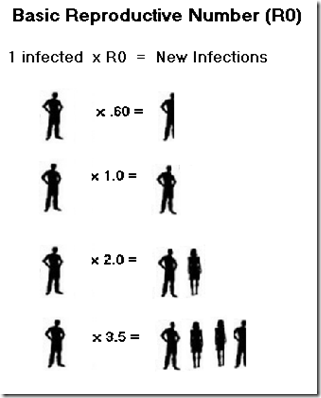
R[SUB]0[/SUB] (pronounced R-nought) or
Basic Reproduction Number
#13,702
One of the most important - yet difficult to determine - pieces of information epidemiologists and statisticians seek on infectious disease outbreaks is just how contagious is it?
Like the CFR (Case Fatality Ratio), the R[SUB]0 [/SUB] can vary considerably over time or geography, often ends up being described as a `range?, and usually isn?t well established (or at least, generally agreed upon) until long after an outbreak has ended. [TABLE="class: tr-caption-container, align: center, cellpadding: 0, cellspacing: 0"]
[TR]
[TD]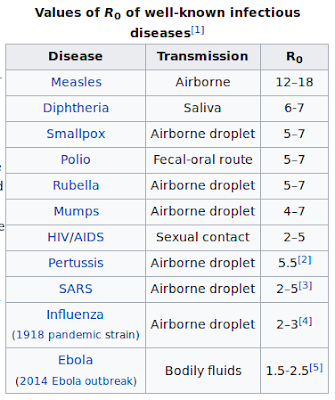 [/TD]
[/TD]
[/TR]
[TR]
[TD="class: tr-caption"]Credit Wikipedia [/TD]
[/TR]
[/TABLE]
Over the years we've looked at some attempts to quantify the R[SUB]0 [/SUB]of recent outbreaks and epidemics, including:
I've only reproduced the author's opening salvo, so follow the link to read it in its entirety.
Volume 25, Number 1?January 2019
Perspective
Although R[SUB]0[/SUB] is a biological reality, this value is usually estimated with complex mathematical models developed using various sets of assumptions. The interpretation of R[SUB]0[/SUB] estimates derived from different models requires an understanding of the models? structures, inputs, and interactions. Because many researchers using R[SUB]0[/SUB] have not been trained in sophisticated mathematical techniques, R[SUB]0[/SUB] is easily subject to misrepresentation, misinterpretation, and misapplication. Notable examples include incorrectly defining R[SUB]0[/SUB] (1) and misinterpreting the effects of vaccination on R[SUB]0[/SUB] (3). Further, many past lessons regarding this metric appear to have been lost or overlooked over time. Therefore, a review of the concept of R[SUB]0[/SUB] is needed, given the increased attention this metric receives in the academic literature (20). In this article, we address misconceptions about R[SUB]0[/SUB] that have proliferated as this metric has become more frequently used outside of the realm of mathematical biology and theoretic epidemiology, and we recommend that R[SUB]0 [/SUB]be applied and discussed with caution.
(Continue . . . )
http://afludiary.blogspot.com/2018/11/eid-journal-complexity-of-basic.html
R[SUB]0[/SUB] (pronounced R-nought) or
Basic Reproduction Number
#13,702
One of the most important - yet difficult to determine - pieces of information epidemiologists and statisticians seek on infectious disease outbreaks is just how contagious is it?
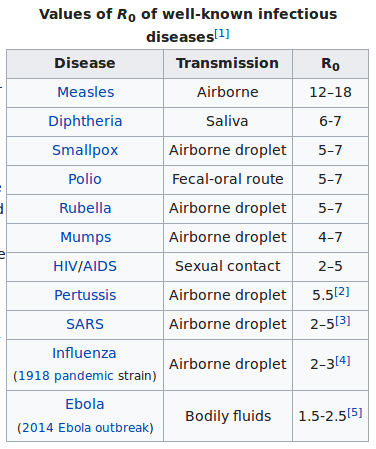
Some viruses ? like measles or diphtheria ? spread through a susceptible population rapidly, while others - like MERS-CoV -have demonstrated only limited transmissibility (see The Elusive R[SUB]0[/SUB] of MERS).
The yardstick by which disease transmissibility is measured is by its R[SUB]0 [/SUB](pronounced R-nought) or Basic Reproductive Number. Essentially, the number of new cases in a susceptible population likely to arise from a single infection. In the simplest of terms, with an R[SUB]0 [/SUB] below 1.0, a virus (as an outbreak) begins to sputter and dies out. Above 1.0, and an outbreak can have `legs?.
Calculating the R[SUB]0 [/SUB] is notoriously difficult, however - even years after an epidemic has passed. Much hinges upon the existence and subtle differences between viral strains, the accuracy of surveillance and reporting, `seasonality?, and individual host responses to the virus (i.e. number of `super spreaders?).Like the CFR (Case Fatality Ratio), the R[SUB]0 [/SUB] can vary considerably over time or geography, often ends up being described as a `range?, and usually isn?t well established (or at least, generally agreed upon) until long after an outbreak has ended. [TABLE="class: tr-caption-container, align: center, cellpadding: 0, cellspacing: 0"]
[TR]
[TD]
 [/TD]
[/TD][/TR]
[TR]
[TD="class: tr-caption"]Credit Wikipedia [/TD]
[/TR]
[/TABLE]
Over the years we've looked at some attempts to quantify the R[SUB]0 [/SUB]of recent outbreaks and epidemics, including:
Study: A Pandemic Risk Assessment Of MERS-CoV In Saudi Arabia
Eurosurveillance: Estimating The Odds Of Secondary/Tertiary Cases From An Imported MERS Case
Eurosurveillance: Stopping Ebola & R0 Calculations
PLoS Currents: Calculating An R0 For Ebola
The Lancet: Transmissibility Of MERS-CoV
In theory, the R[SUB]0 [/SUB] is a simple enough concept, but outbreaks have a lot of moving parts, and not everyone is on the same page when it comes to defining terms. Helping us sort through all of this, we have an excellent Perspective published in the EID Journal on the science behind calculating an outbreak's R[SUB]0 [/SUB][SUB].[/SUB]Eurosurveillance: Estimating The Odds Of Secondary/Tertiary Cases From An Imported MERS Case
Eurosurveillance: Stopping Ebola & R0 Calculations
PLoS Currents: Calculating An R0 For Ebola
The Lancet: Transmissibility Of MERS-CoV
I've only reproduced the author's opening salvo, so follow the link to read it in its entirety.
Volume 25, Number 1?January 2019
Perspective
Complexity of the Basic Reproduction Number (R[SUB]0[/SUB])
Metric Details
Paul L. Delamater , Erica J. Street, Timothy F. Leslie, Y. Tony Yang, and Kathryn H. Jacobsen
Abstract
The basic reproduction number (R[SUB]0[/SUB]), also called the basic reproduction ratio or rate or the basic reproductive rate, is an epidemiologic metric used to describe the contagiousness or transmissibility of infectious agents. R[SUB]0[/SUB] is affected by numerous biological, sociobehavioral, and environmental factors that govern pathogen transmission and, therefore, is usually estimated with various types of complex mathematical models, which make R[SUB]0[/SUB] easily misrepresented, misinterpreted, and misapplied.
R[SUB]0[/SUB] is not a biological constant for a pathogen, a rate over time, or a measure of disease severity, and R[SUB]0[/SUB] cannot be modified through vaccination campaigns. R[SUB]0 [/SUB]is rarely measured directly, and modeled R[SUB]0[/SUB] values are dependent on model structures and assumptions. Some R[SUB]0[/SUB] values reported in the scientific literature are likely obsolete. R[SUB]0[/SUB] must be estimated, reported, and applied with great caution because this basic metric is far from simple.
The basic reproduction number (R[SUB]0[/SUB]), pronounced ?R naught,? is intended to be an indicator of the contagiousness or transmissibility of infectious and parasitic agents. R[SUB]0[/SUB] is often encountered in the epidemiology and public health literature and can also be found in the popular press (1?6). R[SUB]0[/SUB] has been described as being one of the fundamental and most often used metrics for the study of infectious disease dynamics (7?12). An R[SUB]0[/SUB] for an infectious disease event is generally reported as a single numeric value or low?high range, and the interpretation is typically presented as straightforward; an outbreak is expected to continue if R[SUB]0[/SUB] has a value > 1 and to end if R[SUB]0[/SUB] is < 1 (13). The potential size of an outbreak or epidemic often is based on the magnitude of the R[SUB]0[/SUB] value for that event (10), and R[SUB]0[/SUB] can be used to estimate the proportion of the population that must be vaccinated to eliminate an infection from that population (14,15). R[SUB]0[/SUB] values have been published for measles, polio, influenza, Ebola virus disease, HIV disease, a diversity of vectorborne infectious diseases, and many other communicable diseases (14,16?18).
The concept of R[SUB]0[/SUB] was first introduced in the field of demography (9), where this metric was used to count offspring. When R[SUB]0 [/SUB]was adopted for use by epidemiologists, the objects being counted were infective cases (19). Numerous definitions for R[SUB]0[/SUB] have been proposed. Although the basic conceptual framework is similar for each, the operational definitions are not always identical. Dietz states that R[SUB]0[/SUB] is ?the number of secondary cases one case would produce in a completely susceptible population? (19). Fine supplements this definition with the description ?average number of secondary cases? (17). Diekmann and colleagues use the description ?expected number of secondary cases? and provide additional specificity to the terminology regarding a single case (13).
In the hands of experts, R[SUB]0[/SUB] can be a valuable concept. However, the process of defining, calculating, interpreting, and applying R[SUB]0[/SUB] is far from straightforward. The simplicity of an R[SUB]0[/SUB] value and its corresponding interpretation in relation to infectious disease dynamics masks the complicated nature of this metric.
Metric Details
Paul L. Delamater
, Erica J. Street, Timothy F. Leslie, Y. Tony Yang, and Kathryn H. JacobsenAbstract
The basic reproduction number (R[SUB]0[/SUB]), also called the basic reproduction ratio or rate or the basic reproductive rate, is an epidemiologic metric used to describe the contagiousness or transmissibility of infectious agents. R[SUB]0[/SUB] is affected by numerous biological, sociobehavioral, and environmental factors that govern pathogen transmission and, therefore, is usually estimated with various types of complex mathematical models, which make R[SUB]0[/SUB] easily misrepresented, misinterpreted, and misapplied.
R[SUB]0[/SUB] is not a biological constant for a pathogen, a rate over time, or a measure of disease severity, and R[SUB]0[/SUB] cannot be modified through vaccination campaigns. R[SUB]0 [/SUB]is rarely measured directly, and modeled R[SUB]0[/SUB] values are dependent on model structures and assumptions. Some R[SUB]0[/SUB] values reported in the scientific literature are likely obsolete. R[SUB]0[/SUB] must be estimated, reported, and applied with great caution because this basic metric is far from simple.
The basic reproduction number (R[SUB]0[/SUB]), pronounced ?R naught,? is intended to be an indicator of the contagiousness or transmissibility of infectious and parasitic agents. R[SUB]0[/SUB] is often encountered in the epidemiology and public health literature and can also be found in the popular press (1?6). R[SUB]0[/SUB] has been described as being one of the fundamental and most often used metrics for the study of infectious disease dynamics (7?12). An R[SUB]0[/SUB] for an infectious disease event is generally reported as a single numeric value or low?high range, and the interpretation is typically presented as straightforward; an outbreak is expected to continue if R[SUB]0[/SUB] has a value > 1 and to end if R[SUB]0[/SUB] is < 1 (13). The potential size of an outbreak or epidemic often is based on the magnitude of the R[SUB]0[/SUB] value for that event (10), and R[SUB]0[/SUB] can be used to estimate the proportion of the population that must be vaccinated to eliminate an infection from that population (14,15). R[SUB]0[/SUB] values have been published for measles, polio, influenza, Ebola virus disease, HIV disease, a diversity of vectorborne infectious diseases, and many other communicable diseases (14,16?18).
The concept of R[SUB]0[/SUB] was first introduced in the field of demography (9), where this metric was used to count offspring. When R[SUB]0 [/SUB]was adopted for use by epidemiologists, the objects being counted were infective cases (19). Numerous definitions for R[SUB]0[/SUB] have been proposed. Although the basic conceptual framework is similar for each, the operational definitions are not always identical. Dietz states that R[SUB]0[/SUB] is ?the number of secondary cases one case would produce in a completely susceptible population? (19). Fine supplements this definition with the description ?average number of secondary cases? (17). Diekmann and colleagues use the description ?expected number of secondary cases? and provide additional specificity to the terminology regarding a single case (13).
In the hands of experts, R[SUB]0[/SUB] can be a valuable concept. However, the process of defining, calculating, interpreting, and applying R[SUB]0[/SUB] is far from straightforward. The simplicity of an R[SUB]0[/SUB] value and its corresponding interpretation in relation to infectious disease dynamics masks the complicated nature of this metric.
Although R[SUB]0[/SUB] is a biological reality, this value is usually estimated with complex mathematical models developed using various sets of assumptions. The interpretation of R[SUB]0[/SUB] estimates derived from different models requires an understanding of the models? structures, inputs, and interactions. Because many researchers using R[SUB]0[/SUB] have not been trained in sophisticated mathematical techniques, R[SUB]0[/SUB] is easily subject to misrepresentation, misinterpretation, and misapplication. Notable examples include incorrectly defining R[SUB]0[/SUB] (1) and misinterpreting the effects of vaccination on R[SUB]0[/SUB] (3). Further, many past lessons regarding this metric appear to have been lost or overlooked over time.
(Continue . . . )
http://afludiary.blogspot.com/2018/11/eid-journal-complexity-of-basic.html