• FluTrackers.com Inc. does not provide medical advice. Information on this web site is collected from various internet resources, and the FluTrackers board of directors makes no warranty to the safety, efficacy, correctness or completeness of the information posted on this site by any author or poster. The information collated here is for instructional and/or discussion purposes only and is NOT intended to diagnose or treat any disease, illness, or other medical condition. Every individual reader or poster should seek advice from their personal physician/healthcare practitioner before considering or using any interventions that are discussed on this website. By continuing to access this website you agree to consult your personal physican before using any interventions posted on this website, and you agree to hold harmless FluTrackers.com Inc., the board of directors, the members, and all authors and posters for any effects from use of any medication, supplement, vitamin or other substance, device, intervention, etc. mentioned in posts on this website, or other internet venues referenced in posts on this website.
  • We are not asking for any donations. Do not donate to any entity who says they are raising funds for us.

ECDC: Pneumonia cases associated with novel coronavirus, China

tetano

Editor, Senior Moderator
Chinese authorities have identified a cluster of novel coronavirus 2019-nCoV infections in Wuhan City, China. Cases have now been detected in several countries in Asia, but also in Australia, Europe and North America. All cases outside China had a recent travel history to China prior to the disease onset, except in Vietnam. The first cases in the EU/EEA were confirmed in France. Further global spread is likely.
More on situation update, epidemiological curve and global distribution
The 2019-nCoV is a new strain of coronavirus that has not been previously identified in humans. Outbreaks of novel virus infections among people are always of public health concern, especially when there’s little knowledge about the characteristics of the virus, how it spreads between people, how severe are the resulting infections and how to treat them.
See Q&A about the 2019-nCoV
Human-to-human transmission has been confirmed but more information is needed to evaluate the full extent of this mode of transmission. The source of infection is unknown and could still be active.
Risk assessment
  • There is a moderate likelihood of infection for EU/EEA citizens residing in or visiting Wuhan.
  • There is a high likelihood of further case importation into countries with the greatest volume of people who have travelled from Wuhan (i.e. countries in Asia);
  • There is a moderate likelihood of further case importation into EU/EEA countries.
Although the epicentre of the outbreak remains in Wuhan, which is reporting most of the cases, the risk of infection is not limited to Wuhan but to any area where cases are detected.
The outbreak investigations are ongoing and as this is an emerging, rapidly evolving situation, ECDC will provide updated information as it becomes available.


https://www.ecdc.europa.eu/en/novel-coronavirus-china
 
Pneumonia cases associated with novel coronavirus, China


Following the first reports of cases of acute respiratory syndrome in the Chinese Wuhan municipality at the end of December 2019, Chinese authorities have identified a novel coronavirus as the main causative agent.The outbreak has rapidly evolved affecting other parts of China and outside the country. Cases have now been detected in several countries in Asia, but also in Australia, Europe and North America. The first cases in the EU/EEA were confirmed in France. Further global spread is likely.
More on situation update, epidemiological curve and global distribution

The 2019-nCoV is a new strain of coronavirus that has not been previously identified in humans. Outbreaks of novel virus infections among people are always of public health concern, especially when there’s little knowledge about the characteristics of the virus, how it spreads between people, how severe are the resulting infections and how to treat them.
See Q&A about the 2019-nCoV

Human-to-human transmission has been confirmed but more information is needed to evaluate the full extent of this mode of transmission. The source of infection is unknown and could still be active.

Risk assessment
  • There is a moderate likelihood of infection for EU/EEA citizens residing in or visiting Wuhan.
  • There is a high likelihood of further case importation into countries with the greatest volume of people who have travelled from Wuhan (i.e. countries in Asia);
  • There is a moderate likelihood of further case importation into EU/EEA countries.
Although the epicentre of the outbreak remains in Wuhan, which is reporting most of the cases, the risk of infection is not limited to Wuhan but to any area where cases are detected.

This is an emerging, rapidly evolving situation with ongoing outbreak investigations. ECDC is closely monitoring this outbreak and providing risk assessments to guide EU Member States and the EU Commission in their response activities.

Situation update 30 January 2020, 11:00 CET

7824 lab-confirmed cases
of novel coronavirus

170 deaths
all reported in China

France (4), Germany (4), Finland (1)
are the first cases reported in the EU/EEA

https://www.ecdc.europa.eu/en/novel-coronavirus-china
 
Geographical distribution of 2019-nCov cases

Data Graph Map
TwitterFacebookLinked InMail Situation update 30 January 11:00 CET


Since 31 December 2019 and as of 30 January 2020, 7 824 laboratory-confirmed cases of novel coronavirus (2019-nCoV) infection have been reported, including 16 healthcare workers and 170 deaths.

Cases have been reported in:
Asia: China (7 734), Thailand (14), Japan (11), Singapore (10), Taiwan (8), Malaysia (7), Republic of Korea (4), United Arab Emirates (4), Vietnam (2), Cambodia (1), Nepal (1), The Philippines (1), India (1), and Sri Lanka (1).
Europe: France (5), Germany (4), and Finland (1).
America: the United States (5) and Canada (3).
Oceania: Australia (7).

All of the 170 deaths reported have been in China, 162 were from Hubei province, two from Henan province, one from Beijing, one from Hainan province, one from Heilongjiang province, one from Hebei province, one from Shanghai, and one from Sichuan province. Epidemiological curves of 2019-nCoV infections


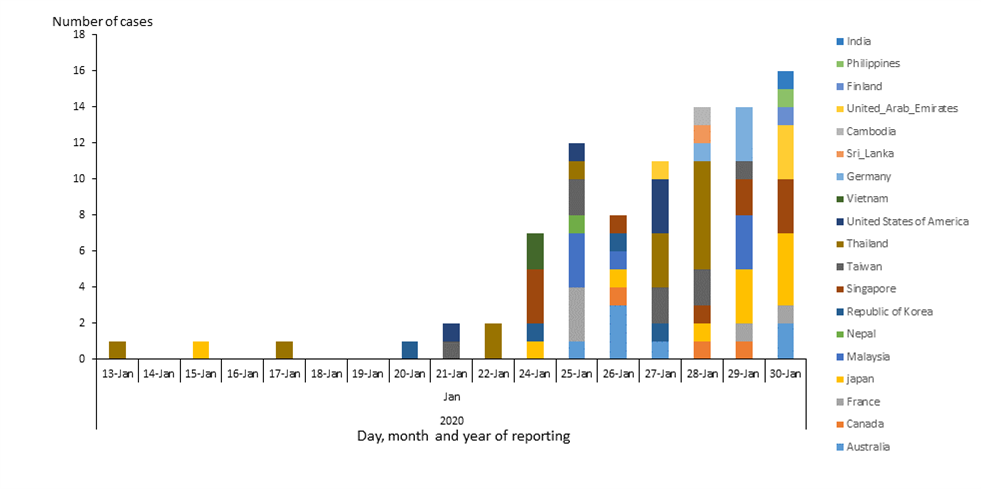
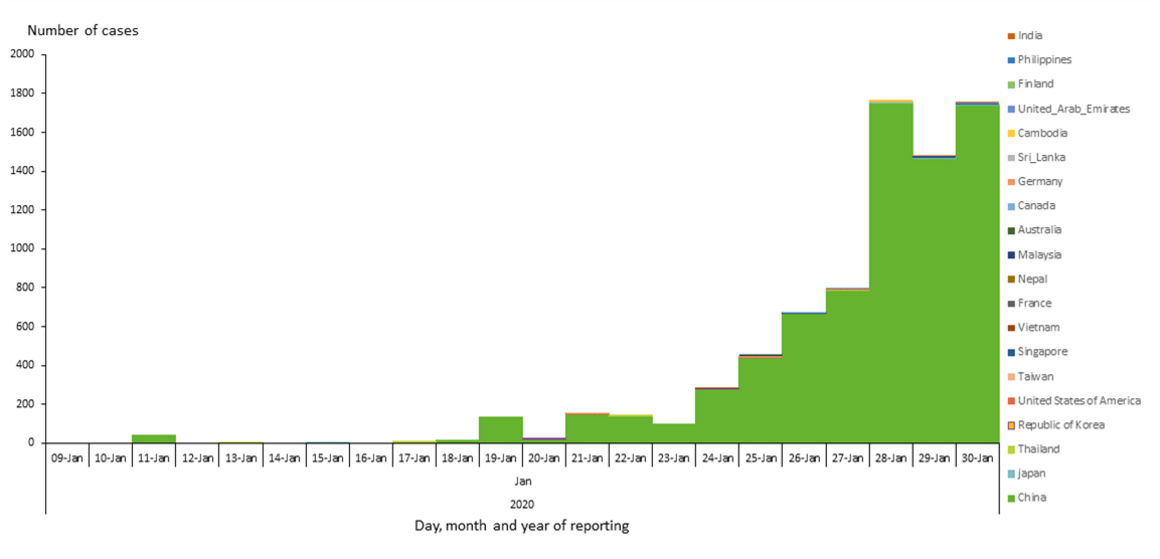
These histograms are based on the available information at the time of publication, originating from several sources. Data completeness depends on the availability of information from the affected areas. All data should be interpreted with caution as the outbreak is evolving rapidly. In addition, due to the unavailability of date-of-onset data, likely testing of retrospective specimens and currently expanding introduction of the specific laboratory test for 2019-nCoV, this figure might not be reflective of the evolution of the epidemic in China
novel-coronavirus-nCoV-distribution-laboratory-confirmed-cases-30-january-2020.jpg.png
Epidemiological curve 2019-nCoV infections
novel-coronavirus-nCoV-distribution-laboratory-confirmed-cases-outside-china-30-january-2020.png


...
https://www.ecdc.europa.eu/en/geogra...019-ncov-cases
 
Back
Top