

Pathfinder
Editor, Senior Moderator
Epidemiological update: Monkeypox multi-country outbreak
Epidemiological update
25 May 2022
A multi-country outbreak of monkeypox is ongoing since early May. As of 25 May 2022, a total of 219 confirmed cases have been reported worldwide, with most of cases being detected in young men, self-identifying as men who have sex with men (MSM).
Monkeypox (MPX) is a zoonotic disease and is currently the most prevalent orthopoxvirus infection in humans after the eradication of smallpox and the cessation of universal smallpox vaccination. In endemic areas, monkeypox virus (MPXV) is probably maintained in nature through circulation among a number of mammals, with occasional spill-over events to humans. In endemic areas, MPXV is transmitted to humans through a bite or direct contact with an infected animal’s blood, meat, bodily fluids or cutaneous/mucosal lesions.
This report presents an update of MPX confirmed cases identified in the European Union/European Economic Area (EU/EEA) and worldwide. Cases detected in the EU/EEA have been reported according to the ECDC case definition and are obtained through screening of official websites. Cases reported from outside the EU/EEA are collected through screening of official websites and media sources.
Epidemiological update
On 14 May 2022, a familial cluster of two cases of monkeypox was reported in the United Kingdom (UK) by the UK Health Security Agency (UKHSA). These cases had no relation to a case imported from Nigeria that was previously reported on 7 May 2022 in the UK. In the following days, several other EU/EEA Member States and other countries have reported cases of monkeypox not linked to travel to endemic countries.
As of 25 May, a total of 118 confirmed MPX cases have been reported from 12 EU/EEA Member States (Table 1, Figure 1). Most cases are in young men, self-identifying as MSM. There have been no deaths. The clinical presentation is generally described to be mild, with most cases presenting with lesions on the genitalia or peri-genital area, indicating that transmission likely occurred during close physical contact during sexual activities. This is the first time that chains of transmission are reported in Europe without known epidemiological links to West or Central Africa, where this disease is endemic. These are also the first cases worldwide reported among MSM.
Table 1. Number of confirmed cases by country, EU/EEA, as of 25 May 2022
Figure 1. Geographical distribution of confirmed cases of MPX in EU/EEA countries, as of 25 May 2022
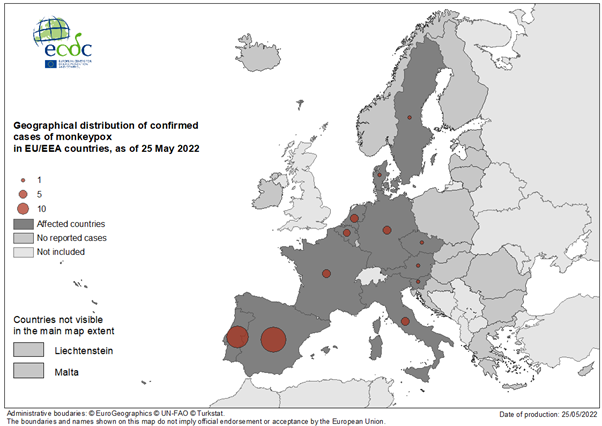 Geographical distribution of confirmed cases of MPX in EU/EEA countries, as of 25 May 2022Worldwide update
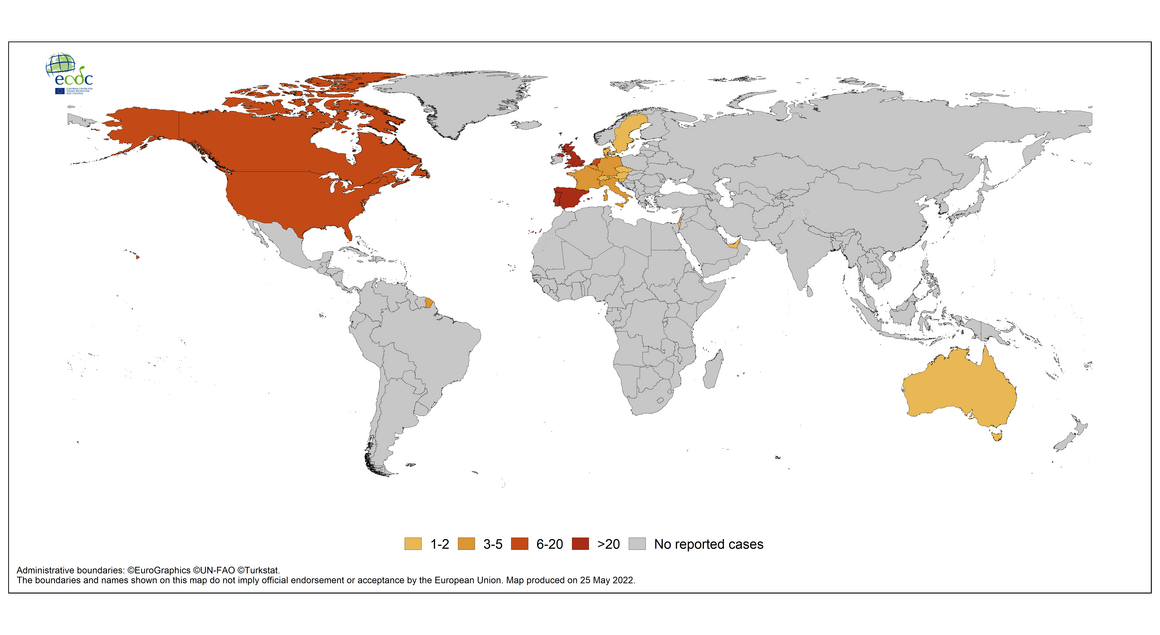
As of 25 May 2022, a total of 219 confirmed cases have been reported from countries where the disease is not considered to be endemic. Countries reporting cases outside the EU/EEA, include Argentina (1 suspected case), Australia (2), Canada (15), Israel (1), the United Kingdom (71), the United States (9), Switzerland (2) United Arab Emirates (1 with a travel history to West Africa) and Morocco (3 suspected cases). In total, 101 confirmed cases of monkeypox have been reported in seven non-EU/EEA countries.
Figure 2. Geographical distribution of confirmed cases confirmed cases of MPX worldwide, as of 25 May 2022
 ECDC actions
ECDC continues to monitor this event through epidemic intelligence activities and report relevant news on an ad-hoc basis. A news item was published on 19 May and an epidemiological update was posted on 20 May. Multi-lateral meetings between affected countries, WHO EURO and ECDC have taken place to share information and coordinate response. An item has been created in EpiPulse to allow countries to share information with one another, WHO EURO and ECDC and to report data on detected cases. Reporting in TESSy is currently being implemented. A rapid risk assessment "Monkeypox multi-country outbreak" was published on 23 May.
Case definition used in EU/EEA
Confirmed case
A person with a laboratory-confirmed monkeypox infection (1) monkeypox virus specific PCR assay positive result or (2) orthopoxvirus specific PCR assay positive result which is then confirmed by nucleotide sequence determination of the detected virus as MPXV) with symptom onset since 1st March 2022
Probable case
(1) A person with an unexplained rash* on any part of their body
AND one or more other symptom(s) of monkeypox infection** with symptom onset since 1st March 2022
AND one of the following:
(2) A person with an unexplained generalised or localised maculopapular or vesiculopustular rash with centrifugal spread, with lesions showing umbilication or scabbing, lymphadenopathy and one or more other MPX-compatible symptoms**.
* Since EU/EEA countries are just starting to identify cases and if testing capacity is sufficient, the above more sensitive case definition can be used. In countries with limited testing capacity for orthopoxviruses, the following description can be added to characterise the rash: ‘unexplained localised or generalised maculopapular or vesiculopustular rash potentially with umbilication or scabbing’.
**Fever (usually high >38.5°C), headache, back ache, fatigue, lymphadenopathy (localised or generalised).
https://www.ecdc.europa.eu/en/news-events/epidemiological-update-monkeypox-multi-country-outbreak
Epidemiological update
25 May 2022
A multi-country outbreak of monkeypox is ongoing since early May. As of 25 May 2022, a total of 219 confirmed cases have been reported worldwide, with most of cases being detected in young men, self-identifying as men who have sex with men (MSM).
Monkeypox (MPX) is a zoonotic disease and is currently the most prevalent orthopoxvirus infection in humans after the eradication of smallpox and the cessation of universal smallpox vaccination. In endemic areas, monkeypox virus (MPXV) is probably maintained in nature through circulation among a number of mammals, with occasional spill-over events to humans. In endemic areas, MPXV is transmitted to humans through a bite or direct contact with an infected animal’s blood, meat, bodily fluids or cutaneous/mucosal lesions.
This report presents an update of MPX confirmed cases identified in the European Union/European Economic Area (EU/EEA) and worldwide. Cases detected in the EU/EEA have been reported according to the ECDC case definition and are obtained through screening of official websites. Cases reported from outside the EU/EEA are collected through screening of official websites and media sources.
Epidemiological update
On 14 May 2022, a familial cluster of two cases of monkeypox was reported in the United Kingdom (UK) by the UK Health Security Agency (UKHSA). These cases had no relation to a case imported from Nigeria that was previously reported on 7 May 2022 in the UK. In the following days, several other EU/EEA Member States and other countries have reported cases of monkeypox not linked to travel to endemic countries.
As of 25 May, a total of 118 confirmed MPX cases have been reported from 12 EU/EEA Member States (Table 1, Figure 1). Most cases are in young men, self-identifying as MSM. There have been no deaths. The clinical presentation is generally described to be mild, with most cases presenting with lesions on the genitalia or peri-genital area, indicating that transmission likely occurred during close physical contact during sexual activities. This is the first time that chains of transmission are reported in Europe without known epidemiological links to West or Central Africa, where this disease is endemic. These are also the first cases worldwide reported among MSM.
Table 1. Number of confirmed cases by country, EU/EEA, as of 25 May 2022
| Austria | 1 |
| Belgium | 4 |
| Czech Republic | 1 |
| Denmark | 1 |
| France | 5 |
| Germany | 5 |
| Italy | 5 |
| The Netherlands | 6 |
| Portugal | 37 |
| Slovenia | 1 |
| Spain | 51 |
| Sweden | 1 |
| Total | 118 |
Figure 1. Geographical distribution of confirmed cases of MPX in EU/EEA countries, as of 25 May 2022
As of 25 May 2022, a total of 219 confirmed cases have been reported from countries where the disease is not considered to be endemic. Countries reporting cases outside the EU/EEA, include Argentina (1 suspected case), Australia (2), Canada (15), Israel (1), the United Kingdom (71), the United States (9), Switzerland (2) United Arab Emirates (1 with a travel history to West Africa) and Morocco (3 suspected cases). In total, 101 confirmed cases of monkeypox have been reported in seven non-EU/EEA countries.
Figure 2. Geographical distribution of confirmed cases confirmed cases of MPX worldwide, as of 25 May 2022
ECDC continues to monitor this event through epidemic intelligence activities and report relevant news on an ad-hoc basis. A news item was published on 19 May and an epidemiological update was posted on 20 May. Multi-lateral meetings between affected countries, WHO EURO and ECDC have taken place to share information and coordinate response. An item has been created in EpiPulse to allow countries to share information with one another, WHO EURO and ECDC and to report data on detected cases. Reporting in TESSy is currently being implemented. A rapid risk assessment "Monkeypox multi-country outbreak" was published on 23 May.
Case definition used in EU/EEA
Confirmed case
A person with a laboratory-confirmed monkeypox infection (1) monkeypox virus specific PCR assay positive result or (2) orthopoxvirus specific PCR assay positive result which is then confirmed by nucleotide sequence determination of the detected virus as MPXV) with symptom onset since 1st March 2022
Probable case
(1) A person with an unexplained rash* on any part of their body
AND one or more other symptom(s) of monkeypox infection** with symptom onset since 1st March 2022
AND one of the following:
- has a positive laboratory test result on orthopoxvirus infection (e.g. orthopoxvirus specific positive PCR without sequencing, electron microscopy, serology);
- has an epidemiological link to a confirmed or probable case of monkeypox in the 21 days before symptom onset;
- reports travel to MPX endemic countries in the 21 days before symptom onset;
- is a person (of any sexual orientation) who had multiple or anonymous sexual partners in the 21 days before symptom onset;
- is a man who has sex with men.
(2) A person with an unexplained generalised or localised maculopapular or vesiculopustular rash with centrifugal spread, with lesions showing umbilication or scabbing, lymphadenopathy and one or more other MPX-compatible symptoms**.
* Since EU/EEA countries are just starting to identify cases and if testing capacity is sufficient, the above more sensitive case definition can be used. In countries with limited testing capacity for orthopoxviruses, the following description can be added to characterise the rash: ‘unexplained localised or generalised maculopapular or vesiculopustular rash potentially with umbilication or scabbing’.
**Fever (usually high >38.5°C), headache, back ache, fatigue, lymphadenopathy (localised or generalised).
https://www.ecdc.europa.eu/en/news-events/epidemiological-update-monkeypox-multi-country-outbreak