Treyfish
Moderator
Re: New outbreak of Ebola in Mali - at least 6 cases, 4 deaths in Bamako
Re: New outbreak of Ebola in Mali - at least 6 cases, 4 deaths in Bamako
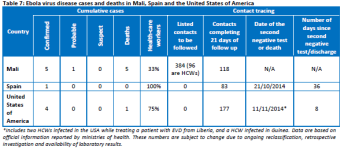
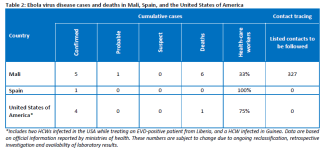
....This second outbreak is more serious. It has so far claimed several lives, involves many more contacts and raises questions about the preparedness of the Malian authorities even as foreign medical agencies rushed in to help Mali.
The nurse probably contracted the disease from an elderly imam, who had fallen ill with an undiagnosed disease in Guinea on October 17th and was brought by car to the Polyclinique Pasteur on October 25th, travelling with four other family members. A battery of tests was conducted, but not for Ebola. He died of kidney failure, a known complication of late-stage Ebola, on October 27th. (see WHO situation report, here) A friend who visited him in hospital died from an undiagnosed disease. The assumption is that both died of Ebola.
Many hands then touched the body of the imam as it was released from hospital, carried to a mosque in Bamako and washed - all within walking distance of the national laboratory and the nerve centre of the Ebola response efforts ? before being taken for burial in his native village of Kour?mal? on the border with Guinea. Two relatives have died so far and several others are ill; a woman who washed his body also passed away, as has a member of her family.
The question for health officials is how far the disease has taken hold in Bamako, a city of 3m people, where it has incubated in recent weeks. What is the risk that Bamako might become the next Freetown or Monrovia?
Weaknesses are being exposed daily in a country only recently torn by civil war. Many still don't believe that Ebola is Mali's problem. Malians still shake hands and share tea from the same cup. There is little public information available, and what there is focuses on near-certainty of death (not true, good treatment can bring down mortality rates from 90% to 40% or less) and warnings against eating bush meat (the biggest danger is contact with infected people).
At a new Ebola treatment center, one doctor spoke about the anti-malarial and antibiotics drugs that would be available (they are no use against Ebola itself but may deal with other problems) but was vague on simple but life-saving treatment, such as intravenous fluids and oral rehydration salts.
At the mosque where the imam?s body had been washed, a team of workers in full biohazard garb was cleaning the site with chlorine bleach disinfectant on November 14th; it was the first time it had been cleaned, said a local man. People walked in and out, and children ran about. A teenager who commanded a huge group of onlookers asked what was going on. Told they were cleaning the site because a woman died of Ebola,? the lad replied: ?You think there is Ebola here?? As your correspondent drove away, a large group of little children chased after the car chanting ?Ebola! Ebola!?:tiphat:http://www.economist.com/news/middl...nd-outbreak-ebola-more-worrying-double-whammy
Re: New outbreak of Ebola in Mali - at least 6 cases, 4 deaths in Bamako
....This second outbreak is more serious. It has so far claimed several lives, involves many more contacts and raises questions about the preparedness of the Malian authorities even as foreign medical agencies rushed in to help Mali.
The nurse probably contracted the disease from an elderly imam, who had fallen ill with an undiagnosed disease in Guinea on October 17th and was brought by car to the Polyclinique Pasteur on October 25th, travelling with four other family members. A battery of tests was conducted, but not for Ebola. He died of kidney failure, a known complication of late-stage Ebola, on October 27th. (see WHO situation report, here) A friend who visited him in hospital died from an undiagnosed disease. The assumption is that both died of Ebola.
Many hands then touched the body of the imam as it was released from hospital, carried to a mosque in Bamako and washed - all within walking distance of the national laboratory and the nerve centre of the Ebola response efforts ? before being taken for burial in his native village of Kour?mal? on the border with Guinea. Two relatives have died so far and several others are ill; a woman who washed his body also passed away, as has a member of her family.
The question for health officials is how far the disease has taken hold in Bamako, a city of 3m people, where it has incubated in recent weeks. What is the risk that Bamako might become the next Freetown or Monrovia?
Weaknesses are being exposed daily in a country only recently torn by civil war. Many still don't believe that Ebola is Mali's problem. Malians still shake hands and share tea from the same cup. There is little public information available, and what there is focuses on near-certainty of death (not true, good treatment can bring down mortality rates from 90% to 40% or less) and warnings against eating bush meat (the biggest danger is contact with infected people).
At a new Ebola treatment center, one doctor spoke about the anti-malarial and antibiotics drugs that would be available (they are no use against Ebola itself but may deal with other problems) but was vague on simple but life-saving treatment, such as intravenous fluids and oral rehydration salts.
At the mosque where the imam?s body had been washed, a team of workers in full biohazard garb was cleaning the site with chlorine bleach disinfectant on November 14th; it was the first time it had been cleaned, said a local man. People walked in and out, and children ran about. A teenager who commanded a huge group of onlookers asked what was going on. Told they were cleaning the site because a woman died of Ebola,? the lad replied: ?You think there is Ebola here?? As your correspondent drove away, a large group of little children chased after the car chanting ?Ebola! Ebola!?:tiphat:http://www.economist.com/news/middl...nd-outbreak-ebola-more-worrying-double-whammy