• FluTrackers.com Inc. does not provide medical advice. Information on this web site is collected from various internet resources, and the FluTrackers board of directors makes no warranty to the safety, efficacy, correctness or completeness of the information posted on this site by any author or poster. The information collated here is for instructional and/or discussion purposes only and is NOT intended to diagnose or treat any disease, illness, or other medical condition. Every individual reader or poster should seek advice from their personal physician/healthcare practitioner before considering or using any interventions that are discussed on this website. By continuing to access this website you agree to consult your personal physican before using any interventions posted on this website, and you agree to hold harmless FluTrackers.com Inc., the board of directors, the members, and all authors and posters for any effects from use of any medication, supplement, vitamin or other substance, device, intervention, etc. mentioned in posts on this website, or other internet venues referenced in posts on this website.
  • We are not asking for any donations. Do not donate to any entity who says they are raising funds for us.

Discussion Thread I - 2019-nCov (new coronavirus)

Status
Not open for further replies.

Pathfinder

Editor, Senior Moderator
[Editor's note: Details of the Wuhan outbreak can be found in this thread]

China - 44 viral pneumonia / suspected SARS? cases in Wuhan, Hubei province - December 30, 2019 - influenza ruled out


Translation Google

[Exclusive] New virus of unknown pneumonia in Wuhan is likely to be transmitted from animals to the Hong Kong government, and it is planned to upgrade the epidemic prevention


Last Update: 01 04 00:20 / Settling Time (HKT): 0103 21:55

Unknown cause of pneumonia outbreak in Wuhan, but so far the local government has not announced the type of virus causing the disease. It is reported that the local virus that has caused the outbreak of unknown pneumonia is very likely to be a new species of coronavirus that jumps from animals to humans. Some experts in Hong Kong believe that the government should immediately upgrade the response level to the severe level in response to the great chance of a new species of coronavirus appearing in the Mainland. It is reported that the government has also formulated further measures to strengthen epidemic prevention, which will be announced today (4th).
...
It is reported that the Mainland has acquired the virus that caused Wuhan's unknown pneumonia this time. It is likely that a new type of coronavirus that jumps from animals to humans is not the same as SARS coronavirus. Some experts have analyzed that there have been severe animal-to-human virus outbreaks in South China, including bird flu and SARS coronavirus. This time, there is no outbreak of bird flu in Wuhan. The epidemic situation is related to markets that sell game. Animal-to-human coronavirus, but not exactly the same as SARS-CoV.
...
https://hk.news.appledaily.com/local...00104/60448286
 
Last edited by a moderator:
This new outbreak of a disease in People’s Republic of China reportedly exhibiting symptoms of viral pneumonia needs to tracked closely. The rapid increase in the number reported cases over the past few days should raise some alarm. The current reports suggest that the human cases have only resulted from animal-to-human transmission from a wet market in Wuhan in China.

The health officials in Hong Kong and Taiwan are taking precautions and monitoring people returning from the Wuhan region. Hong Kong and Taiwan are right to be concerned because China does not have a track record of providing timely information about infectious disease outbreaks.

The rise of fake videos and trolling confuses the breaking news and facts surrounding this outbreak. So far no deaths have been reported, but about 25% of the reported cases are critically ill.

We need to watch for additional cases, or clusters of cases, away from Wuhan. The time to start worrying is when there is confirmed human-to-human transmission or when medical personnel start to become infected.
 
If China was convinced that this was not a coronavirus of any kind, they would put out a statement that SARS has been excluded, and the panic level would drop by about 6 stages. They haven't. It's worth pointing out that South Korea reported a cluster of 55+ cases of atypical pneumonia last year (that ultimately was bacterial in origin) with much less panic because they announced right away that SARS was excluded.

Alternatively, if this was the 2003 SARS virus, having re-emerged from an animal reservoir (or a laboratory), it would be easy to detect. China had no problem admitting that a nurse in Beijing in April 2004 had contracted SARS, even though there was no obvious exposure. (It was later determined to be part of a chain of transmission resulting from a lab accident.) So that seems unlikely as well.

So to me, that means that they're getting some kind of conflicting test results. We know that at least one lab performed some kind of test on some kind of sample and found 4% homology to some gene of SARS-CoV. I am aware of two previous incidents of such conflicting lab results in the absence of infection with the 2003 SARS virus:

- In December 2003, a man in Guandong Province, China, picked up a rat in his apartment with a pair of chopsticks, opened a window and released the rat, and then used the chopsticks as normal without disinfecting them. He took ill several days later and was reported on December 27, 2003, as a suspect SARS case after a PCR positive. It took about eight days of further testing to determine that the man was infected with a SARS-like animal coronavirus, but not the global outbreak strain from earlier in the year. China eventually after the eight days of testing, declared this man a confirmed SARS case, despite the viral difference. Three more people in the province would be confirmed with this virus over the next few weeks. All recovered, none of them transmitted the virus to anyone, and all were officially counted as SARS cases.

- On August 14, 2003, a nursing home in British Columbia, Canada, reported a respiratory outbreak with about a dozen deaths in which multiple patients had tested positive for SARS. Once again, it took about 8 days of further testing in multiple international labs to confirm that the SARS positives were false, and that the test was cross-reactive to a human coronavirus that is common worldwide. These cases were ultimately discarded as SARS cases (despite weeks of later accusations in the international media).

So which case is it this time? I don't know. If they have the sequences from the December 2003 "SARS" cases, it would be interesting to see if tests for those sequences would be more conclusive that testing for the global outbreak strain. While the global outbreak strain is thought not to exist outside of laboratories, we know this other strain exists in animals in Southern China, and given the story above, at least one rat. It also might be that this strain is less transmissible H2H than the global outbreak strain.

A lot of people are worrying about wild game in the market as a source of zoonotic infection. I'm more concerned about rats, bats, and the general filth of the market.

I'd like also to see articles excluding known non-coronavirus possibilities, such as hantavirus, legionella, or histoplasmosis. If something else comes back positive, it's possible that the coronavirus result might be a background detection due to a human coronavirus. One other thought...has anyone tested for MERS? MERS might cause a weak cross-reaction with SARS tests, and would certainly cause such an outbreak.

We'll see what a few more days of lab testing will determine. We're only on day 4 or so since the first media report.
 
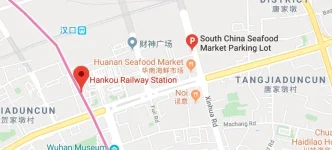
The South China Seafood Market is only 2 blocks from one of the largest rail stations in China - The Hankou Railway Station.


This rail station connects to the high speed train system and during the 2019 Spring festival - alone - the station saw 5.5 million passengers. link


  "Hankou Station is a special station in Jianghan District, Wuhan City, Hubei Province, China. Railways include Beijing-Guangzhou Railway, Handan Railway and many other lines.

Design style: restored to the old European classical architectural style, consistent with the old Hankou railway station on the station road.

Direction of the main station building: Sit north to south.

Main function: Realize elevated waiting, divided into ordinary speed field, high speed field, mainly stopping trains from Shanghai to Hanrong, and also taking into account the Beijing-Guangzhou and Handan lines.

Ancillary works: Hankou Railway Station of Metro Line 2, North Square, North Station, and the underpass tunnel of Wuhan Second Ring Road Development Avenue. Status: Construction is about to start.

The train from Hankou to Dalian crosses the five economic areas of Central South, Central Plains, North China, West Liaoning Corridor, and Liaodong Peninsula. Business and travel are rushing and become the busiest golden line. Shanghai, Shenzhen, Lanzhou ... From south to north, Hankou Station has repeatedly expanded the "Shinkansen" for Wuhan development." link


"At present, it is mainly responsible for passenger trains departing from east to west and passing trains in Wuhan hub. Most of the Shanghai-Hanrong Express trains stop at this station, and they also undertake part of the Beijing-Guangzhou railway and Beijing-Guangzhou high-speed railway train departure and arrival and crossing business." link
 

Attachments

  • hankou.PNG
    hankou.PNG
    176.4 KB · Views: 1
Despite the photo op yesterday (link) the medical screening at the West Kowloon rail station in downtown Hong Kong is lax.

China pneumonia: Hong Kong authorities take low-key approach to passengers arriving in Hong Kong on Wuhan trains
  • Screening facilities at West Kowloon rail terminus appear to be bypassed by travellers disembarking from Wuhan services
  • Hong Kong activates ‘serious’ response level after outbreak of unidentified form of pneumonia, but health chief stands by checks at railway station


January 5, 2020

snip

Three members of staff, from an unknown agency, were standing at the end of the special lane – marked “travellers from Wuhan, please go this way” – but made no visible attempts to identify passengers who had embarked in the Hubei province city.

more..

https://www.scmp.com/news/hong-kong/...ities-take-low
 
Once more we should be concerned that China is not being forth coming about this unidentified outbreak. The Centre for Health Protection in Hong Kong has identified perhaps as many 16 people exhibiting symptoms among people travelling back and forth between Wuhan and Hong Kong. Wuhan has a population of 11 million people. Many of these people must visit other places in China besides Hong Kong. I find it surprising that only Wuhan visitors to Hong Kong are exhibiting symptoms.
 
Most of the people identified in Hong Kong have tested positive for common pathogens such as influenza, which has been excluded as the cause of the main outbreak. Singapore has also isolated one suspected case, but she tested positive for RSV. There is apparently a lot of background noise here. because Wuhan is in the middle of a pretty bad flu season.

Most of the testing over the past few days has been related to SARS. Now that SARS is ruled out, they need to look elsewhere. I can think of at least half a dozen diagnoses (although none of them viral) that might explain this outbreak. I'd think most of them should have been tested for earlier, but we have no way to know what else has been excluded. I think the jump to "novel virus" is a bit premature, at least in the absence of H2H spread.
 

This action is significant because if the CDC knew what this disease was they would be issuing statements to calm down the situation. This statement confirms that probably no one outside China knows what this pathogen is, or how to treat it. They are also asking medical personel to wear 95 masks when evaluating people for this illness which indicates the CDC thinks it could be airborne human to human. Not for sure...but they are leaving open the possibilty and want healthcare personnel to err on the side of caution.
 
Translation Google

China Daily Online Review: Wuhan Viral Pneumonia Prevention and Control Orderly Information Transparency Wins International Recognition

Source: China Daily2020-01-07 11:29 

Since the end of December 2019, the Wuhan Municipal Health Commission has conducted surveillance of respiratory diseases and related diseases and found several cases of viral pneumonia of unknown cause. As of 8:00 on January 5, 2020, the city has reported 59 such cases. It is somewhat gratifying that the incident did not trigger a large-scale panic. The reason is that the government has ensured open and transparent information.

On December 31, 2019, the Wuhan Municipal Health and Health Commission informed that some medical institutions recently found that many cases of pneumonia associated with South China Seafood City were consulted by experts and were diagnosed with viral pneumonia. As soon as the news came out, people asked whether the SARS epidemic had made a comeback. Between 2002 and 2003, SARS invaded most of China and even Asia.

The Wuhan Municipal Government did not respond immediately, but conducted a thorough investigation and research. On January 5, the Wuhan Municipal Health and Health Commission reported that respiratory pathogens such as influenza, bird flu, SARS and the Middle East Respiratory Syndrome (MERS) had been ruled out.

As government departments ensure that information is open and transparent, public confidence has doubled. This is obvious on social media and there is no sign of panic among netizens. In addition, Wuhan's passenger traffic has not been affected. Without panic, the masses will not relocate on a large scale and help the government effectively control the spread of the disease.

The Wuhan Municipal Health and Health Commission's approach has also received the attention and recognition of the international community. On January 5, the World Health Organization (WHO) notified a recent case of unexplained pneumonia in Wuhan and stated that "based on the information currently available, it is not recommended to impose any travel or trade restrictions on China."

It turns out that in major or unexpected events, transparent information can prevent the spread of rumors and public panic. Blocking or selectively disclosing information makes it easier to panic. Authoritative information cannot be made public in the first place, and all kinds of gossips will appear in the room; if the public's security protection strategy cannot be informed, individual self-rescue will start out of order and mass panic will spread. Obviously, open and transparent information is an effective way to dispel public panic. (Editor: Yan Yujie and Wang Hui)

http://cn.chinadaily.com.cn/a/202001/07/WS5e13fb2ca31099ab995f5b7c.html
 
The international media, along with several well known virologists, are now suspecting this is a novel virus. It might be, but there are a lot of things that could still explain this that haven't been ruled out:

- Legionella. This one is almost too obvious. ProMED moderators have mentioned this twice, and it's the first thing I thought of too when I read the first posts a week ago. It's so obvious that you'd think they would have ruled it out by now, but no one has said that. There are also a few testing issues with this bacteria, and let's not forget that in 1976 Philadelphia, it took two months to realize the outbreak of Legionella was not due to a virus.

- Several known zoonotic bacteria, including tularemia, Q fever, and the one that caused the atypical pneumonia outbreak in South Korea last year.

- Hantavirus, perhaps one imported from another part of the world. The CFR of zero to this point is a little low for hantavirus, but with no reported recoveries so far, it's unclear that all patients will survive.

- Anthrax or plague, particularly if widespread antibiotic use is involved. Again, the known CFR is low, but there might be explanations for that.

I hope the labs in Wuhan are continuing to test for and rule out known options. With the exception of plague, everything I mentioned above transmits H2H very poorly or not at all, which is consistent with what is being reported.
 
I think we do not know about human to human transmission. Since there is no test for this illness there could be many people who have mild cases. We just don't know anything at this stage. We don't know how many - really - are/were infected, for how long, where, what.....nothing. We are watching people with symptoms who test negative for known human pathogens.
 
:tiphat:not sure if people will want to go to a dr if they may be forced to isolate at a hospital, and maybe should have to isolate at home?

Quarantine order execution process


2020-01-08
◆ Patients seek medical treatment from public / private hospitals or private clinics

◆ Whether the doctor's diagnosis and treatment meet the two major requirements of isolation:

 1. Have been to Wuhan within 14 days before the onset of illness;

 2. Symptoms of fever, pneumonia, and upper respiratory tract infection

◆ If so, the doctor must fill in the report form and call the CHP to report

◆ After analysis by the Centre for Health Protection, an isolation order will be issued by the Director of Health when necessary to force patients to isolate

◆ Patients must be sent to a public hospital for medical treatment. If the quarantine order is violated, the maximum fine is 5,000 yuan and the prison is 6 months.
:tiphat:http://paper.wenweipo.com/2020/01/08/HK2001080006.htm
 
,,,When asked if the Hong Kong government decided not to send staff to Wuhan to learn about the epidemic situation or the mainland did not allow it, Chen Zhaoshi did not respond positively, saying only that Wuhan was busy dealing with the epidemic situation. When is it appropriate? " This newspaper was informed that a team of scientists in Hong Kong had offered to go to Wuhan or Beijing to assist the local government, but so far they have not been invited by the Mainland.,,,:tiphat:https://news.mingpao.com/pns/%e8%a6%...8e%a5%e8%b5%b0

:tiphat:Taiwan also asked to send people:rolleyes:
The Office of Disease Control also sent a letter to the CCP officials, asking to go and learn about the epidemic.
Director of the Department of Epidemic Center for Disease Control Liuding Ping : "That the current Chinese Communist Party official to say it is not yet obvious situation of human transmission."


In addition, the CDC also sent a letter to the "National Health and Health Commission of China", hoping to send people to mainland China to understand the epidemic situation. However, the other party only stated that it had received the letter and did not respond to further arrangements..:tiphat:https://www.ntdtv.com/b5/2020/01/07/a102747288.html
 
Last edited:
Information seems to be beginning to flow. It looks like the causative agent is a CoV and is speculated to be a BetaCoV, although I do not know on what basis, if it is then bats should become the focus of the investigation for a host reservoir. Reports seem to indicate that the virus has been identified in 15 patients and that its very large genome has been fully sequenced but I have not seen any reports of sequence release or confirmation even that it is a BetaCov, both would be very helpful at this stage. Going forward we will hopefully get some information on the S gene whose protein host the receptor binding domain (as HA does in flu) and the ability to compare this the other BetaCoVs. If the outbreak persist and H2H becomes a factor then sequence changes indicating host adaption would become the research target. Just my thoughts - very possibly entirely erroneous - so caveat emptor.
 
Current status of the “viral pneumonia” outbreak in Wuhan China.

Key points from the Hong Kong Centre for Health Protection (CHP) announcement on January 11, 2020 from post #151 in the News Thread on this outbreak.

1. After preliminary determination, the pathogen of "viral pneumonia with unknown cause" is a novel coronavirus.

2. As of yesterday (January 10), 41 patients in Wuhan have been diagnosed to have been infected with the novel coronavirus. These patients are mainly business operators at a market called "Hua Nan Seafood Wholesale Market" in Wuhan, which has been closed since January 1. (note: other reports have placed the number of confirmed cases in Wuhan at 59 [News Thread #145]).

3. There have been no new cases in Wuhan since January 3.

4. Among the 41 confirmed patients, two patients have been discharged, seven patients are in serious condition and one died, while the remaining patients are in stable condition.

5. 739 close contacts including 419 healthcare workers have been monitoring and none have yet exhibited symptoms.

6. According to the mainland health officials there is no definite evidence of human-to-human transmission. (note: it is not clear the all infections among the 41[59] patients in Wuhan were a result of animal-to-human transmission in the market).

No confirmed cases of this novel coronavirus have yet been reported outside of Hubei Province in China.
 
Thought it helpful to pull this info from media reports of the 1/15/2020 Hong Kong Press Conference (post on page 14 & 15 https://flutrackers.com/forum/forum...-30-2019-1-fatal-case-687-under-observation):

* 70% of patients work long hours in the South China Seafood Market in Wuhan. The relevant merchants mainly sell aquatic products, not game. However, it was revealed that in addition to aquatic products and birds, the market involved also includes bamboo rats, snakes, crickets, hedgehogs, etc. Game, but the quantity of game sold is unknown.

* pointed out that the local staff did not collect only near the aquatic stalls, but the virus was only found in the aquatic stalls. As for the survival time of the virus, it is still to be studied. Because it is not an animal sample, the health committee failed to pinpoint the source of the virus.

* Zhang Zhujun said that of the 41 patients in Wuhan, seven adults had visited the South China Seafood Market, which is believed to be the source of the disease. The remaining patients reported that they had not been there or were "too serious to ask", and most of the patients appeared on the market for sale. The area of ​​aquatic seafood is not for those who sell game.

* a couple infected by the mainland has not been identified. It is said that his wife became ill after he brought home items from the market and polluted the environment. She also pointed out that in addition to the couple's case, there was also a case of a three-person group in which the patients were a father and son and a son-in-law.

*Zhang Zhujun pointed out that environmental samples from the South China seafood market, including the ground, table tops, and gloves, were positive for the new coronavirus, and the samples came from areas where aquatic products were sold. She said that although human-to-human cases of infected couples could not be ruled out at this stage, it is also possible that the husband brought home the virus-carrying items from the market, which polluted the home environment and infected his wife.

* A couple who was defined as a family group case, Zhang Zhujun initially only said that her husband developed the disease first, and his wife developed the disease "every few days". After questioning, she said that "there was no question to be clear". It is believed that the conversation between the mainland personnel occurred about 5 days apart. She also did not ask whether the condition of the wife, who was later affected, was more severe or milder than that of her husband.

* One group is two couples. Mr. worked in the South China seafood market where many cases were found and took the lead. His wife had never been to the market and became ill after 5 days. The infection was transmitted to his wife from the onset of the husband, so there may be a case of human-to-human transmission, but the underground, tabletop and glove samples of the market involved have detected the new coronavirus. Zhang Zhujun acknowledged that the possibility of transmitting the virus through contaminated objects could not be ruled out.

*The Chairman of the Infectious Diseases Advisory Committee of the Hong Kong Medical Association, Liang Zichao, believes that the apparent evidence of the two couples points to human transmission, but it may also be transmitted through articles, such as the wife's handling of her husband's contaminated clothing. . He went on to point out that according to the information published in the Mainland, only one of the 41 confirmed cases is human-to-human, which means that the transmission coefficient of the virus, that is, the efficiency of transmitting to other people is low, and it means that the chance of large-scale spread of the virus in the community is low. .

*The other group of 3 people, father, son, and uncle, lived together and ran the shop together. The time of onset of the three people was very close, and there was a chance to be "common exposure.

* Lai Weiwen pointed out that 7 to 8 of them were in serious condition, severe patients were aged 40 to 78, and had kidney and liver failure at the same time, and 2 patients needed external life support treatment.


*a specific rapid test was developed locally, and viruses were found in throat secretion, sputum and blood. The overall number of white blood cells in patients with pneumonia is normal or low, and the lymphocytes are lower than normal. This phenomenon has occurred in other pneumonia. In addition, the lungs of local pneumonia patients will be filled with inflammatory secretions.

Patients are treated locally with supportive care, including oxygen and intravenous injections. Early treatment with Tamiflu was used locally, but it was discontinued after it was found not to be flu. Local preaching has a certain degree of utility. No local ribavirin or protease was used.

* Two of them needed ECMO (artificial heart and lung) treatment.

Lai Weiwen pointed out that the discharge conditions for pneumonia patients in Wuhan were more than 10 days of fever reduction, and two samples that were 48 hours apart were negative for the virus.

* Lai Weiwen, chief infection control director of the Hospital Authority, pointed out that 7 to 8 patients with pneumonia in Wuhan were severe, including one who died. The patients were mild to moderate pneumonia. The severe cases were 40 to 78 years old. Renal and liver failure occurred. Two of the severe patients needed an external life support device. At least one patient had more than one virus. Other patients have bacterial infections, and it is believed that high-risk people have long-term patients, older people, and obese people...
 
Status
Not open for further replies.
Back
Top