• FluTrackers.com Inc. does not provide medical advice. Information on this web site is collected from various internet resources, and the FluTrackers board of directors makes no warranty to the safety, efficacy, correctness or completeness of the information posted on this site by any author or poster. The information collated here is for instructional and/or discussion purposes only and is NOT intended to diagnose or treat any disease, illness, or other medical condition. Every individual reader or poster should seek advice from their personal physician/healthcare practitioner before considering or using any interventions that are discussed on this website. By continuing to access this website you agree to consult your personal physican before using any interventions posted on this website, and you agree to hold harmless FluTrackers.com Inc., the board of directors, the members, and all authors and posters for any effects from use of any medication, supplement, vitamin or other substance, device, intervention, etc. mentioned in posts on this website, or other internet venues referenced in posts on this website.
  • We are not asking for any donations. Do not donate to any entity who says they are raising funds for us.

Discussion thread: H5N1 avian flu in US dairy cows including human cases (poultry, dairy workers) - March 24, 2024 +

Treyfish

Moderator
Highly Pathogenic Avian Influenza Detected in Idaho Cattle


The Idaho State Department of Agriculture (ISDA), has identified highly pathogenic avian influenza (HPAI) in a Cassia County dairy cattle operation.

These are the first cases of HPAI in a dairy operation in Idaho. The affected facility recently imported cattle from another state that had previously identified cases of HPAI in cattle.

It is suggested the virus may be transmitted from cow-to-cow, in addition to previous reports indicating cattle were acquiring the virus from infected birds.

The primary concern with this diagnosis is on-dairy production losses, as the disease has been associated with decreased milk production.


Symptoms of HPAI in cattle include:
    • Drop in milk production
    • Loss of appetite
    • Changes in manure consistency
    • Thickened or colostrum-like milk
    • Low-grade fever

ISDA Response

The ISDA has placed a quarantine on the positive facility, meaning no livestock are permitted to enter or exit the infected premises. This is an open case, ISDA is continuing to investigate via additional sampling.


The infected cattle are being quarantined from the rest of the herd on the facility
. Pasteurized milk from affected cows does not present a human health concern, and the cows on the dairy will continue to produce milk and all animals will be cared for normally.


This is an evolving situation, and additional updates will be provided by ISDA as they become available.


What Livestock Producers Can Do
    • Enhance biosecurity measures (see below information below).
    • Closely monitor your herd for the following symptoms:
      • Fever
      • Lethargy
      • Loss of appetite
      • Constipation
      • Thickened or colostrum-like milk
      • Decreased milk production


If your cattle appear to be infected:
  1. Contact your local veterinarian immediately.
  2. After talking with your veterinarian, fill out the HPAI Livestock Screen.
  3. Once the screen is submitted, an ISDA veterinarian will review the screen to determine if ISDA assistance is needed. Direct assistance from ISDA will be dependent on the severity and size of the herd as well as the availability of ISDA veterinarians.


Biosecurity Resources
General Public Notice


General Questions

Animal.Information@ISDA.IDAHO.GOV

(208) 332-8540

Media Inquiries

Sydney Kennedy

media@isda.idaho.gov

(208) 332-8507
​:tiphat: https://agri.idaho.gov/main/animals/hpai/
 
Of note from the above Idaho statement:

snip

These are the first cases of HPAI in a dairy operation in Idaho. The affected facility recently imported cattle from another state that had previously identified cases of HPAI in cattle.

It is suggested the virus may be transmitted from cow-to-cow, in addition to previous reports indicating cattle were acquiring the virus from infected birds.
 
How to pasteurize milk at home

Government of Alberta
About MyHealth.Alberta.ca
Current as of: February 24, 2021

Some foods and drinks are pasteurized. This means heat is used to kill harmful germs that can make you sick. Some of these germs (such as E. coli, Salmonella) are in milk naturally, while others may get into the milk as it’s handled and processed. Raw milk, juice, and cider are often pasteurized.

In Canada, it’s against the law to sell raw (unpasteurized) milk because it’s not safe to drink. But if you have raw milk at home from a cow, goat, or sheep, you can pasteurize it to make it safe to drink.

What are the risks of drinking raw milk?

Germs from raw milk can cause problems like:
  • vomiting (throwing up)
  • diarrhea (watery stool which may be bloody)
  • pain or cramping in the abdomen (belly)
  • kidney failure
  • miscarriage or death of an unborn baby
You're at higher risk of getting sick from raw milk if you:
  • are younger than 5 years old
  • are an older adult
  • are pregnant
  • have a weak immune system (such as from cancer, HIV)
  • have health issues (such as diabetes, heart problems)
What do I need to pasteurize milk at home?

You’ll need:
double_boiler.jpg

  • a double boiler (stainless steel or aluminum) or a small pot inside a bigger pot
  • a clean, sterilized cooking thermometer (metal stem probe thermometer)
  • clean containers (such as large canning jars, bottles)
  • a big spoon or spatula
  • an ice-water bath—fill a bowl or the sink with cold water and ice
How do I pasteurize milk at home?

1. Clean and sterilize.
  • Wash your hands and work area.
  • Boil all containers and lids in water for at least 2 minutes to sterilize them.
2. Heat the milk.
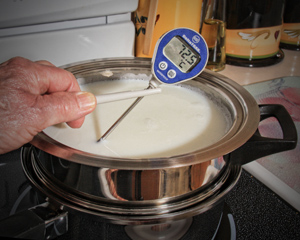
taking_temp.jpg

  • Pour water into the bottom part of the double boiler until it’s half full.
  • Fill the top part of the double boiler with less than 16 cups (1 gallon) of milk.
  • Turn up the burner a little at a time to heat the milk up slowly.
  • Use the cooking thermometer to watch the temperature of the milk. Don’t let the thermometer rest on the bottom or sides of the boiler. Stir the milk often as it’s heating up.
3. Keep the milk at the right temperature.
  • Heat the milk to 63°C (150°F) for at least 30 minutes or 72°C (162°F) for at least 15 seconds.
  • If the temperature falls lower than the one you’re using, you have to start timing again.
4. Cool the milk.
ice_bath.jpg

  • Put the top part of the double boiler in the ice water bath (don’t get water in the milk) to cool it fast. Stir the milk often to cool it faster, until it reaches 20°C (68°F) or cooler.
How do I store the milk?


Pour the cooled milk into sterilized containers right away. Put the containers in the fridge to cool the milk to 4°C (40°F) or colder. How long can I store milk?


You can store pasteurized milk in the fridge for 2 weeks. It’s a good idea to label the milk with the date it was pasteurized. Can I pasteurize milk in the microwave?


Don’t use the microwave to pasteurize milk, because you can’t control the temperature. Can I use this method to pasteurize other foods?


Don't use this method to pasteurize other foods. Other foods may need to be heated to different temperatures to be pasteurized. Contact Alberta Health Services Environmental Public Health to ask about how to pasteurize other types of food.

https://myhealth.alberta.ca/Alberta/Pages/how-to-pasteurize-milk.aspx

 
:tiphat:The U.S. has magic cows!

Who would have thought that? A cow that catches bird flu and doesn't die!! In fact they get well after 2 weeks and all is good! Not only that, but it only affects older milking cows. No younger cows, no bulls, no calves, nope not these magic cows!
I bet these are just about the only animal I heard of that didn't get deathly ill or die.Some birds have survived but the vast amount have died and this includes humans.
If I had some magic cows, I could have milk forever!
I don't think we are being told the whole story about this outbreak, now in 4 states at least.
It must be a trade secret about these cows, that get mild bird flu, affecting only a small amount of the herd and then magically recover in time for lunch and a glass of milk!

Magic cows must be expensive to own and tricky to care for, since no magic cow farmers have shown a single symptom of bird flu! That must mean that this cowflupoo is not very contagious.
 
I do not know what assay is being used to test cattle for H5N1 at this time but from 2008:

"...Our findings show that HPAIV (H5N1) has the potential to infect bovine calves, at least after high-titer intranasal inoculation, and that conventional HI tests may underestimate such infections....The NP-ELISA is currently the assay of choice for the evaluation of bovine serum, and the VN test should be used for confirmation..."


Emerg Infect Dis. 2008 Jul; 14 - Experimental Infection of Cattle with Highly Pathogenic Avian Influenza Virus (H5N1)
 
from

Raj Rajnarayanan
@RajlabN
·
1h
Avian Flu Clade 2.3.4.4b update​


Looked at newly uploaded sequences (GISAID) from Dairy Cattle and birds from Texas Dairy Cows, Blackbirds and Common Grackle have similar mutation pattern Likely source? 1/n
Image
 
Last edited by a moderator:
Hattip to Michael Coston
...
The Texas Department of State Health Services (DSHS) is reporting the first human case of novel avian influenza A(H5N1) in Texas. The patient became ill following contact with dairy cows presumed to be infected with avian influenza. The patient’s primary symptom was conjunctivitis.
...
Although not commonly associated with seasonal influenza, conjunctivitis has been observed in avian influenza A virus infections. Because of this, healthcare providers including optometrists and ophthalmologists, should be aware of the potential of individuals presenting with conjunctivitis who have had exposure to affected animals.
...
GO TO POST
 
In March 2024, samples were collected and tested for influenza from several animals in Texas and Kansas. These animals, including wild birds, cats, and dairy cows, were tested because they exhibited signs of illness. Some of the animals tested positive for influenza. Further testing of these samples indicated the presence of avian influenza A(H5N1
 
...
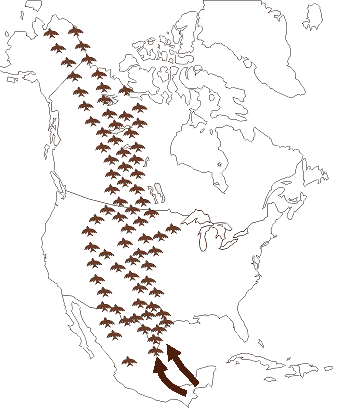
Dr. Jeff Bender, a professor of public health and public health veterinarian at the University of Minnesota in Minneapolis, said that as birds carry out their spring migrations, there will likely be more pockets of outbreaks in other animals.

“That’s what is driving what we are seeing with the cattle, as these birds are doing their spring migration, they may be shedding the virus,” Bender said, noting that the birds’ feces could contaminate animals’ water sources.
...​
GO TO POST

-----------------------------------------------
Migratory Flyways of North America
Central Flyway


centralmap.gif

​...

https://tpwd.texas.gov/huntwild/wild/birding/migration/flyways/central/
 
"At this time, APHIS is not requiring testing. Testing may be done on a voluntary basis and is a tool producers may use to help manage this disease or reduce the risk of introducing the disease." link

This policy is ridiculous. There should be massive widespread testing to, at the very least, quantify the size of the problem.

Irresponsible and against standard outbreak surveillance protocol.
 
What we know about H5N1 bird flu in cows — and the risk to humans
By Helen Branswell April 3, 2024

snip

Is that the full extent of the problem?
Some experts believe it’s unlikely — if only because people haven’t been looking for bird flu infections in cattle before now. “It could have been infecting dairy cattle a year ago. We just never thought about looking … for it,” said David Swayne, an avian influenza expert who is now a private consultant after having worked for the U.S. Department of Agriculture for nearly 30 years.

snip

Are dairy cows spreading the virus to other cows?

That’s suspected, but it is uncertain at this point. The infected herd in Michigan had received cows recently from Texas.

more...

​:tiphat:

https://www.statnews.com/2024/04/03/h5n1-bird-flu-in-cows-risk-to-humans/
 
Last edited by a moderator:
Are people at risk of contracting bird flu after consuming beef or milk?


by: Hayley Boyd

Posted: Apr 3, 2024 / 10:54 AM CDT

Updated: Apr 3, 2024 / 10:55 AM CDT SHARE

Dr. Aileen Marty, Infectious Disease Specialist and Professor at Florida International University, joins Bob Sirott to talk about the latest health news. Dr. Marty talks about the recent case of bird flu found in a person and any risks for consuming beef and milk.

Audio Player

:tiphat: https://wgnradio.com/bob-sirott/are...acting-bird-flu-after-consuming-beef-or-milk/
 
FluTrackers.com
@FluTrackers
·
1m
Bookmark this link - USDA: States Confirmed to be Affected by HPAI in
Domestic Livestock https://flutrackers.com/forum/forum/united-states/h5n1-tracking-af/987593-us-dairy-cows-test-positive-for-h5n1-avian-flu-in-texas-kansas-idaho-michigan-new-mexico-ohio-march-24-one-texas-human-case-april-1?p=988203#post988203…

Direct USDA Map link:
https://aphis.usda.gov/livestock-poultry-disease/avian/avian-influenza/hpai-detections/livestock…
h/t Pathfinder


FluTrackers.com
@FluTrackers
·
1m
Remember these are confirmed only. No one knows how widespread the
dairy cow situation is. So this is a list of "at least".​
 
Back
Top