• FluTrackers.com Inc. does not provide medical advice. Information on this web site is collected from various internet resources, and the FluTrackers board of directors makes no warranty to the safety, efficacy, correctness or completeness of the information posted on this site by any author or poster. The information collated here is for instructional and/or discussion purposes only and is NOT intended to diagnose or treat any disease, illness, or other medical condition. Every individual reader or poster should seek advice from their personal physician/healthcare practitioner before considering or using any interventions that are discussed on this website. By continuing to access this website you agree to consult your personal physican before using any interventions posted on this website, and you agree to hold harmless FluTrackers.com Inc., the board of directors, the members, and all authors and posters for any effects from use of any medication, supplement, vitamin or other substance, device, intervention, etc. mentioned in posts on this website, or other internet venues referenced in posts on this website.
  • We are not asking for any donations. Do not donate to any entity who says they are raising funds for us.

Discussion - Thoughts on a global outbreak of monkeypox

Translation Google

MPOX is transmissible during pregnancy, reveals a Belgian-Congolese study

A new variant of MPOX can be transmitted from mother to child through the placenta during pregnancy, the Institute of Tropical Medicine (IMT) revealed on Thursday, following the publication of a study conducted in collaboration with the Congolese National Institute of Biomedical Research (INRB).

Belga
Agency
Published on 06/19/2025 at 6:18 p.m.

Transmission of the "Clade Ib" variant can lead to complications during pregnancy, such as miscarriage or stillbirth. MPOX has been linked to pregnancy complications in the past, but evidence of mother-to-child transmission remained limited prior to this study.

Three pregnant women infected during the recent spread of the virus in the Democratic Republic of Congo (DRC) were examined as part of this study. Research shows that MPOX can affect the fetus, like the rubella virus, the Zika virus, or chickenpox.

"The virus infected the fetuses through the placenta in all three women," explains Laurens Liesenborghs, Professor of Emerging Infectious Diseases at ITM. "The infection led to a miscarriage, a stillbirth, and a newborn with mpox. We diagnosed lesions on the faces and bodies of both the stillborn baby and the newborn."

Professor Placide Mbala-Kingebeni of the INRB stresses that urgent action is needed to protect pregnant women and stop infections in the DRC. "Vaccination and safe and effective treatments are essential in this regard," he explains.

The study was published in the medical journal The New England Journal of Medicine and was funded by the Flemish Fund for Scientific Research (FWO).

In August 2024, the World Health Organization (WHO) declared its highest-ever global alert for the mpox virus, also known as monkeypox. Last week, the WHO announced the extension of the health emergency.

https://www.dhnet.be/actu/sante/202...-belgo-congolaise-PHOZ5A63HFGNDI2RU2ZCFTKSA4/
------------------------------------------
See also:
Three Cases of Vertical Transmission of Clade Ib Mpox Virus (The Lancet, Correspondence, June 18, 2025)

https://flutrackers.com/forum/forum...virus-the-lancet-correspondence-june-18-2025​
 
Translation Google

DRC: First babies vaccinated against MPOX

June 26, 2025 at 12:25 PM

Pregnant women also took part in the international clinical study, which aims to protect expectant mothers against the virus.

Info By Belga

The first babies have been vaccinated against monkeypox (formerly known as monkeypox) in Boende, in the west-central Democratic Republic of Congo. " The end of the epidemic is not yet in sight ," the University of Antwerp (UAntwerpen) said in a statement Thursday.

Large-scale vaccination campaigns are currently hampered by the fact that the Pox vaccine is not approved for babies and pregnant women. The PregInPoxVac research project aims to address this. Pregnant women are at increased risk of complications from Pox and can transmit the virus.

In August 2024, the World Health Organization (WHO) declared a public health emergency of international concern, the highest-level health alert, regarding MPOX. In the DRC, the country hardest hit by the virus, more than 30,000 cases have been recorded, but this number could be much higher.

The PregInPoxVac project is being conducted jointly by the Universities of Antwerp and Kinshasa. This is the first study to evaluate the safety and immunogenicity (i.e., the ability of a substance to trigger an immune response) of the MVA-BN vaccine (Jynneos) in pregnant and postpartum women, as well as in infants. The vaccine is produced by the Danish biotechnology company Bavarian Nordic. Over the coming months, 215 pregnant women, 144 postpartum women, and 344 infants will participate in the study.

https://www.rtbf.be/article/rdc-les-premiers-bebes-ont-ete-vaccines-contre-le-mpox-11567763​
 
Comment
Open access
Published: 09 July 2025

Increased testing is needed for Mpox in DR Congo to urgently curb disease spread

Prince Imani-Musimwa, Placide Mbala-Kingebeni, Stéphane Hans-Bateyi-Mustafa, Alfred Ombeni-Musimwa & Mija Ververs

Communications Medicine volume 5, Article number: 280 (2025)

The low testing rates of Mpox suspected cases remain a key factor in the continued spread of the disease in the Democratic Republic of Congo (DRC) and neighboring countries. Here, we highlight the causes, as well as the challenges and strategies needed to curb the spread of the current uncontrolled Mpox outbreak in the DRC.
...
Conclusion

The DRC is the epicenter of the Mpox outbreak, which remains a public health emergency of international concern. Despite numerous efforts to contain the current Mpox outbreak, the disease continues to spread in all provinces and neighboring countries. Following several years of war and given the precarious conditions, the country remains vulnerable to emerging diseases with limited resources for large-scale diagnostic capacities. The low testing rates in suspected Mpox patients show that many untested positive patients may be circulating in the community, as a source to continue the spread of the disease. With DRC’s position at the heart of Africa and its multiple crossings with its nine neighboring countries, the uncontrolled epidemic within the country will continue to pose a threat across Africa. Therefore, urgent action is needed to curb the spread of the disease in the DRC.
...

https://www.nature.com/articles/s43856-025-00813-x


Extensive cryptic circulation sustains mpox among men who have sex with men

Posted August 13, 2025.

Joseph Lewnard, Miguel I Paredes, Matan Yechezkel, Gregg S Davis, Vennis Hong, Jessica Skela, Utsav Pandey, Noah T Parker, Lauren C Granskog, Magdalena E Pomichowski, Iris Anne C Reyes, Isabel Rodriguez Barraquer, Nicola F Mueller, Sara Y Tartof
doi: https://doi.org/10.1101/2025.08.09.25333368

This article is a preprint and has not been certified by peer review [what does this mean?]. It reports new medical research that has yet to be evaluated and so should not be used to guide clinical practice.
Abstract


Sporadic cases of mpox continue among men who have sex with men (MSM), with most lacking identifiable transmission links. To resolve underlying dynamics, we prospectively tested for monkeypox virus (MPXV) in rectal swabs from MSM in Los Angeles during summer, 2024, finding that infections exceeded reported mpox cases 33-fold (95% confidence interval: 16-68). Accounting for under-reporting, incidence rates of MPXV infection were comparable to Neisseria gonorrhoeae and Chlamydia trachomatis among MSM. Independent estimates derived from MPXV phylogenetic reconstruction and a meta-analysis of surveillance studies corroborated this extensive under-reporting. We estimate that undiagnosed infections must cause at least 31-44% of all transmission to explain observed MPXV phylogenies; under realistic modeling assumptions, this proportion rises to 61-94%. Contrary to current guidance, our findings suggest MPXV is prevalent among MSM, predominantly causes subclinical infection, and is sustained in circulation by cryptic transmission.

Competing Interest Statement

The authors have declared no competing interest.

Funding Statement


This work was funded by the Center for Forecasting and Outbreak Analytics of the US Centers for Disease Control & Prevention via the Insight Net cooperative agreement (CDC-RFA-FT-23-0069 to SYT and JAL). Its contents are solely the responsibility of the authors and do not necessarily represent the official views of the Centers for Disease Control and Prevention.

...

https://www.medrxiv.org/content/10.1101/2025.08.09.25333368v1
 

Attachments

  • image.png
    image.png
    12.4 KB · Views: 1

...
Countries reporting new importations of clade Ib MPXV
...
The United Kingdom: On 21 August 2025, the United Kingdom notified WHO of one case of mpox due to clade Ib MPXV in an adult male traveler with a recent history of travel to the United Republic of Tanzania. Health authorities in the country have undertaken contact tracing, given contacts the appropriate public health advice, offered vaccination to those eligible, and are monitoring the contacts for mpox symptoms.
...

https://cdn.who.int/media/docs/defa...eport--57.pdf?sfvrsn=420b121c_4&download=true
 

Attachments

  • image.png
    image.png
    29.1 KB · Views: 1
Research and analysis

Mpox outbreak: epidemiological overview, 11 September 2025


Updated 11 September 2025

Contents
  1. Current epidemiological situation of mpox clade Ib up to 31 August 2025
  2. Current epidemiological situation of mpox clade IIb up to 31 August 2025
  3. Data sources
  4. Information about this publication
  5. Additional resources
From 6 February 2025, this report contains the latest national figures for cases of clade Ib and clade IIb mpox found in the UK. Previous reports from June 2022 to January 2025 include data for clade IIb mpox only.

This epidemiological overview provides an update to the number of confirmed and highly probable mpox clade Ib and clade IIb cases in England, Northern Ireland, Scotland and Wales.

Mpox is a zoonotic infection, caused by the monkeypox virus, that occurs mostly in West and Central Africa. Prior to 2022, cases diagnosed in the UK had been either imported from countries where mpox is endemic or contacts with documented epidemiological links to imported cases. Between 2018 and 2021, there had been 7 cases of mpox in the UK. Of these, 4 were imported, 2 were cases in household contacts, and 1 was a case in a health care worker involved in the care of an imported case. There was no documented community transmission in previous outbreaks. The first case of mpox clade Ib infection was confirmed in the UK on 30 October 2024.

Further background information on mpox clade Ib and clade IIb is available.

Current epidemiological situation of mpox clade Ib up to 31 August 2025


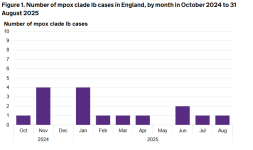
Up to 31 August 2025, 16 cases of mpox clade Ib have been reported in the UK. Of these:
  • 16 were in England
  • 0 in Northern Ireland
  • 0 were in Scotland
  • 0 were in Wales
To 31 August 2025, most of these cases have reported direct or indirect links to travel to countries where mpox clade Ib is circulating. More information can be found in the list of Clade I mpox: affected countries.

Figure 1 shows the monthly number of mpox clade Ib cases in England during 2024 and 2025.


Current epidemiological situation of mpox clade IIb up to 31 August 2025


Detection of cases of mpox clade IIb infection, acquired within the UK, were confirmed in England from 6 May 2022. The outbreak has mainly been in gay, bisexual, and other men who have sex with men without documented history of travel to endemic countries.

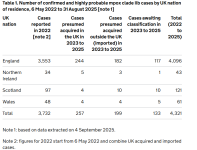
Table 1 presents the number of confirmed and highly probable mpox clade IIb cases by UK nation of residence and likely acquisition route. Up to 31 December 2022, there were 3,732 confirmed and highly probable mpox clade IIb cases reported in the UK. Of these, 3,553 were in England, 34 were in Northern Ireland, 97 were in Scotland and 48 were in Wales.

During the period, 2023 to 2025 (up to 31 August 2025) there have been a total of 589 cases of mpox clade IIb reported in the UK. Of these:
  • 543 were in England (244 cases were presumed to have acquired mpox in the UK, 182 were acquired outside the UK and 117 are awaiting classification)
  • 24 were in Scotland (4 were presumed to have acquired mpox in the UK, 10 were imported cases acquired outside the UK and 10 are awaiting classification)
  • 13 were in Wales (4 were presumed to have acquired mpox in the UK, 4 were imported cases acquired outside the UK and 5 are awaiting classification)
  • 9 were in Northern Ireland (5 were presumed to have acquired mpox in the UK, 3 were imported cases acquired outside the UK and 1 is awaiting classification)
Despite continuing and regular imports of mpox clade IIb, it is likely case numbers during 2023 to 2025 remain substantially lower than that seen in 2022 as a result of high levels of vaccine protection suppressing transmission.

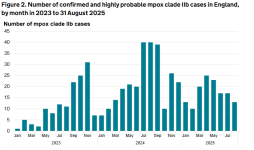
Figure 2 shows the monthly number of mpox clade IIb cases in England during the period 2023 to 2025, where there were between 1 and 40 cases per month, compared to the monthly high of 1,339 cases in July 2022.


Data sources


Mpox surveillance data in England is based on mpox and orthopox virus test results from the Rare and Imported Pathogens Laboratory (RIPL), which is the UK Health Security Agency (UKHSA) mpox reference laboratory, and other UK laboratories with mpox and orthopox testing.

Suspected mpox samples that are positive using a mpox polymerase chain reaction (PCR) test are classified as confirmed cases. Samples which are positive using an orthopox PCR test are classified as highly probable mpox clade IIb cases. Orthopox is the group of viruses which includes mpox. Counts for mpox clade IIb cases presented in this report combine both confirmed and highly probable cases, this should be taken into consideration when interpreting results, as counts may be an overestimate, however impact is likely minimal.

Laboratory data for mpox cases in England are extracted from UKHSA’s Second Generation Surveillance System (SGSS). These data are cleaned and deduplicated before being enhanced through linkage to data from Health Protection Teams reported through UKHSA’s case incident management system.

Counts of confirmed cases in Wales, Northern Ireland, and Scotland are submitted to UKHSA by Public Health Wales, Public Health Agency Northern Ireland, and Public Health Scotland respectively.

...

https://www.gov.uk/government/publi...ber-2025#:~:text=Mpox is a zoonotic infection, in%20West%20and%20Central%20Africa.
 

Attachments

  • image.png
    image.png
    29 KB · Views: 1
  • image.png
    image.png
    74.6 KB · Views: 1
  • image.png
    image.png
    21.9 KB · Views: 1
Research and analysis

Mpox outbreak: epidemiological overview, 11 September 2025


Updated 11 September 2025

Contents
  1. Current epidemiological situation of mpox clade Ib up to 31 August 2025
  2. Current epidemiological situation of mpox clade IIb up to 31 August 2025
  3. Data sources
  4. Information about this publication
  5. Additional resources
From 6 February 2025, this report contains the latest national figures for cases of clade Ib and clade IIb mpox found in the UK. Previous reports from June 2022 to January 2025 include data for clade IIb mpox only.

This epidemiological overview provides an update to the number of confirmed and highly probable mpox clade Ib and clade IIb cases in England, Northern Ireland, Scotland and Wales.

Mpox is a zoonotic infection, caused by the monkeypox virus, that occurs mostly in West and Central Africa. Prior to 2022, cases diagnosed in the UK had been either imported from countries where mpox is endemic or contacts with documented epidemiological links to imported cases. Between 2018 and 2021, there had been 7 cases of mpox in the UK. Of these, 4 were imported, 2 were cases in household contacts, and 1 was a case in a health care worker involved in the care of an imported case. There was no documented community transmission in previous outbreaks. The first case of mpox clade Ib infection was confirmed in the UK on 30 October 2024.

Further background information on mpox clade Ib and clade IIb is available.

Current epidemiological situation of mpox clade Ib up to 31 August 2025


Up to 31 August 2025, 16 cases of mpox clade Ib have been reported in the UK. Of these:
  • 16 were in England
  • 0 in Northern Ireland
  • 0 were in Scotland
  • 0 were in Wales
To 31 August 2025, most of these cases have reported direct or indirect links to travel to countries where mpox clade Ib is circulating. More information can be found in the list of Clade I mpox: affected countries.

Figure 1 shows the monthly number of mpox clade Ib cases in England during 2024 and 2025.


Current epidemiological situation of mpox clade IIb up to 31 August 2025


Detection of cases of mpox clade IIb infection, acquired within the UK, were confirmed in England from 6 May 2022. The outbreak has mainly been in gay, bisexual, and other men who have sex with men without documented history of travel to endemic countries.

Table 1 presents the number of confirmed and highly probable mpox clade IIb cases by UK nation of residence and likely acquisition route. Up to 31 December 2022, there were 3,732 confirmed and highly probable mpox clade IIb cases reported in the UK. Of these, 3,553 were in England, 34 were in Northern Ireland, 97 were in Scotland and 48 were in Wales.

During the period, 2023 to 2025 (up to 31 August 2025) there have been a total of 589 cases of mpox clade IIb reported in the UK. Of these:
  • 543 were in England (244 cases were presumed to have acquired mpox in the UK, 182 were acquired outside the UK and 117 are awaiting classification)
  • 24 were in Scotland (4 were presumed to have acquired mpox in the UK, 10 were imported cases acquired outside the UK and 10 are awaiting classification)
  • 13 were in Wales (4 were presumed to have acquired mpox in the UK, 4 were imported cases acquired outside the UK and 5 are awaiting classification)
  • 9 were in Northern Ireland (5 were presumed to have acquired mpox in the UK, 3 were imported cases acquired outside the UK and 1 is awaiting classification)
Despite continuing and regular imports of mpox clade IIb, it is likely case numbers during 2023 to 2025 remain substantially lower than that seen in 2022 as a result of high levels of vaccine protection suppressing transmission.

Figure 2 shows the monthly number of mpox clade IIb cases in England during the period 2023 to 2025, where there were between 1 and 40 cases per month, compared to the monthly high of 1,339 cases in July 2022.


Data sources


Mpox surveillance data in England is based on mpox and orthopox virus test results from the Rare and Imported Pathogens Laboratory (RIPL), which is the UK Health Security Agency (UKHSA) mpox reference laboratory, and other UK laboratories with mpox and orthopox testing.

Suspected mpox samples that are positive using a mpox polymerase chain reaction (PCR) test are classified as confirmed cases. Samples which are positive using an orthopox PCR test are classified as highly probable mpox clade IIb cases. Orthopox is the group of viruses which includes mpox. Counts for mpox clade IIb cases presented in this report combine both confirmed and highly probable cases, this should be taken into consideration when interpreting results, as counts may be an overestimate, however impact is likely minimal.

Laboratory data for mpox cases in England are extracted from UKHSA’s Second Generation Surveillance System (SGSS). These data are cleaned and deduplicated before being enhanced through linkage to data from Health Protection Teams reported through UKHSA’s case incident management system.

Counts of confirmed cases in Wales, Northern Ireland, and Scotland are submitted to UKHSA by Public Health Wales, Public Health Agency Northern Ireland, and Public Health Scotland respectively.

...

https://www.gov.uk/government/publi...zoonotic infection,in West and Central Africa.
 
News story

New mpox strain identified in England

UKHSA reminds eligible groups to come forward for mpox vaccination.
From: UK Health Security Agency Published 30 October 2024
Last updated 8 December 2025 — See all updates

Updates on clade Ib mpox case numbers are published on the UKHSA data dashboard

Latest update


The UK Health Security Agency (UKHSA) has identified a new recombinant mpox virus in England in an individual who had recently travelled to Asia.

Genomic sequencing showed that the mpox genome contained elements of clade Ib and IIb mpox.


This is not unexpected as both clades are circulating, but highlights the continued potential for mpox virus to evolve and the importance of continued genomic surveillance.

UKHSA continues to assess the significance of the strain.

Dr Katy Sinka, Head of Sexually Transmitted Infections at UKHSA, said:
Our genomic testing has enabled us to detect this new mpox strain. It’s normal for viruses to evolve, and further analysis will help us understand more about how mpox is changing.

Although mpox infection is mild for many, it can be severe. Getting vaccinated is a proven effective way to protect yourself against severe disease, so please make sure to get the jab if you are eligible.

It is important to remain alert to the risks from this unpleasant illness. Anyone who thinks they may have mpox should contact NHS 111 for advice on what to do.​

The UK has a routine mpox vaccination programme in place for eligible groups, including those who have multiple sexual partners, participate in group sex, or visit sex-on-premises venues. Studies show the vaccine is around 75% to 80% effective in protecting against mpox.

UKHSA has shared its findings with relevant international partners, including the World Health Organization (WHO), to support global monitoring efforts.

...

https://www.gov.uk/government/news/ukhsa-detects-first-case-of-clade-ib-mpox
 
Hat tip to Michael Coston

News story

New mpox strain identified in England

UKHSA reminds eligible groups to come forward for mpox vaccination.
From: UK Health Security Agency Published 30 October 2024
Last updated 8 December 2025 — See all updates

Updates on clade Ib mpox case numbers are published on the UKHSA data dashboard

Latest update


The UK Health Security Agency (UKHSA) has identified a new recombinant mpox virus in England in an individual who had recently travelled to Asia.

Genomic sequencing showed that the mpox genome contained elements of clade Ib and IIb mpox.


This is not unexpected as both clades are circulating, but highlights the continued potential for mpox virus to evolve and the importance of continued genomic surveillance.

UKHSA continues to assess the significance of the strain.

Dr Katy Sinka, Head of Sexually Transmitted Infections at UKHSA, said:
Our genomic testing has enabled us to detect this new mpox strain. It’s normal for viruses to evolve, and further analysis will help us understand more about how mpox is changing.

Although mpox infection is mild for many, it can be severe. Getting vaccinated is a proven effective way to protect yourself against severe disease, so please make sure to get the jab if you are eligible.

It is important to remain alert to the risks from this unpleasant illness. Anyone who thinks they may have mpox should contact NHS 111 for advice on what to do.​


The UK has a routine mpox vaccination programme in place for eligible groups, including those who have multiple sexual partners, participate in group sex, or visit sex-on-premises venues. Studies show the vaccine is around 75% to 80% effective in protecting against mpox.

UKHSA has shared its findings with relevant international partners, including the World Health Organization (WHO), to support global monitoring efforts.

...

https://www.gov.uk/government/news/ukhsa-detects-first-case-of-clade-ib-mpox
 
Back
Top