

sharon sanders
Editor-in-Chief & President
hat tip Senior Moderator Fla Medic -
Zero Hour: Virtual Heroes
# 2958
In 1993, a group of renegade computer programmers did what no one thought was possible at the time; they created an immersive 3-D gaming environment that would run on the (then 80386 processors were top of the line) computers of the time.
It was called DooM (tm) – and it changed computer gaming forever.
Fast forward more than 15 years and home computers have gotten much faster, and the software has grown even more realistic.
In 2002, the United States Army released the first in a long series of PC interactive games designed to give players a taste for what real combat was like.
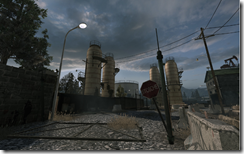
(screen shot from America’s Army)
Conceived by Colonel Casey Wardynski and managed by the U.S. Army's Office of Economic and Manpower Analysis (OEMA) at the United States Military Academy, West Point, New York – the project called America’s Army (also known as AA or Army Game Project) has produced some of the finest simulations available on home computers today.
They are not only entertaining and informative, they are a serious training tool as well.
Taking a page from the Army’s successful implementation of this virtual gaming environment, the National Emergency Medical Services Preparedness Initiative – part of George Washington University – has spent 2 years designing a an EMT/Paramedic training tool called ZERO HOUR- AMERICA’S MEDIC.
This virtual game/training system has 4 built in scenarios; A SARS-like pandemic, and earthquake, a derailment with chemical leak, and a sports complex explosion.
The intent is to show medics what it is like to deal with a MCE (mass casualty event). The scenarios, and resources, change with each game play. Here is how the authors describe the game:
EMS providers playing the game will be tasked with completing a wide variety of missions based on the National Planning Scenarios and designed to push players' skills to the limit. Both new and experienced EMS providers are likely to find the missions extremely challenging because their complexity mirrors that which is seen in real disasters and large-scale events.
Players must deal with chaos, panic, large volumes of patients, and needs that far exceed available resources. Each time EMS providers play the game, they'll have different resources to work with, different scene hazards to deal with, different patients to treat, and different resources they can call upon. As EMS providers know all too well, there are no "winners" in a disaster - all you can do is the best you can do with the resources that you have.
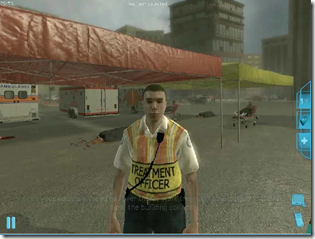
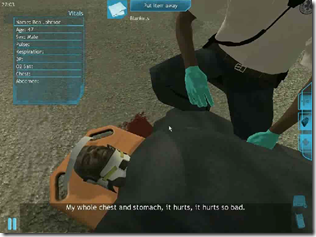
Screen shots from the demo
There are roughly 900,000 EMT’s and Paramedics in the United States, and most have never come face to face with a true MCE. The ability to `game’ these scenarios in a life-like manner, to train (and make inevitable mistakes) on a simulator, is invaluable.
A `demo’ of the game/trainer is available to view as well.
Play Zero Hour

View a demo
Zero Hour: Virtual Heroes
# 2958
In 1993, a group of renegade computer programmers did what no one thought was possible at the time; they created an immersive 3-D gaming environment that would run on the (then 80386 processors were top of the line) computers of the time.
It was called DooM (tm) – and it changed computer gaming forever.
Fast forward more than 15 years and home computers have gotten much faster, and the software has grown even more realistic.
In 2002, the United States Army released the first in a long series of PC interactive games designed to give players a taste for what real combat was like.
(screen shot from America’s Army)
Conceived by Colonel Casey Wardynski and managed by the U.S. Army's Office of Economic and Manpower Analysis (OEMA) at the United States Military Academy, West Point, New York – the project called America’s Army (also known as AA or Army Game Project) has produced some of the finest simulations available on home computers today.
They are not only entertaining and informative, they are a serious training tool as well.
Taking a page from the Army’s successful implementation of this virtual gaming environment, the National Emergency Medical Services Preparedness Initiative – part of George Washington University – has spent 2 years designing a an EMT/Paramedic training tool called ZERO HOUR- AMERICA’S MEDIC.
This virtual game/training system has 4 built in scenarios; A SARS-like pandemic, and earthquake, a derailment with chemical leak, and a sports complex explosion.
The intent is to show medics what it is like to deal with a MCE (mass casualty event). The scenarios, and resources, change with each game play. Here is how the authors describe the game:
EMS providers playing the game will be tasked with completing a wide variety of missions based on the National Planning Scenarios and designed to push players' skills to the limit. Both new and experienced EMS providers are likely to find the missions extremely challenging because their complexity mirrors that which is seen in real disasters and large-scale events.
Players must deal with chaos, panic, large volumes of patients, and needs that far exceed available resources. Each time EMS providers play the game, they'll have different resources to work with, different scene hazards to deal with, different patients to treat, and different resources they can call upon. As EMS providers know all too well, there are no "winners" in a disaster - all you can do is the best you can do with the resources that you have.
Screen shots from the demo
There are roughly 900,000 EMT’s and Paramedics in the United States, and most have never come face to face with a true MCE. The ability to `game’ these scenarios in a life-like manner, to train (and make inevitable mistakes) on a simulator, is invaluable.
I sure wish I’d have had that sort of training available when I was a young medic!
The game is available for a small fee ($14.95) from the NEMSPI website. Be sure to check the system requirements before downloading.
A `demo’ of the game/trainer is available to view as well.
Play Zero Hour
View a demo